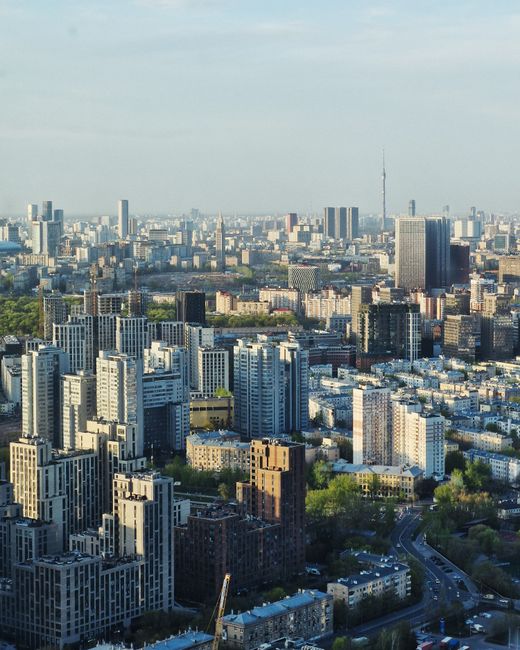
Moscow is Russia’s capital and its largest city, a vast, fast-moving metropolis of about 13 million people on the Moskva river. Its heart is the triangle-shaped Kremlin fortress and Red Square, with the onion domes of St Basil’s Cathedral at one end, ringed by boulevards, Stalin-era skyscrapers and, further out, a glass business district. For centuries it has been the political centre of Russia, and the city carries the layers of that history in its churches, palaces, theatres and its famously ornate metro. This guide explains what Moscow is known for and how it came to be, with notes on current conditions.
Right now in Moscow
- Wed8–15°C47–58°FClear
- Thu5–15°C41–58°FPartly cloudy
- Fri8–17°C46–63°F4 mm rain
Moscow at a glance
- Status: capital of the Russian Federation and a federal city in its own right (ISO 3166-2 code RU-MOW).
- Population: about 13.3 million, the largest city in Europe by most counts; the wider metropolitan area holds several million more.
- Setting: on the Moskva river in the centre of the East European Plain, about 640 km south-east of St Petersburg.
- Currency: the Russian rouble (RUB). Visa and Mastercard cards issued outside Russia do not work.
- World Heritage: three UNESCO sites in the city: the Kremlin and Red Square, the Church of the Ascension at Kolomenskoye and the Novodevichy Convent.
A short history of Moscow
Moscow first appears in the chronicles in 1147, when Prince Yuri Dolgoruky invited an ally to a feast at a small settlement on the hill where the Kremlin stands today. Burned by the Mongols in 1238, it grew as its princes collected taxes for the Golden Horde and gathered the surrounding Russian lands, and in the 14th century the head of the Russian Church moved here.
Under Ivan III (“the Great”), who ended tribute to the Horde in 1480, Italian architects rebuilt the Kremlin in red brick: the walls and towers that stand today date largely from 1485 to 1495, and the Cathedral of the Dormition, where tsars were crowned, from the 1470s. His grandson Ivan IV (“the Terrible”) was crowned the first Tsar of All Rus’ in 1547 and built St Basil’s Cathedral on Red Square in 1555 to 1561 to celebrate the conquest of Kazan.
In 1712 Peter the Great moved the capital to St Petersburg, and Moscow became Russia’s “second capital”, a city of merchants and monasteries. In September 1812 Napoleon’s army entered a largely abandoned Moscow, fires destroyed much of the wooden city, and the French retreat became one of the great disasters of military history. The city was rebuilt in stone in the 19th century.
After the 1917 revolution the Bolsheviks moved the capital back to Moscow in March 1918. The Soviet era remade the city: churches were closed or demolished (the Cathedral of Christ the Saviour was blown up in 1931 and rebuilt in the 1990s), wide avenues were driven through old quarters, the first metro line opened in 1935, and seven monumental “Stalin skyscrapers” rose between the late 1940s and the mid-1950s. In the winter of 1941 the German advance was stopped on the city’s outskirts. Moscow hosted the 1980 Summer Olympics, and in August 1991 a failed coup in the city hastened the end of the Soviet Union. Since then it has grown upwards and outwards, with the glass towers of “Moskva-City” and new parks such as Zaryadye, next to the Kremlin.
What Moscow is known for
The Kremlin and Red Square
The Moscow Kremlin is a walled fortress of about 27 hectares on Borovitsky Hill, with 20 towers, three great cathedrals on Cathedral Square, the bell tower of Ivan the Great, the Armoury museum with its royal regalia and Fabergé eggs, and the Grand Kremlin Palace, still used by the presidency. Red Square, outside the eastern wall, takes its name from an old Russian word that meant both “red” and “beautiful”. Around it stand St Basil’s Cathedral, the Lenin Mausoleum, the red-brick State Historical Museum and the long arcades of the GUM department store. The Kremlin and Red Square were inscribed together on the UNESCO World Heritage List in 1990.
St Basil’s Cathedral
Properly the Cathedral of the Intercession on the Moat, St Basil’s is a cluster of nine chapels topped by painted onion domes of different shapes and colours. It was built for Ivan IV between 1555 and 1561 and is now part of the State Historical Museum. Few buildings say “Russia” to the world as clearly.
The Moscow Metro
Opened in 1935, the Moscow Metro was designed as a “palace for the people”. Stations such as Komsomolskaya, Mayakovskaya, Novoslobodskaya and Ploshchad Revolyutsii are decorated with marble, mosaics, stained glass, chandeliers and bronze statues, and many are protected monuments. The network has grown hugely since 2010, and the Big Circle Line, completed in 2023, is one of the longest metro rings in the world. The seven “Stalin skyscrapers” built between 1947 and the mid-1950s, including Moscow State University, are the city’s other great Soviet landmarks.
Theatres, museums and galleries
The Bolshoi Theatre, founded in 1776, is one of the world’s most famous homes of ballet and opera; its classical building on Teatralnaya Square dates from the 1820s and was restored in 2011. The State Tretyakov Gallery, founded by the merchant Pavel Tretyakov in 1856, holds the great collection of Russian art from medieval icons, including Andrei Rublev’s Trinity, to the 20th century. The Pushkin State Museum of Fine Arts holds European art from antiquity to the Impressionists.
Monasteries and old estates
The Novodevichy Convent, founded in 1524, is an almost untouched ensemble of “Moscow Baroque” architecture (UNESCO, 2004), and its cemetery holds the graves of Chekhov, Gogol and Shostakovich. At Kolomenskoye, a former royal estate, the white tent-roofed Church of the Ascension of 1532 has been a World Heritage Site since 1994.
Climate
Moscow has a humid continental climate: long, cold, snowy winters, when daytime highs stay below freezing from December to February, and warm summers, with July highs of about 25 °C and frequent thunderstorms. Spring arrives late, in May, and autumn turns cold quickly after September.
| Season | Average daily high | Average nightly low | Rain or snow per month |
|---|---|---|---|
| Winter (Dec–Feb) | −3.9 to −2.3 °C | −8.8 to −6.5 °C | 44–53 mm |
| Spring (Mar–May) | 3.0 °C rising to 19.0 °C | −4.2 °C rising to 8.1 °C | 37–61 mm |
| Summer (Jun–Aug) | 22.4–24.7 °C | 12.2–14.8 °C | 77–84 mm |
| Autumn (Sep–Nov) | 16.4 °C falling to 1.6 °C | 8.0 °C falling to −2.4 °C | 52–70 mm |
Moscow gets about 712 mm of rain and snow a year, according to the official 1991–2020 averages for the Moscow (VDNKh) station that Russia submitted to the World Meteorological Organization.
Safety and current conditions
The war with Ukraine is ongoing, and drone attacks and explosions have been reported in Moscow and other large cities. Points to know:
- Flights: there are no direct flights to the UK, the EU or North America. Indirect flights run via Turkey, the Middle East, Serbia, the Caucasus and Central Asia, and airspace closures cause frequent delays and cancellations.
- Insurance: many travel insurance policies exclude Russia, including medical treatment and evacuation, so check the wording of your policy.
- Consular help: many Western embassies in Moscow have reduced staff and several countries’ consulates in Russia have suspended operations, so in-person help is limited. Dual nationals are treated as Russian citizens and may get no consular access at all.
- Papers and money: carry your passport and migration card at all times and make sure your stay is registered. Change US dollars or euros only at banks, hotels and licensed exchange offices.
- Security and law: take cover in buildings or underground during drone attacks, avoid demonstrations, never photograph military or official sites, and remember that social-media posts supporting Ukraine or LGBT+ symbols can lead to detention.
- Emergencies: call 112. British nationals can reach the British Embassy in Moscow on +7 495 956 7200 (24 hours).
Moscow FAQ
Is it safe to travel to Moscow now?
Conditions are difficult. The war with Ukraine is ongoing, drone attacks can close Moscow’s airports at short notice, there is a risk of terrorism and of detention for foreigners, and consular help is very limited. See the safety section above for the details.
Will my travel insurance cover a trip to Moscow?
Usually not. Most standard travel insurance policies exclude Russia. Specialist cover may exist, but read the policy wording carefully.
Can I use my Visa or Mastercard in Moscow?
No. Visa and Mastercard stopped operating in Russia in 2022, so cards issued abroad do not work in Russian shops or cash machines. People in Russia rely on cash in US dollars or euros exchanged for roubles at banks and licensed exchange offices.
What is Moscow known for?
The Kremlin and Red Square, St Basil’s Cathedral, the Bolshoi Theatre, the Tretyakov Gallery, the ornate stations of the Moscow Metro and its Stalin-era skyscrapers. The Kremlin and Red Square, the Novodevichy Convent and the Church of the Ascension at Kolomenskoye are UNESCO World Heritage Sites.
What time zone is Moscow in?
Moscow time is UTC+3 all year, with no daylight saving time.
Plan your trip
Partner links: TravelerCenter may earn a commission if you book, at no extra cost to you.
🇷🇺 Useful Russian phrases for Moscow
All 38 Russian phrases: restaurant, hotel, emergencies, romance (printable) →
Sources · last reviewed 4 October 2026
Researched and last reviewed on 4 October 2026. Safety and practical information from GOV.UK foreign travel information (updated 18 September 2026) and the US State Department’s country information (28 December 2025); World Heritage listings from UNESCO; climate from the official 1991–2020 normals Russia submitted to the World Meteorological Organization; population from Rosstat. History is summarised from standard reference works. Conditions can change at short notice, so check the latest official information.
Data: Weather: MET Norway (CC BY 4.0) · Rates: ECB · Costs: World Bank ICP and price levels · Wikidata (CC0)