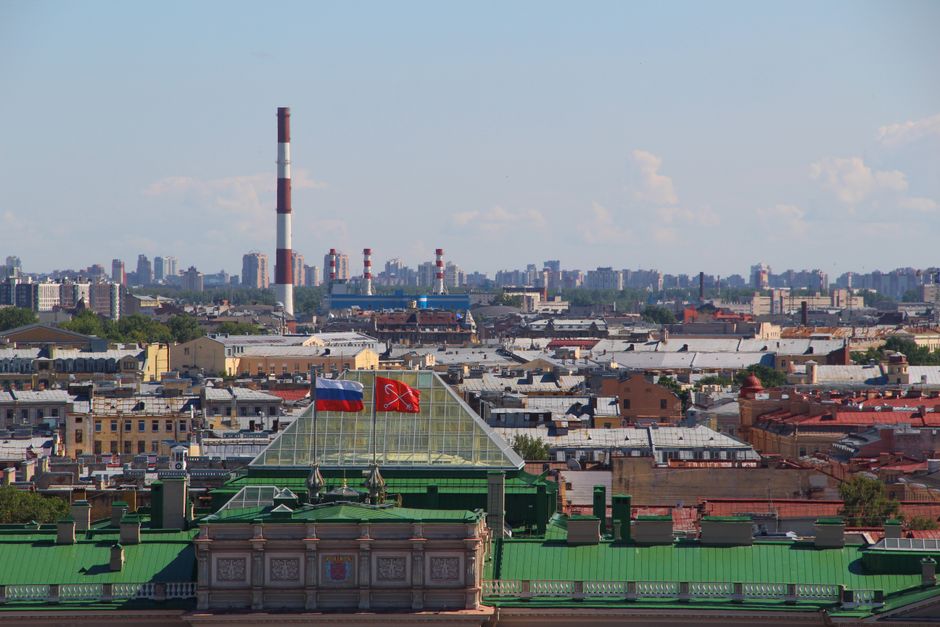
St Petersburg is Russia’s second city and, for two centuries, was its imperial capital: a planned city of canals, granite embankments and pastel palaces built by Peter the Great on the marshy delta of the Neva river where it meets the Gulf of Finland. About 5.6 million people live here. It is the city of the Winter Palace and the Hermitage, of Dostoevsky and Pushkin, of the 1917 revolution and of the 872-day wartime siege, and in June its “White Nights” barely get dark. This guide explains what St Petersburg is known for and how it came to be, with notes on current conditions.
Right now in Saint Petersburg
- Wed 11–13°C 53–56°F Partly cloudy
- Thu 9–12°C 48–54°F Cloudy
- Fri 10–12°C 50–54°F 7 mm Rain
Weather: MET Norway (CC BY 4.0) · Sea temperature: NOAA CoastWatch
St Petersburg at a glance
- Status: a federal city of the Russian Federation (ISO 3166-2 code RU-SPE), capital of the Russian Empire from 1712 to 1918, with a short break in the 1720s.
- Names: Sankt-Peterburg (1703–1914), Petrograd (1914–1924), Leningrad (1924–1991), then St Petersburg again after a referendum in 1991. Locals often call it simply “Piter”.
- Population: about 5.6 million, Russia’s second-largest city.
- Setting: on the Neva delta at the eastern end of the Gulf of Finland, a Baltic Sea port built across dozens of islands, at almost 60° north.
- World Heritage: the Historic Centre of Saint Petersburg and Related Groups of Monuments, inscribed by UNESCO in 1990, includes the city centre and the palace towns around it.
A short history of St Petersburg
Peter the Great founded the city on 27 May 1703 (16 May in the old calendar), when work began on the Peter and Paul Fortress on Hare Island, in land he had just taken from Sweden in the Great Northern War. He wanted a “window on Europe”: a modern port and capital built in stone on a regular plan, with European architects, and he forced nobles, merchants and tens of thousands of conscripted labourers to build it, many of whom died in the harsh conditions. In 1712 the court moved here from Moscow.
Through the 18th century, empresses Elizabeth and Catherine the Great turned the city into one of Europe’s most splendid capitals. The Italian architect Bartolomeo Rastrelli built the Baroque Winter Palace and the palaces at Tsarskoye Selo and Peterhof; Catherine began the art collection that became the Hermitage in 1764 and commissioned the Bronze Horseman statue of Peter. The 19th century added the Neoclassical ensembles of Palace Square, St Isaac’s Cathedral and the Admiralty, and the city of Pushkin, Dostoevsky and Tchaikovsky became Russia’s cultural capital.
The city was the stage for Russia’s revolutions. In January 1905 troops fired on marchers outside the Winter Palace (“Bloody Sunday”); in 1917 the February Revolution overthrew the tsar here, and in October the Bolsheviks stormed the Winter Palace. In 1918 the government moved to Moscow, and in 1924 the city was renamed Leningrad. During the Second World War German and Finnish forces besieged Leningrad from September 1941 to January 1944; around a million civilians died, most of them from starvation, and the siege remains central to the city’s memory. After 1991 the old name returned, the palaces were restored, and the city celebrated its 300th anniversary in 2003.
What St Petersburg is known for
The State Hermitage Museum and the Winter Palace
The Hermitage is one of the largest and oldest art museums in the world. It dates its foundation to 1764, when Catherine the Great bought a collection of Western European paintings, and it now fills the Winter Palace, the Small, Old and New Hermitage buildings and the east wing of the General Staff building across Palace Square. Its collections run from Scythian gold and Egyptian antiquities to Leonardo, Rembrandt and the French Impressionists, all displayed amid the tsars’ state rooms.
Palace Square, Nevsky Prospekt and the canals
Palace Square, framed by the green and white Winter Palace and the curving arch of the General Staff building, is the city’s grandest space. From the nearby Admiralty, Nevsky Prospekt runs east for about 4.5 km past the Kazan Cathedral, the Singer House and the Gostiny Dvor arcades. The Moika, Griboyedov and Fontanka canals, lined with granite embankments and crossed by hundreds of bridges, give the centre its nickname of the “Venice of the North”.
Churches and cathedrals
St Isaac’s Cathedral, completed in 1858, has one of the largest domes in the world, gilded with about 100 kg of gold, and a colonnade with views over the rooftops. The Church of the Saviour on Spilled Blood, built on the spot where Tsar Alexander II was assassinated in 1881, is covered inside with some 7,000 square metres of mosaics. The Peter and Paul Cathedral, inside the fortress, holds the tombs of almost all the Russian emperors from Peter the Great onwards, and the remains of the last tsar, Nicholas II, and his family, reburied there in 1998.
Peterhof, Tsarskoye Selo and Pavlovsk
Around the city are the summer palaces of the tsars, all part of the World Heritage Site. Peterhof, on the Gulf of Finland, is famous for the Grand Cascade and dozens of gravity-fed fountains running down to the sea. At Tsarskoye Selo (now in the town of Pushkin) stands Rastrelli’s blue and white Catherine Palace with its reconstructed Amber Room; Pavlovsk next door has a vast landscape park. All three were badly damaged during the war and have been painstakingly restored.
White Nights, ballet and music
From late May to mid-July the sky never gets fully dark. These “White Nights” are celebrated with the Scarlet Sails festival for school leavers, while the Neva bridges are raised at night to let ships pass. The Mariinsky Theatre, home of the ballet once known as the Kirov, is one of the world’s great stages.
Climate
St Petersburg has a cool, damp climate shaped by the Baltic. Winters are long, grey and cold, with daytime highs a little below freezing and very short days; summers are mild, with July highs around 23 °C and long evenings. Rain and drizzle are common in every season, with the wettest months in late summer.
| Season | Average daily high | Average nightly low | Rain or snow per month |
|---|---|---|---|
| Winter (Dec–Feb) | −2.5 to −0.5 °C | −7.6 to −4.5 °C | 36–51 mm |
| Spring (Mar–May) | 2.3 °C rising to 16.3 °C | −4.0 °C rising to 7.2 °C | 35–47 mm |
| Summer (Jun–Aug) | 20.5–23.3 °C | 12.2–15.3 °C | 69–86 mm |
| Autumn (Sep–Nov) | 15.9 °C falling to 2.8 °C | 9.4 °C falling to −0.9 °C | 56–63 mm |
St Petersburg gets about 668 mm of rain and snow a year, according to the official 1991–2020 averages for the St Petersburg station that Russia submitted to the World Meteorological Organization.
Safety and current conditions
The war with Ukraine is ongoing, and drone attacks and explosions have been reported in St Petersburg, Moscow and other large cities. Points to know:
- Insurance: many travel insurance policies exclude Russia, including medical treatment and evacuation, so check the wording of your policy.
- Consular help: there is no British consulate in St Petersburg and the US consulate has suspended operations, so in-person consular help is limited, and dual nationals are treated as Russian citizens.
- Flights and borders: there are no direct flights to the UK or through EU countries; the border with Finland is closed, and the Narva–Ivangorod crossing into Estonia is open to pedestrians but not vehicles. Expect long waits and questioning at land borders.
- Money: cards issued abroad do not work; change US dollars or euros only at banks, hotels and licensed exchange offices, as paying in foreign currency is illegal.
- Crime: gangs in St Petersburg have targeted tourists for street crime; watch out too for unlicensed taxis and deaths from methanol in bootleg alcohol sold in the Leningrad region.
- Security: follow instructions from the authorities, take cover during drone alerts, avoid demonstrations and never photograph military, official or security sites.
- Emergencies: call 112. British nationals can reach the British Embassy in Moscow on +7 495 956 7200 (24 hours).
St Petersburg FAQ
Is it safe to travel to St Petersburg now?
Conditions are difficult. The war with Ukraine is ongoing, drone attacks can close airspace at short notice, there is a risk of terrorism and of detention for foreigners, and consular help is very limited. See the safety section above for the details.
Can I travel overland from Finland or Estonia?
Not by car. The Finnish government has closed the whole border with Russia, and the Narva–Ivangorod crossing between Estonia and Russia is closed to vehicles but open to pedestrians. Latvian and Lithuanian crossings are restricted.
What is St Petersburg known for?
The State Hermitage Museum and Winter Palace, Palace Square and Nevsky Prospekt, its canals and bridges, St Isaac’s Cathedral and the Church of the Saviour on Spilled Blood, the fountains of Peterhof, the Catherine Palace and its Amber Room, the Mariinsky ballet and the summer White Nights.
When are the White Nights in St Petersburg?
Roughly from late May to mid-July, peaking around the summer solstice on 21 June, when the sun is below the horizon for only about five and a half hours and the sky stays light all night.
What was St Petersburg called in Soviet times?
Leningrad, from 1924 to 1991. It was Petrograd from 1914 to 1924, and residents voted to restore the original name in 1991.
Sources and last review
Researched and last reviewed on 4 October 2026. Safety and practical information from GOV.UK foreign travel information (updated 18 September 2026) and the US State Department’s country information (28 December 2025); World Heritage listings from UNESCO; the Hermitage’s founding date from the museum; climate from the official 1991–2020 normals Russia submitted to the World Meteorological Organization; population from Rosstat. History is summarised from standard reference works. Conditions can change at short notice, so check the latest official information.
Plan your trip
Partner links: TravelerCenter may earn a commission if you book, at no extra cost to you.
🇷🇺 Useful Russian phrases for Saint Petersburg
All 38 Russian phrases: restaurant, hotel, emergencies, romance (printable) →