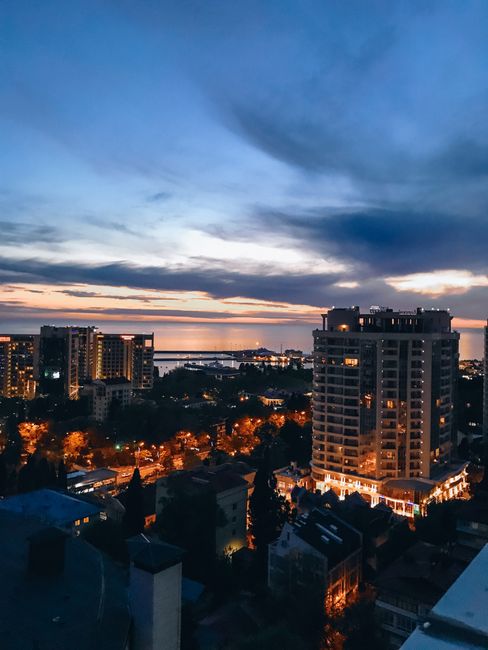
Sochi is Russia’s best-known seaside resort, a long, green ribbon of beaches, sanatoriums, parks and palm trees squeezed between the Black Sea and the western end of the Caucasus mountains. It is one of the few places in Russia with a humid subtropical climate, and in winter the ski slopes of Krasnaya Polyana are less than an hour away. The world came to know it as the host of the 2014 Winter Olympics. This guide explains what Sochi is known for and how it came to be, with notes on current conditions.
Right now in Sochi
- Wed 13–20°C 55–68°F 1 mm Showers
- Thu 12–21°C 54–70°F Mostly clear
- Fri 12–22°C 54–71°F Cloudy
Weather: MET Norway (CC BY 4.0) · Sea temperature: NOAA CoastWatch
Sochi at a glance
- Status: a resort city in Krasnodar Krai (ISO 3166-2 code RU-KDA), in Russia’s south-west.
- Population: about 450,000 within the wider city area, which stretches some 145 km along the coast from Lazarevskoye in the north-west to Adler and the Psou river, the border with Abkhazia.
- Setting: on the north-eastern shore of the Black Sea, backed by forested foothills rising to the peaks of the Western Caucasus; Krasnaya Polyana lies about 40 km inland from Adler.
- Climate: humid subtropical: mild, wet winters on the coast and warm, humid summers.
- World Heritage: the mountains above Sochi are part of the Western Caucasus World Heritage Site (UNESCO, 1999).
A short history of Sochi
For centuries this coast was the homeland of the Circassian (Adyghe) peoples, and of the closely related Ubykh around today’s Sochi. In the early 19th century the Russian Empire fought a long war for control of the north-western Caucasus, building forts along the coast, among them Fort Alexandria, founded in 1838 at the mouth of the Sochi river and soon renamed Navaginskoye. The war ended in 1864 with the defeat of the Circassians, and most of the region’s Circassian population was killed or expelled to the Ottoman Empire, an event that Circassian communities around the world commemorate every 21 May.
Russian, Armenian, Greek and other settlers moved into the emptied valleys in the decades that followed. Sochi became a town in 1917, and its future as a resort was sealed in the 1930s, when the Soviet state chose it as the country’s leading health resort: under a general plan adopted in 1933, dozens of grand sanatoriums with columns, terraces and seaside parks were built for workers to “take the cure”, fed by the sulphurous Matsesta mineral springs. Stalin had a summer dacha here, and Sochi kept its status as the place where Soviet and later Russian leaders spent their summers.
In 2007 the International Olympic Committee awarded Sochi the 2014 Winter Olympic and Paralympic Games. The area was transformed: a coastal cluster of stadiums and ice arenas rose on the Imeretinskaya Lowland near Adler, a new road and railway were built up the Mzymta valley to Krasnaya Polyana, and new ski resorts opened at Rosa Khutor, Gornaya Karusel and Laura. After the Games, the Olympic Park hosted the Formula One Russian Grand Prix from 2014 to 2021, and the Fisht Stadium was a venue for the 2018 FIFA World Cup.
What Sochi is known for
Beaches and the seafront
Sochi’s beaches are mostly shingle and pebble, backed by promenades, piers and parks; the central seafront by the spired 1950s sea terminal (Morskoy Vokzal) and the newer embankments at Adler are the busiest stretches.
Sanatoriums and Soviet resort architecture
The great sanatoriums of the 1930s to 1950s, with their colonnades, fountains and terraced parks, are one of Sochi’s most distinctive sights. Some still operate as health resorts, while others have been rebuilt as hotels. The Matsesta springs, a few kilometres south of the centre, have been used for hydrogen-sulphide baths since the early 20th century.
Parks and gardens
The Sochi Arboretum (Dendrariy), laid out from 1889 on a merchant’s estate, has palms, cedars, bamboo groves and subtropical plants from around the world on terraces above the sea. The Southern Cultures Park in Adler and the Riviera Park in the city centre are other old gardens.
Krasnaya Polyana and the mountains
The former mountain village of Krasnaya Polyana (“Red Meadow”) is now the gateway to the resorts built for the 2014 Games, with ski runs and cable cars climbing above 2,000 metres. In summer the same lifts serve hikers. The Sochi National Park, created in 1983, covers much of the forested hinterland, with gorges, waterfalls such as the Agura falls, caves and the yew and box-tree forests of the Khosta grove. Beyond it, the Caucasus State Biosphere Reserve protects high mountain landscapes that UNESCO inscribed as part of the Western Caucasus World Heritage Site in 1999.
The Olympic Park
The coastal Olympic Park near Adler gathers the 2014 venues around a central square: the Fisht Stadium, named after a peak of the Western Caucasus, the Bolshoy Ice Dome, the Iceberg skating palace and the Adler Arena. Some now house sports schools, exhibitions or events, and the Sirius education centre for gifted children has taken over part of the area.
Climate
Sochi has the mildest winters of any large Russian city: coastal daytime highs average about 10 °C in January, although it is often wet and grey. Summers are warm and humid, with highs of 28 to 29 °C in July and August and sea temperatures in the mid-20s. Rain falls in every season, about 1,650 mm a year, and is heaviest from October to January. Krasnaya Polyana, in the mountains, is much colder and gets reliable snow from December to March.
| Season | Average daily high | Average nightly low | Rain or snow per month |
|---|---|---|---|
| Winter (Dec–Feb) | 9.8–11.9 °C | 3.7–5.6 °C | 132–176 mm |
| Spring (Mar–May) | 12.7 °C rising to 21.2 °C | 5.6 °C rising to 13.3 °C | 105–140 mm |
| Summer (Jun–Aug) | 25.4–28.7 °C | 17.4–20.7 °C | 101–120 mm |
| Autumn (Sep–Nov) | 25.3 °C falling to 15.7 °C | 17.0 °C falling to 8.5 °C | 139–180 mm |
Sochi gets about 1,657 mm of rain and snow a year, according to the official 1991–2020 averages for the Sochi station that Russia submitted to the World Meteorological Organization.
Safety and current conditions
The war with Ukraine is ongoing. Krasnodar Krai, where Sochi lies, has been under martial law since October 2022, and flights to airports in southern Russia are restricted. Points to know:
- Insurance: many travel insurance policies exclude Russia, including medical treatment and evacuation, so check the wording of your policy.
- Consular help: in-person consular help is limited, and dual nationals are treated as Russian citizens.
- Flights and borders: there are no direct flights to the UK or through EU countries, and flights at airports in southern Russia are subject to restrictions, delays, diversions and cancellations when airspace closes.
- Martial law: the authorities can set curfews, restrict movement and detain foreigners; follow any curfews, checks or movement restrictions and carry your passport at all times.
- Money: cards issued abroad do not work; change US dollars or euros only at banks, hotels and licensed exchange offices.
- Security: take cover in buildings during drone alerts and never photograph military, official or infrastructure sites.
- Abkhazia: the Psou river crossing leads only into Abkhazia, a breakaway region of Georgia; entering Georgia from Russia this way is illegal under Georgian law.
- Emergencies: call 112. British nationals can reach the British Embassy in Moscow on +7 495 956 7200 (24 hours).
Sochi FAQ
Is it safe to travel to Sochi now?
Conditions are difficult. The war with Ukraine is ongoing, Krasnodar Krai, where Sochi lies, has been under martial law since October 2022, flights to airports in southern Russia are restricted, and consular help is very limited. See the safety section above for the details.
Where were the 2014 Winter Olympics held?
In two clusters: the ice events were held in the coastal Olympic Park on the Imeretinskaya Lowland near Adler, and the snow events in the mountains around Krasnaya Polyana, about 40 km inland, at Rosa Khutor, Laura, Gornaya Karusel and the RusSki Gorki ski jumps.
Does Sochi have sandy beaches?
Mostly not. Sochi’s beaches are shingle and pebbles, with some sandier stretches in the Imeretinskaya area near Adler. The swimming season runs from about June to October.
Can I cross from Sochi to Georgia?
The crossing on the Psou river leads into Abkhazia, a breakaway region of Georgia not controlled by the Georgian government. Entering Georgia from Russia through Abkhazia is illegal under Georgian law, with heavy fines or up to four years in prison.
What is Sochi known for?
Its subtropical Black Sea coast, Soviet-era sanatoriums, the Arboretum, the ski resorts of Krasnaya Polyana and the 2014 Winter Olympics.
Sources and last review
Researched and last reviewed on 4 October 2026. Safety and practical information from GOV.UK foreign travel information (updated 18 September 2026) and the US State Department’s country information (28 December 2025); World Heritage listing from UNESCO; climate from the official 1991–2020 normals Russia submitted to the World Meteorological Organization. History, the Olympic venues and park dates are summarised from standard reference works and flagged for checking. Conditions can change at short notice, so check the latest official information.
Plan your trip
Partner links: TravelerCenter may earn a commission if you book, at no extra cost to you.
🇷🇺 Useful Russian phrases for Sochi
All 38 Russian phrases: restaurant, hotel, emergencies, romance (printable) →