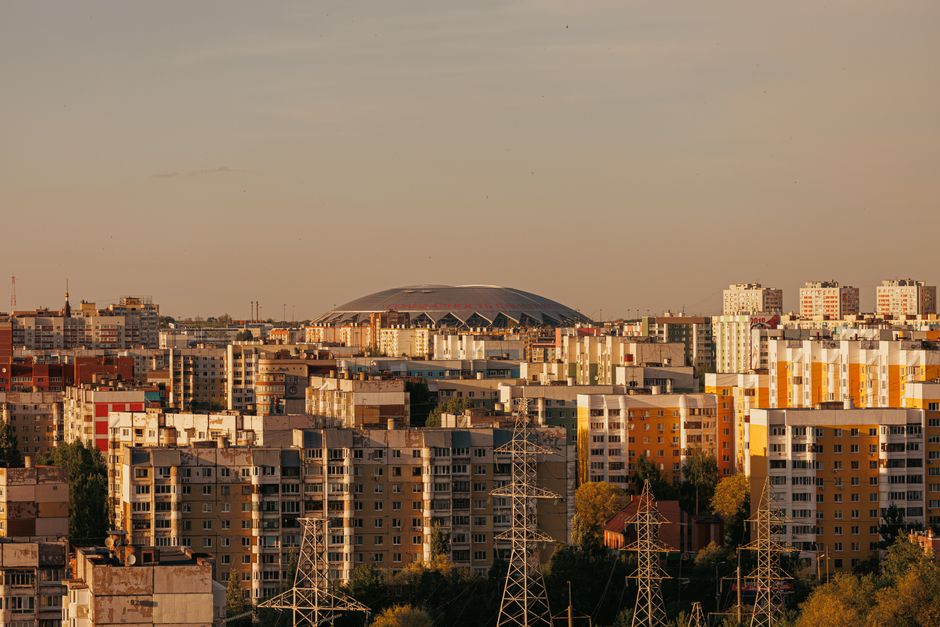
Kazan is the capital of the Republic of Tatarstan and one of Russia’s largest cities, set where the Kazanka river flows into the Volga, about 800 km east of Moscow. It is the historic centre of the Volga Tatars, a mostly Muslim Turkic people, and the city’s skyline shows it: inside the white walls of the Kazan Kremlin, the blue-domed Qolşärif Mosque stands beside the 16th-century Orthodox Annunciation Cathedral. Kazan is also an old university city and a modern sports centre. This guide explains what Kazan is known for and how it came to be, with notes on current conditions.
Right now in Kazan
- Wed7–14°C44–56°F2 mm rain
- Thu7–13°C44–55°FPartly cloudy
- Fri6–13°C42–56°FMostly clear
Kazan at a glance
- Status: capital of the Republic of Tatarstan (ISO 3166-2 code RU-TA), one of the republics of the Russian Federation.
- Population: about 1.3 million, one of Russia’s ten largest cities.
- Languages: Tatar and Russian are both official in Tatarstan; signs are often in both.
- Setting: on the left bank of the Volga at the mouth of the Kazanka, where the Volga widens into the Kuybyshev Reservoir.
- Time zone: Moscow Time, UTC+3 all year.
- World Heritage: the Historic and Architectural Complex of the Kazan Kremlin (UNESCO, 2000); the Bolgar archaeological complex and the Assumption Cathedral and Monastery of Sviyazhsk are both in Tatarstan.
A short history of Kazan
Kazan’s official founding date is 1005, a date based on archaeological finds in the Kremlin, and the city celebrated its millennium in 2005. The region had earlier been the heart of Volga Bulgaria, a Muslim state whose capital, Bolgar, about 140 km to the south, adopted Islam in 922. After the Mongol conquest, the area became part of the Golden Horde, and when the Horde broke up in the 15th century Kazan became the capital of an independent Khanate of Kazan, a rich trading state on the Volga.
In 1552 Ivan IV (“the Terrible”) took Kazan after a long siege, ending the khanate and opening the whole Volga to Russian expansion; St Basil’s Cathedral in Moscow was built to celebrate the victory. Mosques were destroyed, Tatars were expelled from the walled city, and the Kremlin was rebuilt in white stone with Orthodox churches by Pskov masons. Over the following centuries the Tatars rebuilt their community in the Old Tatar Quarter (Staro-Tatarskaya Sloboda) across the Bulak canal, where Catherine the Great allowed stone mosques to be built again from the 1760s.
Kazan grew into one of the main cities of the Russian Empire. Kazan University, founded in 1804, is one of Russia’s oldest: the mathematician Nikolai Lobachevsky taught there, Leo Tolstoy studied there and Lenin was expelled from it in 1887. In 1920 Kazan became the capital of the Tatar Autonomous Soviet Socialist Republic, and after 1990 Tatarstan negotiated wide autonomy within Russia. The 2000s brought a wave of restoration and building, including the Qolşärif Mosque, and major sporting events: the 2013 Summer Universiade, the 2015 World Aquatics Championships and matches of the 2018 FIFA World Cup.
What Kazan is known for
The Kazan Kremlin
The Kremlin stands on a hill above the Kazanka, surrounded by white walls and towers mostly from the 16th and 17th centuries. Inside are the Annunciation Cathedral, built in the 1550s and 1560s, the leaning red-brick Söyembikä Tower, named after the last queen of the khanate, the governor’s palace that now houses the President of Tatarstan, and the Qolşärif Mosque, opened in 2005 and named after the imam who died defending the city in 1552. UNESCO inscribed the Kremlin in 2000 as the only surviving Tatar fortress with traces of its original plan, and as a symbol of the meeting of Muslim and Christian cultures.
Bauman Street and the old city
Bauman Street, a pedestrian street running down from the Kremlin, is lined with 19th-century merchant houses, the Epiphany Cathedral’s tall bell tower and statues. Nearby are the Peter and Paul Cathedral, a richly decorated 18th-century Baroque church, and the Kazan University buildings.
The Old Tatar Quarter
South of the Bulak canal, the Old Tatar Quarter has wooden houses, 18th- and 19th-century mosques such as the Marjani Mosque of the 1760s, and the house of the Tatar poet Gabdulla Tukay. It is the best place to understand the Tatar side of the city’s story.
The Temple of All Religions
On the Volga at the village of Old Arakchino, the Temple of All Religions is not a place of worship but an art project begun in 1992 by the local artist Ildar Khanov: a colourful building combining the domes, minarets and towers of many faiths.
Bolgar, Sviyazhsk and Raifa
Around Kazan are three places linked to its history. Bolgar, the ruins of the medieval capital of Volga Bulgaria, was inscribed by UNESCO in 2014. Sviyazhsk, a small island town founded by Ivan IV in 1551 as a base for the siege of Kazan, has the Assumption Cathedral with rare 16th-century frescoes, inscribed in 2017. The Raifa Monastery, in a forest reserve west of the city, is one of the main Orthodox monasteries of the Volga region.
Tatar food
Tatar cooking is famous across Russia: echpochmak (triangular meat and potato pastries), gubadia (a layered festive pie), bal-bavyrsak and above all chak-chak, fried dough bound with honey.
Climate
Kazan has a continental climate with long, cold winters, when highs stay well below freezing from December to February and snow covers the ground for about five months, and warm summers, with July highs of about 26 °C. Spring is short and arrives in late April or May.
| Season | Average daily high | Average nightly low | Rain or snow per month |
|---|---|---|---|
| Winter (Dec–Feb) | −7.1 to −5.4 °C | −12.8 to −10.5 °C | 37–50 mm |
| Spring (Mar–May) | 0.3 °C rising to 19.8 °C | −6.5 °C rising to 9.1 °C | 33–38 mm |
| Summer (Jun–Aug) | 23.5–25.8 °C | 13.5–15.8 °C | 54–63 mm |
| Autumn (Sep–Nov) | 16.9 °C falling to −0.3 °C | 8.8 °C falling to −4.5 °C | 45–54 mm |
Kazan gets about 564 mm of rain and snow a year, according to the official 1991–2020 averages for the Kazan station that Russia submitted to the World Meteorological Organization.
Safety and current conditions
The war with Ukraine is ongoing, and drone attacks and explosions have been reported in Kazan and other large cities. Points to know:
- Insurance: many travel insurance policies exclude Russia, including medical treatment and evacuation, so check the wording of your policy.
- Consular help: in-person consular help is limited, and dual nationals are treated as Russian citizens.
- Flights and borders: there are no direct flights to the UK or through EU countries; airspace closures during drone attacks cause frequent delays, diversions and cancellations.
- Money: cards issued abroad do not work; change US dollars or euros only at banks, hotels and licensed exchange offices.
- Papers: carry your passport and migration card at all times and make sure your stay is registered.
- Security: take cover in buildings or underground during drone alerts and keep away from windows, avoid demonstrations and never photograph military, official or infrastructure sites.
- Emergencies: call 112. British nationals can reach the British Embassy in Moscow on +7 495 956 7200 (24 hours).
Kazan FAQ
Is it safe to travel to Kazan now?
Conditions are difficult. The war with Ukraine is ongoing, drone attacks and explosions have been reported in Kazan, airspace can close at short notice, there is a risk of terrorism and of detention for foreigners, and consular help is very limited. See the safety section above for the details.
What is Kazan known for?
The Kazan Kremlin, a UNESCO World Heritage Site where a mosque and an Orthodox cathedral stand side by side, the Tatar culture and food of the Old Tatar Quarter, Bauman Street, Kazan University and the colourful Temple of All Religions.
Is Kazan a Muslim city?
Kazan is a mixed city. Tatars, most of whom are Sunni Muslims, and Russians, most of whom are Orthodox Christians, make up the great majority of the population, and mosques and churches stand side by side. It is often described as a meeting point of Islamic and Christian culture.
What language do people speak in Kazan?
Russian is spoken by everyone, and Tatar, a Turkic language, is co-official in Tatarstan and widely used. Street signs and announcements are often in both languages.
How far is Kazan from Moscow?
About 800 km to the east, on the Volga. Overnight trains, domestic flights and the M-12 motorway, opened as far as Kazan in late 2023, link the two cities.
Plan your trip
Partner links: TravelerCenter may earn a commission if you book, at no extra cost to you.
🇷🇺 Useful Russian phrases for Kazan
All 38 Russian phrases: restaurant, hotel, emergencies, romance (printable) →
Sources · last reviewed 4 October 2026
Researched and last reviewed on 4 October 2026. Safety and practical information from GOV.UK foreign travel information (updated 18 September 2026) and the US State Department’s country information (28 December 2025); World Heritage listings from UNESCO; climate from the official 1991–2020 normals Russia submitted to the World Meteorological Organization; population from Rosstat. History is summarised from standard reference works. Conditions can change at short notice, so check the latest official information.
Data: Weather: MET Norway (CC BY 4.0) · Rates: ECB · Costs: World Bank ICP and price levels · Wikidata (CC0)