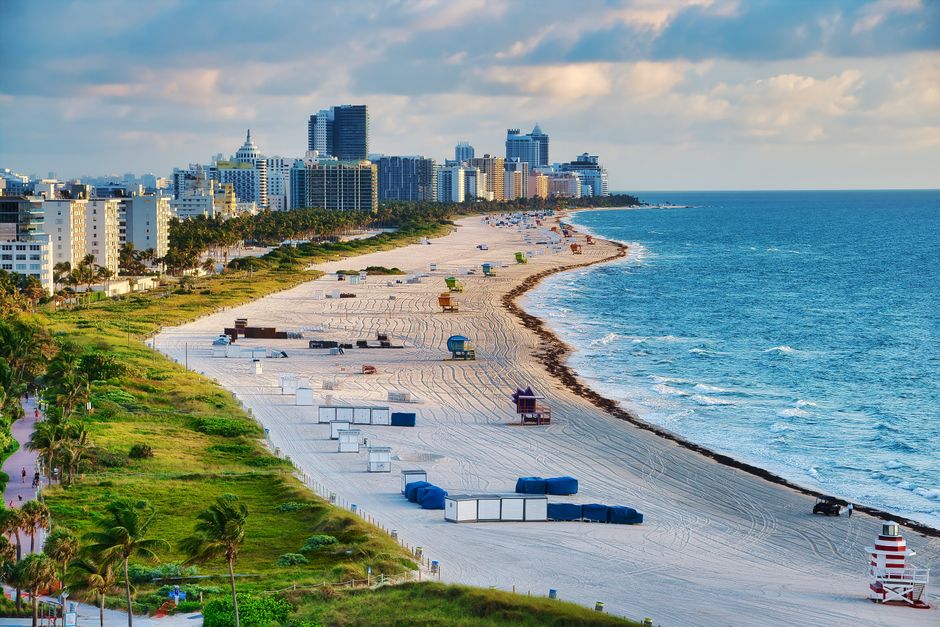
Miami Beach is a separate city on a long barrier island between Biscayne Bay and the Atlantic, linked to Miami by causeways. Its southern end, South Beach, is one of the world’s most famous beach districts: pastel Art Deco hotels along Ocean Drive, a wide strand of pale sand with candy-colored lifeguard towers, the pedestrian Lincoln Road and a nightlife that runs until dawn. Further north, Mid-Beach and North Beach are calmer, with grand 1950s resort hotels and family-friendly stretches of sand. Come between November and April for warm, dry days, and plan around spring break in March and Art Week in December.
Right now in Miami Beach
- Wed25–31°C77–88°F4 mm rain
- Thu24–30°C76–86°F6 mm rain
- Fri25–29°C76–84°F3 mm rain
- Mon 12 Oct Columbus Day
Top tours in Miami Beach
See all tours for Miami Beach →
From local operators, with prices and reviews; you check availability and book on Viator, our partner. We may earn a commission at no extra cost to you. How we earn money
Miami Beach at a glance
- Best for: beach days, Art Deco architecture, people-watching on Ocean Drive, nightlife, art fairs and an easy base for Miami.
- How long: 2–3 days for the beach and South Beach; 4–5 days with Miami, the Everglades or a day in the Keys.
- Best time: November to April, with highs of 74–80 °F (23–26 °C) and about 4 rainy days a month. Summer is hot and stormy, and it is hurricane season.
- Getting there: fly to Miami International Airport (MIA) and take Metrobus route 150, the Miami Beach Airport Express, for $2.25, or a taxi; Fort Lauderdale airport (FLL) is the other option.
- Getting around: on foot, by bike along the Beachwalk and on the city’s free trolleys, which run every 20 minutes or so from 8 a.m. to 11 p.m.
- Before you go: entry rules, money, driving and general safety are on our United States travel guide.
Miami Beach’s neighborhoods and who each one suits
The city runs for about 7 miles (11 km) of ocean beach from South Pointe to 87th Terrace, with the bayside islands and Venetian Causeway on its western side.
South Beach (SoBe)
Everything south of about 23rd Street: the Art Deco Historic District, Ocean Drive, Collins and Washington Avenues, Lincoln Road and Española Way. This is where the action is, with the most hotels, restaurants and clubs, and the busiest beach. Great for first-timers and night owls; light sleepers should pick a room away from Ocean Drive and Washington Avenue.
South of Fifth (SoFi)
The quieter, smarter tip of the island below 5th Street, with South Pointe Park, its fishing pier and views of cruise ships sailing out of PortMiami. Upmarket condos, fine dining and a calmer beach make it a favorite for couples and families who want to be near South Beach without the noise.
Mid-Beach
From about 23rd to 63rd Street along Collins Avenue, home to the big resort hotels of the 1950s and 1960s, such as the Fontainebleau and the Eden Roc, and newer luxury towers. The beach is wide and the Beachwalk and boardwalk run alongside the dunes. Good for a resort stay with pools and spas.
North Beach
North of 63rd Street, a more local, residential area with mid-century modern buildings, North Beach Oceanside Park and lower hotel prices. Families and longer stays do well here. Just beyond, the separate towns of Surfside and Bal Harbour have their own beaches, a famous luxury mall and different hotel tax rates.
Top things to see in Miami Beach
Prices, rules and hours below were checked on the official sites in October 2026, unless we say otherwise; check again before you go.
The Art Deco Historic District and Ocean Drive
South Beach has one of the largest collections of Art Deco buildings in the world, mostly small hotels and apartment blocks from the 1930s and 1940s with racing stripes, porthole windows, neon signs and “eyebrow” sunshades, alongside Mediterranean Revival and later “MiMo” (Miami Modern) styles. Walk Ocean Drive between 5th and 15th Streets, then Collins and Washington Avenues one and two blocks inland. The Art Deco Welcome Center on Ocean Drive, run by the Miami Design Preservation League, leads guided walking tours. Ocean Drive is best seen in the morning, before the café crowds, and again at dusk when the neon comes on.
Lummus Park and South Beach
Across Ocean Drive from the Art Deco hotels, Lummus Park is a strip of palms and lawns with an outdoor gym, volleyball nets and the beach beyond, dotted with the quirky, colorful lifeguard towers that have become a symbol of the city. The sand is free to all, and the water is usually calm and clear in winter. It is the busiest beach in Miami Beach, especially at weekends.
South Pointe Park and Pier
At the island’s southern tip, this landscaped park has walking paths, a children’s play area, a long fishing pier and front-row views of the cruise ships passing through Government Cut. It is one of the best sunrise spots in South Florida and a calmer place to swim than Lummus Park.
Lincoln Road and Española Way
Lincoln Road is a palm-lined pedestrian mall of shops, galleries and pavement restaurants, designed by Morris Lapidus in the 1960s, with the New World Center concert hall nearby. A few blocks south, Española Way is a tiny Mediterranean-style street of pink stucco and bistro tables, best in the evening.
More to see
- The Wolfsonian–FIU: a museum of design and propaganda art in a 1920s storage building on Washington Avenue.
- The Bass: the city’s contemporary art museum in Collins Park, near the beach.
- Holocaust Memorial Miami Beach: a moving sculpture garden near the convention center.
- Miami Beach Botanical Garden: a quiet green corner next to the convention center.
- The Beachwalk: a paved path behind the dunes for walking, running and cycling from South Pointe to Mid-Beach.
Museums
- The Bass Museum of Art
- Wolfsonian-FIU
Monuments
- Holocaust Memorial Miami Beach
Historic centres
- Lincoln Road
- Ocean Drive
Parks and gardens
- Lummus Park
- South Pointe Park
Beach rules and beach safety
Miami Beach is strict about its beach. According to the City of Miami Beach, alcohol and smoking are always prohibited on city beaches, and these are always banned on the sand: cigarettes, coolers, inflatable devices, tents and tables, loud music, glass containers, and Styrofoam, plastic straws and balloons. Drink at the beach bars and hotel pools instead, and leave no litter.
Lifeguards and flags: swim in front of a staffed lifeguard tower. On the day we checked, Ocean Rescue’s towers were staffed from 9 a.m. to 7 p.m.; the city posts the day’s hours, tides, water temperature and swimming conditions on its “Current Beach Conditions” page, with two live webcams. Florida’s statewide flags fly from the towers when lifeguards are on duty: green for low hazard, yellow for moderate surf or currents, red for high surf or strong currents, red with a crossed-out swimmer when the water is closed, and purple for dangerous marine life such as jellyfish. The city stresses that no flag does not mean safe water. Rip currents are the main risk: if one pulls you out, swim parallel to the beach, then back to shore. Kitesurfers are banned south of 29th Street, except at 25th Street.
Water quality and seaweed: the Florida Department of Health tests the water weekly at 79th, 73rd, 53rd and 21st Streets and South Pointe Drive, and the city reported that about 98% of its 2026 tests had not led to a swimming advisory. Advisories are more likely after heavy rain from May to October, so check the city’s page after a storm. Sargassum seaweed sometimes piles up on the shore; city crews clear it daily after checking for sea turtle nests. The rotting weed smells of rotten eggs and the tiny creatures living in it can cause skin rashes, but according to the Florida Department of Health the levels on an open beach are not expected to harm health. Sea turtles nest here in summer, so keep away from marked nests.
Spring break in Miami Beach
The city treats March as a “high-impact period”. In March 2026, from Thursday to Sunday every week, beach entrances on Ocean Drive were limited to 5th, 7th, 8th, 10th, 12th and 14th Streets, with security checkpoints for coolers, glass, inflatables, tents and tables; amplified music without a permit was restricted; police ran licence-plate readers on the MacArthur and Julia Tuttle causeways and DUI checkpoints on set nights; a traffic plan limited access to the South of Fifth and Flamingo Park neighborhoods from 6 p.m.; and rentals of golf carts, scooters, mopeds and similar vehicles were suspended. Expect similar measures in March 2027 and check the city’s website before you book. Outside March, South Beach is far more relaxed.
Other things to do in Miami Beach
Nightlife and food
South Beach’s clubs and hotel bars are some of the most famous in the country, with late nights and high prices; dress up and expect cover charges. For something gentler, have a Cuban coffee at a ventanita, stone crabs in season (mid-October to early May) or a sunset drink in SoFi. Restaurant bills in Miami Beach include a 2% city resort tax on food and drink on top of sales tax, and many add an automatic service charge: read the bill before you tip.
On and in the water
Paddleboarding, jet-skis, boat charters and fishing trips leave from the marinas on the bay side, and the calm winter sea is good for swimming. Surfing is possible when an Atlantic swell arrives, usually in winter, around First Street and South Pointe.
Day trips and onward travel
Miami and Key Biscayne
Downtown Miami is about 15 to 30 minutes away across the MacArthur Causeway, with Little Havana, Wynwood’s murals, Vizcaya and the Pérez Art Museum. Key Biscayne’s quieter beaches and lighthouse are a short drive beyond. See our Miami guide.
Everglades National Park and the Florida Keys
Shark Valley in Everglades National Park, for tram rides and cycling among alligators, is about an hour west on the Tamiami Trail. As of October 2026 the National Park Service charges $35 per private vehicle, plus $100 per person for non-US residents aged 16 and over without an annual or America the Beautiful pass. Key Largo and its coral reefs are about two hours south, and Key West is best as an overnight trip. See our Everglades National Park, Florida Keys and Key West guides.
Nearby destinations
- Miami8 km
- Fort Lauderdale36 km
- Everglades National Park79 km
- Naples171 km
- Florida Keys194 km
- Key West217 km
- Nassau292 km
- Paradise Island293 km
Getting there and getting around
From the airports
From Miami International Airport, take the free MIA Mover from the terminal’s third level to the Miami Intermodal Center. According to the airport, Metrobus route 150 Miami Beach Airport Express leaves from the MIA Metrorail station every 30 minutes from 6 a.m. to 11:40 p.m. and runs along Miami Beach from 41st Street to South Pointe Drive; as of October 2026 the fare is $2.25, payable by contactless card. Taxis from MIA use the meter, with a $15 minimum and a $2 airport fee. Fort Lauderdale-Hollywood airport is further away; Broward County lists a taxi estimate of about $80 to South Beach. Brightline trains from Orlando and the Palm Beaches arrive at MiamiCentral in downtown Miami, a bus or taxi ride from the beach.
Free trolleys, buses and bikes
The City of Miami Beach runs free trolleys on several routes, including the South Beach Loop, from 8 a.m. to 11 p.m. seven days a week, about every 20 minutes; the city’s Trolley Tracker or the Transit app shows them in real time. Miami-Dade Transit buses, including route 150, run the length of Collins Avenue for $2.25. The flat island is ideal for cycling, and walking is the best way to see the Art Deco district.
Driving and parking
You do not need a car to enjoy South Beach, and parking is expensive. According to the city, the usual meter rate in South Beach is $4 an hour on the street and $2 an hour in city lots, with lower rates further north. From 1 August to 31 October 2026 the city is offering parking at $1 an hour in municipal lots, garages and on-street spaces, only through the ParkMobile app with a zone promo code, for up to three hours per session. In past spring breaks the city has also set flat rates at its South Beach garages and doubled towing fees for non-residents. The Venetian Causeway is a cashless toll road; the MacArthur and Julia Tuttle causeways are free. Hotel valet parking is typically charged per night.
When to go and how long to stay
Miami Beach is warm all year, tempered by the ocean breeze. Winter is the dry, sunny high season; from May to October it is hot and humid, with short, heavy afternoon storms. The table uses NOAA’s 1991–2020 climate normals for the Miami Beach weather station: average daily highs and lows, and days with at least 0.10 in (2.5 mm) of rain.
| Season | Average high / low | Rainy days per month | What it’s like | Good for |
|---|---|---|---|---|
| Winter (Dec–Feb) | 74–76 °F (23–24 °C) / 61–65 °F (16–18 °C) | 4 | Sunny, dry and pleasant; sea a little cool for some | Beach, Art Deco walks, Art Week; peak prices |
| Spring (Mar–May) | 76–83 °F (25–28 °C) / 65–74 °F (18–23 °C) | 4–6 | Warm and mostly dry; spring break crowds in March | Beach days, water sports |
| Summer (Jun–Aug) | 86–88 °F (30–31 °C) / 76–78 °F (25–26 °C) | 9–10 | Hot, humid and stormy in the afternoons | Lower rates, warm sea, early-morning beach |
| Autumn (Sep–Nov) | 87 °F falling to 79 °F (31 to 26 °C) / 77 °F falling to 69 °F (25 to 20 °C) | 11 in September, 5 in November | Peak hurricane season early on; drier by November | Deals, $1 parking to 31 October, quieter beaches |
The station averages about 57 in (1,452 mm) of rain a year, with September the wettest month at about 8.4 in (215 mm). On 4 October 2026 the city reported a sea temperature of 79 °F (26 °C).
Hurricane season: according to NOAA’s National Hurricane Center (NHC), the Atlantic hurricane season runs from 1 June to 30 November, with most activity between mid-August and mid-October. Miami Beach is a low-lying barrier island, so take any evacuation order seriously. Follow forecasts from the National Hurricane Center and the National Weather Service in Miami, check your evacuation zone with Miami-Dade County, obey any evacuation orders, and consider travel insurance.
Events worth planning around
- Early December: Art Basel Miami Beach, 4–6 December 2026 (preview days 2 and 3 December), at the heart of Miami Art Week. Hotel prices soar.
- February: the South Beach Wine & Food Festival.
- March: spring break, with the city’s high-impact rules from Thursday to Sunday.
- April: Miami Beach Pride in Lummus Park.
How long to stay: 2, 3 and 4 days
2 days: day one, an Art Deco walking tour, lunch on Española Way and an afternoon on the beach at Lummus Park, then dinner and drinks on South Beach; day two, sunrise at South Pointe Park, a bike ride up the Beachwalk, Lincoln Road and the Wolfsonian or the Bass.
3 days: add Little Havana and Wynwood in Miami. 4 days: add Shark Valley in the Everglades or a long day to Key Largo’s reefs.
Weather month by month
Where to stay in Miami Beach and the resort tax
- South Beach: boutique Art Deco hotels and party hotels; central and lively, often noisy.
- South of Fifth: quieter and upmarket, close to South Pointe Park.
- Mid-Beach: big resort hotels with pools, spas and wide beaches.
- North Beach: better value and a more local feel, on the trolley and bus routes.
Florida prices are shown before tax. As of October 2026, a hotel room in Miami Beach carries Florida’s 6% sales tax and Miami-Dade County’s 1% surtax, Miami-Dade’s 3% convention development tax and the City of Miami Beach’s 4% resort tax: 14% in all. The city’s 2% resort tax also applies to food and drink in restaurants, bars and nightclubs. Many hotels add a daily resort fee and charge for valet parking. Under the Federal Trade Commission’s fees rule in force since May 2025, mandatory fees such as resort fees must be included in the total advertised price; taxes may be shown separately. Compare total prices, and book early for March, Art Week and holiday weekends.
Practical tips for Miami Beach
- Check the bill: many restaurants add a service charge, and Ocean Drive cafés can be very pricey; look at the menu first.
- Leave the drinks behind: alcohol, glass and coolers are banned on the beach.
- Check the beach page: the city’s “Current Beach Conditions” page lists flags, lifeguard hours and any water quality advisories.
- Use the free trolley: it saves on parking and taxis along the island.
- Watch your belongings: do not leave bags unattended on the sand.
- Emergencies: call 911.
What to pack for Miami Beach
Swimwear, a cover-up for walking to the café (and for entering shops), flip-flops and comfortable sandals, a sun hat, sunglasses and plenty of reef-friendly sunscreen. Bring a beach towel; tents are not allowed on the sand, so rent chairs and umbrellas from the beach concessions for shade. For the evenings, smart-casual clothes for restaurants and clubs, and a light layer against air conditioning. From May to October add a compact umbrella for afternoon downpours.
Miami Beach travel FAQ
Can you drink alcohol on Miami Beach?
No. Alcohol and smoking are always prohibited on the City of Miami Beach’s beaches, and glass containers and coolers are banned too.
How do I get from Miami airport to South Beach?
Take the free MIA Mover to the Miami Intermodal Center, then Metrobus route 150, the Miami Beach Airport Express, every 30 minutes from 6 a.m. to 11:40 p.m. for $2.25 as of October 2026. A metered taxi has a $15 minimum from the airport.
Is the Miami Beach trolley free?
Yes. The city’s trolleys are free and run from 8 a.m. to 11 p.m. daily, about every 20 minutes, including the South Beach Loop.
What is the hotel tax in Miami Beach?
As of October 2026, 14%: 7% sales tax, Miami-Dade’s 3% convention development tax and the city’s 4% resort tax. Resort fees and parking are extra.
How much does parking cost in South Beach?
Usually $4 an hour on the street and $2 an hour in city lots. Until 31 October 2026 the city charges $1 an hour through the ParkMobile app, for up to three hours a session.
What do the beach flags mean in Miami Beach?
Green means low hazard, yellow moderate surf or currents, red high surf or strong currents, red with a crossed-out swimmer means the water is closed, and purple warns of dangerous marine life. Always swim near a staffed tower.
Is there seaweed on Miami Beach?
Sometimes, mostly in spring and summer, when sargassum washes in. City crews clear it every day, and it is not expected to harm health on an open beach, though it can smell and irritate the skin.
What are the spring break rules in Miami Beach?
In March 2026, from Thursday to Sunday, South Beach had limited beach entrances with bag checks, traffic controls, DUI checkpoints and a ban on renting scooters and golf carts. Check the city’s website for March 2027.
When is Art Basel Miami Beach in 2026?
From 4 to 6 December 2026, with preview days on 2 and 3 December. Book hotels well ahead.
Is Miami Beach safe during hurricane season?
Most trips between 1 June and 30 November go ahead normally, but NOAA’s National Hurricane Center expects most storms from mid-August to mid-October. Watch the forecasts, follow evacuation orders and consider travel insurance.
Plan your trip
Partner links: TravelerCenter may earn a commission if you book, at no extra cost to you.
Sources · last reviewed 4 October 2026
Researched and last reviewed on 4 October 2026. Beach rules, spring break measures, lifeguard flags, beach conditions, sargassum, trolleys, parking rates and the resort tax: City of Miami Beach; county hotel taxes: Miami-Dade County and the Florida Department of Revenue; airport bus and taxi rules: Miami International Airport; Fort Lauderdale taxi estimate: Broward County; Everglades fees: National Park Service; hurricane season: NOAA’s National Hurricane Center; resort fees: Federal Trade Commission; climate: NOAA’s 1991–2020 normals for the Miami Beach weather station; Art Basel dates: Art Basel. Other event months, neighborhood descriptions and travel times are general references and flagged for checking. Prices, hours and timetables change, so check the official sites before you go. For entry rules, money and general safety, see our United States travel guide.
Also: NOAA NCEI normals 1991–2020, Miami Beach (climate)
Data: Weather: MET Norway (CC BY 4.0) · Sea temperature: NOAA CoastWatch · Air quality: OpenAQ · Rates: ECB · Holidays: Nager.Date · Costs: World Bank ICP and price levels · © OpenStreetMap contributors (ODBL) · Wikidata (CC0)