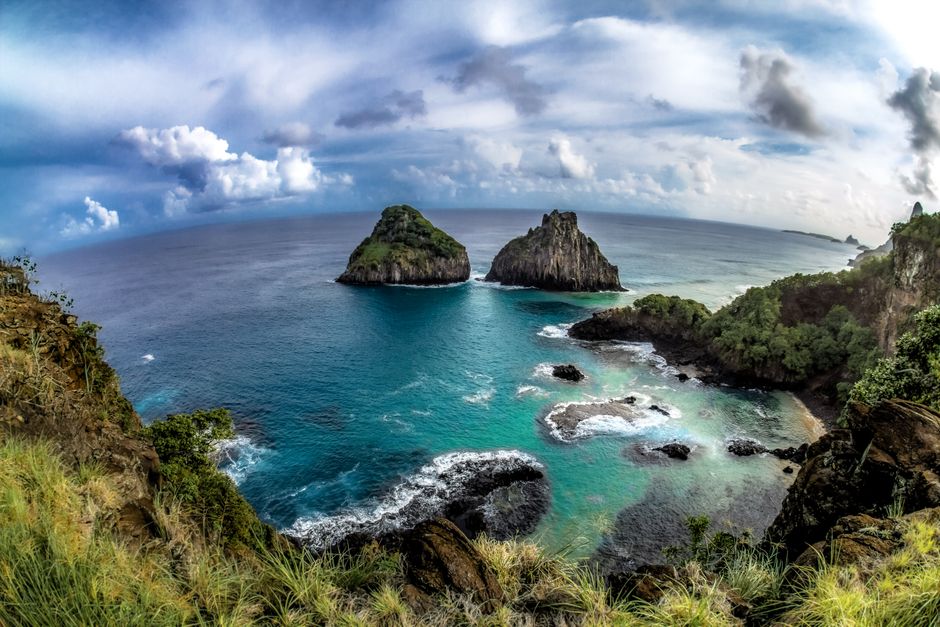
Fernando de Noronha is a volcanic archipelago of 21 islands and islets in the Atlantic, 545 km (339 miles) off Recife, and one of the most protected places in Brazil. About 70% of it is a marine national park, created in 1988 and covering 10,929 hectares (27,000 acres) of land and sea, and the rest an environmental protection area where the island’s village, guesthouses and roads are. The rewards are extraordinary: Baía do Sancho, often voted one of the world’s best beaches, spinner dolphins that gather by the hundreds in a bay every morning, sea turtles, reef sharks and rays in water so clear that divers see 30 m (100 ft) or more, natural pools at low tide and sunsets behind the twin peaks of Morro Dois Irmãos. The price is high, and deliberately so: every visitor pays a daily state environmental fee and a national park ticket, flights are limited, and the most sensitive natural pools have daily visitor slots. The islands, a UNESCO World Heritage Site with the Rocas Atoll, are warm all year.
Right now in Fernando de Noronha
- Wed26–27°C79–81°FMostly clear
- Thu26–27°C79–80°FMostly clear
- Fri26–27°C78–80°FClear
- Mon 12 Oct Our Lady of Aparecida (Nossa Senhora Aparecida)
Top tours in Fernando de Noronha
See all tours for Fernando de Noronha →
From local operators, with prices and reviews; you check availability and book on Viator, our partner. We may earn a commission at no extra cost to you. How we earn money
Fernando de Noronha at a glance
- Best for: beaches, snorkeling and diving, dolphins and turtles, hiking and sunsets.
- How long: 4–5 days, as the island administration suggests at least three; a week for divers.
- Best time: August to December for calm seas, clear water and the least rain; January to May brings swells, good for surfing but rougher at some beaches.
- Getting there: daily flights of about an hour from Recife, and some from Natal and other cities, to the island’s small airport.
- Fees (as of October 2026): the state Environmental Preservation Fee (TPA), R$105.79 (about US$20) for one day, rising with each day, and the national park ticket, R$384 (about US$74) for 10 days.
- Time zone: the islands are an hour ahead of Recife and Rio (UTC−2).
- Before you go: the e-visa, money and general safety are in our Brazil travel guide; for the mainland, see our Recife travel guide.
The fees: TPA and the national park ticket (as of October 2026)
Every visitor pays two separate charges.
The Environmental Preservation Fee (TPA)
Charged by the Pernambuco state district administration (Administração do Distrito Estadual de Fernando de Noronha) to everyone who doesn’t live on the islands, under state law, the TPA is calculated by the number of days you stay, and it rises faster for longer stays. The 2026 table:
| Days on the island | TPA 2026 |
|---|---|
| 1 | R$105.79 (about US$20) |
| 2 | R$211.59 (about US$41) |
| 3 | R$317.38 (about US$61) |
| 4 | R$423.17 (about US$81) |
| 5 | R$520.50 (about US$100) |
| 6 | R$596.68 (about US$114) |
| 7 | R$672.85 (about US$129) |
| 10 | R$901.36 (about US$173) |
| 14 | R$1,536.12 (about US$294) |
| 30 | R$7,460.56 (about US$1,429) |
You can pay online on the administration’s site before you fly, by Brazilian credit card or bank slip; if your credit card was issued outside Brazil, you can only pay at the counter at Fernando de Noronha airport, according to the administration. Days beyond your planned stay are paid when you leave, and days not agreed in advance with the administration are charged double, under state law.
The national park ticket
The Fernando de Noronha Marine National Park, run by ICMBio, charges R$384 (about US$74) for the general public, including foreigners, and R$192 for Brazilians, valid for 10 days, under an ICMBio ordinance of October 14, 2025. Children under 12 are exempt. Buy it online and enter with the QR code, or at the ticket office in the park’s visitor center in Boldró, open from 8 a.m. to 7 p.m. The ticket covers Baía do Sancho, Baía dos Porcos, Baía do Sueste, Praia do Leão, the Baía dos Golfinhos viewpoint, Ponta das Caracas, the Sueste fort, Praia da Caieira and the dive sites, and is needed to book the trails with natural pools.
Visitor limits and the natural pools
The islands control visitor numbers through the TPA, which is charged by the day, the limited number of flights and beds, and, inside the national park, daily limits at its most fragile sites. The trails with natural pools, the Atalaia pool, Enseada do Abreu, the Capim Açu trail, the Pontinha–Caieira trail and Morro São José, have a maximum number of places per day set by a carrying-capacity study, according to ICMBio, and you must book a slot with your park ticket number, online or at the visitor center. Times change every day to match low tide, which lasts about four hours, so plan around the tide table. Most pools allow only floating with a life jacket, mask and snorkel, and Capim Açu, Pontinha–Caieira and the Morro São José swim require a guide registered with ICMBio. Book on your first day, as places run out.
Fernando de Noronha’s areas: where things are
The main island is about 10 km (6 miles) long. Its north-west coast, facing Brazil, is the calm “inner sea” (mar de dentro), with most of the beaches; the south-east coast, facing Africa, is the rougher “outer sea” (mar de fora).
Vila dos Remédios
The historic village, with the 18th-century fort of Nossa Senhora dos Remédios, the church, the Noronha Memorial museum and many guesthouses and restaurants.
Boldró, Floresta Nova and the center
The park visitor center and the Projeto Tamar turtle center are in Boldró, by the Fortinho do Boldró sunset viewpoint; most guesthouses are spread across the inland neighborhoods.
The inner sea beaches
From the Porto de Santo Antônio harbor, a line of beaches runs south-west: Praia do Cachorro, Praia do Meio and Conceição below Morro do Pico, then Boldró, Americano, Bode, Cacimba do Padre, Baía dos Porcos and Sancho.
The outer sea
Wilder coves and pools: Atalaia, Sueste, Leão and Caieira.
Top things to see in Fernando de Noronha
Baía do Sancho
A beach of golden sand below green cliffs, reached by stairs and ladders through a crack in the cliff, with clear water and reef fish. It is inside the national park. The trail to the Sancho waterfalls is closed because of the risk of landslides and falling rocks, according to ICMBio.
Baía dos Porcos and Morro Dois Irmãos
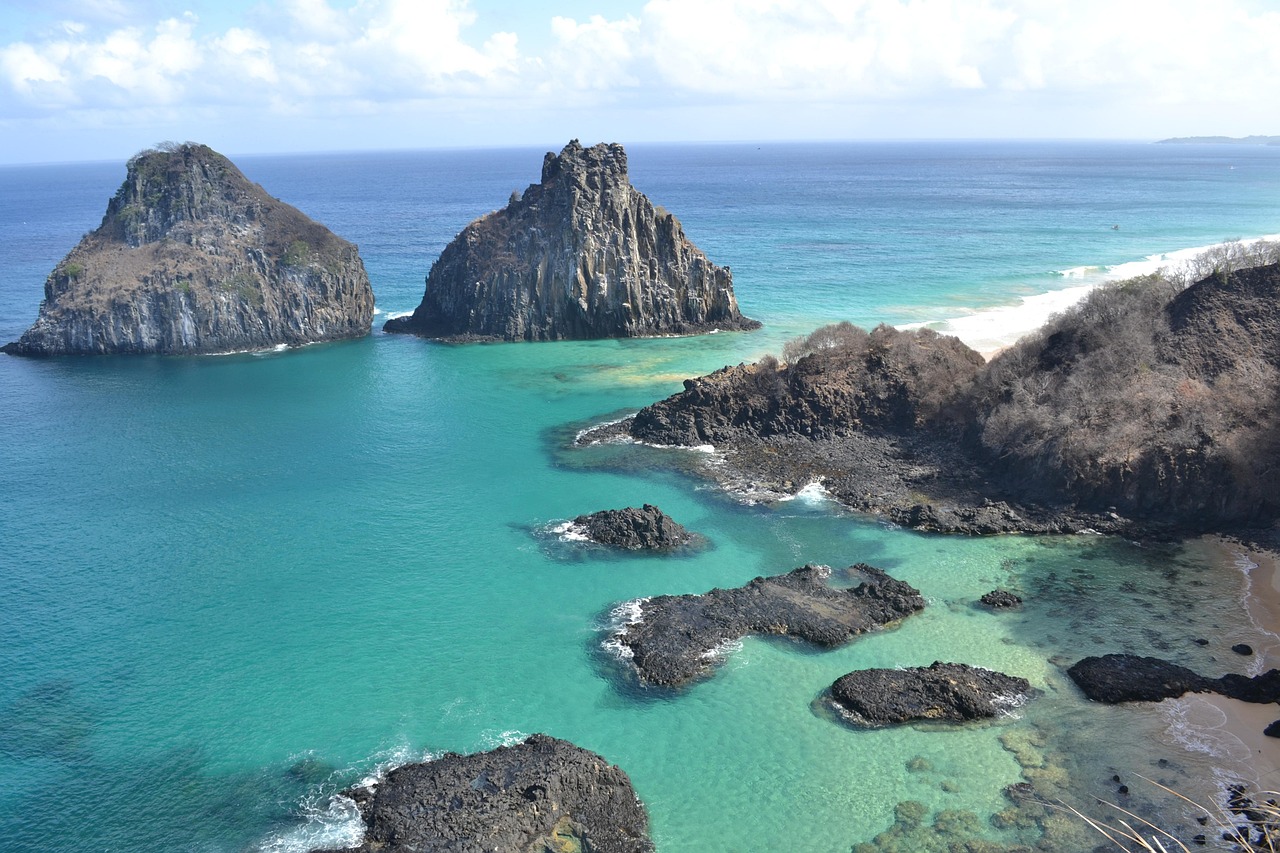
A tiny cove of rock pools with the islands’ most photographed view, the twin peaks of Dois Irmãos, reached on foot along the rocks from Cacimba do Padre at low tide.
Baía dos Golfinhos viewpoint
From the cliff-top viewpoint you can watch spinner dolphins, which rest in the bay in large groups, usually early in the morning. Swimming and boats are banned in the bay.
Praia do Leão and Baía do Sueste
Leão, on the outer sea, is a wide beach where sea turtles nest; Sueste has a mangrove and calm water, but it was temporarily closed for swimming and snorkeling as of October 2026, according to ICMBio.
The natural pools
Atalaia, Abreu and the other pools are shallow, coral-floored lagoons exposed at low tide, full of fish, octopus and small sharks; slots are limited, so book early.
More to see
- The Fortinho do Boldró: the classic sunset spot, with Dois Irmãos on the horizon.
- Forte dos Remédios and the village: history from the Portuguese forts to the island’s past as a prison.
- Projeto Tamar: the sea turtle conservation center in Boldró, with evening talks.
- Cacimba do Padre: a long beach with big surf from January to March.
Other things to do in Fernando de Noronha
Diving and snorkeling
Noronha is one of Brazil’s top dive destinations, with warm, clear water, wrecks, turtles, rays and sharks; dive centers run trips for certified divers and introductory “baptism” dives. Many snorkelers try “planasub”, being towed behind a boat on a board.
Dive sites
The best-known dives include the wreck of the Ipiranga, a Brazilian navy corvette that sank in 1983 off the inner sea, lying upright at about 60 m (200 ft) and reached on technical dives; the Pedras Secas, rocky pinnacles with swim-throughs off the outer sea; and the Laje Dois Irmãos and Cagarras sites, with turtles, rays and reef sharks. Visibility is usually best from about September to January. All scuba diving inside the national park is with licensed operators and needs a park ticket.
Boat trips and the island tour
Morning and sunset boat trips along the inner sea often meet spinner dolphins. The “ilha tour” by buggy or truck covers the main viewpoints and beaches in a day, ending with sunset at Boldró.
Hiking
Many trails in the park can be walked without booking with a park ticket, such as Golfinho–Sancho, the Sancho viewpoint, Baía dos Porcos, Farol and Leão; the pool trails need a slot and, for some, a guide.
History of the islands
Fernando de Noronha was sighted by Portuguese navigators in the early 1500s and granted to the merchant Fernão de Loronha, whose name it carries. The Dutch and the French occupied it briefly in the 17th and 18th centuries, until Portugal built a ring of forts, including Nossa Senhora dos Remédios, and turned the main island into a prison colony, which lasted until the 20th century; prisoners cut much of the original forest so they couldn’t hide or build rafts. During the Second World War it became a military territory, with a US air base, and it was run by the armed forces until 1988, when it passed to the state of Pernambuco and the national park was created.
Food
Fresh fish, lobster in season, and Pernambuco dishes; expect high prices, since almost everything is shipped or flown in.
Getting there and getting around
Flights
Daily flights of about an hour link Recife with Fernando de Noronha’s airport, the island administration says; check current routes from Recife, Natal and other cities with Azul and Gol. Flights are on small aircraft with limited baggage, and fares are high, so book early. Arrival is in the middle of the island, a few minutes from most guesthouses. Private boats can anchor if they pay the district’s anchoring fee.
On the island
A single road, the BR-363, crosses the island. A public bus runs along it, taxis are available, and many visitors rent buggies, electric bikes or cars. Most beaches are reached by short trails from the road.
Rules to know
- Single-use plastics, including plastic bottles under 500 ml, straws, cups, cutlery, bags and styrofoam, are banned on the islands by district decree.
- Don’t feed or touch animals, stay on the trails and follow the park’s protocols at pools and beaches.
- Some areas close for wildlife, such as turtle nesting beaches at night.
When to go and how long to stay
Fernando de Noronha is warm all year, with air temperatures around 25–30 °C (77–86 °F) and warm water. The rainiest months are usually from about March to July; August to December is drier, with calm, clear seas, the best time for diving and snorkeling. From January to May, the islands get swells, which bring surf to Cacimba do Padre and Boldró and stronger waves at some beaches, according to ICMBio. Sea turtles nest from about December to June. The islands fill up from December to February, in July and around New Year, so book flights, guesthouses and pool slots well ahead.
Fernando de Noronha month by month
- January to March: warm, with the north swell bringing surf to Cacimba do Padre and Boldró and stronger waves on inner-sea beaches; rain begins to increase; high season in January and around Carnival.
- April to July: the rainiest months, with showers rather than all-day rain, lower prices and fewer visitors; the swell eases from about May, and turtles still nest on the outer-sea beaches.
- August to October: drying out, with calm, clear seas and excellent snorkeling and diving visibility; a favorite time for many visitors.
- November and December: sunny and calm, with turtle nesting starting again and the Christmas and New Year peak, when flights and pousadas sell out.
3 days in Fernando de Noronha
Day 1: buy or validate the park ticket, book pool slots, then sunset at the Fortinho do Boldró. Day 2: Baía dos Golfinhos viewpoint early, Sancho and Baía dos Porcos. Day 3: a boat trip with dolphins and a natural pool at low tide.
5 days in Fernando de Noronha
Add Leão and the outer sea, the island tour, a dive or planasub, Projeto Tamar’s evening talk and the historic village.
Where to stay in Fernando de Noronha and the fees
Accommodation is mostly in licensed pousadas, from simple family guesthouses to luxury eco-lodges, with no big hotels; prices are among the highest in Brazil. Book only licensed accommodation, as your stay must match what you declare for the TPA. Budget for the TPA and park ticket on top: a five-day stay costs R$520.50 in TPA plus R$384 for the park for a foreign adult, about R$904 (about US$173) per person in fees as of October 2026.
What things cost in Fernando de Noronha
Noronha is one of Brazil’s most expensive destinations, since almost everything is flown or shipped in. Official fees as of October 2026, plus our estimates:
| Item | Typical price |
|---|---|
| TPA for 5 days | R$520.50 (about US$100), official |
| National park ticket (foreigners, 10 days) | R$384 (about US$74), official |
| Boat trip along the inner sea (about 3 hours) | about R$200–350 (US$40–65) |
| Island tour by buggy or truck (full day) | about R$250–400 (US$50–75) |
| Two-tank boat dive for certified divers | about R$700–1,100 (US$135–210) |
| Buggy rental per day | about R$350–500 (US$65–95) |
| Lunch at a simple restaurant | about R$70–130 (US$13–25) |
| Double room, simple pousada | about R$600–1,200 (US$115–230) a night; eco-lodges much more |
Saving money
Stay in a family-run pousada, use the island bus instead of a buggy on some days, eat lunch at self-service restaurants, and book flights months ahead; the fees themselves can’t be avoided.
Practical tips for Fernando de Noronha
- Fees: if your card is foreign, pay the TPA at the airport on arrival; buy the park ticket online and book pool slots the day you arrive.
- Money: cards are widely accepted, but carry some cash; there are few ATMs.
- Plastics: bring a refillable bottle and reusable bag.
- Sea conditions: ask lifeguards and locals about swells before swimming, especially from January to May.
- Health: the CDC doesn’t list Pernambuco among the areas where yellow fever vaccination is recommended; medical facilities are limited, so travel insurance with evacuation cover matters.
- Safety: crime is rare on the islands; the main risks are the sea, the sun and slippery rocks on trails.
- Emergencies: call 190 for police, 192 for an ambulance and 193 for the fire department.
What to pack for Fernando de Noronha
Pack swimwear, a rash guard, reef-safe sunscreen, a hat, sunglasses, a snorkel mask, water shoes or trail sandals for rocks and ladders, a light rain jacket, a refillable bottle and a reusable bag. Bring cash, your passport and e-visa, and a plug adapter for Brazil’s type N sockets.
Fernando de Noronha travel FAQ
How much is the Fernando de Noronha tax?
As of October 2026, the TPA costs R$105.79 for one day, R$520.50 for five days and R$672.85 for seven. Foreign cards can only pay at the airport.
How much is the Fernando de Noronha national park ticket?
R$384 for foreigners and R$192 for Brazilians, valid for 10 days, as of October 2026. Children under 12 are exempt.
Is there a visitor limit in Fernando de Noronha?
The natural pool trails have daily slots set by a carrying-capacity study, booked with your park ticket. Flights, beds and the daily TPA also limit numbers.
How do I get to Fernando de Noronha?
By plane, about an hour from Recife, with daily flights; some routes also run from Natal and other cities.
When is the best time to visit Fernando de Noronha?
August to December, for calm seas and clear water. January to May has swells; the rainiest months are usually March to July.
How many days do I need in Fernando de Noronha?
At least three, ideally four or five, to see the main beaches, book the pools and take a boat trip.
Can you swim with dolphins in Fernando de Noronha?
No. You can watch them from the Baía dos Golfinhos viewpoint and often from boat trips, but swimming in the bay is banned.
Do I need a yellow fever vaccine for Fernando de Noronha?
It isn’t required, and the CDC doesn’t list Pernambuco among the areas where it is recommended.
Can I pay the Fernando de Noronha TPA with a foreign card?
Only at the counter at Fernando de Noronha airport when you arrive; online payment takes Brazilian cards and bank slips.
Is Fernando de Noronha worth the cost?
For beaches, snorkeling, diving and wildlife, many visitors think so; plan at least four days so the fixed park ticket and flights are spread over more time.
Plan your trip
Partner links: TravelerCenter may earn a commission if you book, at no extra cost to you.
🇵🇹 Useful Portuguese phrases for Fernando de Noronha
All 38 Portuguese phrases: restaurant, hotel, emergencies, romance (printable) →
Sources · last reviewed 4 October 2026
Researched and last reviewed on 4 October 2026. The TPA table, payment rules, foreign-card rule, double charge for unscheduled days, distance from Recife, flights and the plastic ban: the Fernando de Noronha district administration; park ticket price, validity, exemptions, the visitor center, covered sites, pool booking, carrying-capacity limits, guides, the Sancho waterfall closure, the Sueste swimming closure and the swell season: ICMBio’s Fernando de Noronha park; exchange rate: the Central Bank of Brazil; yellow fever: the US CDC. The number of islands, park creation date, dolphin and turtle seasons, visibility, rainy season, temperatures, the island tour, trails without booking, the road and bus, and the UNESCO listing come from secondary sources or general knowledge and are flagged for checking. Fees change every year, so check the official sites before you go. For entry rules and money, see our Brazil travel guide.
Data: Weather: MET Norway (CC BY 4.0) · Sea temperature: NOAA CoastWatch · Rates: ECB · Holidays: Nager.Date · Costs: World Bank ICP and price levels · Wikidata (CC0)