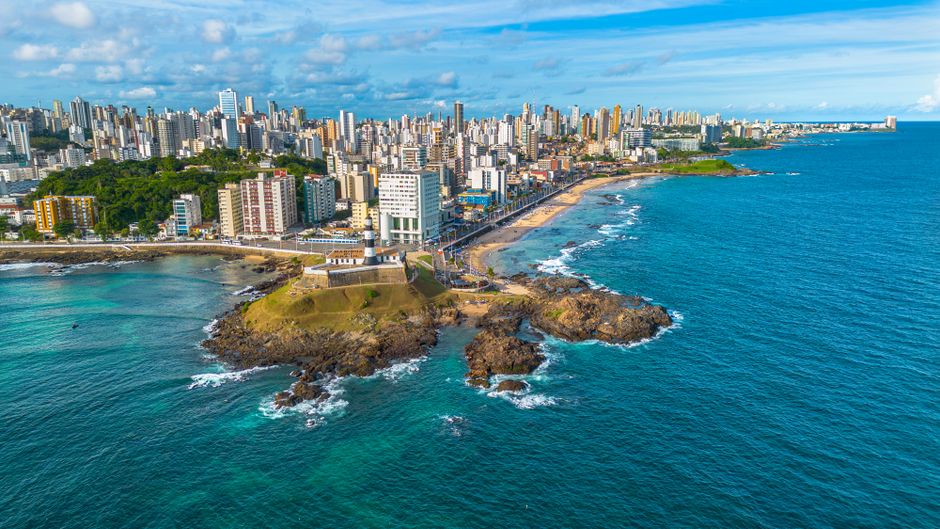
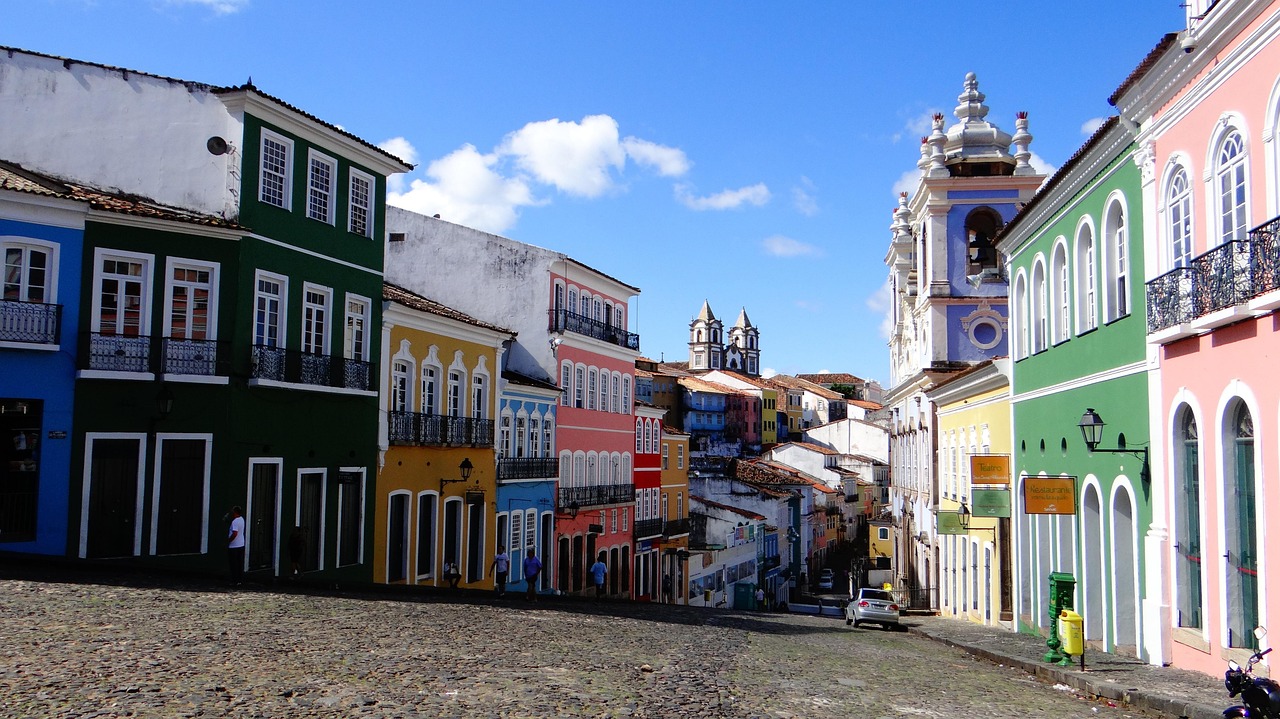
Salvador, the capital of Bahia, was Brazil’s first capital and for two centuries the main port of the Portuguese Atlantic, where millions of enslaved Africans were brought ashore. That history made it the heart of Afro-Brazilian culture: the drums of Olodum, capoeira, the candomblé religion, acarajé fritters fried in palm oil, and one of the world’s biggest street Carnivals. Its upper town, the Pelourinho, is a UNESCO-listed maze of pastel colonial houses and gilded Baroque churches on a cliff above the Bay of All Saints, linked to the lower town by the Lacerda Elevator. Add beaches from Porto da Barra, where you can watch the sun set over the bay, to the long Atlantic shore north of the city, and island trips across the bay. With 2.4 million people, Salvador is warm all year; most rain falls from April to July.
Right now in Salvador
- Wed25–29°C77–84°FMostly clear
- Thu24–29°C75–85°F1 mm rain
- Fri25–29°C78–85°FMostly clear
- Mon 12 Oct Our Lady of Aparecida (Nossa Senhora Aparecida)
Top tours in Salvador
See all tours for Salvador →
From local operators, with prices and reviews; you check availability and book on Viator, our partner. We may earn a commission at no extra cost to you. How we earn money
Salvador at a glance
- Best for: colonial architecture, Afro-Brazilian culture, music, Carnival, food and beaches.
- How long: 3 days for the city; 5–7 to add the islands of the bay or a beach town such as Praia do Forte or Morro de São Paulo.
- Best time: September to March, the driest and sunniest months; Carnival 2027 runs from February 6 to 10.
- Getting there: Salvador International Airport (SSA), about 30 km (19 miles) north-east of the center, with flights from all over Brazil and some from Europe.
- Getting around: two metro lines, ride-hailing apps and taxis; the historic center is best on foot.
- Before you go: the e-visa, money, health and general safety are in our Brazil travel guide.
Salvador’s areas: where things are
Salvador sits on a peninsula between the Bay of All Saints (Baía de Todos os Santos) and the Atlantic. A steep escarpment splits the old city into the upper town (Cidade Alta) and the lower town (Cidade Baixa).
The Pelourinho and the upper town
The historic center, listed by UNESCO in 1985, packs colonial houses, churches, museums, music schools and restaurants into a few blocks around the Terreiro de Jesus and the sloping Largo do Pelourinho. Santo Antônio Além do Carmo, just north, is quieter, with guesthouses and views over the bay.
The lower town and the bay
Below the cliff are the Mercado Modelo craft market, the port, the ferry and boat terminals for the islands and, farther north along the bay, the hill church of Bonfim and the Ribeira waterfront.
Barra
Where the bay meets the ocean, the lighthouse fort of Santo Antônio da Barra overlooks Porto da Barra beach, with many hotels and the start of Carnival’s beachfront circuit.
Rio Vermelho and the Atlantic coast
Rio Vermelho is the nightlife and food district, famous for its acarajé stalls; beyond it, beaches such as Itapuã and Stella Maris stretch north toward the airport.
Salvador in brief: history and culture
Salvador was founded in 1549 by the Portuguese as the capital of their colony, and it stayed the capital until 1763, when the seat of government moved to Rio de Janeiro. Its wealth came from sugar and tobacco worked by enslaved Africans, many from the Bight of Benin and West Central Africa, and their descendants make up most of the city’s population today, the largest Black majority of any big city outside Africa. African religions survived as candomblé, whose terreiros (temples) are found across the city and whose deities, the orixás, were linked with Catholic saints, so many festivals mix both. Capoeira, the martial art disguised as a dance, the samba de roda, recognized by UNESCO, and the blocos afro such as Olodum and Ilê Aiyê, which made Carnival a celebration of Black pride from the 1970s, all have roots here.
Top things to see in Salvador
The Pelourinho
Walk the cobbled lanes, hear drum groups rehearse on weekday evenings (Olodum’s Tuesday rehearsals are famous), and visit the Afro-Brazilian Museum, the House of Jorge Amado and the Pierre Verger photography center. Go by day, and stay on the main streets at night, where police are posted.
The São Francisco Church and Convent
The interior of this 18th-century church is covered almost entirely in gold-leaf carving, one of the richest Baroque interiors in Brazil, with blue-and-white Portuguese tiles in the cloister.
The Lacerda Elevator and the Mercado Modelo
The art-deco Lacerda Elevator, a city landmark since 1873 in its first form, carries passengers 72 m (236 ft) between the upper and lower towns for a token fare, with views over the bay. At its foot, the Mercado Modelo sells crafts, musical instruments and souvenirs.
The Church of Bonfim
Salvador’s most beloved church, on a hill on the bay, is covered in colored ribbons (fitas) tied to its railings for luck; the Lavagem do Bonfim procession and washing of the church steps takes place in January.
Barra lighthouse and Porto da Barra
The Santo Antônio da Barra fort holds the Nautical Museum, and the small, calm beach below is where crowds gather to applaud the sunset.
More to see
- The Museum of Modern Art of Bahia (Solar do Unhão): a colonial sugar estate on the bay, with a sunset jazz session on some Saturdays.
- The Dique do Tororó: a lake with giant sculptures of the orixás, the candomblé deities.
- The Afro-Brazilian Museum and the Museum of Sacred Art: two of the city’s best collections.
- Capoeira schools: watch or join a class in the historic center.
Beaches in Salvador
- Porto da Barra: calm water and sunsets over the bay, very crowded on weekends.
- Farol da Barra: natural pools below the lighthouse at low tide.
- Itapuã and Stella Maris: wider Atlantic beaches with beach kiosks, near the airport.
- Praia do Forte: about 80 km (50 miles) north, a village with natural pools and a sea turtle conservation center.
Other things to do in Salvador
Carnival
Salvador’s Carnival is a moving party: music trucks (trios elétricos) crawl along the beachfront Barra–Ondina circuit and through the center, followed by crowds dancing in roped-off “blocos” (for which you buy a shirt, the abadá) or in the free street crowd (the pipoca). In 2027 Carnival falls between Saturday, February 6 and Ash Wednesday, February 10, with the official program usually starting a few days earlier.
Carnival tips
- Circuits: the Barra–Ondina circuit (Dodô) along the seafront has the big stars on trios elétricos; the Campo Grande circuit (Osmar) in the center is more traditional; the Pelourinho circuit (Batatinha) has smaller groups, fanfares and children’s events.
- Blocos or pipoca: a bloco shirt (abadá) gets you inside the ropes around a trio, with security and drinks points; the pipoca is free but crowded. Camarotes are private viewing boxes with food, drink and shows.
- Staying safe: carry only a copy of your ID, a little cash and a cheap phone in a front pocket or pouch, stay with friends, drink water and use the official meeting points.
- Getting around: streets around the circuits close; plan to walk, and book hotels within walking distance of your circuit months ahead.
Boat trips on the Bay of All Saints
Schooner tours visit the islands of Frades and Itaparica, and catamarans and ferries cross the bay to Itaparica and toward Morro de São Paulo.
Food
Bahian cooking blends African, Portuguese and Indigenous traditions: acarajé (black-eyed pea fritters stuffed with shrimp and vatapá), moqueca baiana (fish or seafood stew with coconut milk and palm oil), bobó de camarão and cocada sweets.
Where to eat in Salvador
- Acarajé stalls: the baianas de acarajé, women in white lace dresses, fry the fritters in palm oil at stalls across the city, most famously in Rio Vermelho’s Largo de Santana and Largo da Mariquita and in Barra in the late afternoon. Say “quente” if you want it spicy, “frio” if not.
- The Pelourinho: restaurants serving moqueca and other Bahian dishes in colonial houses, some with live music.
- Rio Vermelho: the city’s food and bar district, with seafood, botecos and late-night bars.
- The São Joaquim market: a sprawling, authentic market on the bay, selling fruit, spices, ceramics and candomblé offerings.
Festivals through the year
Salvador’s calendar is packed with religious and popular festivals, many blending Catholic and candomblé traditions:
- January: the Lavagem do Bonfim, when baianas in white carry scented water in a procession of several kilometers to wash the steps of the Bonfim church, on the second Thursday after Epiphany.
- February 2: the festival of Iemanjá, goddess of the sea, when thousands bring flowers and gifts to Rio Vermelho beach to be carried out to sea by boats.
- Carnival: February or March, the city’s biggest event.
- June: the São João festivals, when many locals head to inland towns.
- July 2: Bahia Independence Day, with a parade through the historic center commemorating the 1823 victory over Portuguese troops.
- December 4: the feast of Santa Bárbara, linked to the orixá Iansã, in the Pelourinho.
Day trips from Salvador
- Itaparica and the islands of the bay: by boat from the lower town.
- Praia do Forte: beaches and the sea turtle center, about 1.5 hours by road.
- Cachoeira: a colonial river town in the sugar country, about 2 hours inland.
- Morro de São Paulo: a car-free island resort, by catamaran from the lower town; better for two nights.
Getting there and getting around
Islands and coast: how to get there
- Itaparica: the car ferry (ferry-boat) leaves from the São Joaquim terminal for Bom Despacho, about an hour; small passenger launches cross from the Mercado Modelo to Mar Grande.
- Morro de São Paulo: catamarans from the Náutico terminal near the Mercado Modelo take about 2–2.5 hours; the crossing can be rough, so take seasickness tablets.
- Praia do Forte: buses and transfers north along the Estrada do Coco and Linha Verde, about 1.5 hours.
From the airport
Salvador International Airport (SSA) is about 30 km (19 miles) from the historic center. Metro line 2 runs from a station near the airport to the city, connecting with line 1, and taxis and ride-hailing cars take 40 minutes to an hour to the Pelourinho or Barra.
In the city
Walk within the Pelourinho, take the Lacerda Elevator or the Gonçalves funicular between the upper and lower towns, and use ride-hailing apps or taxis between areas, especially at night. City buses cover the beaches.
When to go and how long to stay
According to INMET’s 1991–2020 normals for its Ondina station, Salvador’s average highs are 30–31 °C (86–88 °F) from December to March and 27 °C (80–81 °F) from June to August, with nights rarely below 21 °C (70 °F). About 1,830 mm (72 in) of rain falls a year, most of it from April to July, when May is the wettest month; September to March is drier and sunnier. Carnival and the New Year are the busiest and most expensive times.
Salvador’s weather month by month
The table shows INMET’s 1991–2020 averages for its Ondina station, on the seafront between Barra and Rio Vermelho.
| Month | Average high | Average low | Rain (Ondina) |
|---|---|---|---|
| January | 31 °C (88 °F) | 24 °C (75 °F) | 77 mm (3.0 in) |
| February | 31 °C (88 °F) | 24 °C (75 °F) | 99 mm (3.9 in) |
| March | 31 °C (88 °F) | 24 °C (75 °F) | 147 mm (5.8 in) |
| April | 30 °C (85 °F) | 24 °C (74 °F) | 285 mm (11.2 in) |
| May | 28 °C (83 °F) | 23 °C (73 °F) | 302 mm (11.9 in) |
| June | 27 °C (81 °F) | 22 °C (71 °F) | 238 mm (9.4 in) |
| July | 27 °C (80 °F) | 21 °C (70 °F) | 194 mm (7.6 in) |
| August | 27 °C (80 °F) | 21 °C (70 °F) | 130 mm (5.1 in) |
| September | 28 °C (82 °F) | 22 °C (71 °F) | 99 mm (3.9 in) |
| October | 29 °C (84 °F) | 22 °C (72 °F) | 91 mm (3.6 in) |
| November | 30 °C (86 °F) | 23 °C (74 °F) | 108 mm (4.3 in) |
| December | 31 °C (87 °F) | 24 °C (74 °F) | 63 mm (2.5 in) |
- December to March: hot, sunny and the busiest time, with festivals almost every week from New Year to Carnival.
- April to July: the rainy season; showers are heavy but usually short, and prices drop; May is the wettest month.
- August and September: drying out, with pleasant temperatures and fewer visitors.
- October and November: sunny and warm, a good balance of weather and prices.
3 days in Salvador
Day 1: the Pelourinho, São Francisco Church and an evening drum rehearsal. Day 2: the Lacerda Elevator, Mercado Modelo, Bonfim and the Museum of Modern Art at sunset. Day 3: Barra lighthouse and beach, and dinner in Rio Vermelho.
A week in Salvador and Bahia
Add a schooner trip on the bay, two nights in Praia do Forte or Morro de São Paulo, and a day in Cachoeira.
Where to stay in Salvador
- Pelourinho and Santo Antônio: boutique guesthouses in colonial houses, close to the sights; quiet streets at night.
- Barra: hotels near the beach and Carnival circuit, with restaurants and good transport.
- Rio Vermelho: nightlife and food, between the center and the beaches.
- The north coast: beach resorts near the airport and in Praia do Forte.
What things cost in Salvador
Our estimates for planning, as of October 2026:
| Item | Typical price |
|---|---|
| Acarajé from a street stall | about R$15–25 (US$3–5) |
| Moqueca for two at a mid-range restaurant | about R$150–250 (US$30–50) |
| Lacerda Elevator | a token fare of under R$1 |
| Schooner day trip on the bay with transfer | about R$120–220 (US$25–40) |
| Ride-hailing from the airport to Barra | about R$60–100 (US$12–20) |
| Carnival bloco shirt (abadá) | from a few hundred to more than R$1,000 per day for the big blocos |
| Double room, mid-range hotel in Barra | about R$300–600 (US$60–115) a night, much more at Carnival |
Practical tips for Salvador
- Guides: people offering unofficial tours or tying ribbons on your wrist in the Pelourinho will expect money; agree a price or say no politely.
- Money: cards are widely accepted; carry small notes for street food and tips.
- Safety: stay on the busy, policed streets of the historic center, especially after dark, and use ride-hailing apps or taxis to move between neighborhoods at night. Keep phones out of sight, take little to the beach, and keep valuables at the hotel during Carnival, when pickpockets work the crowds.
- Health: yellow fever vaccination is recommended by the CDC only for designated areas of Bahia, so ask a travel doctor if you will go inland.
- Emergencies: call 190 for police, 192 for an ambulance and 193 for the fire department.
What to pack for Salvador
Pack light, breathable clothes, swimwear, sandals and comfortable shoes for steep cobblestones, a hat, sunscreen and repellent, and a light rain jacket from April to July. Cover shoulders and knees for churches and candomblé ceremonies, and wear white on Fridays if you want to join a local tradition. Bring a plug adapter for Brazil’s type N sockets.
Salvador travel FAQ
When is Carnival in Salvador in 2027?
Carnival falls between Saturday, February 6 and Ash Wednesday, February 10, 2027; the official program usually starts a few days before.
Is the Pelourinho safe?
The main streets are busy and policed by day and in the evening. Avoid empty side streets after dark, and use ride-hailing apps to get back to your hotel.
What is the best time to visit Salvador?
September to March, the driest and sunniest months. April to July is the rainy season.
How do I get from Salvador airport to the city?
By metro line 2 from near the airport, or by taxi or ride-hailing car, which takes 40 minutes to an hour.
Which beach in Salvador is best for swimming?
Porto da Barra, with calm water on the bay; it gets crowded on weekends.
Do I need a yellow fever vaccine for Salvador?
The CDC recommends it only for designated areas of Bahia; ask a travel doctor about your route.
How many days do I need in Salvador?
Three days for the city, and a week to add the islands and beaches nearby.
What should I eat in Salvador?
Acarajé from a street stall, moqueca baiana, bobó de camarão, vatapá and cocada sweets.
What is the Lavagem do Bonfim?
A January procession in which baianas carry scented water to wash the steps of the Bonfim church, on the second Thursday after Epiphany.
Can I see capoeira in Salvador?
Yes. Groups perform and train in the Pelourinho and at capoeira schools, many of which welcome visitors to watch or take a class.
Plan your trip
Partner links: TravelerCenter may earn a commission if you book, at no extra cost to you.
🇵🇹 Useful Portuguese phrases for Salvador
All 38 Portuguese phrases: restaurant, hotel, emergencies, romance (printable) →
Sources · last reviewed 4 October 2026
Researched and last reviewed on 4 October 2026. Climate: INMET’s 1991–2020 normals for Salvador (Ondina); population: IBGE’s 2022 census; Carnival dates: calculated from Easter, see our country guide; yellow fever: the US CDC; crime patterns: the UK government’s Brazil pages; exchange rate: the Central Bank of Brazil. History, UNESCO listing, the Lacerda Elevator, museums, rehearsals, Carnival circuits, beaches, metro and airport details, day trips and food come from secondary sources or general knowledge and are flagged for checking. Check the official sites before you go. For entry rules and money, see our Brazil travel guide.
Data: Weather: MET Norway (CC BY 4.0) · Sea temperature: NOAA CoastWatch · Air quality: OpenAQ · Rates: ECB · Holidays: Nager.Date · Costs: World Bank ICP and price levels · Wikidata (CC0)