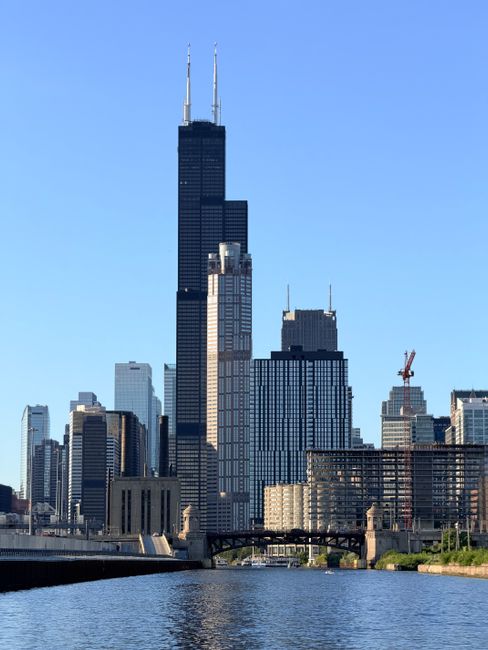
Short answer: Chicago O’Hare International Airport (ORD) is about 16 miles (26 km) from downtown Chicago. The easiest and cheapest way into the city is the CTA Blue Line train, which leaves from a station inside the airport, runs 24 hours a day and reaches downtown in about 40–45 minutes for $5 one way. A taxi from the stand outside baggage claim averages about $50 to downtown, depending on traffic (all as of November 2026).
- IATA code
- ORD
- ICAO code
- KORD
- Serves
- Chicago
Find flights to Chicago (ORD)
Results open on our flights page, comparing airlines and agencies; Kiwi.com opens in a new tab. Leave Return empty for a one-way trip. TravelerCenter may earn a commission when you book, at no extra cost to you.
Travel guides for places this airport serves
O’Hare has four terminals: Terminals 1, 2 and 3, joined together in the middle of the airport, and Terminal 5, the international terminal, on the east side. (There is no Terminal 4.) It is a hub for both United and American Airlines, and Airports Council International counted 84.9 million passengers at ORD in 2025, up 6% on the year before and the sixth-highest total in the world. Check your terminal before you set off and give yourself time at busy hours.
Getting from O’Hare to downtown Chicago
Prices below are the official fares from the Chicago Transit Authority (CTA) and the Chicago Department of Aviation as of November 2026.
CTA Blue Line train
- Station: O’Hare station, on the lower level of the main parking garage, connected to Terminals 1, 2 and 3 by pedestrian tunnels on the basement level. Follow the “Trains to City” or “CTA Trains” signs; from baggage claim it is under a ten-minute walk. From Terminal 5, ride the free Airport Transit System (ATS) to Terminal 2 or 3 first.
- Route: every train from O’Hare goes through downtown on its way to Forest Park (or UIC-Halsted at some hours), with stops in the Loop such as Clark/Lake, Washington, Monroe and Jackson. Change there to other “L” lines.
- Journey time: about 40–45 minutes to downtown.
- Hours: 24 hours a day, seven days a week, with more frequent trains at weekday rush hours. Weekend track work sometimes replaces part of the O’Hare branch with shuttle buses, so check CTA service alerts before you travel.
- Fare: $5 one way when you board at O’Hare (the regular CTA fare elsewhere is $2.50), including up to two free transfers within two hours. Reduced fare at O’Hare is $1.25 with a reduced-fare permit. Tip: an unlimited-ride pass lets you board at O’Hare at no extra charge, and a 1-day pass costs $5, the same as the single fare. Passes cost $15 for 3 days and $20 for 7 days.
- How to pay: tap a contactless credit or debit card, phone or watch directly on the gate, or buy a Ventra card or ticket at the machines outside the station (a new Ventra card costs $5, returned as travel credit if you register it within 90 days). Passes need a Ventra card or the Ventra app. Use the same card or phone for every leg so your transfers are free.
Taxi: about $50 to downtown
- Where: every terminal has a taxi stand at the lower-level curb outside baggage claim. Use only these stands and do not accept rides from drivers approaching you elsewhere.
- Fare: Chicago taxis run on the meter, by time and distance. The airport puts the average fare from O’Hare to downtown at about $50, more in heavy traffic. The City of Chicago updated its taxi rates on July 1, 2026; make sure the meter is on.
- Accessible taxis: wheelchair-accessible taxis can be requested on 1-888-928-2227.
- Suburbs: suburban taxis must be booked ahead with a suburban company. They pick up in the lower-level middle commercial lane at Terminals 1, 2 and 3 and the inner commercial lane at Terminal 5.
At rush hour the expressways into the city can be very slow, and that is when the Blue Line wins easily.
Rideshare, limousines and pre-booked transfers
Uber and Lyft pick up on the upper level: at Terminal 2, look for the orange poles 2A to 2G (there is an indoor waiting area between vestibules 2A and 2D), and at Terminal 3, the green poles 3G, 3H, 3J and 3K. Follow the airport signs at the other terminals. Black cars and limousines pick up in the center lane (lane 2) of the lower level; call your company after you collect your bags and they will give you the car and door number. Prices move with demand, so compare the in-app quote with a taxi. A pre-booked transfer is worth it for families, groups with lots of luggage or very late arrivals; you can book one from the box near the top of this page.
Metra and Pace buses (for the suburbs)
- Metra North Central Service: a weekday-only commuter train between Union Station downtown and Antioch in the northern suburbs. It stops at the O’Hare Transfer station, behind the Multi-Modal Facility (take the ATS there). Trains are few, so check the timetable; fares depend on zones.
- Pace buses: leave from bus bays 8 and 9 at the Multi-Modal Facility. Route 250 runs daily to the Des Plaines Metra station and Evanston; route 330 runs on weekdays and Saturdays south to Summit.
Terminals
O’Hare had 199 gates in April 2026, most of them leased to its two hub airlines, United and American. Your booking shows your terminal; the outline below comes from the Chicago Department of Aviation and the airlines as of November 2026.
- Terminal 1 (Concourses B and C, 51 gates): the main home of United and its partners.
- Terminal 2 (Concourses E and F, 43 gates): shared by several airlines. The free Butch O’Hare Family Lounge is here, past security.
- Terminal 3 (Concourses G, H, K and L, 75 gates): the main home of American Airlines and its partners.
- Terminal 5 (Concourse M): the international terminal, where most international flights arrive and clear customs. Delta also flies its domestic routes from here.
Moving between terminals
- Terminals 1, 2 and 3: connected on the secure side, so you can walk between them after security by following the overhead signs.
- Airport Transit System (ATS): a free driverless train that runs 24 hours a day, every 3–5 minutes at busy times, between Terminals 1, 2, 3 and 5 and the Multi-Modal Facility (rental cars, Economy Lot F, Metra and Pace). End to end takes about 10 minutes. It runs outside security, so you go through security again at your new terminal.
- Terminal Transfer Bus (airside): for connecting passengers with a same-day flight and boarding pass, every 15 minutes from 11:30 a.m. to 9:30 p.m., between Terminal 5 (gate M13) and Terminal 1 (gate C18B) or Terminal 3 (gates G17 and K20). Outside those hours, connect between Terminal 5 and the other terminals by ATS and clear security again.
Arriving: passport control, baggage and SIM/eSIM
- Passport control: international arrivals pass U.S. Customs and Border Protection, mostly at Terminal 5. Visitors have their photo taken and may give fingerprints; eligible travelers can use the CBP Mobile Passport Control app or Global Entry kiosks to save time. Entry rules, including ESTA for Visa Waiver travelers, are on our United States travel guide.
- Connecting onward: after an international arrival you collect your bags, clear customs, drop them at the airline’s recheck belt and go through security again before your next flight. Allow plenty of time, especially if you need to change terminals.
- Lost or delayed bags: report it at your airline’s baggage office in the claim area before you leave. For items left in the terminal, use the airport’s Lost and Found.
- Phone and data: check your roaming fees before you fly. An eSIM bought before departure usually works the moment you land. Free airport Wi-Fi (below) covers you until then.
Departing: check-in times and security
- Check-in times: follow your airline’s check-in and bag-drop deadlines, which are usually earlier for international flights. Check in online where you can.
- Go to the right terminal: Terminal 5 is a separate building, reached by the ATS from Terminals 1, 2 and 3. Some international flights leave from Terminals 1 and 3, so check your booking.
- ID for domestic flights: adults need a REAL ID-compliant driver’s license or state ID, a passport or another TSA-accepted ID to fly within the United States. Visitors can use their passport.
- Liquids: TSA’s 3-1-1 rule applies: liquids, gels and aerosols in containers of 3.4 oz (100 ml) or less, all in one quart-sized clear bag. Medicines and baby formula are allowed in larger amounts; declare them at the checkpoint.
- Faster security: TSA PreCheck lanes are available at O’Hare for members.
Facilities
- Wi-Fi: free and unlimited in every terminal, before and after security. Join “_Free_ORD _Wi-Fi” or “Boingo Hotspot” and choose “Watch Ad to Connect”.
- Families: the free Butch O’Hare Family Lounge, past security in Terminal 2, has play space, charging points and stroller parking, and the “Kids on the Fly” play exhibit gives younger travelers somewhere to burn off energy.
- Lounges: United, American, Delta and several international airlines run lounges for premium passengers and members; Terminal 5 has a newer Delta Sky Club among others. Check your airline for access rules.
- Food and shops: every terminal has coffee shops, quick bites and sit-down restaurants on both sides of security, with a good choice of local Chicago favorites. Prices are higher than in town.
Car rental and parking
Car rental: all the main rental companies, including Alamo, Avis, Budget, Dollar, Enterprise, Hertz, National, Sixt and Thrifty, are together in the Multi-Modal Facility at 10255 W. Zemke Boulevard, a short ride on the free ATS train from every terminal. A car makes sense for the suburbs and road trips, but downtown parking is expensive and the “L” covers most sights, so read the getting-around notes on our Chicago travel guide first. You can compare rental prices from the box near the top of this page.
Parking: the Chicago Department of Aviation runs the car parks (rates include taxes, as of November 2026):
- Main Garage next to Terminals 1, 2 and 3: hourly parking on Level 1 and daily parking on Levels 2–6, $43 for 8 to 24 hours.
- Terminal 5 Garage and Lot D next to the international terminal.
- Economy parking: Lot F (covered, in the Multi-Modal Facility, on the ATS) $30 a day; Lots G and H $16 a day, with shuttle buses to the ATS every 5 to 10 minutes, 24 hours a day. Lot H takes credit cards only.
Pay at the cashier on exit, by cash or major credit card. For a week away, the economy lots cost less than half the Main Garage rate.
Hotels near the airport
For most visitors, staying downtown makes more sense: the Blue Line runs all night and takes under an hour. An airport hotel is worth it for a dawn departure, a late arrival or a long layover. The Hilton Chicago O’Hare Airport stands directly across from Terminals 1, 2 and 3 and can be reached on foot through the underground walkways. Many more hotels cluster in nearby Rosemont, one stop away on the Blue Line. You can search hotels near ORD from the box near the top of this page.
Plan your trip: once you land, our Chicago travel guide covers the Loop, the lakefront, museums and food, and the United States travel guide has entry rules, money and getting around the country. Flying on? See our guides to Atlanta, Dallas Fort Worth and Denver airports.
Frequently asked questions
How do I get from O’Hare to downtown Chicago?
Take the CTA Blue Line from the station inside the airport: about 40–45 minutes to the Loop, 24 hours a day, for $5 (or free with an unlimited-ride pass, from $5 a day). A taxi averages about $50 depending on traffic, and Uber and Lyft pick up on the upper level of Terminals 2 and 3 (as of November 2026).
How much is a taxi from O’Hare to downtown?
Chicago taxis are metered, and the airport puts the average fare to downtown at about $50, more in heavy traffic (as of November 2026). Use the taxi stands at the lower-level curb outside baggage claim.
Does the Blue Line run 24 hours?
Yes. The Blue Line runs 24 hours a day, seven days a week, with fewer trains late at night. Weekend track work occasionally swaps part of the route for shuttle buses, so check CTA alerts before late-night or weekend trips.
Which terminal is international at O’Hare?
Terminal 5 is the international terminal, where most international flights arrive and clear customs. United (Terminal 1) and American (Terminal 3) also fly some international departures from their own terminals, so always check your booking.
How do I get from Terminal 1 to Terminal 5?
Take the free ATS train, which runs 24 hours a day; you then go through security again at Terminal 5. If you are connecting with a same-day flight, the airside Terminal Transfer Bus runs every 15 minutes from 11:30 a.m. to 9:30 p.m. and keeps you behind security.
Is there free Wi-Fi at O’Hare?
Yes, free and unlimited in all terminals. Join “_Free_ORD _Wi-Fi” or “Boingo Hotspot” and choose “Watch Ad to Connect”.
Researched and last reviewed on 10 November 2026. Sources: the Chicago Department of Aviation (transit, taxis, rideshare, terminals, ATS, parking, rental cars, Wi-Fi and facilities), the Chicago Transit Authority (Blue Line service and fares), TSA (ID and liquids rules), U.S. Customs and Border Protection, Choose Chicago, the city’s official tourism site, and Airports Council International (passenger figures). Fares, hours and terminal assignments change, so check the official links before you travel.
Before you go: guidebooks and travel gear
Affiliate links: we may earn a commission at no extra cost to you. As an Amazon Associate we earn from qualifying purchases. We pick items for the place, not for the commission. How we earn money