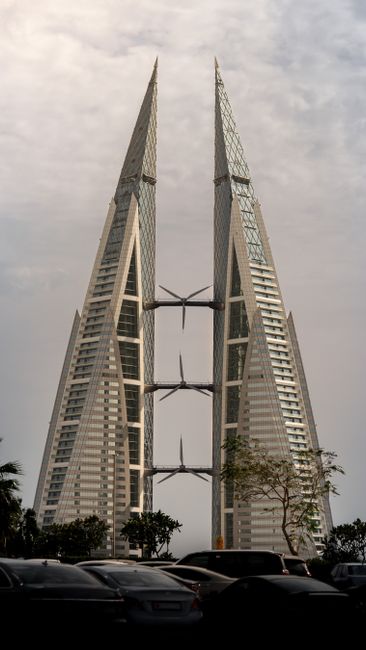
Bahrain is a small island kingdom in the Arabian Gulf, linked to Saudi Arabia by a 25 km (16-mile) causeway and long known as one of the region’s most open and easygoing countries. Its main island holds the capital, Manama, with an old souk behind the Bab Al Bahrain gateway, waterfront towers on Bahrain Bay and a lively restaurant scene in Adliya, while the island of Muharraq, across the bridges, preserves the old merchants’ houses of the pearling era. Bahrain’s history is among the oldest in the Gulf: it was the center of the Bronze Age civilization of Dilmun, and it has three UNESCO World Heritage Sites, the fort and ancient harbor of Qal’at al-Bahrain, the Dilmun Burial Mounds and Muharraq’s pearling path. Visitors also come for the Formula 1 circuit at Sakhir, beach resorts, diving and weekend breaks from Saudi Arabia. Most nationalities need a visa, but many can get one on arrival or online. Bahrain is hot and humid from May to October and pleasant from November to March.
Right now in Bahrain
- Wed 29–34°C 84–93°F Clear
- Thu 30–35°C 86–94°F Clear
- Fri 31–35°C 88–96°F Clear
Weather: MET Norway (CC BY 4.0)
Multi-day tours of Bahrain
Multi-day tours from local operators. You check dates and book on Viator, our partner; we may earn a commission at no extra cost to you. How we earn money
Bahrain at a glance
Bahrain covers only about 780 km² (300 square miles), smaller than New York City, spread over the main island of Bahrain, Muharraq, Sitra and dozens of smaller islands, plus the Hawar Islands near Qatar and several artificial islands. About 1.6 million people live in the kingdom, around half of them foreign residents, mostly from South Asia. Bahrain is a constitutional monarchy ruled by the Al Khalifa family since the 18th century; it became independent from British protection in 1971 and a kingdom in 2002. Oil was discovered here in 1932, the first in the Arab side of the Gulf, but today the economy relies on finance, aluminum, tourism and services. Arabic is the official language, and English is widely spoken. Bahrain has both Sunni and Shia Muslim communities and long-established Christian, Hindu and Jewish minorities.
Time and the weekend: Bahrain uses Arabia Standard Time (UTC+3) all year, with no daylight saving. The weekend is Friday and Saturday.
A short history
Around 4,000 years ago, Bahrain was the heart of Dilmun, a trading civilization that linked Mesopotamia with the Indus Valley and was remembered in Sumerian texts as a paradise of fresh springs. Later it was known to the Greeks as Tylos. After the coming of Islam, the islands passed between regional powers, the Portuguese held them in the 16th century, and Persian rule followed until the Al Khalifa family took control in 1783. Through the 19th and early 20th centuries, Bahrain was the Gulf’s leading pearl market and a British protectorate. The discovery of oil in 1932 and the collapse of natural pearling with the arrival of cultured pearls changed the economy, and independence came in 1971. Today Bahrain is a regional banking center with a long tradition of trade and openness.
Bahrain’s governorates
- Capital Governorate: Manama, with the souk, the National Museum, the Al Fateh Grand Mosque, Bahrain Bay, Adliya and Juffair.
- Muharraq Governorate: Muharraq’s old town and pearling path, the airport, Arad Fort and the Amwaj Islands.
- Northern Governorate: Qal’at al-Bahrain, the Dilmun Burial Mounds at A’ali and Saar, Seef, Budaiya and the north coast.
- Southern Governorate: Riffa, the Bahrain International Circuit at Sakhir, the Tree of Life, Al Areen Wildlife Park, the desert south and the Hawar Islands.
Where to go: Manama, Muharraq and the island
Bahrain is small enough to base yourself in Manama and see everything on day trips; most sights are within 30 minutes by car.
Manama
The capital has the Bahrain National Museum, Bab Al Bahrain and the Manama Souq, the Al Fateh Grand Mosque, the Bahrain World Trade Center, Bahrain Bay and the restaurants and galleries of Block 338 in Adliya. See our Manama guide.
The Al Fateh Grand Mosque
One of the largest mosques in the world, the Al Fateh Grand Mosque in Juffair can hold thousands of worshippers under its large dome, with Italian marble floors, Austrian chandeliers and calligraphy throughout. It usually welcomes non-Muslim visitors on guided tours outside prayer times, with abayas and headscarves provided for women; check the current visiting hours before you go.
Muharraq and the Pearling Path
Bahrain’s capital until 1923, Muharraq has a historic center of narrow lanes, restored merchants’ houses, traditional cafes and cultural centers along the UNESCO-listed Pearling, Testimony of an Island Economy trail, inscribed in 2012. See Shaikh Isa bin Ali House, Siyadi House and the Bu Mahir seashore fort, and visit Arad Fort nearby.
Qal’at al-Bahrain
On the north coast, about 15 minutes from Manama, a Portuguese-era fort stands on an artificial mound built up by about 4,500 years of settlement, the ancient capital and harbor of Dilmun. It was Bahrain’s first UNESCO World Heritage Site, in 2005, and its site museum displays finds from the excavations. Sunset here is a highlight.
The Dilmun Burial Mounds
Across the northern part of the island, thousands of Bronze Age burial mounds and the large “royal mounds” of A’ali, built between about 2200 and 1750 BCE, were inscribed by UNESCO in 2019, among the largest ancient cemeteries in the world.
Sakhir and the south
The south has the Bahrain International Circuit, home of the Formula 1 Bahrain Grand Prix, the Tree of Life, a lone tree surviving in the desert for more than 400 years, Al Areen Wildlife Park, the country’s first oil well at Jebel Dukhan and long, quiet beaches. The Hawar Islands, near Qatar, are a nature reserve with nesting seabirds, reached by boat.
Riffa and the interior
Inland from Manama, the town of Riffa is home to the restored Shaikh Salman bin Ahmed Al Fateh Fort, a 19th-century fort on a ridge overlooking the Hunainiya valley, and the royal golf club. On the way south, the A’ali pottery workshops still make clay pots in traditional kilns.
Amwaj Islands and the beaches
Artificial islands northeast of Muharraq with beach resorts and a lagoon; other beaches are mostly at hotels and in the south, along with public beaches such as Al Jazayer.
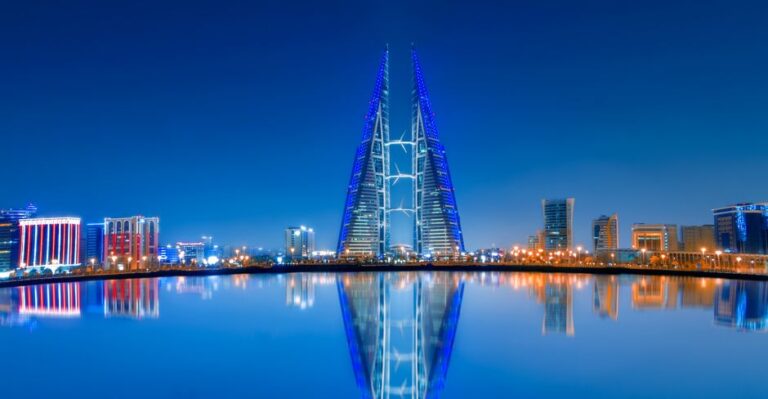
Manama Travel Guide
Plan a trip to Manama, Bahrain: the National Museum, Bab Al Bahrain and the souk, Qal'at al-Bahrain, Muharraq's UNESCO pearling path, the Dilmun Burial…
Best time to visit Bahrain
Bahrain has a hot desert climate with high humidity. November to March is the best time, with sunny days of about 21–28 °C (69–82 °F), cool evenings and almost all of the year’s rain, which falls on about a dozen days a year. April and October are warm to hot. May to September brings average highs of 36–40 °C (97–103 °F), warm nights above 30 °C (86 °F) and sticky humidity, especially in August and September, with extremes of 47 °C (117 °F). Dusty shamal winds can blow in late spring and early summer.
| Month | Average high | Average low | Rain | Rain days (≥1 mm) | Sunshine (hours per day) |
|---|---|---|---|---|---|
| Jan | 21 °C (69 °F) | 14 °C (58 °F) | 18 mm (0.7 in) | 2.5 | 7.5 |
| Feb | 22 °C (72 °F) | 15 °C (60 °F) | 13 mm (0.5 in) | 1.9 | 7.8 |
| Mar | 26 °C (78 °F) | 18 °C (65 °F) | 15 mm (0.6 in) | 2.5 | 7.9 |
| Apr | 31 °C (87 °F) | 22 °C (72 °F) | 6 mm (0.2 in) | 1.3 | 8.5 |
| May | 36 °C (97 °F) | 27 °C (81 °F) | 0 mm (0 in) | 0.3 | 10.2 |
| Jun | 39 °C (101 °F) | 30 °C (86 °F) | 0 mm (0 in) | 0 | 11.5 |
| Jul | 40 °C (103 °F) | 31 °C (89 °F) | 0 mm (0 in) | 0 | 10.9 |
| Aug | 40 °C (103 °F) | 32 °C (89 °F) | 0 mm (0 in) | 0 | 10.8 |
| Sep | 38 °C (100 °F) | 30 °C (85 °F) | 0 mm (0 in) | 0 | 10.5 |
| Oct | 34 °C (93 °F) | 26 °C (80 °F) | 1 mm (0 in) | 0.2 | 9.9 |
| Nov | 28 °C (82 °F) | 22 °C (71 °F) | 17 mm (0.7 in) | 1.6 | 8.3 |
| Dec | 23 °C (73 °F) | 17 °C (62 °F) | 15 mm (0.6 in) | 2.3 | 7.6 |
| Year | 31 °C (88 °F) | 24 °C (75 °F) | 85 mm (3.4 in) | 12.6 | 9.3 |
Figures are the 1991–2020 climate normals for Bahrain International Airport that Bahrain submitted to the World Meteorological Organization; sunshine is the monthly total divided by the number of days. Relative humidity averages 59% over the year, from about 46% in June to 69% in January.
Crowds and prices through the year
- Weekends all year: Thursday evening to Saturday, Bahrain fills with visitors from Saudi Arabia; hotels, restaurants and the causeway are busiest.
- Peak (November to March and race weekends): the best weather; hotel prices peak when the Grand Prix is held.
- Low (June to September): hot and humid, with lower hotel prices and quieter attractions.
Festivals and events
- Formula 1 Bahrain Grand Prix: usually in spring at Sakhir; check the official F1 calendar for dates.
- Spring of Culture (usually February to April): music, theater and art across the kingdom.
- Bahrain National Day (16–17 December): fireworks and celebrations.
- Ramadan (in 2027 expected from about 8 February to 9 March): quiet days and festive evenings in Ramadan tents.
- Ashura (in 2027 expected in mid-June): a major Shia commemoration, with processions in Manama and villages.
Public holidays
Public holidays include New Year’s Day, Labor Day (1 May), Eid al-Fitr (about 10 March 2027), Arafat Day and Eid al-Adha (about 16–18 May 2027), the Islamic New Year, Ashura (two days), the Prophet’s Birthday and National Day (16–17 December). Islamic dates follow the lunar calendar and are confirmed shortly before.
How long to stay: sample itineraries
1 day: stopover
From the airport, it is about 15 minutes to Manama: see the National Museum, walk through Bab Al Bahrain into the souk, and finish at Qal’at al-Bahrain for sunset before a late dinner in Adliya. Gulf Air connects Bahrain with Europe, Asia and the Gulf, which makes a one- or two-night stopover easy to add.
2 days: Manama and Muharraq
Day one: the National Museum, Bab Al Bahrain and the souk, and sunset at Qal’at al-Bahrain. Day two: Muharraq’s pearling path and Arad Fort, then dinner in Adliya.
4 days: the whole island
Add the Dilmun Burial Mounds at A’ali, the Al Fateh Grand Mosque, the Bahrain International Circuit and the Tree of Life, and a beach or diving day at Amwaj or a south-coast resort.
Combining Bahrain with its neighbors
Short flights link Bahrain with Doha, Dubai and Abu Dhabi, and drivers can continue over the causeway into Saudi Arabia’s Eastern Province with a Saudi visa. See our Qatar and United Arab Emirates guides.
Entry, money and costs
Entry: visa on arrival and eVisa (last reviewed October 2026)
Everyone except citizens of the other GCC states (Saudi Arabia, Kuwait, Qatar, the UAE and Oman) needs a visa. Your passport must be valid for at least six months from arrival.
- Visa on arrival: citizens of almost 70 countries can get a visit visa at Bahrain International Airport, including the United States, the United Kingdom, Ireland, Canada, Australia, New Zealand, all EU countries, Switzerland, Norway, Japan, South Korea, Singapore, Malaysia, China, India, Russia, Brazil, Mexico and much of South America. Visas are normally issued for two weeks; you may be asked for proof of a return or onward ticket and accommodation.
- eVisa: eligible travelers can apply in advance through the official eVisa portal, evisa.gov.bh, the only official website. Bahrain’s national portal lists a two-week single-entry eVisa at a BHD 4 application fee plus a BHD 9 visa fee, paid in two steps (the visa fee only after approval), with a processing time of three to five working days. You need a passport copy, a hotel reservation, a return ticket and a three-month bank statement.
- Longer and multiple-entry visas: eVisas of three months, one year, five years and ten years are available for eligible nationalities, and UK and Irish citizens can apply for multiple-entry visas of three or six months.
- Other nationalities: those not eligible online or on arrival need a guarantor in Bahrain, such as a hotel, company or citizen, to apply for them.
Fees are non-refundable, and holding a visa doesn’t guarantee entry. Overstaying leads to fines. As a public-health measure, Bahrain doesn’t admit non-Bahraini passengers who have visited countries affected by the current Ebola outbreak in the previous 30 days. A unified GCC Grand Tours visa for the Gulf states had not launched as of October 2026.
The King Fahd Causeway to Saudi Arabia
The causeway, opened in 1986, links Bahrain with Al Khobar and Dammam in Saudi Arabia’s Eastern Province. To cross, you need a valid Saudi visa (many nationalities can get a Saudi tourist eVisa), a Bahrain exit and Saudi entry at the immigration island halfway across, and car insurance and rental permission for both countries. The King Fahd Causeway Authority’s Jesr app shows waiting times and handles some formalities. Queues are longest on Thursday evenings, Fridays and holidays. The causeway has closed at short notice at times, so check its status before you set off.
Customs and medicines
Declare anything prohibited or dutiable. Some skincare products and e-cigarette refills containing CBD are illegal. If you take prescription medicines, carry a doctor’s note; some medicines may need prior approval, so check with a Bahrain embassy before you travel and bring only what you need.
Money and cards
The Bahraini dinar (BHD, BD) is divided into 1,000 fils and pegged to the US dollar; at the Central Bank of Bahrain’s rate, US$1 is about BHD 0.376, so BHD 1 is about US$2.66. Cards and phone payments are widely accepted, and ATMs are common; carry some cash for the souk. Saudi riyals are often accepted in shops. VAT of 10% applies to most goods and services.
Tipping
Hotels and many restaurants add a service charge. Otherwise, about 10% in restaurants and rounding up taxi fares is appreciated.
Typical travel costs
| Item (as of October 2026) | Bahraini dinars | About US dollars |
|---|---|---|
| Two-week single-entry eVisa: application + visa fee | BHD 4 + BHD 9 | $11 + $24 |
| Taxi from the airport to central Manama | about BHD 4–6 | about $11–16 |
| Museum or fort entry | about BHD 1–2 | about $2.70–5.30 |
| Karak tea or coffee | about BHD 0.2–1.5 | about $0.50–4 |
| Casual restaurant meal | about BHD 3–8 | about $8–21 |
| Mid-range hotel room, per night | about BHD 40–80 | about $105–210 |
| Rental car, per day | about BHD 12–20 | about $32–53 |
eVisa fees are official; the rest are typical ranges, not official prices. Conversions use the Central Bank of Bahrain’s rate.
Getting there and getting around
Bahrain International Airport
Bahrain International Airport (BAH), on Muharraq Island about 15 minutes from Manama, is the hub of Gulf Air, with a passenger terminal opened in 2021. It has flights across the Gulf, to the Indian subcontinent, Europe and Asia. Taxis, ride-hailing and buses link it with the city.
Flight disruptions
Since early 2026, regional tensions have led to periodic airspace closures across the Gulf, so flights can be delayed, rerouted or canceled at short notice; check your flight with the airline and the airport’s status before you travel. The King Fahd Causeway has also closed at short notice, so check its status before you travel by road.
Getting around
Bahrain is compact: the main sights are within about 30 minutes of Manama. Public buses run across the island cheaply but are slow, and most visitors use taxis, ride-hailing apps or a rental car.
| Getting around Bahrain (October 2026) | How it works | Typical cost |
|---|---|---|
| Public buses | Routes across Manama, Muharraq and towns; travel card or cash | Under BHD 1 per trip |
| Taxis and ride-hailing | Metered taxis and apps | About BHD 3–8 across Manama |
| Rental car | Best for the forts, mounds and south | From about BHD 12 per day |
| Causeway to Al Khobar | By car or intercity coach, with a Saudi visa | Toll plus visa costs |
Driving
Bahrain drives on the right. Many visitors can drive with their home license for a short stay (UK photocard licenses are accepted for up to three months); for longer stays you need an International Driving Permit or a Bahraini license. Police checkpoints may appear on main roads. Drink-driving is a serious offense: any alcohol in your system can lead to a fine, a travel ban and possible prison.
Culture, food and everyday etiquette
Islam and local customs
Bahrain is more liberal than most Gulf states, but social values are conservative. Respect local customs, especially in Ramadan and during Shia religious occasions such as Ashura, which are marked publicly in Bahrain. Greet with “as-salaam alaykum,” use your right hand to eat and pass things, and don’t photograph people without permission. Arabic coffee with dates or halwa is the traditional welcome.
Food and drink
Bahraini cuisine includes machboos (spiced rice with fish or meat), muhammar (sweet rice cooked with dates or sugar), grilled hamour, mahyawa (a fish sauce) and balaleet, with Bahraini halwa, a sticky saffron-and-rosewater sweet, as the national treat. Manama’s restaurants range from Iranian bakeries and Indian canteens in the souk to fine dining in Adliya and Bahrain Bay. Alcohol is legal and served in licensed hotels, bars, clubs and some restaurants, but public drunkenness is an offense.
Pearls and shopping
Bahrain’s natural pearls were once the finest in the Gulf, and the country still trades only in natural pearls. Buy from established jewelers in the Gold City and the Manama Souq, and ask for a certificate from the national pearl and gemstone laboratory for valuable pieces. Other good buys are Bahraini halwa, dates, incense, traditional textiles and pottery from A’ali. The big malls, such as City Centre Bahrain, Seef Mall and The Avenues on Bahrain Bay, stay open late.
Laws visitors need to know
- Dress: dress modestly in public, especially at religious sites; women should cover shoulders and knees, and clothing shouldn’t be transparent or carry offensive slogans. Nudity, including topless sunbathing, is forbidden.
- ID: carry photo ID, such as your passport; you can be fined up to BHD 300 if you can’t show it when asked.
- Behavior: swearing, spitting, aggressive behavior and rude gestures, including road rage, can lead to prison and deportation. Public displays of affection are illegal.
- Photography and social media: filming or photographing security and military sites, operations or incidents, or sharing such images, is prohibited; online posts critical of the government or monarchy or culturally insensitive can be crimes.
- Gatherings: public gatherings on roads and squares are temporarily banned; leave the area if you see one.
- Drones: flying drones without a license or in restricted airspace is illegal.
Safety, health, accessibility and connectivity
Safety
Crime in Bahrain is low, and Manama is generally safe to walk around, day and night.
- Summer heat and humidity: highs near 40 °C (104 °F) and humid nights from May to September make heat exhaustion a real risk; drink water often and avoid midday activity outdoors.
- Dress codes and public decency: follow the rules above; mosques require long clothes and a headscarf for women.
- Alcohol: only in licensed venues; drunken behavior in public, including at the airport and in transit, can bring fines, prison, deportation or denied boarding.
- Ramadan etiquette: don’t eat, drink, smoke or chew gum in public during daylight; play music quietly and dress conservatively. These actions can be offenses under Bahraini law.
- Drugs and medicines: illegal drugs are strictly forbidden, including residual amounts, even in transit; dealing can bring a life sentence. Carry a doctor’s note for prescription medicines.
- Photography: don’t photograph security sites, incidents or people without consent.
- Sea: a curfew applies on Bahrain’s waterways from 6:30 p.m. to 4 a.m., and maritime boundaries are sensitive; check that dhows and boats carry life jackets.
- Desert: the south is flat and the desert small, but carry water and a phone, and don’t drive off-road without a 4×4.
- Demonstrations: protests can occur, particularly around anniversaries and in some villages; avoid them and follow police instructions.
- Flight disruptions: since early 2026, regional tensions have led to periodic airspace closures across the Gulf, and flights can be delayed, rerouted or canceled at short notice. Check your flight with the airline and the airport’s status before you travel (the King Fahd Causeway has also closed at short notice, so check its status too), and follow instructions from the local authorities, including emergency alerts sent to phones.
- Emergencies: police, ambulance and fire 999.
Health and insurance
Medical care is good in Manama, but you will be charged for emergency treatment; travel insurance with medical cover is essential. Pharmacies are common. Tap water is desalinated; most people drink bottled water. A yellow fever certificate is required if arriving from a country with a risk of transmission.
Accessibility
The airport, malls, newer hotels and the National Museum are accessible. The souk’s narrow lanes, older buildings in Muharraq and archaeological sites are less so; ask in advance.
Connectivity and power
Mobile coverage is excellent across the island; prepaid SIMs and eSIMs from Batelco, Zain and stc Bahrain are sold at the airport. Power is 230 V, 50 Hz, with type G sockets (British three-pin).
Things to do: heritage, sea and motorsport
Bahrain’s highlights are its ancient past and pearling heritage: the National Museum, Qal’at al-Bahrain at sunset, the Dilmun Burial Mounds, Muharraq’s pearling path and Arad Fort. Add the souk and Bab Al Bahrain, a guided visit to the Al Fateh Grand Mosque, dinner in Block 338, a lap or karting session at the Bahrain International Circuit, the Tree of Life and Al Areen Wildlife Park. In the water, try a licensed pearl-diving experience, diving at the underwater theme park off the coast, kayaking around Muharraq and beach days at Amwaj or the Hawar Islands.
Pearl diving and diving
Bahrain has revived pearl diving as a visitor experience: licensed operators take snorkelers and divers to the old oyster beds north of the island, where you can search for natural pearls and keep what you find, subject to the rules of the trip. Scuba divers can also explore an underwater park of sunken structures and a large aircraft off the south coast, as well as reefs and wrecks around the islands. Book only with licensed operators, and check sea conditions, as summer water is very warm and winter winds can make the sea rough.
Bahrain with children
Families will enjoy the Bahrain National Museum’s dioramas and reconstructed burial mound, Al Areen Wildlife Park’s Arabian oryx and gazelles, karting at the Bahrain International Circuit, water parks and beach resorts on the Amwaj Islands, and evening walks in Bahrain Bay’s parks. Distances are short and restaurants welcome children late into the evening; keep outdoor activities for winter mornings and evenings.
Responsible travel
Bahrain’s waters are home to one of the largest dugong populations in the world, as well as sea turtles, dolphins and coral reefs, and the Hawar Islands are a protected nesting area for seabirds such as the Socotra cormorant. Choose boat operators who keep their distance from wildlife, don’t take shells or coral, and take litter home from beaches and desert picnics. At heritage sites such as the burial mounds, don’t climb on the mounds or remove anything.
What to pack
Pack light, modest clothes that cover shoulders and knees, a scarf for mosque visits, swimwear for pools and beaches, a hat, sunglasses and high-SPF sunscreen. Add a light sweater for winter evenings and air-conditioning, comfortable shoes for the souk and archaeological sites, a type G plug adapter, your passport (always carried) and a doctor’s note for prescription medicines.
Bahrain travel FAQ
Do I need a visa for Bahrain?
Yes, unless you are a GCC citizen. Citizens of almost 70 countries, including the US, UK, Canada, Australia and EU countries, can get a visa on arrival; others can apply for an eVisa online.
How much does a Bahrain eVisa cost?
The two-week single-entry eVisa costs a BHD 4 application fee plus a BHD 9 visa fee, according to Bahrain’s national portal; processing takes three to five working days.
What is the official website for the Bahrain eVisa?
evisa.gov.bh, run by the Nationality, Passports and Residence Affairs department. Other websites are not official.
Can I drive from Bahrain to Saudi Arabia?
Yes, over the King Fahd Causeway, with a valid Saudi visa and car insurance and rental permission for both countries. Expect long queues on weekends.
Can tourists drink alcohol in Bahrain?
Yes. Alcohol is legal in licensed hotels, bars and restaurants, but public drunkenness is an offense, including at the airport.
What is the best time to visit Bahrain?
November to March, when days are warm and sunny. Summers are very hot and humid.
What is the weekend in Bahrain?
Friday and Saturday.
What are Bahrain’s UNESCO World Heritage Sites?
Qal’at al-Bahrain (2005), Pearling, Testimony of an Island Economy in Muharraq (2012) and the Dilmun Burial Mounds (2019).
Do I need to carry my passport in Bahrain?
Yes, or other photo ID. You can be fined up to BHD 300 if you can’t show ID when the authorities ask.
When is the Bahrain Grand Prix?
It is usually held in spring at the Bahrain International Circuit in Sakhir; check the official F1 calendar for dates.
Are flights to Bahrain ever disrupted?
Sometimes. Since early 2026, regional tensions have led to periodic airspace closures across the Gulf, and flights can be delayed, rerouted or canceled at short notice. Check your flight with the airline and the airport’s status before you travel. The King Fahd Causeway to Saudi Arabia has also closed at short notice, so check its status too.
What currency is used in Bahrain?
The Bahraini dinar (BHD), divided into 1,000 fils and worth about US$2.66.
What plug adapter do I need for Bahrain?
Type G, the British three-pin plug, at 230 V and 50 Hz.
Sources and last review
Researched and last reviewed on 5 October 2026. Visa-on-arrival eligibility, the official eVisa portal and the two-payment process come from Bahrain’s eVisa portal (Nationality, Passports and Residence Affairs); eVisa fees, documents and processing time from Bahrain’s national portal; multiple-entry visa types from the Nationality, Passports and Residence Affairs department; the “almost 70 countries” figure and GCC exemption from the Bahrain Tourism and Exhibitions Authority; laws on dress, alcohol, ID, behavior, photography, social media, gatherings, drones, drugs, medicines, the waterway curfew, driving, the Ebola entry restriction, emergency numbers, the April 2026 causeway and airspace closure and the factual background on local rules from GOV.UK’s Bahrain travel information (updated 20 August 2026); airspace disruption from the European Union Aviation Safety Agency; UNESCO listings from UNESCO; the exchange rate from the Central Bank of Bahrain; climate from the 1991–2020 normals Bahrain submitted to the World Meteorological Organization; area, population and capital from Wikidata. The causeway’s opening year and formalities, the Jesr app’s functions, VAT, Saudi riyal acceptance, history, holidays and Ramadan and Ashura 2027 dates, bus fares and typical prices are general references and flagged for checking. Entry rules can change at short notice, so check official sources before you travel.
Plan your trip
Partner links: TravelerCenter may earn a commission if you book, at no extra cost to you.
🇪🇬 Useful Arabic phrases for Bahrain
All 38 Arabic phrases: restaurant, hotel, emergencies, romance (printable) →