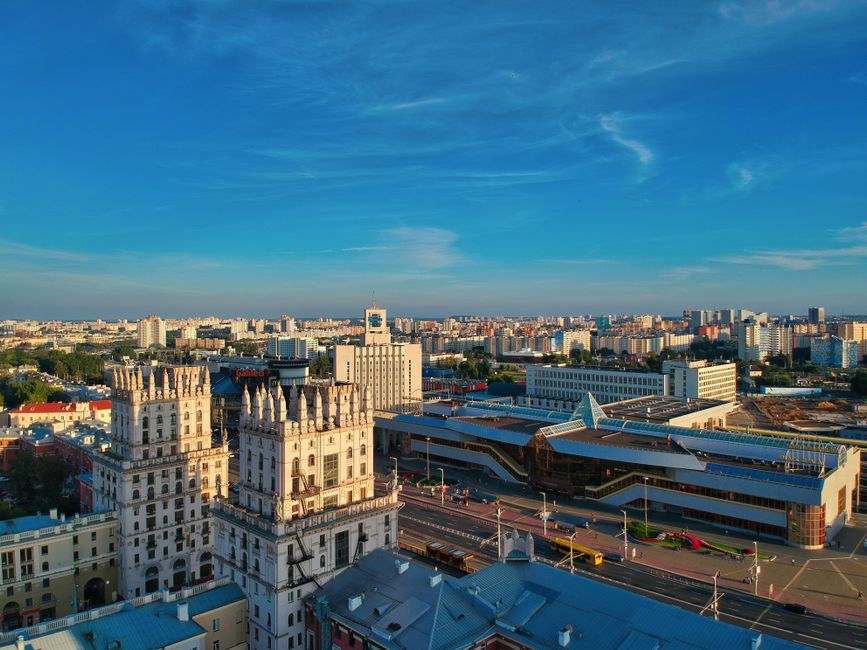
Minsk, the capital of Belarus, is a city of about two million people on the Svislach river. Almost destroyed in the Second World War, it was rebuilt from the late 1940s as a showpiece Soviet capital, with monumental avenues, vast squares and Stalinist palaces, and that rebuilt city is what most of Minsk still looks like today. Pockets of the older town survive in the Upper Town and the Trinity Suburb. This guide explains what Minsk is known for and how it came to be, with notes on current conditions.
Right now in Minsk
- Wed 11–17°C 52–62°F Mostly clear
- Thu 12–20°C 53–68°F Clear
- Fri 10–14°C 50–57°F 4 mm Cloudy
Weather: MET Norway (CC BY 4.0)
Minsk at a glance
- Status: capital of Belarus and a city with special status (ISO 3166-2 code BY-HM).
- Population: just under 2 million (1,996,730 on 1 January 2025, according to Belstat), about a fifth of the people of Belarus.
- Setting: on the Svislach river in the centre of the country, on low hills of the Minsk Upland.
- Languages: Belarusian and Russian are both official; Russian is far more widely used in daily life.
- Time zone: UTC+3 all year, the same as Moscow.
- Currency: the Belarusian rouble (BYN).
A short history of Minsk
Minsk is first mentioned in the Primary Chronicle in 1067, when the princes of Kyiv fought the Prince of Polotsk on the Nemiga river, beside the town. It was a fortress of the Principality of Polotsk and later a trading town of the Grand Duchy of Lithuania, which was largely Ruthenian (old Belarusian) in language and culture. Minsk received Magdeburg rights of self-government in 1499. After the union of Poland and Lithuania it was part of the Polish-Lithuanian Commonwealth, a mixed town of Orthodox and Catholic churches, Uniate monasteries and, later, a large Jewish community.
The Russian Empire annexed Minsk in the second partition of Poland in 1793, and the city became a provincial capital. By 1900 about half of its people were Jewish. After the First World War and the revolution, Minsk was briefly the capital of the Belarusian People’s Republic, declared in March 1918, and then, from 1919, of the Byelorussian Soviet Socialist Republic.
The Second World War was catastrophic. German forces took Minsk in June 1941, a week after their invasion of the Soviet Union, and held it for three years. The Minsk ghetto was one of the largest in occupied Europe, and almost all of its inhabitants were murdered, many at Maly Trostenets, a death camp near the city. Belarus lost about a quarter of its population in the war, and when the Red Army retook Minsk on 3 July 1944, now the national Independence Day, most of the city lay in ruins.
The city was rebuilt to a single plan, centred on what is now Independence Avenue, with Stalinist Empire-style buildings, wide squares and parks along the Svislach. In 1974 it was awarded the Soviet title of “Hero City”. When the Soviet Union broke up, the agreement dissolving it was signed in December 1991 at Viskuli in western Belarus, and Minsk became the capital of independent Belarus. Alexander Lukashenko has been president since 1994. After the disputed presidential election of August 2020, mass protests in Minsk and other cities were met with a large-scale crackdown, and Belarus allowed Russian forces to use its territory in the 2022 invasion of Ukraine.
What Minsk is known for
Independence Avenue
Independence Avenue (Praspiekt Niezaliežnasci) runs for about 15 km from Independence Square north-east across the city. Its central stretch is one of the most complete ensembles of post-war Soviet architecture anywhere, with arcaded buildings, the KGB headquarters, October Square with the Palace of the Republic, and Victory Square with its obelisk and eternal flame.
The Upper Town and the Trinity Suburb
The Upper Town (Verkhni Gorad) around Freedom Square keeps a few older buildings: the twin-towered Cathedral of the Holy Spirit, originally a 17th-century Catholic monastery church, the Baroque Cathedral of the Virgin Mary and a reconstructed 17th-century town hall. Across the river, the Trinity Suburb (Troitskoye Predmestye) is a rebuilt quarter of small, colourful 19th-century houses. Nearby, on an island in the Svislach, the Island of Tears memorial honours Belarusian soldiers who died in the Soviet war in Afghanistan.
War memorials and museums
The Belarusian State Museum of the History of the Great Patriotic War, rebuilt in 2014 beside the Victory Park, is one of the largest museums about the Second World War. The Yama memorial marks the place where thousands of Jews from the Minsk ghetto were shot in 1942. Outside the city, the Khatyn memorial remembers a village whose 149 inhabitants were killed in 1943, one of hundreds of Belarusian villages destroyed with their people, and the Maly Trostenets memorial stands at the site of the death camp.
The National Library and Soviet modernism
The National Library of Belarus, opened in 2006, is a 23-storey rhombicuboctahedron (a “diamond”) on the city’s north-eastern edge, lit with coloured LEDs at night. The city also has fine examples of later Soviet modernism and a metro with decorated stations.
Mir and Nesvizh
About 90 to 120 km south-west of Minsk are Belarus’s two best-known castles, both UNESCO World Heritage Sites: Mir Castle, a red-brick fortress begun around 1500 (inscribed 2000), and the palace and park of the Radziwiłł family at Nesvizh (inscribed 2005).
Climate
Minsk has a moderate continental climate: cold, grey winters with highs a little below freezing from December to February and frequent snow, and mild to warm summers, with July highs of about 24 °C and the most rain in summer showers.
| Season | Average daily high | Average nightly low | Rain or snow per month |
|---|---|---|---|
| Winter (Dec–Feb) | −1.9 to −0.6 °C | −6.6 to −4.9 °C | 40–47 mm |
| Spring (Mar–May) | 4.5 °C rising to 18.9 °C | −3.1 °C rising to 7.2 °C | 41–66 mm |
| Summer (Jun–Aug) | 22.4–24.3 °C | 10.9–12.9 °C | 71–98 mm |
| Autumn (Sep–Nov) | 17.5 °C falling to 3.6 °C | 7.6 °C falling to −1.1 °C | 49–55 mm |
Minsk gets about 688 mm of rain and snow a year, according to the official 1991–2020 averages for the Minsk station that Belarus submitted to the World Meteorological Organization.
Safety and current conditions
Visitors face a significant risk of arrest if they have at any time taken part in activity the Belarusian authorities now consider illegal, including donations, online posts and activity outside Belarus. Russian military activity takes place inside the country. Points to know:
- Political risk: stay vigilant, avoid crowds and leave immediately if a protest breaks out. Security forces, some in plain clothes, may stop and search you, check your documents and ask you to unlock your phone. Storing or sharing material Belarus has labelled “extremist”, including content from BBC News Russian, is an offence.
- Phones and devices: security officers may ask you to unlock your phone and inspect devices, including at the border, and people have been arrested over material created or stored abroad.
- Insurance: Belarus requires visitors to hold medical insurance of at least €10,000, and many travel insurance policies exclude Belarus, so check that your policy is valid there.
- Consular help: Belarus does not recognise dual nationality and is unlikely to allow consular access to dual nationals who are detained. The US Embassy in Minsk suspended operations in February 2022.
- Papers: carry your passport (or a printed copy of its photo page) and any visa. Hotels register guests staying more than 10 days; if you stay privately, make sure your host does it.
- Money: almost no banks accept foreign cards, cash machines have limits, and UK banks may block cards used in Belarus because of sanctions. Bring US dollars or euros and change them only at licensed exchange offices with your passport.
- Leaving: crossings into Poland, Lithuania and Latvia can close at short notice, and the border with Ukraine is closed to British nationals. Get an exit stamp when you leave.
- Emergencies: 101 fire, 102 police, 103 ambulance. Contact the British Embassy in Minsk on +375 17 229 8200. US citizens must contact a US embassy in another country.
Minsk FAQ
Is it safe to travel to Minsk now?
Visitors face real legal risks: people can be arrested for past political activity, donations or online posts, even outside Belarus, Russian military activity takes place in the country, and consular help is limited. See the safety section above for the details.
Do I need a visa for Belarus?
Belarus allows visa-free entry for up to 30 days to citizens of the UK and many other European countries by road or rail until 31 December 2026, and to citizens of 76 countries by air through Minsk, but US citizens are not covered and the rules do not apply if you arrive from or travel on to Russia. You need medical insurance of €10,000. These rules are set by Belarus and can change.
Can I use my bank card in Minsk?
Usually not. Almost no major Belarusian banks accept foreign cards, cash machines limit withdrawals, and UK banks may block cards used in Belarus because of sanctions.
Why does Minsk look so Soviet?
Because it was almost completely destroyed in the Second World War and rebuilt from the late 1940s to a single Soviet plan, with wide avenues, monumental buildings and big squares. Independence Avenue is one of the best-preserved examples of Stalinist city planning.
What is Minsk known for?
Its post-war Soviet architecture along Independence Avenue, the Upper Town and Trinity Suburb, its Second World War memorials and museum, the diamond-shaped National Library, and the nearby UNESCO-listed castles of Mir and Nesvizh.
Sources and last review
Researched and last reviewed on 4 October 2026. Safety and practical information from GOV.UK foreign travel information (updated 10 September 2026) and the US State Department’s country information (28 December 2025); World Heritage listings from UNESCO; climate from the official 1991–2020 normals Belarus submitted to the World Meteorological Organization; population from Belstat. History is summarised from standard reference works. Conditions can change at short notice, so check the latest official information.
Plan your trip
Partner links: TravelerCenter may earn a commission if you book, at no extra cost to you.
🇷🇺 Useful Russian phrases for Minsk
All 38 Russian phrases: restaurant, hotel, emergencies, romance (printable) →