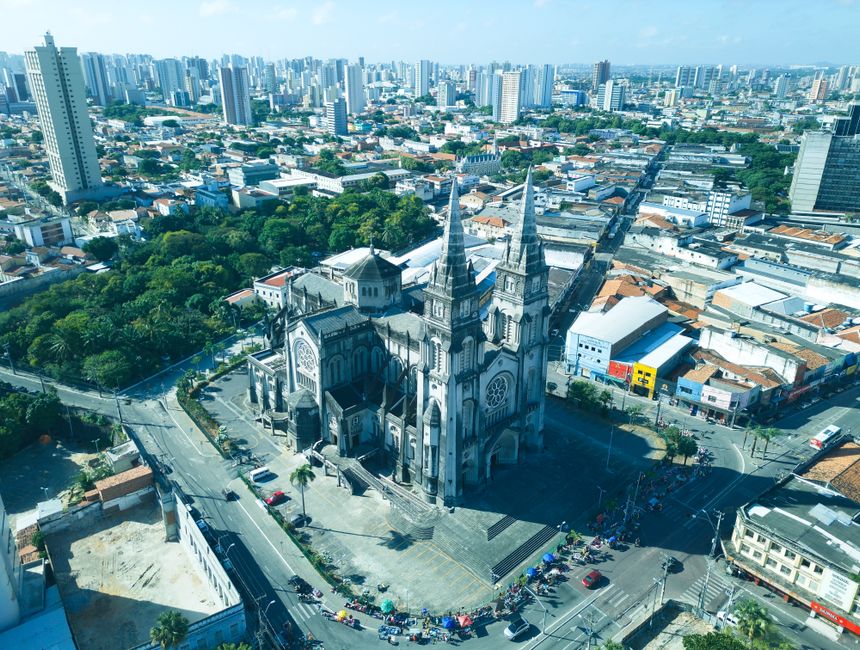
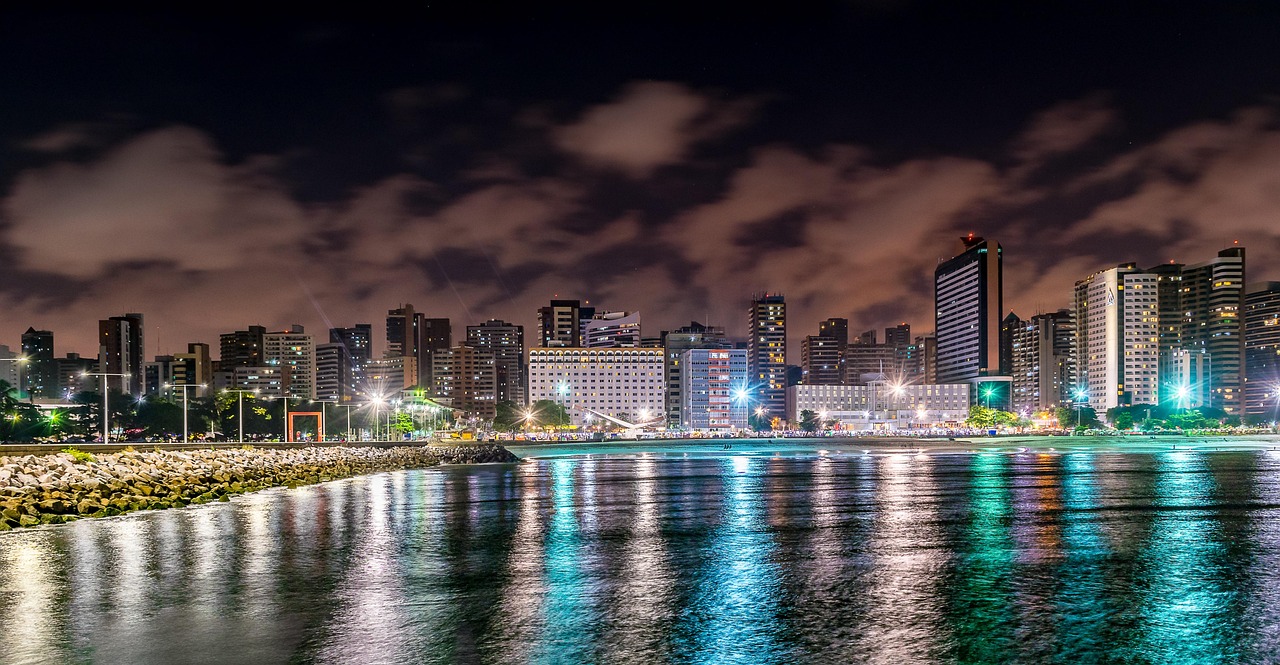
Fortaleza, the capital of Ceará, is a sunny beach city of about 2.4 million people on Brazil’s north-east coast, only about 4 degrees south of the Equator, where the trade winds blow and the sun shines on most days of the year. It is not a colonial showpiece, but it is a lively, easy base: a long seafront of urban beaches and promenades, the Dragão do Mar cultural center, a famous craft market, seafood shacks on Praia do Futuro, one of Latin America’s biggest water parks nearby, and the kitesurfing beaches of Cumbuco, the red cliffs of Canoa Quebrada and the dunes of Jericoacoara within a few hours. It has many direct flights from Brazil’s big cities and some from Europe, and it is cheaper than the beach towns farther south. The rain comes in a short season, mostly from February to May; the rest of the year is dry, warm and breezy.
Right now in Fortaleza
- Tue 26–30°C 78–86°F Clear
- Wed 26–30°C 79–86°F Clear
- Thu 27–30°C 80–86°F Clear
- Mon 12 Oct Our Lady of Aparecida (Nossa Senhora Aparecida)
Weather: MET Norway (CC BY 4.0) · Sea temperature: NOAA CoastWatch · Holidays: Nager.Date
Top tours in Fortaleza
See all tours for Fortaleza →
From local operators, with prices and reviews; you check availability and book on Viator, our partner. We may earn a commission at no extra cost to you. How we earn money
Fortaleza at a glance
- Best for: beaches, kitesurfing nearby, seafood, crafts, nightlife and a base for Jericoacoara and Canoa Quebrada.
- How long: 2–3 days in the city; a week or more to add the coast.
- Best time: July to January, dry, sunny and windy; February to May is the rainy season.
- Getting there: Pinto Martins International Airport (FOR), about 10 km (6 miles) south of the beachfront, with flights from across Brazil and some from Europe.
- Getting around: ride-hailing apps and taxis; a light rail and metro serve some of the city, but not the main beachfront.
- Before you go: the e-visa, money and general safety are in our Brazil travel guide; for the dunes to the west, see our Jericoacoara and Lençóis Maranhenses guides.
Fortaleza’s areas: where things are
Meireles and Iracema
The heart of the beachfront: the Avenida Beira-Mar promenade, with hotels, kiosks, the evening craft fair and jogging paths, runs through Meireles and Mucuripe; Praia de Iracema, to the west, has the old Iracema Bridge pier and nightlife around the Dragão do Mar center.
The center
The historic downtown, with the Metropolitan Cathedral, the Central Market (Mercado Central) packed with lace, hammocks and cashew nuts, the José de Alencar Theater and the Fortaleza fort that gave the city its name.
Praia do Futuro
A long, open beach east of Mucuripe port, lined with big beach restaurants (barracas) serving crab and fried fish; the sea is rougher here.
The coast nearby
Cumbuco to the west, Porto das Dunas (Beach Park) and Prainha to the east, and Canoa Quebrada about 160 km (100 miles) south-east.
Aldeota, Varjota and Meireles inland
Just inland from the Beira-Mar, Aldeota is the upscale business and shopping district, and the small Varjota neighborhood is the city’s main restaurant district, with dozens of places within a few blocks, from regional cooking to sushi and steakhouses.
Fortaleza in brief: history and culture
Fortaleza grew around a Dutch fort of the 1640s, taken over by the Portuguese and renamed Fortaleza de Nossa Senhora da Assunção, which still stands as a military base and gave the city its name, “fortress”. For two centuries it was a small cattle and cotton town; it boomed in the 20th century as people from the dry interior (the sertão) moved to the coast, and it is now Brazil’s fourth-largest city by population, according to the 2022 census. That sertão heritage shapes its culture: forró music and dancing, the woodblock-illustrated cordel booklets of popular poetry sold in markets, leather crafts, lace made by the rendeiras on the coast, and a famous sense of humor; Ceará is known across Brazil for its comedians.
Ceará was also the first Brazilian province to abolish slavery, in 1884, four years before the rest of the country, a story told at the Dragão do Mar center, named after the jangadeiro (raft fisherman) Francisco José do Nascimento, who refused to carry enslaved people to the ships. The jangadas, simple sailing rafts, still go out from Mucuripe and from fishing villages along the coast.
Top things to see in Fortaleza
Avenida Beira-Mar
Walk the promenade at sunset, browse the nightly craft fair, eat at the kiosks and watch fishermen’s jangadas (sailing rafts) come in at Mucuripe.
Dragão do Mar Center of Art and Culture
A modern cultural complex near Praia de Iracema with a planetarium, art museum, cinemas and theaters, surrounded by restored warehouses full of bars.
Mercado Central and the Metropolitan Cathedral
A four-story market for hammocks, embroidery, lace, leather, cachaça and cashew sweets, next to the Gothic-revival cathedral.
Theatro José de Alencar
An art-nouveau theater from 1910 with a cast-iron façade imported from Scotland, and gardens by Roberto Burle Marx.
More to see
- Iracema Bridge (Ponte dos Ingleses): an old pier for sunset and dolphin-spotting.
- The Ceará Museum: the state’s history, in the old provincial assembly building downtown.
- Mucuripe fish market: the morning catch, sold where the jangadas land.
- Forró nights: the city is a capital of forró dancing.
Beaches in Fortaleza
- Meireles and Iracema: urban beaches for walks and sunsets more than swimming; check water-quality reports.
- Praia do Futuro: the city’s main swimming beach, with beach restaurants; currents can be strong.
- Cumbuco: about 30 km (19 miles) west, with dunes, lagoons and steady wind for kitesurfing.
- Porto das Dunas and Prainha: east of the city, with the Beach Park water park and a quieter fishing beach.
Other things to do in Fortaleza
Beach Park
One of Latin America’s largest water parks, at Porto das Dunas in Aquiraz, about 30 minutes east of the city, with big slides, a wave pool and resort hotels.
Dunes, lagoons and paragliding
Around Cumbuco, the Lagoa do Banana and Lagoa do Parnamirim have zip lines into the water (tirolesas) and dune slides on boards (esquibunda), and licensed buggy drivers race over the dunes “com emoção” (with thrills) or “sem emoção” (gently), as you choose. Paragliding and tandem flights are popular at Canoa Quebrada.
Kitesurfing and buggy rides
Cumbuco has kite schools on lagoons and the beach, with the strongest wind from about July to January, and licensed buggy trips over the dunes.
Shopping for crafts
Fortaleza is one of Brazil’s best places to buy crafts: hammocks woven in the interior, bobbin lace and embroidery, cashew sweets and nuts, cachaça, bottles of colored sand arranged in pictures by artisans from Beberibe and Majorlândia, leather sandals and cordel booklets. The Mercado Central has the most choice, and the nightly Beira-Mar fair and the Centro de Turismo, in a former prison downtown, are good alternatives. Bargaining is accepted at stalls.
Food
Ceará is known for crab (caranguejo, eaten with a wooden mallet on Thursday nights at Praia do Futuro), grilled fish, tapioca crepes, carne de sol (salt-cured beef), baião de dois (rice and beans with cheese), and cashew fruit juice and nuts.
Where to eat
- Praia do Futuro barracas: giant beach restaurants with pools and shows, famous for Thursday-night crab.
- Varjota and Meireles: the city’s main restaurant areas, with regional dishes such as baião de dois, carne de sol with macaxeira (cassava) and paçoca (pounded dried meat with cassava flour).
- The Beira-Mar kiosks: fish, shrimp and cold beer on the promenade.
- The Mercado dos Peixes at Mucuripe: buy fresh fish and shrimp and have it cooked at stalls next door.
- Tapioca stands: the Tapioqueiras center on the road to the south coast is a cluster of tapioca kiosks.
Canoa Quebrada in more depth
About 160 km (100 miles) south-east, Canoa Quebrada is a former fishing village on red cliffs above a long beach, famous for its dunes, buggy tours, paragliding and kitesurfing, and the “Broadway” street of bars and restaurants. It has a crescent moon and star carved into the cliff as its symbol. Stay two nights to make the trip worthwhile.
Day trips from Fortaleza
- Cumbuco: dunes, lagoons and kitesurfing, about 40 minutes west.
- Canoa Quebrada: red cliffs, dunes and a lively village, about 3 hours south-east.
- Morro Branco: colored-sand cliffs at Beberibe, about 1.5 hours away.
- Jericoacoara: 5–6 hours by road; spend at least three nights.
More of the Ceará coast
- Lagoinha: a palm-fringed beach with a lagoon and dunes, about 2 hours west.
- Flecheiras and Mundaú: quiet fishing beaches with natural pools at low tide, about 2–2.5 hours west, on the way toward Jericoacoara.
- Águas Belas and Morro Branco: colored-sand cliffs and a labyrinth of sandstone east of the city, about 1.5 hours away.
- Guaramiranga and the Baturité mountains: a cool hill town of coffee farms, forest and colonial houses about 2 hours inland, known for its jazz and blues festival during Carnival.
Nearby destinations
- Jericoacoara244 km
Getting there and getting around
Arriving
Pinto Martins International Airport (FOR) is about 10 km (6 miles) from the beachfront hotels, 20–30 minutes by taxi or ride-hailing car. Long-distance buses and transfers leave from the bus station and hotels for Jericoacoara, Canoa Quebrada and other coastal towns.
Getting around tips
The Beira-Mar is a pleasant walk or cycle (the city has shared bikes), Praia do Futuro is a short ride-hailing trip from Meireles, and the center is 10–15 minutes away by car. Beach Park runs shuttles from hotels, and tour operators collect from hotels for Cumbuco, Canoa Quebrada and Jericoacoara. Traffic is heavy at rush hours on the avenues to the airport.
In the city
Ride-hailing apps and taxis are the easiest way around; the beachfront is walkable. The city’s light rail and metro lines are useful for some routes downtown but not for most visitor trips.
When to go and how long to stay
According to INMET’s 1991–2020 normals for Fortaleza, average highs stay at 31–32 °C (87–89 °F) all year and nights at 23–25 °C (73–77 °F). About 1,580 mm (62 in) of rain falls a year, most of it from February to May, with March and April the wettest months; from August to December it hardly rains at all. The trade winds blow hardest from about July to January, which keeps the heat bearable and draws kitesurfers. The busiest times are July, December to January and Carnival.
Fortaleza’s weather month by month
The table shows INMET’s 1991–2020 averages for its Fortaleza station.
| Month | Average high | Average low | Rain (Fortaleza) |
|---|---|---|---|
| January | 31 °C (88 °F) | 24 °C (76 °F) | 156 mm (6.2 in) |
| February | 31 °C (88 °F) | 24 °C (76 °F) | 187 mm (7.4 in) |
| March | 31 °C (87 °F) | 24 °C (75 °F) | 337 mm (13.3 in) |
| April | 31 °C (87 °F) | 24 °C (75 °F) | 385 mm (15.2 in) |
| May | 31 °C (87 °F) | 24 °C (75 °F) | 229 mm (9.0 in) |
| June | 30 °C (87 °F) | 23 °C (74 °F) | 130 mm (5.1 in) |
| July | 31 °C (87 °F) | 23 °C (73 °F) | 70 mm (2.7 in) |
| August | 31 °C (88 °F) | 23 °C (73 °F) | 20 mm (0.8 in) |
| September | 31 °C (89 °F) | 24 °C (74 °F) | 14 mm (0.5 in) |
| October | 32 °C (89 °F) | 24 °C (76 °F) | 10 mm (0.4 in) |
| November | 32 °C (89 °F) | 25 °C (76 °F) | 10 mm (0.4 in) |
| December | 32 °C (89 °F) | 25 °C (77 °F) | 37 mm (1.5 in) |
- January: hot, with the first showers; summer holidays and the busiest beaches.
- February to May: the rainy season, with March and April the wettest months; heavy showers alternate with sun, and prices drop outside Carnival.
- June and July: drying out, with fresh trade winds; July school holidays fill the coast.
- August to December: dry, sunny and windy, the best beach weather and kitesurfing season; December is busy.
2 days in Fortaleza
Day 1: the center, Mercado Central and the cathedral, then the Dragão do Mar and Praia de Iracema at night. Day 2: Praia do Futuro or Beach Park, and the Beira-Mar craft fair at sunset.
4 days in Fortaleza
Days 1–2 as above, then a day in Cumbuco for the dunes, lagoons and a buggy ride, and a day at Beach Park or Morro Branco before dinner in Varjota.
A week in Fortaleza and the coast
Add a day in Cumbuco, two nights in Canoa Quebrada, or three nights in Jericoacoara.
Culture and events
Fortaleza’s Fortal, an out-of-season Carnival with trios elétricos, is usually held in July; the city’s Carnival itself is quieter, with many residents heading to the coast or the mountains. The Dragão do Mar center hosts concerts, films and exhibitions year-round, and the Centro Cultural Banco do Nordeste and the Theatro José de Alencar have free or cheap events. Ceará’s comedians perform in humor bars that are a local institution.
Fortaleza for families
Beach Park is the big draw for children, along with the calm water at some Beira-Mar stretches at low tide, the planetarium at the Dragão do Mar, and buggy rides and sandboarding at Cumbuco. Choose a hotel with a pool, as the urban beaches aren’t always good for swimming.
Fortaleza’s beaches for swimming
The city beaches near the port and river mouths can be unsuitable for swimming after rain, when the state environment agency’s reports advise against it; Praia do Futuro, Porto das Dunas and Cumbuco are usually better choices. Swim near lifeguards and avoid the water near the rocks and breakwaters.
Where to stay in Fortaleza
- Meireles and the Beira-Mar: most hotels, on the promenade, close to restaurants.
- Praia de Iracema: cheaper hotels near the nightlife.
- Porto das Dunas: resorts at Beach Park, good for families.
- Cumbuco: kite pousadas and resorts by the dunes.
What things cost in Fortaleza
Fortaleza is good value compared with Rio and São Paulo. Our estimates for planning, as of October 2026:
| Item | Typical price |
|---|---|
| Crab or fried fish at a Praia do Futuro barraca, for two | about R$120–220 (US$25–40) |
| Beach Park day ticket | about R$250–350 (US$50–65), cheaper online in advance |
| Buggy tour in Cumbuco | about R$300–500 (US$60–95) per buggy |
| Ride-hailing from the airport to Meireles | about R$25–45 (US$5–9) |
| Dinner for two at a mid-range restaurant | about R$180–350 (US$35–65) |
| Double room, mid-range hotel on the Beira-Mar | about R$300–600 (US$60–115) a night |
Practical tips for Fortaleza
- Sun: the Equator is close; use high-factor sunscreen and a hat even on cloudy days.
- Swimming: follow lifeguard flags at Praia do Futuro, and check water-quality reports for the city beaches.
- Money: cards are accepted almost everywhere; carry small notes for beach vendors.
- Health: the CDC does not recommend yellow fever vaccination for travel limited to the city of Fortaleza; dengue is common in the rainy season, so use repellent.
- Safety: stay on the busy, lit parts of the beachfront at night, use ride-hailing apps or taxis after dark and to get to and from the center, and keep phones and valuables out of sight on beaches and in crowds.
- Emergencies: call 190 for police, 192 for an ambulance and 193 for the fire department.
What to pack for Fortaleza
Pack light, breathable clothes, swimwear, sandals, a hat, sunglasses and high-factor sunscreen, a light layer for air-conditioned buses and planes, and insect repellent. Bring a plug adapter for Brazil’s type N sockets.
Fortaleza travel FAQ
What is the best time to visit Fortaleza?
July to January, the dry, sunny and windy season. Most rain falls from February to May.
Which beach is best for swimming in Fortaleza?
Praia do Futuro, the city’s open beach with beach restaurants; follow the lifeguard flags.
How do I get from Fortaleza to Jericoacoara?
By bus or transfer, about 5–6 hours, with a 4×4 for the last stretch, or by flying to Jericoacoara’s airport in Cruz.
Do I need a yellow fever vaccine for Fortaleza?
No: the CDC does not recommend it for travel limited to the city of Fortaleza, and Brazil does not require it for entry.
How many days do I need in Fortaleza?
Two to three days in the city, more to add Cumbuco, Canoa Quebrada or Jericoacoara.
Is Fortaleza safe for tourists?
Most visits are trouble-free on the busy beachfront; use ride-hailing apps at night and keep valuables out of sight.
What is Beach Park?
One of Latin America’s largest water parks, at Porto das Dunas in Aquiraz, about 30 minutes east of Fortaleza, with slides, a wave pool and resorts.
Is Fortaleza good for kitesurfing?
The city beaches aren’t, but Cumbuco, about 40 minutes west, is one of Brazil’s main kitesurf spots, best from about July to January.
What is the food like in Fortaleza?
Seafood, especially crab and shrimp, plus northeastern dishes such as baião de dois, carne de sol and tapioca.
Is Fortaleza cheaper than Rio?
Generally yes: hotels, food and tours usually cost less than in Rio or São Paulo.
Sources and last review
Researched and last reviewed on 4 October 2026. Climate: INMET’s 1991–2020 normals for Fortaleza; population: IBGE’s 2022 census; yellow fever: the US CDC; exchange rate: the Central Bank of Brazil. Neighborhoods, sights, the theater’s history, beaches, Beach Park, Cumbuco and other coastal distances, wind season, transport and food, plus the history and culture section, come from secondary sources or general knowledge and are flagged for checking. Check the official sites before you go. For entry rules and money, see our Brazil travel guide.
Plan your trip
Partner links: TravelerCenter may earn a commission if you book, at no extra cost to you.
🇵🇹 Useful Portuguese phrases for Fortaleza
All 38 Portuguese phrases: restaurant, hotel, emergencies, romance (printable) →