
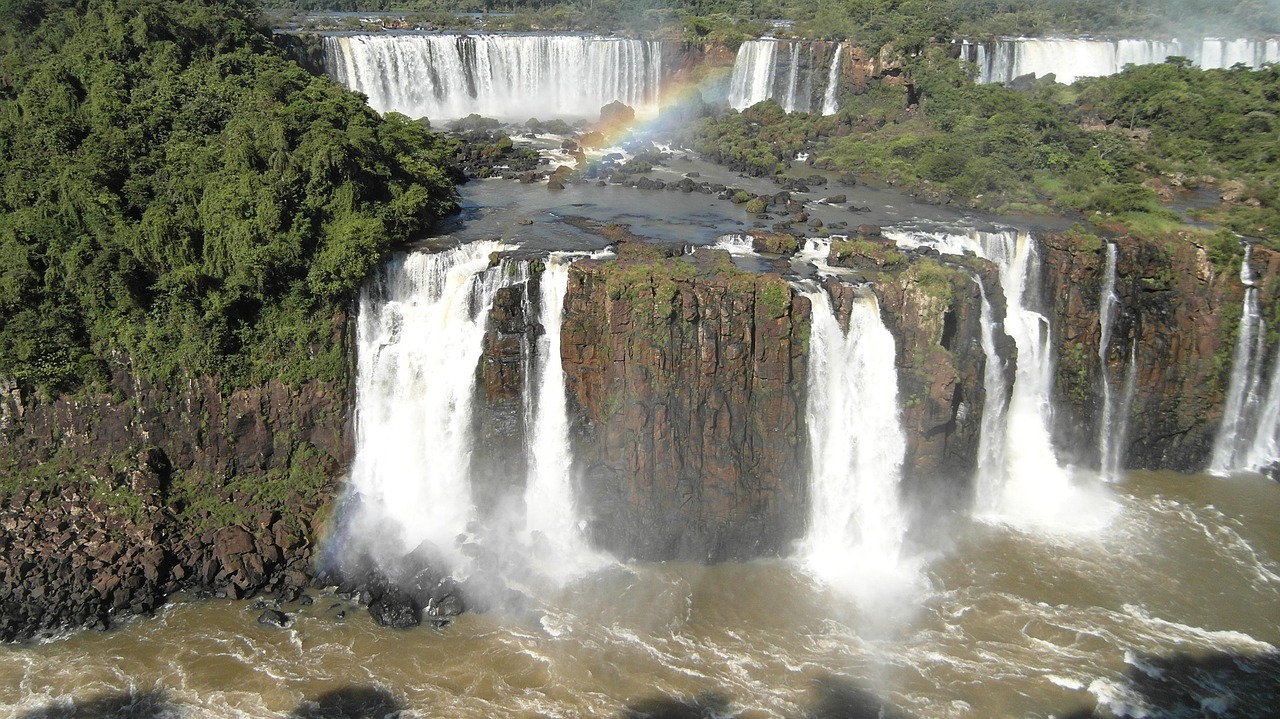
Foz do Iguaçu, a city of about 285,000 people in the far west of Paraná, sits where Brazil, Argentina and Paraguay meet, and it exists for visitors because of one thing: the Iguaçu Falls, the largest set of waterfalls in the world, a horseshoe of about 275 cascades thundering into the gorge of the Iguaçu River. The Brazilian side, in Iguaçu National Park, gives the grand panorama and a walkway out over the river beneath the Devil’s Throat; the Argentine side, across the border in Iguazú National Park, has trails right along the top of the falls. Add boat rides into the spray, the Itaipu dam, a bird park full of toucans and macaws, and the Triple Frontier landmark, and you have two or three busy days. The falls flow all year, and the city is hot and humid in summer and mild, even chilly, in winter.
Right now in Foz do Iguaçu (Iguaçu Falls)
- Wed19–29°C66–83°F4 mm rain
- Thu21–29°C69–85°F12 mm rain
- Fri23–24°C73–75°F56 mm rain
- Mon 12 Oct Our Lady of Aparecida (Nossa Senhora Aparecida)
Top tours in Foz do Iguaçu
See all tours for Foz do Iguaçu →
From local operators, with prices and reviews; you check availability and book on Viator, our partner. We may earn a commission at no extra cost to you. How we earn money
Foz do Iguaçu at a glance
- Best for: the falls, boat trips, birds and butterflies, a dam tour and a three-country border.
- How long: two full days for both sides of the falls; three to add Itaipu, the bird park and a boat trip.
- Best time: March to May and August to November, with mild weather and fewer crowds; the falls are at their most powerful after heavy rain upstream.
- Getting there: Foz do Iguaçu International Airport (IGU), on the road to the national park, with flights from São Paulo, Rio, Brasília and other cities.
- Park fee: R$134 (about US$26) for foreign adults on the Brazilian side as of October 2026, sold online with a time slot.
- Before you go: the e-visa, money, health and general safety are in our Brazil travel guide.
Foz do Iguaçu’s areas: where things are
The city lies at the meeting of the Paraná and Iguaçu rivers. The falls are about 25 km (16 miles) south-east of the center, inside Iguaçu National Park, with the airport on the way, along the BR-469 highway, which also leads to the bird park and the hotels of the “Rodovia das Cataratas”. Itaipu is north of the city on the Paraná River, the Friendship Bridge crosses west to Ciudad del Este in Paraguay, and the Tancredo Neves Bridge crosses the Iguaçu River south to Puerto Iguazú in Argentina.
Downtown
The city center has most budget and mid-range hotels, restaurants, the urban bus terminal (TTU) and nightlife, and is the cheapest base without a car.
The road to the falls
Resort hotels, the airport, the bird park and the national park entrance sit along the highway between the city and the falls, and one historic hotel stands inside the park beside the falls.
Top things to see in Foz do Iguaçu
Iguaçu National Park and the falls (Brazilian side)
Iguaçu National Park was created on January 10, 1939, protects about 185,000 hectares (457,000 acres) of Atlantic Forest and has been a UNESCO World Natural Heritage Site since 1986, according to the park concessionaire, Urbia+Cataratas. It borders Argentina’s park for more than 60 km (37 miles).
The ticket includes the park’s double-decker buses for the roughly 12-km (7.5-mile) ride each way between the visitor center and the Cataratas trail, the trail itself, the walkway, the elevator and the viewpoints, and access to the park’s other trails and paths. The classic visit takes about two hours: walk the trail of about 1.5 km (1 mile) along the gorge, with the falls opening up on the Argentine side opposite, to the walkway out over the river below the Devil’s Throat (Garganta do Diabo), where you will get wet; then take the elevator up to the Porto Canoas area for the view of the river above the falls.
| Item (as of October 2026) | Price or hours |
|---|---|
| Entry, foreign adults (“Integral”) | R$134 (about US$26), including a voluntary R$3 contribution to the Fundo Iguaçu |
| Entry, citizens of Brazil, Argentina, Paraguay, Uruguay and Venezuela | R$121 (about US$23), same contribution included |
| Children up to 6 | Free, with an original photo document |
| Hours | Every day; ticket entry slots Monday–Friday 9 a.m.–4 p.m., weekends 8:30 a.m.–4 p.m.; you may stay until the park closes at 5:30 p.m. |
| Parking | R$65 (about US$12) a day for cars |
| Lockers | R$45 |
Tickets are limited and sold online, with a date and time slot, on the official site, cataratasdoiguacu.com.br; prices were set from December 19, 2025 with ICMBio’s approval. There are no half-price tickets for students or seniors, because Brazil’s half-price laws don’t apply to federal parks, according to the operator. Two- and three-day passes, a sunrise visit (Wednesday to Saturday, starting at 5:30 a.m.), a sunset visit and a night-sky program are sold separately.
The Argentine side
Across the border, Argentina’s Iguazú National Park has a longer network of walkways at the top and bottom of the falls and a small train to the edge of the Devil’s Throat. Allow a full day. You cross by bus, taxi or tour via the Tancredo Neves Bridge, passing Brazilian exit and Argentine entry checks, so bring your passport. Our Iguazú guide is coming soon; check Argentina’s park and entry rules before you go.
Sunrise, sunset and night visits
The concessionaire runs three special experiences outside normal hours, each with limited places and its own ticket, bought in advance on the official site:
- Sunrise at the Falls (Amanhecer nas Cataratas): from Wednesday to Saturday, with boarding at 5:30 a.m. at the visitor center since September 16, 2026, a walk along the Cataratas trail to the walkways before the park opens, and breakfast at the Cocar restaurant from 7 to 9 a.m. The ticket lets you stay in the park all day.
- Sunset at the Falls (Pôr do Sol nas Cataratas): on Tuesdays, Fridays and Saturdays after the park closes, with boarding at 5 p.m. since September 22, 2026, the main viewpoints and walkways, and a drinks service at the Espaço Naipi from 5:30 to 7 p.m. This ticket also covers the whole day.
- Céu das Cataratas: a night of stargazing beside the falls, with astronomy and Guarani sky lore, on Saturdays, with boarding at 7 p.m. and only 20 places each time.
Times change with the seasons, so check the official site.
How to plan your visit to the Brazilian side
1. Buy your ticket online for an early slot, ideally the first of the day, and print or download it.
2. Arrive at the visitor center, show a photo ID, and board the double-decker bus; it stops at the start of the Macuco Safari boat trip and at the Cataratas trail.
3. Walk the Cataratas trail of about 1.5 km (1 mile), stopping at each viewpoint; the Argentine falls face you across the gorge.
4. At the end, walk out on the walkway toward the Devil’s Throat (expect to be drenched), then take the elevator up to the Porto Canoas area.
5. Ride the bus back from Porto Canoas, or stop for lunch at the restaurants there, overlooking the river above the falls.
Allow two to three hours for the trail alone, a full day if you add a boat trip, the cycle path or another trail.
Boat trips under the falls
Inside the Brazilian park, a concession runs speedboat rides up the river into the spray of the falls, combined with a jungle ride and short walk, and gentler river trips; tickets are sold separately from park entry. Expect to be soaked: bring a waterproof bag.
Itaipu Binational Dam
One of the world’s largest hydroelectric dams, on the Paraná River between Brazil and Paraguay, is open for visits every day from 8:30 a.m. to 4 p.m., according to its official tourism site. As of October 2026, the Itaipu Panorâmica bus tour of the outside of the dam costs R$63 (about US$12), and the longer Itaipu Especial tour of about two and a half hours, inside and out, including the generator hall and the central control room, costs R$185 (about US$35); spaces are limited. The dam is lit up on some evenings.
Parque das Aves
A private bird park next to the national park entrance, with walk-through aviaries of toucans, macaws, flamingos and harpy eagles, many of them rescued animals, and a butterfly house; it opens every day from 8:30 a.m. to 4:30 p.m., according to its site. Allow two hours.
More to see
- The Triple Frontier Landmark (Marco das Três Fronteiras): a viewpoint and show at the meeting of the Iguaçu and Paraná rivers, where you can see Argentina and Paraguay.
- The Poço Preto and Bananeiras paths: quieter forest paths in the national park, for walkers and cyclists; the Poço Preto path is open for walking from 9 a.m. to noon.
- The Cataratas cycle path: an 11.6-km (7.2-mile) paved bike path through the forest from the visitor center to the start of the Cataratas trail; bring your own bike.
- The Omar Ibn Al-Khattab Mosque and Chen Tien Buddhist temple: signs of the city’s large Lebanese and Chinese communities.
Other things to do in Foz do Iguaçu
Trails and wildlife
The park’s forest shelters coatis, which beg at the trails (don’t feed them: they bite), capuchin monkeys, toucans and hundreds of butterfly species, and big cats that visitors almost never see. The concessionaire sometimes closes trails for wildlife monitoring: the Canafístula trail is closed from September 28 to October 12, 2026.
Shopping in Paraguay
Ciudad del Este, across the Friendship Bridge, is a huge duty-free shopping town. Brazil limits what you can bring back duty-free, traffic on the bridge is heavy, and you need your passport.
Food
Foz is a churrasco town, with big all-you-can-eat steakhouses and buffet dinners with dance shows of Latin American music; the Lebanese community runs excellent Arab restaurants.
Where to eat in Foz do Iguaçu
Inside the park, the Porto Canoas restaurant serves a buffet with a view of the river above the falls, and the Cocar restaurant at the visitor center serves breakfast and meals. In the city, the Vila A and central areas have steakhouses, Arab and Lebanese restaurants, pizzerias and casual bars; fish from the Paraná River, such as surubim and dourado, appears on many menus. Several restaurants put on dinner shows of music and dance from Brazil, Argentina, Paraguay and the Andes.
What things cost in Foz do Iguaçu
Official prices, as of October 2026, plus our estimates for planning:
| Item | Typical price |
|---|---|
| Iguaçu National Park entry (foreign adult) | R$134 (about US$26), official fare |
| Park parking (car) | R$65 (about US$12) a day, official fare |
| Itaipu Panorâmica / Itaipu Especial tours | R$63 / R$185 (about US$12 / US$35), official fares |
| City bus to the park | a few reais, set by the city |
| Taxi or ride-hailing from downtown to the park | about R$50–80 (US$10–15) |
| Day tour to the Argentine side with transport | about R$250–450 (US$50–85), plus Argentine park entry |
| Dinner for two at a steakhouse | about R$250–400 (US$50–75) |
| Double room, mid-range hotel downtown | about R$300–600 (US$60–115) a night |
Argentina’s park charges its own entry in Argentine pesos; check its official site.
Day trips from Foz do Iguaçu
- The Argentine side of the falls: a full day, via Puerto Iguazú.
- Ciudad del Este, Paraguay: a half day for shopping.
- The Moisés Bertoni Monument, Paraguay, and the Saltos del Monday: waterfalls and a historic naturalist’s house on the Paraguayan side.
Nearby destinations
- Iguazú National Park21 km
Getting there and getting around
Arriving
Foz do Iguaçu International Airport (IGU) has domestic flights from São Paulo, Rio de Janeiro, Brasília, Curitiba and other cities, and it is on the BR-469 road between the city and the falls. Long-distance buses link the city’s bus station with Curitiba and São Paulo, but it is a long ride.
Buses, taxis and tours
Urban bus line 120, Parque Nacional–Aeroporto, runs from the urban bus terminal (TTU) downtown past the airport to the national park visitor center and back, according to the park. Taxis and ride-hailing apps are easy to find. Tours and private drivers are the simplest way to see both sides of the falls in one trip and handle the border crossing.
When to go and how long to stay
The falls are spectacular in every season; their flow depends on rain in the river basin upstream and can rise or drop sharply within days. Summer, from December to March, is hot and humid, with storms; winter, from June to August, has mild days and cool nights. Holidays and long weekends bring big crowds: the park received a record 186,906 visitors in September 2026, and 15,942 on September 6 alone, according to the concessionaire. Book a morning time slot and go on a weekday if you can.
Foz do Iguaçu month by month
- December to February: hot and humid summer, with storms; school holidays and New Year bring crowds and higher prices; the falls are often full after rain.
- March to May: warm days, fewer people after Easter, and pleasant walking weather; a good time to visit.
- June to August: mild days and cool, sometimes cold nights; July school holidays fill the park, and some winters bring lower water.
- September to November: spring, with flowers and birdsong in the forest, comfortable temperatures and holiday weekends; September 2026 was the park’s busiest September on record.
Two days in Foz do Iguaçu
Day 1: the Brazilian side of the falls in the morning, with a boat ride, and the bird park in the afternoon. Day 2: a full day on the Argentine side.
Three days
Add the Itaipu Especial tour and the Triple Frontier Landmark at sunset, or a sunrise visit to the falls.
Where to stay in Foz do Iguaçu
- Downtown: the most choice and the cheapest rooms, close to restaurants and the bus to the park.
- The Rodovia das Cataratas: resort hotels in gardens near the airport and the park, best with a car or tours.
- Inside the park: one hotel next to the falls lets guests see them before and after the day visitors.
Practical tips for Foz do Iguaçu
- Tickets: buy park tickets online on the official site and pick an early slot; bring a photo document for each visitor.
- Getting wet: the walkway and boat rides soak you; use a poncho and a waterproof phone pouch.
- Coatis: keep food out of sight and don’t feed or touch them.
- Border crossings: carry your passport, and check Argentina’s and Paraguay’s entry rules for your nationality.
- Health: the CDC recommends yellow fever vaccination for travelers going to Iguaçu Falls; there is no malaria here.
- Safety: the park and tourist areas are well organized and visitors rarely have problems; watch your belongings in Ciudad del Este’s crowded streets and around the bridges, and keep phones secure on the walkway.
- Emergencies: call 190 for police, 192 for an ambulance and 193 for the fire department.
What to pack for Foz do Iguaçu
Pack light clothes, a rain poncho or light rain jacket, quick-drying shoes or sandals with grip for wet walkways, a waterproof bag for phones and cameras, sunscreen, a hat and insect repellent. Bring a sweater for winter evenings, your passport for the border and a plug adapter for Brazil’s type N sockets.
Foz do Iguaçu travel FAQ
How much is the Iguaçu Falls entrance fee in Brazil?
As of October 2026, R$134 (about US$26) for foreign adults, including a voluntary R$3 contribution, and R$121 for Brazilians and other Mercosur citizens. Children up to 6 enter free.
What are the opening hours of Iguaçu National Park?
Every day; entry slots run from 9 a.m. to 4 p.m. on weekdays and 8:30 a.m. to 4 p.m. on weekends, and you can stay until 5:30 p.m.
Is the Brazilian or Argentine side of Iguaçu Falls better?
See both: Brazil has the panoramic view and the Devil’s Throat walkway in about two hours, and Argentina has longer trails over the falls that take a full day.
Do I need a passport to visit the Argentine side?
Yes. You leave Brazil and enter Argentina at the Tancredo Neves Bridge, so carry your passport and check Argentina’s entry rules.
How do I get from Foz do Iguaçu to the falls?
Take bus 120 from the urban bus terminal (TTU), which also stops at the airport, a taxi, a ride-hailing car or a tour.
How much is the Itaipu dam tour?
As of October 2026, R$63 for the panoramic bus tour and R$185 for the special tour inside the dam.
Do I need a yellow fever vaccine for Iguaçu Falls?
It isn’t required, but the CDC recommends it for travelers going to Iguaçu Falls.
When is the best time to visit Iguaçu Falls?
Any time; March to May and August to November are pleasant and less crowded. Avoid Brazilian holidays and long weekends if you can.
What is the Sunrise at the Falls tour?
An early visit with boarding at 5:30 a.m. from Wednesday to Saturday, before the park opens, including breakfast and a full-day stay. Places are limited; book on the official site.
How long does it take to see the Brazilian side of Iguaçu Falls?
About two to three hours for the Cataratas trail and walkway; a full day with a boat trip or other trails.
Plan your trip
Partner links: TravelerCenter may earn a commission if you book, at no extra cost to you.
🇵🇹 Useful Portuguese phrases for Foz do Iguaçu
All 38 Portuguese phrases: restaurant, hotel, emergencies, romance (printable) →
Sources · last reviewed 4 October 2026
Researched and last reviewed on 4 October 2026. Iguaçu National Park fees, hours, tickets, inclusions, exemptions, parking, lockers, special visits, trail closures, visitor records, park history and size, the cycle path and bus line 120: Urbia+Cataratas, the park concessionaire; Itaipu tours and prices: Itaipu’s official tourism site; bird park hours: Parque das Aves; population: IBGE’s 2022 census; yellow fever and malaria: the US CDC; exchange rate: the Central Bank of Brazil. The number of falls, boat trips, the Argentine side, distances, the border crossings, Ciudad del Este, the Triple Frontier Landmark, food and the hotel inside the park come from secondary sources or general knowledge and are flagged for checking. Prices change, so check the official sites before you go. For entry rules and money, see our Brazil travel guide.
Data: Weather: MET Norway (CC BY 4.0) · Air quality: OpenAQ · Rates: ECB · Holidays: Nager.Date · Costs: World Bank ICP and price levels · Wikidata (CC0)