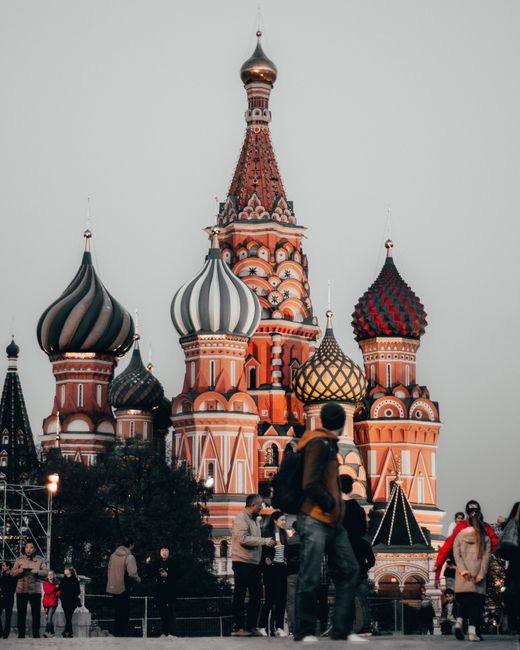
Russia is the largest country in the world, spanning eleven time zones from the Baltic Sea to the Pacific, from the Arctic tundra to the subtropical Black Sea coast and the deserts of the Caspian. Its two great cities, Moscow and St Petersburg, are among the most visited in Europe in normal times, with the Kremlin and Red Square, the Hermitage and the palaces of the tsars, and beyond them lie the medieval towns of the Golden Ring, the Volga, Lake Baikal, the Trans-Siberian Railway and the volcanoes of Kamchatka. Since Russia’s full-scale invasion of Ukraine in February 2022, however, sanctions have cut most flights and payment links, and conditions for foreign visitors have changed a great deal. This guide describes the country, its history, landmarks and climate, and how things currently stand for visitors.
Right now in Russia
- Wed 9–15°C 47–58°F Clear
- Thu 5–14°C 42–57°F Partly cloudy
- Fri 8–17°C 46–63°F 4 mm Cloudy
Weather: MET Norway (CC BY 4.0)
Russia at a glance
Russia covers about 17.1 million square kilometres, almost twice the size of the United States or China, across eastern Europe and northern Asia. The Ural Mountains divide European Russia, where most people live, from Siberia and the Russian Far East. Great rivers run north to the Arctic Ocean (the Ob, the Yenisei, the Lena) and south to the Caspian (the Volga, Europe’s longest river). Its highest mountain, Elbrus (5,642 m) in the Caucasus, is the highest peak in Europe, and Lake Baikal in southern Siberia is the deepest and oldest lake on Earth. Russia borders 14 countries by land, including Norway, Finland, Estonia, Latvia, Lithuania and Poland (via the Kaliningrad exclave), Belarus, Ukraine, Georgia, Azerbaijan, Kazakhstan, China, Mongolia and North Korea.
About 146 million people live in Russia, according to the Russian statistics service, Rosstat, whose figure includes Crimea, which Russia annexed from Ukraine in 2014 and which most countries consider part of Ukraine. Three-quarters of them live in European Russia. Russian is the state language, and dozens of other languages, including Tatar, Bashkir, Chechen and Yakut, are official in the republics. Most believers are Russian Orthodox Christians, with large Muslim communities in the Volga region and the North Caucasus, and Buddhists in Buryatia, Tuva and Kalmykia. The currency is the rouble (RUB); on 2 October 2026 the Bank of Russia’s official rate was 83.25 roubles to the US dollar and 94.53 to the euro. Moscow time, used in Moscow and St Petersburg, is UTC+3 all year; there is no daylight saving time, and the country stretches from UTC+2 in Kaliningrad to UTC+12 in Kamchatka and Chukotka.
A short history
The roots of the Russian state lie in Kyivan Rus’, the medieval federation centred on Kyiv that adopted Orthodox Christianity in 988. After the Mongol invasions of the 13th century, the princes of Moscow gradually gathered the Russian lands; Ivan III threw off Mongol overlordship in 1480, and Ivan IV was crowned the first tsar in 1547. The Romanov dynasty ruled from 1613 to 1917. Peter the Great founded St Petersburg in 1703 and made Russia a European power, and under Catherine the Great and her successors the empire expanded to the Black Sea, the Caucasus, Central Asia and the Pacific.
The revolutions of 1917 ended the monarchy, and after a civil war the Bolsheviks created the Soviet Union in 1922, with Russia as its largest republic. The Soviet era brought rapid industrialisation and mass repression under Stalin, enormous losses in the Second World War, and superpower rivalry with the United States in the Cold War. The Soviet Union broke up in December 1991, and the Russian Federation became an independent state. Vladimir Putin has led Russia as president or prime minister since 1999. In 2014 Russia annexed Crimea from Ukraine, and on 24 February 2022 it launched a full-scale invasion of Ukraine, which the UN General Assembly condemned and which led Western countries to impose wide-ranging sanctions.
Russia’s regions
- Moscow and Central Russia: the capital, the Kremlin and Red Square, and the old towns of the Golden Ring north-east of Moscow, such as Vladimir, Suzdal, Sergiev Posad, Yaroslavl and Rostov Veliky, with white-stone churches and monasteries.
- North-West Russia: St Petersburg and its palaces, Novgorod and Pskov, the wooden churches of Kizhi on Lake Onega, the Solovetsky Islands in the White Sea and the Kaliningrad exclave on the Baltic.
- The Volga: Kazan and its Kremlin, Nizhny Novgorod, Samara and Volgograd along Europe’s longest river.
- The South and the Caucasus: the Black Sea coast around Sochi, the Caucasus mountains and Elbrus, and the republics of the North Caucasus. Security incidents have occurred in parts of the North Caucasus.
- The Urals and Siberia: Yekaterinburg, Novosibirsk, Lake Baikal and Irkutsk, the Altai mountains and the route of the Trans-Siberian Railway.
- The Far East and the Arctic: Vladivostok, the volcanoes of Kamchatka, Sakhalin, Yakutia, Murmansk and the Arctic coast, where emergency help and search and rescue are limited.
Safety and current conditions
Before 2022, millions of foreign tourists visited Russia each year. Today the situation is very different. The main points to know:
- The war: the war with Ukraine is ongoing, and drone attacks and explosions have been reported in Russia, particularly near the border with Ukraine but also in and near large cities and infrastructure across western and central Russia. Airspace closes during attacks, causing frequent and unpredictable delays, diversions and cancellations. The Kursk, Belgorod and Bryansk regions on the Ukrainian border are under a “counter-terrorist operation” regime, and martial law was declared in border regions, including Krasnodar Krai and Rostov, in October 2022.
- Detention: foreigners have been questioned and detained, sometimes without a clear reason. Changes to Russia’s criminal code in December 2024 widened the scope for prosecuting foreigners believed to act against Russian interests, even for actions outside Russia, such as supporting Ukraine on social media, donating to Ukrainian organisations or displaying LGBT+ symbols. Spreading information the authorities deem “fake” about the armed forces can bring up to 15 years in prison.
- Border questioning: some foreign and dual nationals have been held for hours at the border, questioned about their political views or Ukrainian contacts, had fingerprints and DNA taken, and been pressured to hand over their phones.
- Terrorism: there is a risk of terrorist attacks, including in major cities. In March 2024 a gunman attack at the Crocus City Hall concert venue near Moscow killed 145 people.
- Law and freedoms: peaceful assembly and free speech are not protected in practice; even a single person can be treated as a protest. Since January 2024 the “international LGBT movement” has been designated as “extremist”, and same-sex couples face legal and social risks. Jehovah’s Witnesses are banned as “extremist”.
- Insurance: many travel insurance policies exclude Russia, including medical treatment and evacuation, so check the wording of your policy.
- Consular help: many Western embassies in Moscow have reduced staff and several countries’ consulates have suspended operations, so in-person help is limited, especially in remote regions and the North Caucasus.
- Dual nationals: Russia treats dual nationals as Russian citizens, may refuse consular access, and can call up men for military service.
Places travellers have known
These are the places most often visited in Russia in the past. They are described here as background.
Moscow
The capital is home to the Kremlin and Red Square, St Basil’s Cathedral, the Bolshoi Theatre, the Tretyakov Gallery and the palatial stations of the Moscow Metro. Read more about its history in our page on Moscow.
St Petersburg
Peter the Great’s imperial capital, built on the Neva delta in 1703, is a city of canals, palaces and the State Hermitage Museum, surrounded by the summer palaces of Peterhof and Tsarskoye Selo.
The Golden Ring
A loop of old towns north-east of Moscow, including Vladimir and Suzdal, whose white-stone monuments are a UNESCO World Heritage Site, and the Trinity Lavra of St Sergius at Sergiev Posad, the spiritual heart of Russian Orthodoxy.
Kazan and the Volga
The capital of Tatarstan, where a mosque and an Orthodox cathedral stand side by side inside the UNESCO-listed Kazan Kremlin.
Sochi and the Caucasus
The Black Sea resort that hosted the 2014 Winter Olympics, backed by the mountains of the Western Caucasus World Heritage Site.
Lake Baikal and the Trans-Siberian Railway
The world’s deepest lake, in southern Siberia, holds about a fifth of the planet’s unfrozen fresh surface water and is a UNESCO World Heritage Site. The Trans-Siberian Railway, about 9,300 km from Moscow to Vladivostok, was once a classic overland journey.
Kamchatka and the Far East
The peninsula of active volcanoes, geysers and brown bears on the Pacific, also on the World Heritage List.
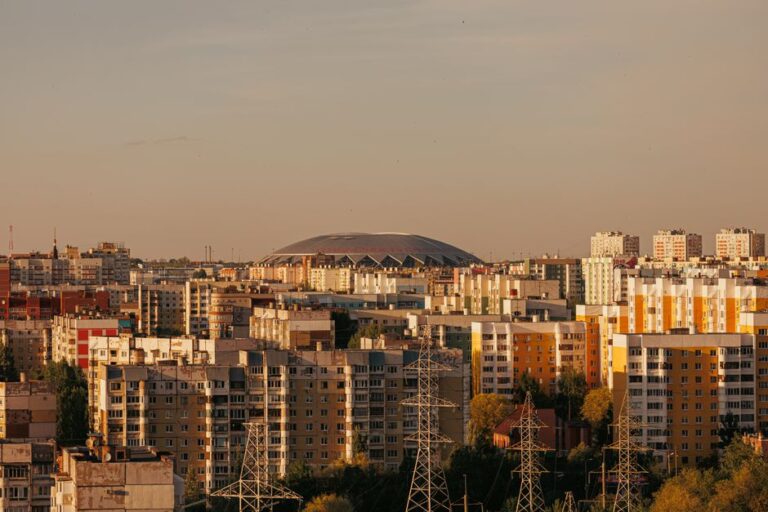
Kazan Travel Guide
Kazan travel guide: the UNESCO-listed Kazan Kremlin and Qolşärif Mosque, Bauman Street, the Old Tatar Quarter, Bolgar and Sviyazhsk, Tatar food, safety notes, history…
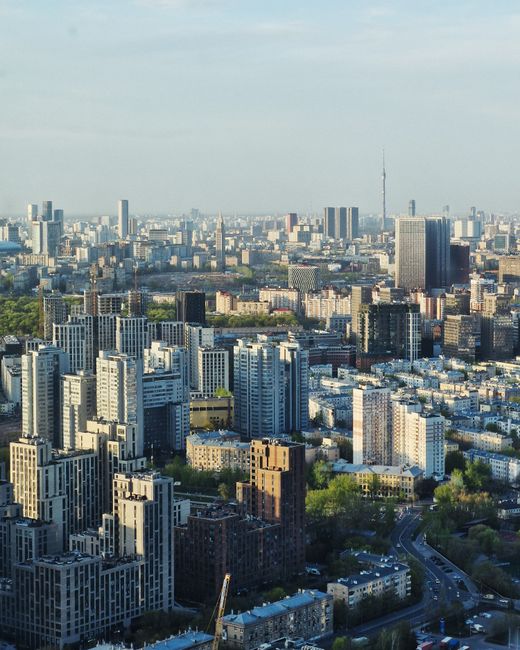
Moscow Travel Guide
Moscow travel guide: the Kremlin and Red Square, St Basil's Cathedral, the Moscow Metro, the Bolshoi and Tretyakov, Novodevichy and Kolomenskoye, safety notes, history…
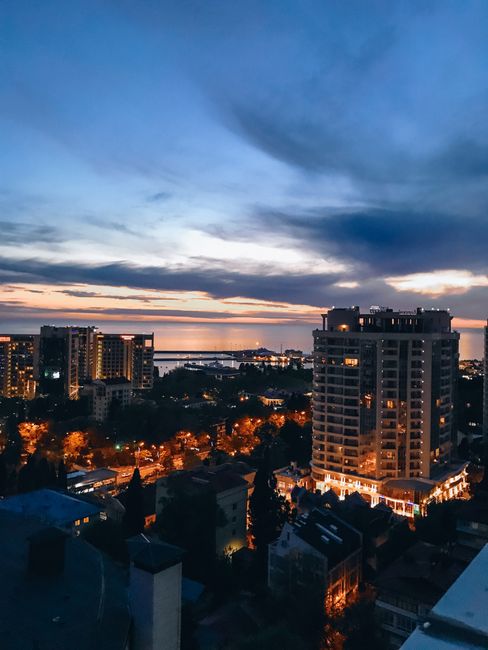
Sochi Travel Guide
Sochi travel guide: the Black Sea seafront and sanatoriums, the Arboretum, Krasnaya Polyana and the Western Caucasus, the 2014 Olympic Park, safety notes, history…
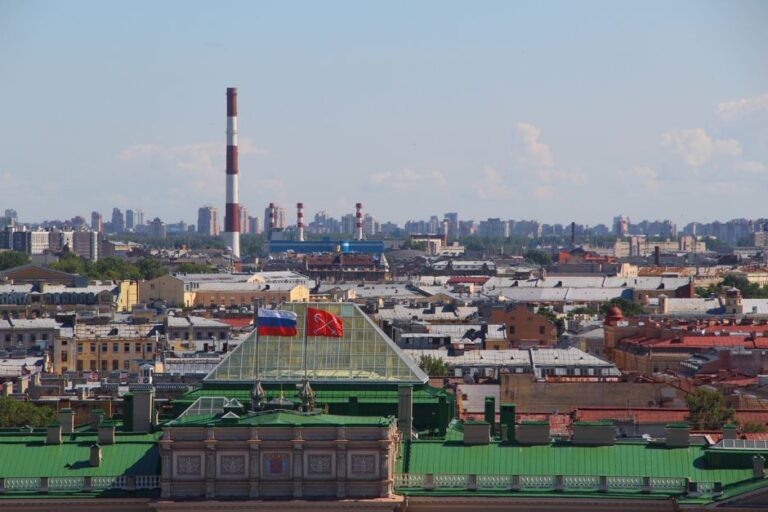
St Petersburg Travel Guide
St Petersburg travel guide: the Hermitage and Winter Palace, Nevsky Prospekt and the canals, St Isaac's, Peterhof and Tsarskoye Selo, White Nights, safety notes,…
Climate and seasons
Most of Russia has a continental climate, with long, very cold winters and short, warm summers; the further east and north you go, the more extreme it becomes. Moscow and Kazan have snow cover for four to five months, St Petersburg is milder but damp and dark in winter, while the Black Sea coast around Sochi is subtropical. In parts of Siberia winter temperatures fall below −40 °C. The table uses official 1991–2020 averages.
| City | January high / low | July high / low | Rain and snow per year |
|---|---|---|---|
| Moscow | −3.9 / −8.7 °C | 24.7 / 14.8 °C | 712 mm |
| St Petersburg | −2.5 / −7.2 °C | 23.3 / 15.3 °C | 668 mm |
| Kazan | −7.1 / −12.8 °C | 25.8 / 15.8 °C | 564 mm |
| Sochi | 9.8 / 3.7 °C | 27.9 / 20.1 °C | 1,657 mm |
Entry rules
Entry rules are set by the Russian authorities and can change at short notice. In summary:
- Visas: British, US, Canadian and Australian citizens need a visa arranged before travel. UK residents aged 12 and over must give fingerprints at a visa application centre in London, Manchester or Edinburgh, and that biometric data is also taken on arrival in Russia.
- e-visa: Russia’s Ministry of Foreign Affairs issues a unified electronic visa to citizens of 64 countries, including all EU countries, Norway, Switzerland, Iceland, Japan, India, China and Turkey, but not the UK, the US, Canada or Australia. It is single-entry, allows a stay of up to 30 days, is valid for 120 days from issue, must be applied for between 86 and 4 days before arrival, requires medical insurance and can be used only at designated airports and border crossings. The official portal says that, because of sanctions, fees can be paid only with cards issued by banks in certain countries.
- Passport: it must be valid for at least six months after your visa expires, and you cannot use a visa in an expired passport. Sign your passport if it was issued after January 2017.
- Migration card and registration: you sign a migration card at passport control and must keep your half until you leave. Every foreigner must be registered at their place of stay within seven working days; hotels do this automatically, and you must show proof when you leave.
- Customs: CBD products are illegal, GPS devices and some other electronics need a licence, and antiques and art need export permits. Cash rules are explained below.
- Leaving: you may be stopped from leaving if you have unpaid debts, fines or penalties in Russia, and dual nationals who receive a military call-up notice are barred from leaving.
Sanctions and everyday practicalities
Sanctions imposed since 2022 by the UK, the EU, the US and other countries, and Russia’s own counter-measures, have changed how travel works:
- Payments: Visa and Mastercard stopped operating in Russia in 2022. Cards issued outside Russia do not work in Russian shops or cash machines, and Russian-issued cards work only inside Russia. There are few remaining ways to transfer money to Russia, and Western banks may refuse transfers even to non-sanctioned banks.
- Cash: paying directly in foreign currency is illegal. Visitors have to bring US dollars or euros and change them at banks, hotels or licensed exchange offices. You may bring in and take out cash worth up to US$10,000 without declaring it, but you cannot leave Russia with more than that amount, even if you declare it.
- Flights: the UK, the EU, the US and Canada closed their airspace to Russian airlines in 2022, and Western airlines do not fly to Russia. There are no direct flights to the UK or through EU countries; the remaining routes go via Turkey, the Middle East, Serbia, Azerbaijan, Georgia and Central Asia. The UK has sanctioned Aeroflot, Rossiya and Ural Airlines; UK sanctions guidance says British nationals can buy tickets for journeys that start in, or within, Russia without breaching UK sanctions. The US Federal Aviation Administration has downgraded Russia’s air safety rating.
- Land borders: Finland has closed its entire border with Russia. The Narva–Ivangorod crossing with Estonia is open to pedestrians only, and Latvia, Lithuania and other European countries restrict or ban the entry of Russian-registered vehicles. The border between Russia and Ukraine is closed.
- Phones and internet: foreign SIM cards may not get mobile internet or text messages; a SIM that has been off the Russian network for 72 hours can be blocked from data and SMS for hours or days. Buying a local SIM requires your passport and biometric checks and can take up to two weeks. Facebook, Instagram, X and LinkedIn are blocked.
- Electronics: assume that phone and internet communications may be monitored, and think carefully about which devices you bring. Some equipment, including GPS devices, needs a licence.
Safety, health and the law
Beyond the points above, watch for pickpocketing and theft in tourist areas, street crime by gangs in St Petersburg, drink spiking, deaths from methanol in counterfeit alcohol, unlicensed taxis and criminals posing as police. Always carry your passport, as police carry out random checks and copies are not accepted. Drug offences, including possessing CBD products, carry long prison sentences. Photography is banned at military, official and secure sites, including airports, often without signs. Healthcare may not meet Western standards, hospitals may ask for payment before treatment, and the EHIC and GHIC are not valid. The emergency number is 112.
Russia travel FAQ
Is it safe to travel to Russia now?
Conditions are difficult. The war with Ukraine is ongoing, drone attacks can close airspace and airports at short notice, there is a risk of terrorism and of detention for foreigners, and consular help is very limited. Read the safety section above for the details.
Does travel insurance cover Russia?
Usually not. Most standard travel insurance policies exclude Russia, including medical treatment and evacuation. Some specialist insurers offer cover, but read the exclusions carefully.
Can I use Visa or Mastercard in Russia?
No. Visa and Mastercard stopped operating in Russia in 2022, so foreign-issued cards do not work in shops or cash machines. People who travel have to bring US dollars or euros in cash and exchange them for roubles locally.
Are there direct flights to Russia from the UK, the EU or the US?
No. Western countries closed their airspace to Russian airlines in 2022, and their own airlines do not fly to Russia. The only routes are indirect, via Turkey, the Middle East, Serbia, Azerbaijan, Georgia or Central Asia.
Do I need a visa for Russia?
Most Western visitors do. British, US, Canadian and Australian citizens need a visa arranged in advance. Citizens of the EU and several dozen other countries can apply for Russia’s unified e-visa, valid for a single stay of up to 30 days.
Can I cross into Russia from Finland or Estonia?
The Finnish government has closed its whole land border with Russia. The Narva–Ivangorod crossing between Estonia and Russia is open to pedestrians but closed to vehicles, and other crossings from Latvia and Lithuania are restricted.
What should dual nationals know?
Russia treats dual nationals as Russian citizens. They may be refused consular access if detained, may be stopped from leaving if they receive a call-up notice, and must notify the Russian authorities of their second citizenship.
What time zone is Moscow in?
Moscow time is UTC+3 all year, with no daylight saving time. Russia spans eleven time zones, from UTC+2 in Kaliningrad to UTC+12 in Kamchatka.
Sources and last review
Researched and last reviewed on 4 October 2026. Entry rules, sanctions effects, money, flights, phones, borders and safety from GOV.UK foreign travel information (updated 18 September 2026) and the US State Department’s country information (28 December 2025); the unified e-visa and registration rule from the Russian Ministry of Foreign Affairs’ official e-visa portal; exchange rates from the Bank of Russia; World Heritage listings from UNESCO; climate from the official 1991–2020 normals Russia submitted to the World Meteorological Organization; UK sanctions from GOV.UK. The population figure, the EU, US and Canadian airspace closures and the time-zone details come from secondary sources or general knowledge and are flagged for checking. History and geography are summarised from standard reference works. Sanctions and entry rules can change at short notice, so check the latest official information.
Plan your trip
Partner links: TravelerCenter may earn a commission if you book, at no extra cost to you.
🇷🇺 Useful Russian phrases for Russia
All 38 Russian phrases: restaurant, hotel, emergencies, romance (printable) →