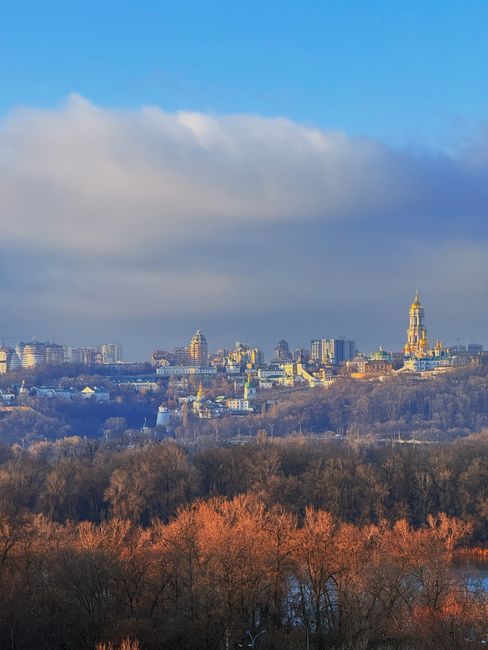
Kyiv, Ukraine’s capital and largest city, spreads across green hills and wide plains on both banks of the Dnipro river. It is one of the oldest cities in Eastern Europe: the cradle of the medieval state of Kyivan Rus’, where Christianity was adopted in 988, and the home of some of the region’s most important churches and monasteries, including the golden-domed St Sophia’s Cathedral and the Kyiv-Pechersk Lavra above the river. Today it is the seat of a country at war. This guide explains what Kyiv is known for and how it came to be, with notes on current conditions.
Right now in Kyiv
- Wed 10–20°C 51–67°F Partly cloudy
- Thu 12–22°C 54–71°F Clear
- Fri 14–21°C 57–69°F 2 mm Clear
Weather: MET Norway (CC BY 4.0)
Kyiv at a glance
- Status: capital of Ukraine, a city with special status (ISO 3166-2 code UA-30).
- Population: about 2.95 million on 1 February 2022, the last official estimate before the full-scale invasion; the statistics service has not published figures since, and numbers have changed with displacement.
- Setting: on the Dnipro, with the historic centre on the high right (west) bank and newer districts on the low left bank.
- Language: Ukrainian is the official language; many residents also speak Russian.
- Time zone: Eastern European Time, UTC+2 (UTC+3 in summer).
- Currency: the hryvnia (UAH).
- World Heritage: Saint-Sophia Cathedral and related monastic buildings, and the Kyiv-Pechersk Lavra, inscribed together by UNESCO in 1990 and placed on the List of World Heritage in Danger in 2023.
A short history of Kyiv
Legend says Kyiv was founded by three brothers, Kyi, Shchek and Khoryv, and their sister Lybid; the city traditionally dates itself to 482. By the 9th and 10th centuries it was the capital of Kyivan Rus’, a powerful state of Eastern Slavs ruled by princes of Scandinavian origin, on the trade route “from the Varangians to the Greeks”. In 988 Prince Volodymyr the Great adopted Christianity from Byzantium and, according to the chronicles, had the people of Kyiv baptised in the Dnipro. His son Yaroslav the Wise built St Sophia’s Cathedral and the Golden Gate in the 11th century, and the monks Anthony and Theodosius founded the cave monastery that became the Kyiv-Pechersk Lavra.
In 1240 the Mongols sacked the city. It later came under Lithuanian and Polish rule, became a centre of Orthodox learning in the 17th century with the Kyiv-Mohyla Academy, and passed to Russian rule after the Cossack Hetmanate allied with Muscovy in 1654.
During the revolutionary years of 1917 to 1921 Kyiv was the capital of the short-lived Ukrainian People’s Republic and changed hands many times. It became the capital of Soviet Ukraine in 1934. The 1932–33 famine known as the Holodomor devastated the Ukrainian countryside. In the Second World War the city was occupied by German forces from 1941 to 1943; at Babyn Yar, in September 1941, they murdered more than 33,000 Jews in two days, and tens of thousands more people over the following years. The centre, including Khreshchatyk street, was rebuilt in grand Stalinist style after the war. In 1986 the Chornobyl nuclear disaster took place about 100 km to the north.
Ukraine became independent in 1991, with Kyiv as its capital. Maidan Nezalezhnosti (Independence Square) was the centre of the Orange Revolution of 2004 and of the Revolution of Dignity in 2013 and 2014. When Russia launched its full-scale invasion in February 2022, Russian forces advanced on the capital from the north and west but withdrew from the Kyiv region at the end of March 2022. The city has since been a frequent target of missile and drone attacks.
What Kyiv is known for
St Sophia’s Cathedral
Founded in the 11th century under Yaroslav the Wise, St Sophia’s is one of the great monuments of the medieval Orthodox world. Behind its 18th-century Ukrainian Baroque exterior, with white walls and green and gold domes, the interior keeps original mosaics and frescoes, including the towering mosaic of the Virgin Orans in the apse. Its tall blue and white bell tower overlooks Sofiiska Square.
The Kyiv-Pechersk Lavra
The Monastery of the Caves, founded in 1051, grew from caves dug into the Dnipro hills by its first monks. The Near and Far Caves still hold the mummified remains of saints, and above ground the complex has gilded churches, the Great Lavra Bell Tower, the Dormition Cathedral (destroyed in 1941 and rebuilt in 2000) and several museums of the national reserve. It is one of the holiest places of Eastern Orthodoxy.
St Michael’s and St Andrew’s
The blue and gold St Michael’s Golden-Domed Monastery, demolished by the Soviet authorities in the 1930s, was rebuilt in the late 1990s and faces St Sophia’s along a short boulevard. St Andrew’s Church, designed by the Italian architect Bartolomeo Rastrelli in the 1740s and 1750s, stands on a hill at the top of the winding, cobbled Andriivskyi Descent, the street of artists and of the writer Mikhail Bulgakov, whose house there is a museum.
The Golden Gate, Khreshchatyk and Maidan
The Golden Gate is a 1982 reconstruction over the ruins of the 11th-century gate of Yaroslav’s city. Khreshchatyk and Maidan Nezalezhnosti are the stage for the city’s celebrations and political history.
The Dnipro, its hills and parks
Kyiv is one of Europe’s greenest capitals. Parks run along the steep right bank of the Dnipro, from the Volodymyrska Hill to the Mariinskyi Park beside the Mariinskyi Palace, with views over the river and its islands. To the south, the Motherland Monument, a 62-metre steel statue completed in 1981, rises above the National Museum of the History of Ukraine in the Second World War; in 2023 the Soviet coat of arms on its shield was replaced by Ukraine’s trident. The Pyrohiv open-air museum on the southern edge of the city gathers wooden churches, windmills and farmhouses from all over Ukraine.
Climate
Kyiv has a humid continental climate: cold, snowy winters, with average temperatures a little below freezing from December to February, and warm summers, with July averaging about 21 °C and frequent thunderstorms. Winter temperatures can drop below −20 °C, which matters when attacks on the energy system cause power, heating and water cuts.
| Season | Average temperature (day and night) | Rain or snow per month |
|---|---|---|
| Winter (Dec–Feb) | −3.2 to −1.8 °C | 37–47 mm |
| Spring (Mar–May) | 2.5 °C rising to 15.8 °C | 40–65 mm |
| Summer (Jun–Aug) | 19.5–21.3 °C | 56–74 mm |
| Autumn (Sep–Nov) | 14.9 °C falling to 2.6 °C | 46–58 mm |
Kyiv gets about 618 mm of rain and snow a year. The figures are the official 1991–2020 averages for the Kyiv station that Ukraine submitted to the World Meteorological Organization; that submission gives average (mean) temperatures rather than daytime highs and night-time lows.
Safety and current conditions
An armed conflict is ongoing in Ukraine. Russian missile and drone attacks on Kyiv are frequent and have killed and injured civilians and damaged homes, energy, rail and other infrastructure. Martial law is in force and Ukraine’s airspace is closed. Points to know:
- Air alerts: install an air-alert app (such as Air Alert, Air Raid Siren or Alarm Map), know where your nearest shelter is, and go there immediately when an alert sounds. Kyiv’s deep metro stations are used as shelters.
- Martial law and curfew: a nationwide curfew applies; check the hours locally, carry your passport at all times and follow instructions from officials.
- Power cuts: attacks on the energy system cause scheduled and emergency blackouts that can also cut heating and water. Keep water, food, warm clothing, a charged power bank and some cash in hryvnias.
- Getting in and out: by rail or road from or towards Poland, Slovakia, Hungary, Romania or Moldova; be ready to leave at short notice.
- Insurance: standard travel insurance policies almost always exclude war zones, so check the wording of your policy.
- Consular help: in-person consular help in Ukraine is very limited, and some countries offer full consular services only in neighbouring countries.
- Emergencies: 101 fire and rescue (also for reporting unexploded weapons), 102 police, 103 ambulance. British nationals can call the British Embassy in Kyiv on +380 44 490 3660; US citizens can email KyivACS@state.gov.
Kyiv FAQ
Is it safe to travel to Kyiv now?
An armed conflict is ongoing. Russian missile and drone attacks on Kyiv are frequent, air-raid alerts sound often, martial law and a curfew apply, and the airspace is closed. See the safety section above for the details.
Are there flights to Kyiv?
No. Ukraine’s airspace has been closed to civilian flights since February 2022. The only ways in and out are by road and rail through neighbouring countries.
Will travel insurance cover a trip to Kyiv?
Usually not. Most standard travel insurance policies exclude war zones. Specialist cover exists for people who must travel for work, but read the policy carefully.
What is Kyiv known for?
St Sophia’s Cathedral and the Kyiv-Pechersk Lavra, both UNESCO World Heritage Sites, St Michael’s Golden-Domed Monastery, St Andrew’s Church and the Andriivskyi Descent, the Golden Gate, Khreshchatyk and Maidan, the green hills above the Dnipro and the Motherland Monument.
Is it Kyiv or Kiev?
Kyiv is the official English spelling, transliterated from the Ukrainian name Київ, and has been used by the Ukrainian government since 1995. The UK, the US and most international media switched to it in 2019 to 2022. “Kiev” is the older spelling based on the Russian name.
Sources and last review
Researched and last reviewed on 4 October 2026. Safety and practical information from GOV.UK foreign travel information (updated 2 October 2026) and the US State Department’s country information (27 August 2026); World Heritage listing and danger status from UNESCO; climate from the official 1991–2020 normals Ukraine submitted to the World Meteorological Organization; pre-war population from the State Statistics Service of Ukraine. History is summarised from standard reference works. Conditions can change at short notice, so check the latest official information.
Plan your trip
Partner links: TravelerCenter may earn a commission if you book, at no extra cost to you.
🇺🇦 Useful Ukrainian phrases for Kyiv
All 38 Ukrainian phrases: restaurant, hotel, emergencies, romance (printable) →