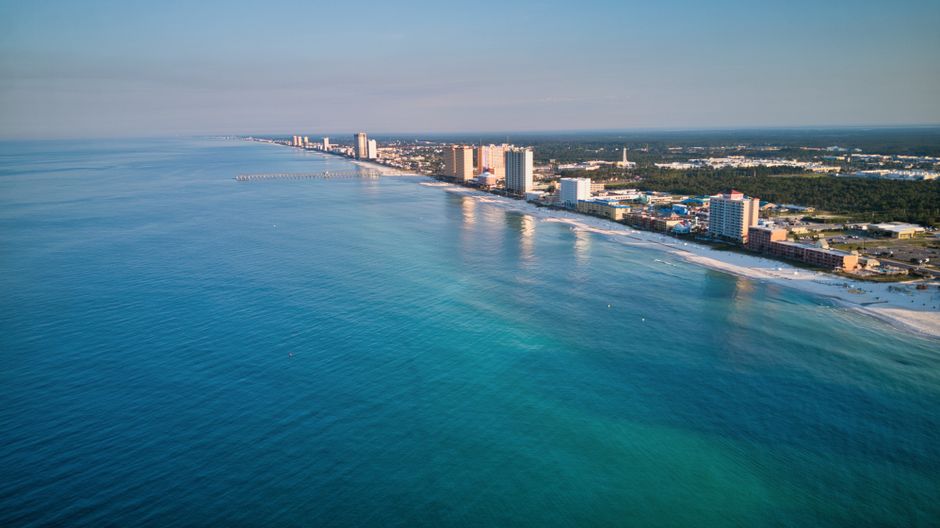
Panama City Beach is a long, lively resort town on Florida’s Panhandle, with about 27 miles (43 km) of white quartz sand and clear green Gulf water stretching west from St. Andrew Bay. The city says it welcomes more than 4 million visitors a year to a town of about 19,000 residents. It is a classic, good-value American beach holiday: condo towers and family motels, mini-golf and seafood shacks, the Pier Park shopping and dining district, and two long fishing piers. At its eastern end, St. Andrews State Park and the boat-only Shell Island show the coast at its most natural. The town was once famous for wild spring breaks, and strict rules now apply in March. Like the rest of the western Panhandle, it is on Central Time. The best months are April to June and September to October.
Right now in Panama City Beach
- Wed22–29°C71–85°FCloudy
- Thu22–29°C72–85°FCloudy
- Fri23–27°C73–81°F28 mm rain
- Mon 12 Oct Columbus Day
Top tours in Panama City Beach
See all tours for Panama City Beach →
From local operators, with prices and reviews; you check availability and book on Viator, our partner. We may earn a commission at no extra cost to you. How we earn money
Panama City Beach at a glance
- Best for: affordable family beach holidays, white sand and green water, Shell Island, snorkelling and dolphin tours, fishing piers and seafood.
- How long: 4–7 days for the beach, St. Andrews State Park and Shell Island, with a day along 30A or to Mexico Beach.
- Best time: April to June and September to October, with average highs of 79–89 °F (26–32 °C). Winters are cool, around 64–67 °F (18–20 °C), and the sea is cold.
- Getting there: fly to Northwest Florida Beaches International Airport (ECP), about 20 minutes from the beach, and rent a car.
- Time zone: Central Time (America/Chicago), one hour behind Orlando and Miami.
- Before you go: entry rules, money, driving and general safety are on our United States travel guide.
Panama City Beach’s areas and who each one suits
The city runs along Front Beach Road, which hugs the Gulf, with the faster Panama City Beach Parkway (US 98) inland. It is in Bay County; the separate city of Panama City lies across the bay on the mainland.
Central PCB and Pier Park
The busiest stretch, around Pier Park and the Russell-Fields City Pier, with high-rise condos, big beach hotels, restaurants, bars and attractions within walking distance. Ideal for first-timers and families who want everything close; less peaceful at night and during spring break.
The east end and Thomas Drive
Towards St. Andrews State Park, Thomas Drive and the Grand Lagoon have marinas, boat tours, seafood restaurants and condo resorts. The best base for boating, fishing and Shell Island trips.
The west end and Laguna Beach
West of Pier Park, the buildings get lower and the beach quieter, with vacation homes, smaller condos and Camp Helen State Park near the Walton County line. Good for families and couples who prefer calm evenings and space on the sand.
Top things to see in Panama City Beach
Prices and rules below were checked in October 2026, on official sites unless we say otherwise; check again before you go.
St. Andrews State Park
At the eastern tip of the beach, this former military reservation of about 1,200 acres (490 ha) protects white beaches on the Gulf and the bay, dunes, pine woods, a fishing pier and a campground. Its rock jetties enclose a calm, shallow lagoon, one of the best snorkelling spots on the Panhandle for small fish and crabs, perfect for children. As of 2026 the entrance fee is about $8 per vehicle with 2–8 people, $4 for one person in a car and $2 for pedestrians and cyclists; check the Florida State Parks site for current fees and hours. Come early on summer weekends, when the park can fill up.
Shell Island
Shell Island is an undeveloped barrier island about 7 miles (11 km) long across the pass from St. Andrews, with no buildings, no shade and no facilities, just dunes, shells and clear water on both sides. You can only get there by boat: the Shell Island Shuttle, which runs from St. Andrews State Park, charges $19.95 round trip for ages 13 and over and $12.95 for ages 3–12 as of October 2026, with under-3s free; park entry is extra. According to the operator, boats leave every 30 minutes from 9:00 a.m. to 5:00 p.m. from Memorial Day to Labor Day, and hourly from 10:00 a.m. to 4:00 p.m. in spring and autumn, weather and water permitting. Bring everything you need, including water, shade and a bag for your rubbish, and check the last boat back. Pontoon rentals, snorkel tours and dolphin cruises from the Grand Lagoon also stop there.
The piers
Two long concrete fishing piers reach far into the Gulf: the Russell-Fields City Pier at Pier Park and the M.B. Miller County Pier further east. Both are popular with anglers and walkers, and great for watching dolphins, rays and sunsets. There is a small fee to walk or fish; check at the entrance.
Pier Park
An open-air shopping and entertainment district across Front Beach Road from the City Pier, with shops, restaurants, a cinema, a SkyWheel observation wheel and frequent free events. It is the center of the town’s evening life for families.
More to see
- Camp Helen State Park: a quiet state park at the west end, between the Gulf and Lake Powell, a rare coastal dune lake.
- Panama City Beach Conservation Park: the city’s free nature park, with boardwalks and trails through wetlands and pine forest.
- Gulf World Marine Park: a marine park with dolphins, sea lions and a sea-turtle rescue program.
- Man in the Sea Museum: a small diving-history museum on the west end.
Other sights
- Pier Park
Museums
- Man in the Sea Museum
Parks and gardens
- Camp Helen State Park
- St. Andrews State Park
Beaches and other things to do
Beach flags and the $500 double red fine
Panama City Beach takes water safety very seriously after years of drownings in rip currents. The city’s flags mean: green, low hazard (calm conditions, exercise caution); yellow, medium hazard (moderate surf and/or currents); red, high hazard (high surf and/or strong currents); purple, dangerous marine life; and double red, water closed to the public. Entering the Gulf under double red flags brings a $500 fine, and $1,000 for a second offence. Swim near a lifeguard or a flag pole, and text PCBFLAGS to 888777 for the city’s flag alerts. If you are caught in a rip current, do not fight it: float and swim parallel to the shore.
Other beach rules
Glass is not allowed on the beach, and the city issues citations for it. Among its spring-break rules, the city’s ordinances prohibit alcohol on the sandy Gulf beach during March, restrict alcohol sales hours in March and ban drinking in commercial parking lots that month. In 2026 the city also closed part of the beach near its eastern border every night from 10:00 p.m. to 4:00 a.m. between 12 March and 30 April, with fines of up to $500; expect similar measures in future springs. Sea turtles nest here in summer, so keep lights off the beach at night, and take your tents and furniture with you at the end of the day. Red tide occasionally reaches the Panhandle: check the Florida Fish and Wildlife Conservation Commission’s red tide status, NOAA’s Gulf Coast harmful algal bloom forecast and the Florida Department of Health’s Healthy Beaches advisories.
On the water
Dolphin-watching cruises, snorkel trips to Shell Island and pontoon rentals leave from the Grand Lagoon and Thomas Drive marinas. Divers come for the artificial reefs and shipwrecks offshore, and charter boats go after snapper, grouper and king mackerel. Parasailing, jet skis and paddleboards are available along the beach in season.
Day trips and onward travel
Scenic Highway 30A and Destin
West of town, the pretty planned beach towns of Rosemary Beach, Alys Beach, Seaside and Grayton Beach line Scenic Highway 30A in Walton County, a good half-day for lunch, shops and a beach walk. Destin, with Crab Island and its fishing harbor, is about an hour west.
Mexico Beach, Port St. Joe and Apalachicola
East along US 98 past Tyndall Air Force Base, the “Forgotten Coast” is quiet and unspoilt: Mexico Beach, rebuilt after Hurricane Michael; St. Joseph Peninsula State Park near Port St. Joe, with high dunes and scalloping in the bay in summer; and Apalachicola, an old cotton and oyster port with a charming historic center, about 1½ hours away. Note that Apalachicola is on Eastern Time.
Nearby destinations
- Destin69 km
- Gulf Shores182 km
Getting there and getting around
By air
Northwest Florida Beaches International Airport (ECP) is inland, north of the west end, and the airport says it is about 20 minutes from Panama City Beach. It has daily nonstop flights to a range of US cities, some seasonal, plus rental cars, taxis and ride sharing. Destin–Fort Walton Beach Airport (VPS) is about an hour and a half west, and Tallahassee and Pensacola are further options.
Driving and getting around
A car is the easiest way to get around the long, spread-out town. Front Beach Road is slow and busy in summer and during spring break; use the Parkway (US 98) or Back Beach Road for longer hops. Local buses run along the beach, but services are limited. From I-10, the main routes south are US 231 and SR 77 via Panama City, or SR 79 to the west end. There are no toll roads on the usual routes; if you do use one in a rental car, Florida’s electronic tolls are billed through the rental company’s toll program, with its own fees.
When to go and how long to stay
Panama City Beach has hot, humid summers and cool winters. The table uses NOAA’s 1991–2020 climate normals for the Panama City 5N weather station, just north of the bay: average daily highs and lows, and days with at least 0.10 in (2.5 mm) of rain. Like the rest of the Panhandle, it has no real dry season: winter fronts bring about 4–5 in (104–128 mm) of rain a month, and summer thunderstorms more. March is spring-break season, June to August the family peak, and autumn the quiet sweet spot.
| Season | Average high / low | Rainy days per month | What it’s like | Good for |
|---|---|---|---|---|
| Winter (Dec–Feb) | 64–67 °F (18–20 °C) / 43–46 °F (6–8 °C) | 6 | Cool and changeable, sometimes cold and windy; empty beaches | Long, cheap stays, beach walks, fishing |
| Spring (Mar–May) | 73–85 °F (23–30 °C) / 52–66 °F (11–19 °C) | 4–6 | Warming quickly; spring break in March | Beaches from late April, state parks, Shell Island |
| Summer (Jun–Aug) | 89–91 °F (32–33 °C) / 73–75 °F (23–24 °C) | 9–10 | Hot and humid, warm sea, afternoon thunderstorms | Swimming, snorkelling, boat trips |
| Autumn (Sep–Nov) | 89 °F (32 °C) falling to 73 °F (23 °C) / 71 °F (22 °C) falling to 50 °F (10 °C) | 7 in September, 4 in November | Warm sea and quiet beaches in September and October | Beach days, fishing, good-value stays |
The station averages about 61.3 in (1,556 mm) of rain a year. The Atlantic hurricane season runs from 1 June to 30 November, with most activity from mid-August to mid-October, according to NOAA’s National Hurricane Center. On 10 October 2018 Hurricane Michael came ashore just east of here, near Tyndall Air Force Base and Mexico Beach, as a Category 5 storm with sustained winds of about 161 mph, according to the National Weather Service in Tallahassee, the strongest storm on record to hit the Panhandle. The region has largely rebuilt. In the season, follow the National Hurricane Center and the National Weather Service, check your evacuation zone with Bay County Emergency Services, obey evacuation orders and consider travel insurance.
Events worth planning around
- March: spring break, with the alcohol ban on the beach and other special rules; families may prefer April.
- Summer: fireworks and free concerts at Pier Park and the beach, especially around 4 July.
- Autumn: seafood festivals and fishing tournaments; check this year’s dates locally.
How long to stay: 4, 5 and 7 days
4 days: two beach days around Pier Park, a morning at St. Andrews State Park snorkelling in the jetty lagoon, and a Shell Island trip with a dolphin cruise.
5 days: add Camp Helen State Park and the Conservation Park, or a fishing charter. 7 days: add a day along 30A and a day east to Mexico Beach, St. Joseph Peninsula and Apalachicola.
Weather month by month
Where to stay in Panama City Beach and the hotel taxes
- Central PCB near Pier Park: walkable, lively and well served; book a high floor for the view.
- East end and Thomas Drive: close to St. Andrews, marinas and Shell Island boats.
- West end and Laguna Beach: quieter vacation homes and low-rise condos.
Panama City Beach is in Bay County. On a hotel or vacation-rental stay of six months or less you pay 7% sales tax (the 6% state rate plus a 1% county surtax) and Bay County’s 5% tourist development tax, which applies in the beach ZIP codes, about 12% in total. Since 1 October 2026 the tourist tax has been collected by the Bay County Tax Collector instead of the Clerk’s Office. Most rentals add cleaning fees, and resorts may charge resort and parking fees. Under a US Federal Trade Commission rule in force since 12 May 2025, mandatory fees such as resort fees must be included in the advertised total price (taxes may be shown separately), so compare total prices. During spring break many rentals set a minimum age for the person booking, often 21 or 25.
Practical tips for Panama City Beach
- Respect the flags: the $500 double red fine is enforced, and the rule is there to save lives.
- No glass, and no alcohol on the beach in March: leave both at your accommodation.
- Go to Shell Island prepared: there is no shade, water or shop; bring everything and take it back.
- Remember the time zone: Central Time, one hour behind Orlando and Tallahassee.
- Lightning: leave the beach at the first thunder; summer storms build fast.
- Emergencies: call 911.
What to pack for Panama City Beach
Pack swimwear, a rash guard, a wide-brimmed hat, sunglasses and plenty of reef-safe sunscreen, plus a beach umbrella or shade tent for Shell Island, where there is none. A mask and snorkel are worth bringing for the St. Andrews jetties, along with water shoes, a cooler with plastic or metal bottles rather than glass, and a dry bag for boat trips. Add a light rain jacket for summer storms, and warm layers and a windproof jacket from November to March, when nights can drop into the 40s °F (around 6–8 °C).
Panama City Beach travel FAQ
What is the fine for swimming under double red flags in Panama City Beach?
$500 for entering the water when double red flags are flying, and $1,000 for a second offence, according to the city. Double red means the water is closed to the public.
Is alcohol allowed on Panama City Beach?
Not during March, when a city ordinance prohibits alcohol on the sandy Gulf beach. Glass is banned all year. Outside March, check the current city and county rules before you bring drinks to the beach.
How do I get to Shell Island?
By boat. The Shell Island Shuttle leaves from St. Andrews State Park: as of October 2026, $19.95 round trip for ages 13 and up and $12.95 for ages 3–12, plus park entry. Tours and pontoon rentals from the Grand Lagoon also go there.
How much does it cost to enter St. Andrews State Park?
About $8 per vehicle with 2–8 people, $4 for a single-occupant car and $2 for pedestrians and cyclists as of 2026. Check the Florida State Parks site before you go.
What time zone is Panama City Beach in?
Central Time (America/Chicago), one hour behind Orlando and Miami. Apalachicola and towns further east are on Eastern Time.
What is the hotel tax in Panama City Beach?
About 12%: 7% sales tax plus Bay County’s 5% tourist development tax on stays of six months or less. Resort fees and parking are extra unless included in the total price.
Which airport serves Panama City Beach?
Northwest Florida Beaches International Airport (ECP), about 20 minutes from the beach, with rental cars, taxis and ride sharing. Destin–Fort Walton Beach Airport is about 1½ hours west.
Was Panama City Beach damaged by Hurricane Michael?
Michael made landfall just to the east on 10 October 2018 as a Category 5 hurricane, devastating Panama City, Tyndall Air Force Base and Mexico Beach. The beach resort escaped the worst, and the area has largely rebuilt.
When is the best time to visit Panama City Beach?
Late April to early June and September to October: warm sea, fewer crowds and lower prices than in summer. Avoid March if you want a quiet family trip.
Plan your trip
Partner links: TravelerCenter may earn a commission if you book, at no extra cost to you.
Sources · last reviewed 4 October 2026
Researched and last reviewed on 4 October 2026. Beach flags, double red fines and glass rule: the City of Panama City Beach; March alcohol ordinances and the 2026 night closures: the city’s ordinances; visitor and resident numbers: the city; Shell Island Shuttle fares and times, and the St. Andrews entrance fee: the Shell Island Shuttle; tourist tax: the Florida Department of Revenue and the Bay County Clerk of Court; airport: Northwest Florida Beaches International Airport; Hurricane Michael: the National Weather Service in Tallahassee; resort-fee rule: the US Federal Trade Commission; hurricane season: NOAA’s National Hurricane Center; climate: NOAA’s 1991–2020 normals for the Panama City 5N station. The state-park fee, beach length, pier details, drive times and events are general references and flagged for checking. Prices, hours and rules change, so check the official sites before you go. For entry rules, money and general safety, see our United States travel guide.
Also: NOAA NCEI normals 1991–2020, Panama City 5 N (climate)
Data: Weather: MET Norway (CC BY 4.0) · Sea temperature: NOAA CoastWatch · Rates: ECB · Holidays: Nager.Date · Costs: World Bank ICP and price levels · © OpenStreetMap contributors (ODBL) · Wikidata (CC0)