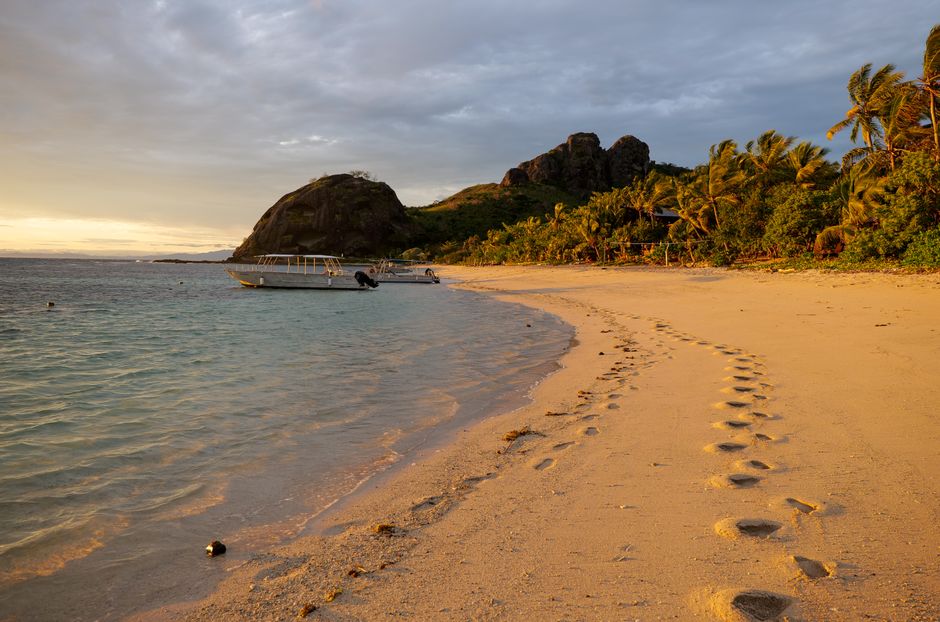
The Yasawa Islands are a chain of about 20 volcanic islands stretching some 80 km (50 miles) north from the Mamanuca group off Fiji’s west coast. They feel a world away from the resort strip of Denarau: high, grassy hills drop to long white beaches, small villages sit in the coconut palms, and most accommodation is in simple, friendly island resorts, from dorms and thatched bures to secluded boutique lodges. There are no roads, cars, banks or shops to speak of; life revolves around the sea, the village and the daily arrival of the Yasawa Flyer, the big yellow catamaran that runs up the chain from Port Denarau each morning and back each afternoon. That makes the Yasawas Fiji’s best island-hopping destination: buy a flexible pass, choose your islands as you go, and spend your days snorkeling with reef sharks, swimming with manta rays from May to October, climbing to summit lookouts for sunset, exploring the limestone Sawa-i-Lau caves and sitting in on a village kava ceremony. The islands lie in the dry rain shadow of Viti Levu, with plenty of sunshine, especially from May to October.
Right now in Yasawa Islands
- Wed24–26°C75–79°FClear
- Thu24–25°C75–77°FClear
- Fri24–25°C76–77°FClear
Top tours in Yasawa Islands
See all tours for Yasawa Islands →
From local operators, with prices and reviews; you check availability and book on Viator, our partner. We may earn a commission at no extra cost to you. How we earn money
Yasawas at a glance
- Best months: May to October for dry weather and manta rays; July to September is busiest. November to April is hotter and wetter, with a risk of tropical cyclones.
- Getting there: the Yasawa Flyer catamaran leaves Port Denarau at about 8:45 a.m. daily and returns by about 6 p.m.; seaplanes and helicopters fly from Nadi Airport to some resorts.
- Where to stay: island resorts, from backpacker dorms to beachfront bures and a few luxury lodges; most include or require meal plans.
- Time needed: five to ten nights to island-hop properly; a single resort for three or four nights.
- Costs (as of October 2026): a Bula Pass for unlimited Yasawa Flyer trips costs FJ$639 for 5 days and FJ$945 for 15 days; FJ$1 = about US$0.44.
- Before you go: there are no banks or ATMs in the Yasawas. Entry rules, the arrival card, the departure tax and money are covered in our Fiji travel guide.
Getting to and around the islands
The Yasawa Flyer
The Yasawa Flyer, run by Yasawa Adventures Fiji, formerly known as Awesome Adventures and part of the South Sea Cruises Group, is a large, high-speed catamaran with air-conditioned areas, a travel desk, a licensed bar, a food kiosk and outdoor viewing decks. It leaves Port Denarau each morning by 8:45 a.m., calls at South Sea Island in the Mamanucas and then works its way north through the Yasawa Islands as far as the Blue Lagoon area, dropping off and picking up passengers at each resort, and is back at Port Denarau by around 6 p.m. Resorts send small boats out to meet the Flyer, so be ready with your bags on the beach at the time your resort gives you. Check in at the terminal at Port Denarau 30 minutes before departure, or the day before after 10:30 a.m. to skip the morning queue. An optional upgrade to the Captain’s Lounge buys a private air-conditioned lounge with snacks and drinks.
Passes and packages
- Bula Pass: unlimited hop-on, hop-off travel on the Yasawa Flyer for 5 to 15 days; accommodation is not included, and you must have a booking for each night you get off the boat. From 1 September 2026, prices run from FJ$639 for 5 days to FJ$945 for 15 days.
- Yasawa Pass: the same flexible boat travel, with accommodation included; choose dorms, standard bures or upgraded bures, and book as you go or in advance.
- Packages: set itineraries of 3 to 11 nights covering two to five islands, with transfers, accommodation and meals.
The onboard travel desk takes card payments (no cash) for transfers and resort bookings as you travel. Book at least 24 hours before you want to get off, and confirm your final dates at least 14 days before arriving in Fiji in peak season. Cards attract a 2.5–3% administration fee.
Getting to Port Denarau
Coaches pick up from most Nadi, Wailoaloa, Denarau and Vuda hotels for the Flyer. If you fly in the same morning, a scheduled coach leaves Nadi Airport at 6:45 a.m. (FJ$11 per adult) and an express transfer at 7:15 a.m. (FJ$49), but given the risk of flight delays, it is safer to spend your first night near Nadi. A coach also meets the returning boat at about 6:15 p.m. for the airport and hotels.
Seaplanes and helicopters
Seaplanes and helicopters fly from Nadi Airport to a few resorts in about 30 to 45 minutes, useful for luxury lodges in the far north or for a scenic arrival. Yasawa Island, at the northern tip, also has a small airstrip used by its resort.
The islands, from south to north
Kuata and Wayasewa
The first Yasawa stop, about two hours from Port Denarau, Kuata has dramatic volcanic rock formations, a summit walk for sunset and one of Fiji’s best shark snorkels, where guides take you to see reef sharks and, for qualified divers, bigger species. Neighboring Wayasewa has a village and a resort below a striking cliff.
Waya
Waya is a large, mountainous island with several villages, coves and resorts, and hikes across the ridges with views down the chain.
Naviti, Drawaqa and Nanuya Balavu: the manta channel
Around Naviti, the largest island in the central Yasawas, small islands such as Drawaqa and Nanuya Balavu frame a channel where manta rays glide in to feed on plankton almost every day from about May to October, usually on the changing tide. Resorts nearby ring a bell or drum when the mantas arrive, and guests jump into boats to swim with them. Sightings are not guaranteed, but encounters are often long.
Nanuya Lailai, Tavewa and the Blue Lagoon
In the north, Nanuya Lailai, Tavewa, Matacawalevu and Nacula surround a sheltered stretch of water made famous by the 1980 movie The Blue Lagoon. This is the main hub of the northern Yasawas, with several resorts, good snorkeling, a walk over the hill to a hilltop tea house with lagoon views and easy boat trips to the caves.
Sawa-i-Lau
The limestone island of Sawa-i-Lau, near Yasawa Island, hides a pair of caves: you swim into a large, cathedral-like chamber lit from above, then duck through a short underwater passage, with a guide, into a dark second chamber. The caves belong to the nearby village, which charges an entry fee, often included in resort tours.
Yasawa Island
The northernmost and largest island in the group has a few villages and a luxury resort with its own airstrip. It is beyond the Flyer’s regular route.
Top things to do in the Yasawas
- Swim with manta rays in the Drawaqa channel from May to October, never touching them, as handling damages their protective mucus.
- Snorkel with reef sharks off Kuata Island with experienced guides.
- Explore the Sawa-i-Lau caves on a guided tour from the northern resorts.
- Climb a summit at sunrise or sunset, such as the hills behind Kuata, Mantaray and the Blue Lagoon resorts.
- Dive: several resorts have dive centers offering beginner courses and reef, wall and cave dives.
- Village and school visits: many resorts organize visits to neighboring villages, with a kava ceremony, a church service on Sunday or a visit to the local school.
- Kayak, paddleboard and handline fish in calm bays; most resorts lend kayaks and snorkeling gear.
- Night snorkeling, beach bonfires, meke performances and cooking classes at the resorts.
Food and drink
Island resorts provide all meals, and on most islands there is nowhere else to eat, so compare meal plans when you book. Expect buffet or set menus of fish, chicken, curries, rice, cassava and tropical fruit, with a lovo feast once a week. Bring snacks if you have special dietary needs. Alcohol is sold at resort bars; bringing your own onto the Flyer is not allowed.
Nearby destinations
- Mamanuca Islands88 km
- Nadi99 km
- Coral Coast162 km
When to go and how long to stay
The Yasawas are warm all year, with highs of 29 to 32 °C (84 to 89 °F) and nights rarely below 22 °C (72 °F). The dry season (May to October) has the most sunshine, the calmest seas and the manta rays; the southeast trade winds can make crossings choppy. The wet season (November to April) is hotter, wetter and the cyclone season, but rain usually falls in short, heavy bursts.
| Month | Average high | Average low | Rain | Rain days (≥1 mm) |
|---|---|---|---|---|
| Jan | 32 °C (89 °F) | 25 °C (76 °F) | 244 mm (9.6 in) | 13 |
| Feb | 32 °C (89 °F) | 25 °C (76 °F) | 191 mm (7.5 in) | 13 |
| Mar | 31 °C (89 °F) | 25 °C (76 °F) | 252 mm (9.9 in) | 15 |
| Apr | 31 °C (88 °F) | 24 °C (75 °F) | 166 mm (6.5 in) | 11 |
| May | 30 °C (86 °F) | 23 °C (74 °F) | 94 mm (3.7 in) | 7 |
| Jun | 29 °C (85 °F) | 23 °C (73 °F) | 66 mm (2.6 in) | 5 |
| Jul | 29 °C (84 °F) | 22 °C (72 °F) | 39 mm (1.5 in) | 4 |
| Aug | 29 °C (84 °F) | 22 °C (72 °F) | 61 mm (2.4 in) | 5 |
| Sep | 29 °C (85 °F) | 22 °C (72 °F) | 72 mm (2.8 in) | 5 |
| Oct | 30 °C (85 °F) | 23 °C (73 °F) | 95 mm (3.8 in) | 6 |
| Nov | 31 °C (87 °F) | 24 °C (75 °F) | 105 mm (4.1 in) | 8 |
| Dec | 31 °C (88 °F) | 24 °C (76 °F) | 166 mm (6.5 in) | 9 |
| Year | 30 °C (86 °F) | 24 °C (74 °F) | 1,551 mm (61 in) | 99 |
Figures are the Fiji Meteorological Service’s 1991–2020 normals for Yasawa-i-Rara, the weather station at the northern tip of the chain, as submitted to the World Meteorological Organization. The Yasawas get much less rain than Nadi, about 1,550 mm (61 in) a year, and July is the driest month.
How long to stay: 4, 7 and 12 days
- Four days: one or two islands in the south, such as Kuata and Waya, with a shark snorkel and summit sunset.
- Seven days: three islands, for example Kuata, the manta channel around Drawaqa and the Blue Lagoon, with the Sawa-i-Lau caves.
- Twelve days: four or five islands at a slow pace, adding Waya, Nacula or a luxury lodge, and a few nights in the Mamanuca Islands on the way back.
Where to stay in the Yasawas
Accommodation ranges from dormitories in social backpacker resorts to private beachfront bures and a handful of luxury lodges. Island resorts served by the Yasawa Flyer include Barefoot Kuata Island Resort, Waya Island Resort, Octopus Resort on Waya, Barefoot Manta Island Resort on Drawaqa, Mantaray Island Resort on Nanuya Balavu, Paradise Cove, Coconut Beach Resort, Blue Lagoon Beach Resort, Nanuya Island Resort, Boathouse Nanuya, Mai Sunset Beach and Oarsman’s Bay Lodge. A few exclusive resorts in the far north, including one on Yasawa Island, are reached by seaplane.
- Budget: dorm beds and basic bures with shared bathrooms, usually with a compulsory meal plan.
- Mid-range: private beachfront bures with en-suite bathrooms, fans and verandas.
- Luxury: villas with plunge pools, all-inclusive dining and private transfers.
Resorts run on generators and solar power, so electricity may only be available from sunset to midnight and in the morning; Wi-Fi is often limited to the main building. Bring a power bank.
Choosing the right resort
The Yasawas’ small resorts each have a distinct character, so it pays to mix them. Some are social, with communal tables, volleyball, bar games and evening entertainment; others are quiet, with a handful of bures, hammocks and early nights. Southern islands such as Kuata and Waya are closest to Port Denarau, which suits short stays; the central islands are best for mantas; and the northern resorts around the Blue Lagoon are farthest, with the calmest water and the caves. Families should check minimum ages and pool facilities, since a few resorts are adults-only, while divers should pick resorts with an on-site dive center. Look at whether the beach faces east for sunrise or west for sunset, whether the snorkeling is straight off the sand, and how steep the walk is from the landing to your bure. Because the Flyer passes each resort only once in each direction per day, changing islands costs you a morning or an afternoon, so stay at least two nights in each place.
Typical costs
| Item (as of October 2026) | Fijian dollars | About US dollars |
|---|---|---|
| Bula Pass, 5 / 7 / 10 days | FJ$639 / FJ$669 / FJ$759 | US$282 / US$296 / US$335 |
| Bula Pass, 15 days | FJ$945 | US$417 |
| Coach, Nadi Airport to Port Denarau, adult / express | FJ$11 / FJ$49 | US$5 / US$22 |
| Surfboard or paddleboard on the Yasawa Flyer, per board | FJ$30.70 | US$14 |
| Malamala Beach Club day pass with a Bula Pass | FJ$109 | US$48 |
| Dorm bed with meals, per person per night | about FJ$120–180 | about US$55–80 |
| Private bure with meals for two, per night | about FJ$400–800 | about US$175–355 |
| Luxury lodge, per night | about FJ$1,500 and up | about US$660 and up |
| Manta ray or Sawa-i-Lau cave trip | about FJ$70–120 | about US$30–55 |
Pass, coach and board prices are the operators’ published prices for travel from 1 September 2026 to 31 March 2027; a fuel surcharge has applied to South Sea Cruises resort transfers since 7 April 2026, and card payments carry a 2.5–3% fee. Accommodation and activity prices are typical ranges, not official figures. Conversions use the Reserve Bank of Fiji’s rate of US$0.44 to FJ$1 on 5 October 2026.
Safety in the Yasawas
- Cyclone season (November to April): boats stop running during tropical cyclone warnings. When Tropical Cyclone Vaianu passed in April 2026, day trips were suspended and only one Yasawa route ran on a reduced schedule, and boats then traveled slowly for days because of debris. Build flexibility into your plans and have travel insurance.
- Currents and channels: the manta channel and passes between islands can have strong currents; always swim with the resort’s guides and boats.
- Reef cuts: wear reef shoes and treat coral cuts straight away; they infect easily in the tropics.
- Sun: shade is limited on boats and beaches; use reef-safe sunscreen, a rash vest and a hat.
- Remoteness: medical help is hours away. Resorts have first aid and radio contact, but serious cases need evacuation to Nadi, so bring travel insurance that covers it, and carry any medicines you need.
- Dengue: use repellent; mosquito-borne diseases occur in Fiji.
- Water: drink the bottled or filtered water provided by your resort.
Practical tips for the Yasawas
- Cash: bring enough Fijian dollars for village fees, bar bills that are cash only and small purchases; there are no ATMs.
- Luggage: pack light. Bags are carried on and off small boats at each stop; a dry bag protects electronics.
- Reconfirm: confirm your Flyer seat the day before each transfer.
- Village etiquette: dress modestly, remove your hat and bring a small gift of kava (sevusevu) when visiting a village.
What to pack
Swimwear, a rash vest, reef shoes, a mask and snorkel, reef-safe sunscreen, a hat, insect repellent, a headlamp or flashlight for nights without power, a power bank, a dry bag, a light rain jacket, a sarong or T-shirt that covers your shoulders, seasickness tablets, any medicines you need and cash in Fijian dollars.
Yasawa Islands travel FAQ
How do I get to the Yasawa Islands?
Take the Yasawa Flyer catamaran from Port Denarau, near Nadi, which leaves at about 8:45 a.m. daily; or fly by seaplane or helicopter from Nadi Airport to some resorts.
How long does the Yasawa Flyer take?
About two hours to the first Yasawa island, Kuata, and four to five hours to the Blue Lagoon area at the northern end of the route.
What is the Bula Pass?
A flexible, hop-on, hop-off ticket for unlimited Yasawa Flyer trips for 5 to 15 days, from FJ$639 to FJ$945 for travel from 1 September 2026; accommodation is booked separately. The Yasawa Pass includes accommodation.
When can you swim with manta rays in the Yasawas?
From about May to October, in the channel between Drawaqa and Nanuya Balavu islands, usually on the change of tide. Sightings are likely but not guaranteed.
Are there ATMs in the Yasawa Islands?
No. Bring cash from Nadi or Port Denarau; resorts accept cards, usually with a fee.
Is there electricity and Wi-Fi in the Yasawas?
Resorts use generators and solar power, so electricity may only run in the evening and morning, and Wi-Fi is often limited to the main building.
Which Yasawa island is best?
Kuata for reef sharks and summit views, Drawaqa and Nanuya Balavu for manta rays, Waya for hiking, and Nanuya Lailai and the Blue Lagoon area for beaches, snorkeling and the Sawa-i-Lau caves.
Can I visit the Yasawas on a day trip?
You can ride the Yasawa Flyer up the chain and back in a day without going ashore, but the islands are best experienced by staying at least a few nights.
Do I need to book Yasawa resorts in advance?
It is wise in July to September and school holidays. At other times, Bula Pass and Yasawa Pass holders can book as they go through the onboard travel desk, at least 24 hours before getting off.
Are meals included at Yasawa resorts?
Most resorts sell meal plans, often compulsory, because there are no other places to eat on most islands.
Plan your trip
Partner links: TravelerCenter may earn a commission if you book, at no extra cost to you.
Sources · last reviewed 5 October 2026
Researched and last reviewed on 5 October 2026. The Yasawa Flyer, passes, prices, check-in, coach transfers, manta season, resort list, banking and power information come from Yasawa Adventures Fiji and South Sea Cruises, including their April 2026 cyclone notice; the exchange rate from the Reserve Bank of Fiji; climate from the Fiji Meteorological Service’s 1991–2020 normals for Yasawa-i-Rara, as published by the World Meteorological Organization; coordinates and area from Wikidata. Island descriptions, sailing times to individual islands, Sawa-i-Lau fees, seaplane times and accommodation and activity prices are general references or estimates and should be checked with the resorts. For entry rules, the arrival card, the departure tax and money, see our Fiji travel guide.
Data: Weather: MET Norway (CC BY 4.0) · Sea temperature: NOAA CoastWatch · Rates: ECB · Costs: World Bank ICP and price levels · Wikidata (CC0)