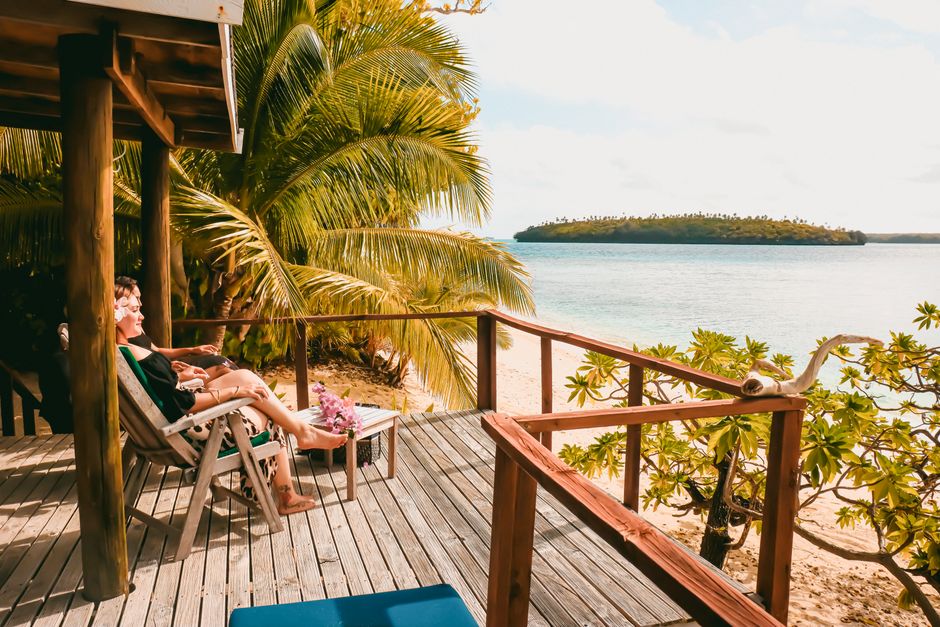
Vava’u is Tonga’s northern island group: a cluster of more than 50 hilly, forested islands, many uninhabited, scattered around a maze of sheltered channels, coral reefs and turquoise anchorages. The main island, ‘Utu Vava’u, wraps around the Port of Refuge, a deep, fjord-like harbor that is one of the safest anchorages in the South Pacific, and on its shore sits Neiafu, Tonga’s second town, a relaxed place of churches, cafés, dive shops and yacht moorings. Each southern winter, from about July to October, humpback whales migrate here from Antarctica to mate, give birth and nurse their calves in the calm, warm water, and Vava’u is one of the few places on Earth where you can legally swim alongside them, in small groups with licensed guides. The same months bring hundreds of cruising yachts and steady trade winds that make Vava’u one of the Pacific’s best sailing grounds. Beyond the whales, there are sea caves to swim into, empty beaches, snorkeling over coral gardens, kayaking between islands and the slow, Sunday-observing rhythm of Tongan village life.

Right now in Vava'u (Neiafu)
- Wed 24–25°C 75–76°F Partly cloudy
- Thu 24–24°C 74–75°F Partly cloudy
- Fri 23–24°C 74–75°F 1 mm Clear
Weather: MET Norway (CC BY 4.0) · Sea temperature: NOAA CoastWatch
Top tours in Vava'u
See all tours for Vava'u →
From local operators, with prices and reviews; you check availability and book on Viator, our partner. We may earn a commission at no extra cost to you. How we earn money
Vava’u at a glance
- Best months: July to October for humpback whales, sailing and dry, mild weather; August and September usually have the most mothers and calves. November to April is the hot, wet cyclone season.
- Base: Neiafu, on the Port of Refuge, for restaurants, operators and transport; island resorts and eco-lodges on the outer islands for peace and quiet.
- Getting there: fly from Tongatapu to Lupepau’u Airport (VAV), about an hour and 20 minutes, or take the weekly overnight ferry from Nuku’alofa; many visitors also arrive by yacht.
- Time needed: four to five days for whales and the islands; a week or more for sailing.
- Sundays: whale boats, tours and most shops don’t operate.
- Before you go: entry, money and culture are covered in our Tonga travel guide.
Getting to Vava’u and finding your way around
Lupepau’u Airport and Neiafu
Lupepau’u Airport sits on the north side of the main island, about 15 to 20 minutes by road from Neiafu. Lulutai Airlines flies small planes from Fua’amotu on Tongatapu, and from Ha’apai; schedules are limited, there are no flights on Sundays, and baggage allowances are small. Most guesthouses and resorts arrange airport pickups, and taxis meet flights. The inter-island ferry from Nuku’alofa calls at Neiafu’s wharf roughly once a week after an overnight voyage of about 20 hours via Ha’apai.
Neiafu
Neiafu climbs a hillside above the Port of Refuge, with the large Catholic church, the market, a few supermarkets and banks with ATMs, and a waterfront strip of cafés, bars and tour and dive operators. In whale season it is busy with visitors, yachties and boats leaving each morning; outside it, it slows right down. The town has the island group’s only real range of restaurants, so even if you stay outside it, you’ll probably come in for supplies.
The main island and causeways
A causeway links the main island to Pangaimotu, and roads run across the main island to villages and lookouts, to Keitahi Beach in the east and to the villages of the north coast. A rental car or taxi gets you around the main island, but most of what makes Vava’u special is only reachable by boat.
The outer islands
To the south of Neiafu, islands such as Kapa, Nuku, Vaka’eitu, ‘Euakafa, Hunga, Ofu and Fofoa form a sheltered inner lagoon dotted with beaches, villages and small resorts. Further out, islands on the reef edge face the open ocean, where whales are most often found.
Top things to see in Vava’u
Swimming with humpback whales
From about July to October, boats leave Neiafu every morning except Sunday to look for humpback whales. A day trip usually lasts six to eight hours, in a small boat with six to eight guests, a skipper and a licensed guide. When the crew finds a calm pod, often a mother and calf resting near the surface, swimmers slip quietly into the water in groups of four and float as the whales go about their day. The experience can be overwhelming: a 15-meter (50-foot) adult gliding beneath you, a calf circling its mother or a male singing below.
Tonga’s Whale Watching and Swimming Regulations 2013, administered by the Ministry of Tourism, set the rules:
- Only licensed whale swimming operators may put swimmers in the water with whales.
- No more than four clients plus one trained local guide per vessel may be in the water with a pod at a time, and only one licensed vessel may put swimmers in with any one pod.
- Swimmers must stay at least 5 m (16 feet) from whales; boats may not come closer than 10 m (33 feet) to drop off or pick up swimmers, and whale-watching boats must stay 50 m (165 feet) from a pod with a calf.
- Interaction with any pod is limited to 90 minutes, after which the pod must be left alone for at least 90 minutes.
- No scuba, jet skis, motorized swimming aids, artificial lights, touching or feeding; private boats must keep at least 300 m (about 1,000 feet) away.
Encounters are never guaranteed, and on some days the whales are restless or the weather too rough. Book two or three days if whales are your main reason for coming, and book months ahead for August and September. You should be a confident swimmer in open water; operators supply wetsuits, masks, snorkels and fins.
Swallows’ Cave
On the west side of Kapa island, about 30 minutes by boat from Neiafu, Swallows’ Cave is a tall sea cave that boats can nose into. Inside, the water is astonishingly clear, swiftlets nest in the roof, and shafts of light illuminate schools of baitfish. You can snorkel inside and outside the entrance, where coral grows on the walls. Old graffiti covers parts of the cave walls.
Mariner’s Cave
On Nuapapu island, Mariner’s Cave is entered only by diving through an underwater opening about 1 to 2 m (3 to 6 feet) below the surface and swimming a few meters through a tunnel into an air-filled chamber. Inside, the air fogs and clears as the swell rises and falls. The cave is named after William Mariner, a young Englishman who lived in Tonga in the early 1800s and wrote about it. Only attempt it with a guide, in calm conditions and if you are comfortable holding your breath underwater; many visitors are happy just to watch from the boat.
Port of Refuge and Mount Talau
The Port of Refuge, a long, winding harbor with steep, wooded shores, is the heart of Vava’u. For the best view, climb Mount Talau, a flat-topped hill of about 131 m (430 feet) just west of Neiafu, protected as a national park; a steep path and steps lead to the summit, where you look out over the harbor, the islands and the anchored yachts. Go in the late afternoon for the light.
Beaches and island picnics
Many of Vava’u’s best beaches are on small islands reached by boat: Port Maurelle on Kapa, a sheltered white-sand bay with good snorkeling, and the sandy spits of islands on the southern edge of the group. On the main island, Keitahi Beach on the east side and the beaches near Ano village are reachable by road. Respect village beaches, especially on Sundays.
Snorkeling and diving
Vava’u’s reefs, walls and caves offer good snorkeling and diving year-round, with hard and soft corals, turtles, reef sharks and occasional eagle rays. Dive shops in Neiafu visit sites such as caves and swim-throughs, coral gardens and the wreck of the Clan MacWilliam, a cargo ship that burned and sank in the Port of Refuge in 1927. Visibility is often excellent in winter.
Other things to do in Vava’u
- Sailing: charter a bareboat yacht if you’re qualified, or join a skippered day sail or multi-day trip. Anchorages are numbered on local charts, distances are short and the water is sheltered.
- Sea kayaking: guided day trips and multi-day kayak camping trips between islands, staying in villages or on beaches.
- Fishing: game fishing for marlin, tuna, wahoo and mahi-mahi from Neiafu.
- Village visits and feasts: some villages host traditional feasts with dancing, often on Saturday evenings.
- Sunday church: visitors are welcome at services, where the harmonies are unforgettable; dress modestly.
- Kava: join locals at a kava club if invited.
- Yachting events: in September, regattas and social events gather the cruising fleet in Neiafu.
Food and drink
Neiafu’s waterfront cafés and restaurants serve fresh fish, burgers, pizza and international dishes, with a few places offering Tongan food. Try ‘ota ‘ika (raw fish in lime and coconut cream), lu pulu (corned beef in taro leaves baked in coconut cream) and fresh tuna. At the market, buy tropical fruit, vegetables and handicrafts. On the outer islands, you’ll usually eat at your resort, often with a set dinner. Many places close on Sundays; check ahead.
Island hopping from Vava’u
Exploring the Vava’u group
Within the group, the easiest ways to get around are a sailing charter, a day trip with a tour or dive operator, or water taxis arranged by your accommodation. Short open-water crossings can be choppy when the trade winds are strong, so check the boat has life jackets and listen to local advice on the weather.
Ha’apai
South of Vava’u, Ha’apai is Tonga’s quietest island group, with long beaches, few visitors and whale swimming with fewer boats. Lulutai Airlines and the inter-island ferry link the two groups; check schedules carefully, as they change often.
Tongatapu and ‘Eua
Most visitors pass through Tongatapu for international flights. If you have time, add a night or two to see Nuku’alofa and the blowholes, or take the ferry or a short flight to ‘Eua for hiking and whale watching from the cliffs. See our Tonga travel guide.
When to go and how long to stay
Vava’u is warm all year, but noticeably milder in winter, with highs around 26 °C (80 °F) from June to September and cooler nights. The dry season from May to October has the least rain and the most settled sailing weather; November to April is hotter and wetter, and tropical cyclones can affect Tonga in those months, most often in February.
| Month | Vava’u high / low | Rain | Rain days |
|---|---|---|---|
| Jan | 30 / 23 °C (86 / 74 °F) | 244 mm (9.6 in) | 19 |
| Feb | 30 / 24 °C (87 / 74 °F) | 235 mm (9.2 in) | 19 |
| Mar | 30 / 23 °C (87 / 74 °F) | 271 mm (10.7 in) | 20 |
| Apr | 29 / 23 °C (85 / 73 °F) | 266 mm (10.5 in) | 17 |
| May | 28 / 22 °C (83 / 71 °F) | 173 mm (6.8 in) | 15 |
| Jun | 27 / 21 °C (80 / 69 °F) | 140 mm (5.5 in) | 14 |
| Jul | 26 / 20 °C (80 / 67 °F) | 94 mm (3.7 in) | 14 |
| Aug | 26 / 20 °C (80 / 68 °F) | 80 mm (3.1 in) | 13 |
| Sep | 27 / 21 °C (80 / 69 °F) | 146 mm (5.7 in) | 13 |
| Oct | 28 / 21 °C (82 / 70 °F) | 142 mm (5.6 in) | 13 |
| Nov | 29 / 22 °C (84 / 72 °F) | 142 mm (5.6 in) | 13 |
| Dec | 29 / 23 °C (85 / 74 °F) | 244 mm (9.6 in) | 16 |
Figures are the Tonga Meteorological Service’s climatological averages for Lupepau’u Airport (Vava’u), based on 1981–2010: mean daily maximum and minimum, total rainfall and the number of days with more than 0.1 mm of rain. The annual total is about 2,180 mm (86 in).
How long to stay: 4, 6 and 10 days
- 4 days: two whale-swim days, a boat trip to Swallows’ Cave and Port Maurelle, and the walk up Mount Talau.
- 6 days: three whale days, a day of snorkeling or diving, and a day of kayaking or sailing, with one Sunday rest day.
- 10 days: a week on a sailing charter or at an outer-island resort, plus a few days in Neiafu for whales.
Events
The whale season (about July to October) is the main event, with September bringing regattas and social events for the cruising fleet. The king’s birthday in early July and the Heilala Festival are celebrated mostly in Nuku’alofa. Christmas and New Year bring church services and family gatherings.
Where to stay
- Neiafu: guesthouses, apartments, small hotels and backpacker lodges on the hillside above the Port of Refuge, close to operators and restaurants.
- Outer-island resorts and eco-lodges: small places on islands such as Kapa, Hunga, Ofu and Foeata, often solar-powered, with meals included and boat transfers from Neiafu.
- The main island beyond town: a few beachfront lodges and fales near Keitahi and other villages.
- On the water: bareboat or skippered yacht charters.
Book early for July to October, especially for the outer islands and for packages that combine accommodation and whale-swim days.
Typical costs in Vava’u
| Item (as of October 2026) | Tongan pa’anga | About US dollars |
|---|---|---|
| Whale swim day trip (in season) | about T$450–600 | about US$190–250 |
| Swallows’ Cave and snorkeling half-day trip | about T$100–180 | about US$40–75 |
| Two-tank dive | about T$300–400 | about US$125–165 |
| Flight, Tongatapu to Vava’u, one way | about T$250–400 | about US$105–165 |
| Guesthouse room in Neiafu, per night | about T$100–200 | about US$40–85 |
| Outer-island resort, per night with meals | about T$400–900 | about US$165–375 |
| Casual meal in Neiafu | about T$25–50 | about US$10–21 |
All prices are typical ranges, not official figures, and vary by operator, package and season. Conversions use about US$0.42 to T$1 (National Reserve Bank of Tonga, 5 October 2026).
Safety in Vava’u
- Whale swims: go only with a licensed operator, listen to the briefing, keep 5 m (16 feet) from the whales, and stay away from tails and pectoral fins; a calf’s curiosity can bring a protective mother close quickly.
- Open water: conditions on the outer edge of the group can be rough; wear the flotation offered if you are not a strong swimmer, and take seasickness tablets if you need them.
- Mariner’s Cave: the underwater entrance requires breath-holding; go only with a guide in calm seas.
- Currents and reefs: currents run through channels between islands; snorkel near your boat and don’t touch coral.
- Cyclones: November to April is cyclone season; follow Tonga Meteorological Service warnings.
- Earthquakes and tsunamis: if you feel a strong or long earthquake on the coast, head to high ground.
- Small boats: check for life jackets on water taxis and avoid crossings in strong winds.
- Roads: drive slowly, watch for pigs, dogs and children, and avoid driving at night.
What to pack for Vava’u
A 3 to 5 mm wetsuit or shorty if you have one (water can be around 23 to 24 °C, 73 to 75 °F, in August and September), a well-fitting mask and snorkel, reef-safe sunscreen, a hat, polarized sunglasses, a warm layer and windproof jacket for boat days and cool evenings, seasickness tablets, a dry bag, modest clothes for town and church, cash in pa’anga and a Type I power adapter.
Vava’u travel FAQ
When is the best time to swim with whales in Vava’u?
From about July to October, with August and September usually the peak for mothers and calves. Book early for those months.
How much does a whale swim cost in Vava’u?
Typically about T$450–600 (about US$190–250) per person for a day trip in 2026, varying by operator and package; multi-day packages often cost less per day.
Is swimming with whales in Tonga ethical?
It is regulated by Tonga’s 2013 whale regulations: only licensed operators, a maximum of four swimmers plus a guide per pod, minimum distances, 90-minute limits and no touching. Choose an operator that follows the rules and lets the whales lead.
Do I need to be a strong swimmer?
You should be comfortable in deep open water with mask, snorkel and fins. Operators provide wetsuits, which add buoyancy, but encounters happen offshore.
How do I get to Vava’u?
Fly from Tongatapu with Lulutai Airlines (about an hour and 20 minutes), take the weekly overnight ferry from Nuku’alofa, or arrive by yacht.
Can I swim with whales on Sunday?
No. Sunday is a legal day of rest in Tonga, so whale boats, tours and most businesses don’t operate.
Where should I stay in Vava’u?
In Neiafu for convenience, restaurants and easy access to whale and dive boats; on an outer island for quiet and beaches, with boat transfers to the operators.
Can you visit Mariner’s Cave without diving?
You need to swim down about 1 to 2 m (3 to 6 feet) and through a short underwater tunnel to enter. If you’d rather not, Swallows’ Cave can be entered by boat or snorkeling at the surface.
Is Vava’u good for sailing?
Yes. It is one of the South Pacific’s best cruising grounds, with sheltered water, short hops between anchorages and steady trade winds from May to October. Bareboat and skippered charters operate from Neiafu.
What else is there to do outside whale season?
Snorkeling, diving, kayaking, sailing, beaches, Mount Talau and village life continue all year, with fewer visitors and lower prices, though the wet season from November to April is hotter and rainier.
Sources and last review
Researched and last reviewed on 5 October 2026. Whale-swimming rules come from Tonga’s Whale Watching and Swimming Regulations 2013 (Attorney General’s Office, 2016 revised edition); the climate table from the Tonga Meteorological Service’s 1981–2010 averages for Lupepau’u Airport; exchange rates from the National Reserve Bank of Tonga. Whale season timing, flight and ferry details, cave and dive site descriptions, Mount Talau’s height and all prices are general estimates or secondary sources. Prices and schedules change, so check with operators before you go.
Plan your trip
Partner links: TravelerCenter may earn a commission if you book, at no extra cost to you.