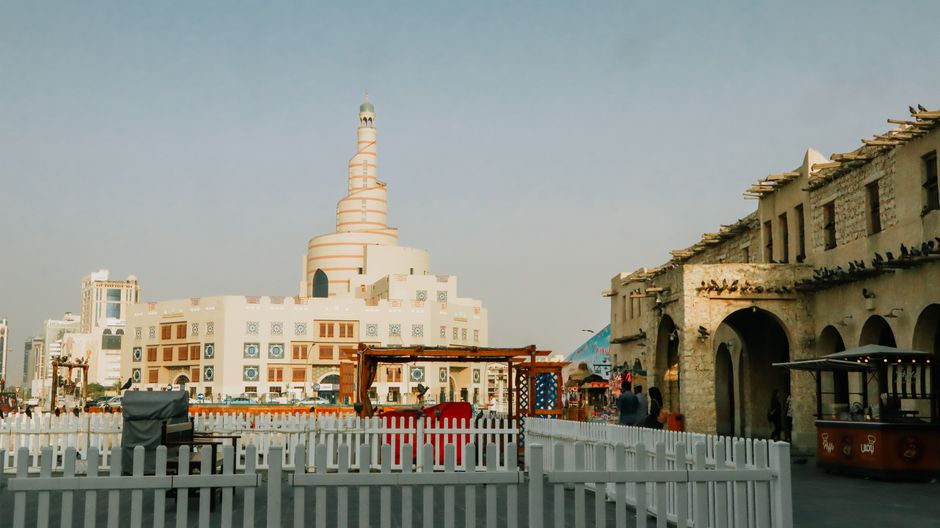
Qatar is a small, wealthy peninsula jutting north from Arabia into the Arabian Gulf, and for most visitors it means Doha: a capital of futuristic towers and world-class museums wrapped around a crescent bay, with a rebuilt souk, a driverless metro and one of the world’s best-connected airports. Beyond the city, the country is flat desert and coast: the sand dunes and “inland sea” of Khor Al Adaid in the southeast, mangroves and turtle-nesting beaches in the north, the UNESCO-listed ruins of the pearl-trading town of Al Zubarah, and strange limestone formations on the west coast. Qatar hosted the 2022 FIFA World Cup, and its stadiums, the new city of Lusail and a busy calendar of Formula 1, MotoGP and other events are part of its appeal. Many travelers come on a stopover with Qatar Airways, and a long list of nationalities can enter visa-free. Plan around the climate, warm and pleasant from November to March but extremely hot from May to September, and around local laws, which are strict on alcohol, vaping, dress, photography of people and medicines.
Right now in Qatar
- Wed 28–38°C 83–101°F Clear
- Thu 28–40°C 83–104°F Clear
- Fri 29–38°C 84–100°F Clear
Weather: MET Norway (CC BY 4.0)
Multi-day tours of Qatar
Multi-day tours from local operators. You check dates and book on Viator, our partner; we may earn a commission at no extra cost to you. How we earn money
Qatar at a glance
Qatar covers about 11,600 km² (4,500 square miles), a little smaller than Connecticut, and is about 180 km (110 miles) from north to south. Its only land border is with Saudi Arabia, in the south. Roughly three million people live in the country, the large majority of them foreign residents from South Asia, the Arab world, Africa, the Philippines and the West; Qatari citizens are a small minority. Most of the population lives in and around Doha. Qatar is an emirate ruled by the Al Thani family since the 19th century; it became independent from British protection in 1971, and its wealth comes from the North Field, one of the world’s largest natural gas fields. Arabic is the official language, and English is widely spoken.
Time and the weekend: Qatar uses Arabia Standard Time (UTC+3) all year, one hour behind the UAE, with no daylight saving. The weekend is Friday and Saturday.
A short history
People have lived on the peninsula since the Stone Age, but for most of its history Qatar was a sparse land of Bedouin camps and coastal towns that lived from fishing and pearling. Al Zubarah, on the northwest coast, became one of the Gulf’s great pearl markets in the 18th century. The Al Thani family established their rule from Doha in the 19th century, and Qatar came under British protection in 1916. The collapse of the pearl trade in the 1930s brought hardship until oil was found at Dukhan in 1939, and the development of offshore gas from the 1990s made Qatar one of the richest countries in the world per person. Doha’s skyline, museums and stadiums have almost all been built since 2000.
Qatar’s regions
- Doha: the capital, with the Museum of Islamic Art, the National Museum, Souq Waqif, the Corniche, West Bay and The Pearl.
- Lusail and Al Daayen: the new city north of Doha, with Lusail Stadium, Lusail Boulevard, the racing circuit and beaches.
- Al Wakrah and the south: Al Wakrah’s restored souk, Mesaieed, Sealine Beach and the dunes and inland sea of Khor Al Adaid.
- Al Khor and the north: mangroves at Al Thakhira and Purple Island, the fishing villages of Al Ruwais and Fuwairit, and the UNESCO site of Al Zubarah.
- The west: the desert landscapes of Zekreet and Bir Zekreet, Richard Serra’s East-West/West-East sculpture and the oil town of Dukhan.
- Al Shahaniya and the interior: camel racing, the Sheikh Faisal bin Qassim Al Thani Museum and farms.
Where to go: Doha, desert and coast
Almost every trip is based in Doha, with day trips to the desert, the north and the west. Two or three days cover Doha’s highlights; four or five allow a desert night and the north.
Doha
The capital has the Museum of Islamic Art and MIA Park, the National Museum of Qatar, Souq Waqif and the Falcon Souq, the Corniche, Katara Cultural Village, Msheireb Downtown, The Pearl and Lusail, all linked by the metro. See our Doha guide.
Khor Al Adaid (the Inland Sea)
In the far southeast, an inlet of the Gulf reaches into high sand dunes on the Saudi border, a protected nature reserve and the country’s most dramatic landscape. Visit on a licensed 4×4 tour from Doha or Sealine, with swimming, dune driving and sunset; camps run in the cooler months.
Al Zubarah and the north
Qatar’s only UNESCO World Heritage Site, Al Zubarah Archaeological Site, preserves the remains of an 18th-century walled town that grew rich from pearling and trade, with a restored early 20th-century fort. Combine it with the fishing villages of Al Ruwais and Fuwairit, where hawksbill turtles nest from about April to July, and the mangroves of Al Thakhira for kayaking.
Al Khor and Purple Island
North of Doha, the town of Al Khor has a corniche and mangrove islets linked by boardwalks at “Purple Island” (Jazirat Bin Ghanim), popular for kayaking and birdwatching.
The west coast: Zekreet
About 1.5 hours west of Doha, the Zekreet peninsula has mushroom-shaped limestone formations, a coastal fort and four tall steel plates of Richard Serra’s East-West/West-East sculpture standing in the desert. Bring a 4×4 or join a tour.
Lusail
North of Doha, the planned city of Lusail has the 80,000-seat Lusail Stadium, where the 2022 World Cup final was played, the Lusail Boulevard with its fountains and towers, the Place Vendôme mall, Lusail Marina and Lusail International Circuit, home of the Formula 1 and MotoGP races. It is linked to Doha by the metro Red Line and has its own tram network.
Al Wakrah and the beaches
Al Wakrah, south of Doha on the metro Red Line, has a restored souk on the seafront and a public beach; Sealine, Simaisma and Fuwairit have quieter beaches, and Banana Island is a resort island reached by ferry from Doha.
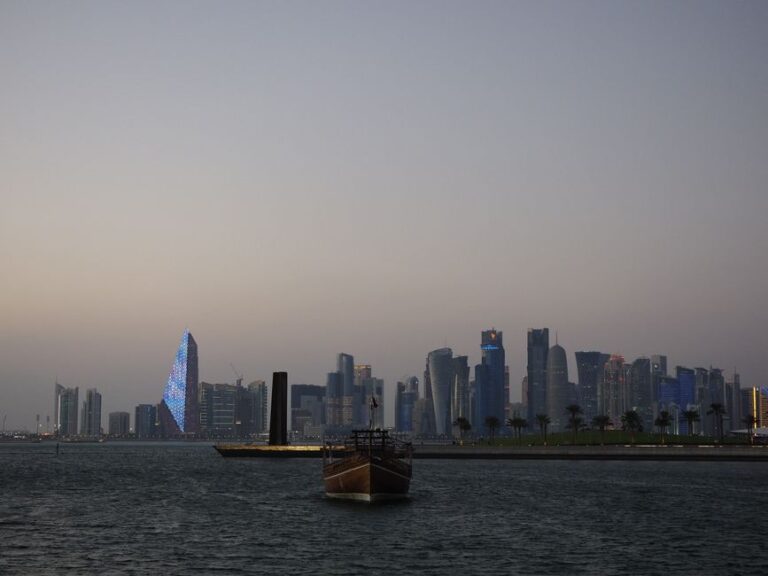
Doha Travel Guide
Plan a trip to Doha: the Museum of Islamic Art and National Museum of Qatar hours, Souq Waqif and the Falcon Souq, the Corniche,…
Best time to visit Qatar
Qatar is hot and dry. November to March is the best season, with sunny days of about 23–30 °C (74–86 °F), cool nights in December and January and most of the year’s events. April and October are hot, about 33–35 °C (91–96 °F). May to September is extreme: average highs of 38–42 °C (101–108 °F), with very humid air near the coast in August and September. Rain is rare, about 75 mm (3 inches) a year on average, falling in short winter showers, and dust storms (shamal winds) can blow in spring and early summer.
| Month | Average high | Average low | Average humidity |
|---|---|---|---|
| Jan | 23 °C (74 °F) | 17 °C (62 °F) | 58% |
| Feb | 24 °C (76 °F) | 17 °C (63 °F) | 56% |
| Mar | 28 °C (83 °F) | 20 °C (68 °F) | 47% |
| Apr | 33 °C (91 °F) | 24 °C (75 °F) | 40% |
| May | 38 °C (101 °F) | 29 °C (84 °F) | 34% |
| Jun | 42 °C (108 °F) | 32 °C (90 °F) | 32% |
| Jul | 42 °C (107 °F) | 33 °C (92 °F) | 43% |
| Aug | 41 °C (106 °F) | 33 °C (92 °F) | 48% |
| Sep | 39 °C (103 °F) | 31 °C (89 °F) | 52% |
| Oct | 35 °C (96 °F) | 28 °C (83 °F) | 54% |
| Nov | 30 °C (86 °F) | 24 °C (75 °F) | 56% |
| Dec | 26 °C (78 °F) | 19 °C (67 °F) | 59% |
| Year | 34 °C (92 °F) | 26 °C (78 °F) | 48% |
Figures are averages of the official monthly observations at Doha International Airport for 2018–2024, published on Qatar’s open data portal by the Civil Aviation Authority’s meteorology department; annual rainfall at the airport averaged about 76 mm (3 inches) in 2013–2024. A full 30-year WMO normal for Qatar was not available. Inland desert areas are hotter by day and cooler at night than Doha.
Crowds and prices through the year
- Peak (November to March): the best weather and the busiest event calendar; hotel prices rise sharply during major sports events.
- Shoulder (October and April): hot but manageable, with lower prices.
- Low (May to September): the cheapest hotel rates and summer promotions; outdoor sightseeing only early or late in the day.
Festivals and events
- MotoGP Qatar Grand Prix (6–8 November 2026): at Lusail International Circuit.
- Formula 1 Qatar Grand Prix (27–29 November 2026): also at Lusail.
- Qatar National Day (18 December): parades, fireworks and celebrations on the Corniche.
- Design Doha Biennial (2026): design exhibitions organized with Qatar Museums.
- Camel racing season (winter): races with robot jockeys at Al Shahaniya.
- Ramadan (in 2027 expected from about 8 February to 9 March): quiet days and lively nights, with special Ramadan tents and the Garangao children’s festival mid-month.
Public holidays
Public holidays include Qatar National Sport Day (the second Tuesday of February), Eid al-Fitr (about 10 March 2027, for several days), Eid al-Adha (about 16 May 2027) and Qatar National Day (18 December). Islamic holidays follow the lunar calendar and are announced shortly before. Government offices close, but malls, hotels and many attractions stay open.
How long to stay: sample itineraries
1–2 days: Doha stopover
The Museum of Islamic Art, Souq Waqif and the Corniche on day one; the National Museum of Qatar, Msheireb and Katara on day two. The metro links the airport with all of them.
4 days: Doha and the desert
Two days in Doha, a day trip or overnight camp at Khor Al Adaid, and a day in the north at Al Zubarah, Al Thakhira’s mangroves and Purple Island.
6–7 days: the whole peninsula
Add Lusail and The Pearl, the west coast at Zekreet, a beach day at Banana Island or Fuwairit, and camel racing in winter. Combine Qatar with a short flight to Manama, Dubai or Abu Dhabi.
Entry, money and costs
Entry: visa-free entry, Hayya e-visas and visas on arrival (last reviewed October 2026)
Qatar’s Ministry of Interior and Qatar Tourism offer visa-free entry to about 100 nationalities, with an e-visa through the Hayya platform for others. You need a passport valid for at least six months (Qatar Tourism lists three months for some categories, so allow six to be safe), a return or onward ticket and, in many cases, a hotel booking. Citizens of the other GCC states, Saudi Arabia, the UAE, Bahrain, Kuwait and Oman, don’t need a visa.
- Visa-free, up to 90 days: citizens of most European countries, including Germany, France, Italy, Spain, the Netherlands, Switzerland and Turkey, as well as Malaysia, Seychelles and the Bahamas, receive a free, multiple-entry visa waiver on arrival valid for 180 days, allowing stays of up to 90 days in total.
- Visa-free, 30 days: citizens of about 47 countries, including the United Kingdom, Ireland, Australia, New Zealand, Canada, Japan, South Korea, Singapore, China, India, Brazil and Argentina, receive a free 30-day waiver, extendable once for another 30 days.
- United States citizens: Qatar Tourism says US citizens receive a visa valid for two years, or until the passport expires, with multiple entries and stays of up to 90 days.
- Hayya e-visa: nationalities not on the visa-free lists apply online through the Hayya portal: the A1 visa for most travelers, with a hotel reservation; the A2 for GCC residents; and the A3 for holders of a valid visa or residence permit from the Schengen area, the UK, the US, Canada, Australia or New Zealand. Some can instead book a Discover Qatar hotel before travel and pay a QAR 100 visa fee on arrival.
- Qatar–Oman joint tourist visa: citizens of certain countries can get a 30-day visa on arrival valid for both Qatar and Oman, with multiple entries.
Stays over 30 days require health insurance from a Ministry of Public Health–registered provider, with a standard premium of QAR 50 per person per month. Transit passengers can’t stay airside for more than 24 hours. Rules change, so use the Qatar Tourism visa checker or the Ministry of Interior before you travel. A unified GCC Grand Tours visa covering Qatar, the UAE, Bahrain and the other Gulf states had not launched as of October 2026.
Customs and medicines
Importing, selling or using e-cigarettes and vapes, including liquids and electronic shisha, is illegal, and customs will confiscate them. Don’t bring pork products, alcohol, drugs or pornographic material. Declare money, gold or gems worth more than QAR 50,000. Medicines: some prescription and over-the-counter medicines are controlled in Qatar. Carry a prescription and a medical report in English or Arabic, issued within the last six months, describing your medicine and treatment, and apply for a permit for controlled medicines through the Ministry of Public Health’s online service before you travel. Bag scanners at Hamad International check transit passengers too.
Money and cards
The Qatari riyal (QAR, QR) is divided into 100 dirhams and pegged to the US dollar at about QAR 3.64 to US$1. Cards and phone payments are accepted almost everywhere; carry a little cash for the souk and small shops. There is no general sales tax or VAT on most purchases, though hotels and restaurants add service charges.
Tipping
Many restaurant bills include a service charge; where none is added, 10% is generous. Rounding up taxi fares and tipping porters and drivers a few riyals is appreciated.
Typical travel costs
| Item (as of October 2026) | Qatari riyals | About US dollars |
|---|---|---|
| Doha Metro ride, standard / Goldclub | QAR 2 / 10 | $0.55 / $2.75 |
| Metro daily maximum, standard card | QAR 6 | $1.65 |
| Visa on arrival with Discover Qatar hotel booking (where required) | QAR 100 | $27 |
| Health insurance for stays over 30 days, per month | QAR 50 | $14 |
| Museum ticket, adult (MIA or National Museum) | about QAR 50 | about $14 |
| Desert tour to Khor Al Adaid, per person | about QAR 250–400 | about $70–110 |
| Casual restaurant meal | about QAR 30–70 | about $8–19 |
| Mid-range hotel room, per night in winter | about QAR 400–800 | about $110–220 |
Metro fares, the visa fee and the insurance premium are official; the rest are typical ranges, not official prices.
Getting there and getting around
Hamad International Airport
All international flights use Hamad International Airport (DOH), the hub of Qatar Airways, about 10 km (6 miles) from central Doha and on the metro Red Line. The airport is known for its art, gardens and transit facilities, and Qatar Airways and Qatar Tourism sell stopover packages with discounted hotels. The only land border crossing is Abu Samra, on the border with Saudi Arabia, for travelers with a Saudi visa and suitable car insurance.
Flight disruptions
Since early 2026, regional tensions have led to periodic airspace closures across the Gulf, so flights can be delayed, rerouted or canceled at short notice; check your flight with the airline and the airport’s status before you travel.
Stopovers
Qatar Airways and Qatar Tourism promote stopovers of one to four nights, with discounted hotel rates booked through Discover Qatar, which can also arrange the visa on arrival for eligible nationalities. With the metro running from the airport into the city, even a 12-hour layover is enough for the Museum of Islamic Art and Souq Waqif, as long as you allow time for immigration and security on the way back.
Doha Metro, Lusail Tram and buses
The driverless Doha Metro has three lines and 37 stations over 76 km (47 miles), with trains about every 6 minutes; journeys cost QAR 2 in standard class (QAR 10 in Goldclub), with a daily maximum of QAR 6 on a standard travel card. Tap in and tap out. The metro doesn’t run on Friday mornings, during prayers. Free Metrolink buses link neighborhoods with stations, and the Lusail Tram serves Lusail. Karwa public buses cover the rest of the country cheaply but slowly.
| Getting around Qatar (October 2026) | How it works | Cost |
|---|---|---|
| Doha Metro | Red, Gold and Green lines; tap in and out | QAR 2 per trip, QAR 6 daily maximum (standard) |
| Lusail Tram and Metrolink | Tram in Lusail; free feeder buses near metro stations | Tram on travel card; Metrolink free |
| Karwa taxis and ride-hailing | Metered taxis, Uber, Careem and local apps | About QAR 25–60 across Doha |
| Rental car | Needed for the north, west and desert edges | From about QAR 120 per day |
Driving
Qatar drives on the right. Visitors from many countries can drive a rental car with their home license and an International Driving Permit; check your nationality’s rules with the rental company. Speeds are high and road discipline poor, so drive defensively. Drink-driving has zero tolerance, with penalties of one month to three years in prison or fines of QAR 10,000 to QAR 50,000, and using a phone while driving costs QAR 500. Unpaid traffic fines, listed in the Metrash app, can stop you leaving the country, so settle them before departure. For the dunes, go with a licensed tour or travel in convoy in a properly equipped 4×4 with water and a phone.
Culture, food and everyday etiquette
Islam and local customs
Qatar is a conservative Muslim country. Friday is the holy day, with midday prayers when many businesses close and the metro starts later. Greet with “as-salaam alaykum,” wait for a woman to offer her hand, and use your right hand to eat and pass things. Qataris often meet in a majlis, a sitting room for guests, and Arabic coffee (gahwa) with dates is the traditional welcome. Falconry, camel racing and pearling are proud traditions you can see at the Falcon Souq, Al Shahaniya and the museums.
Food and drink
Try machboos (spiced rice with meat or fish), harees, thareed, madrouba (a creamy rice-and-chicken porridge), balaleet (sweet vermicelli with egg) and luqaimat, along with karak, sweet spiced tea sold at roadside stalls. Doha’s restaurant scene includes Michelin-recognized fine dining, Lebanese, Iranian and Turkish grills, and inexpensive South Asian canteens. Alcohol is sold only in licensed hotel restaurants and bars to people aged 21 and over, who must show original photo ID; residents buy it through a permit system.
Shopping and souks
Souq Waqif is the place for spices, oud perfume, incense, traditional clothing, coffee pots and falconry equipment; bargaining is normal in small shops. The Gold Souk nearby sells jewelry by weight. Big malls such as Mall of Qatar, Place Vendôme, Doha Festival City and Villaggio have international brands, and many stay open late, especially in Ramadan.
Laws visitors need to know
- Dress: men and women should cover shoulders and knees in public, including while driving; the dress code is strictly enforced in government buildings, healthcare facilities and banks.
- Alcohol: drinking in public or being drunk in public can bring up to six months in prison or a fine of up to QAR 3,000.
- Vaping: illegal, with possible fines, prison or deportation.
- Smoking: banned in all enclosed public places, including malls, restaurants and public transport.
- Photography and social media: taking or sharing images of people without consent can be punished with a fine of up to QAR 100,000 or prison; posts that insult people or are culturally insensitive can be crimes.
- Relationships: sex outside marriage and same-sex sexual activity are illegal; public intimacy can lead to arrest.
- Religion: blasphemy and proselytizing are illegal.
- ID: carry your passport or a copy at all times.
- Debt: unpaid bills and bounced cheques are crimes and can lead to travel bans.
Safety, health, accessibility and connectivity
Safety
Qatar has very low crime. The main risks for visitors are the heat, fast driving, strict laws and the regional situation.
- Summer heat: from May to September, highs above 40 °C (104 °F) are normal, with very humid nights on the coast in late summer. Drink water constantly, avoid exertion outdoors from about 10 a.m. to 4 p.m., and watch for heat exhaustion.
- Dress codes and decency: follow the rules above; mosques require long clothes and a headscarf for women.
- Alcohol: only in licensed hotel venues, with original ID; never in public.
- Ramadan etiquette: during daylight hours, don’t eat, drink, smoke or chew gum in public, including in your car; avoid loud music, and dress conservatively.
- Drugs and medicines: zero tolerance, including for residual amounts and for transit passengers; carry documents for your medicines and a Ministry of Public Health permit for controlled ones.
- Photography and drones: ask before photographing people; avoid military, government and construction sites; drones need licenses.
- Desert safety: use licensed operators for dune drives; travel in convoy, carry water and a phone, and tell someone your plans. Never enter the dunes near Khor Al Adaid alone.
- Sea: traditional dhows may not meet Western safety standards; check that life jackets are on board.
- Flight disruptions: since early 2026, regional tensions have led to periodic airspace closures across the Gulf, and flights can be delayed, rerouted or canceled at short notice. Check your flight with the airline and the airport’s status before you travel, and follow instructions from the local authorities, including emergency alerts sent to phones.
- Emergencies: police, ambulance and fire 999.
Health and insurance
Healthcare in Doha is of a high standard, but visitors pay for treatment; travel insurance with medical and evacuation cover is strongly recommended and is compulsory for stays over 30 days. Tap water is treated desalinated water, but most people drink bottled water. Yellow fever and, in some cases, polio vaccination certificates are required if arriving from affected countries.
Accessibility
The metro, the airport, museums and newer hotels are accessible, with lifts and step-free access. The souk’s lanes, beaches and desert camps are harder going; ask in advance.
Connectivity and power
Mobile coverage is excellent in cities; prepaid SIMs and eSIMs from Ooredoo and Vodafone Qatar are sold at the airport. Power is mainly 240 V with type G sockets (British three-pin).
Things to do: museums, desert, sea and sport
Qatar’s highlights are its museums (the Museum of Islamic Art, the National Museum of Qatar, the 3-2-1 Qatar Olympic and Sports Museum and the Msheireb Museums), evenings in Souq Waqif, dune driving and swimming at the Inland Sea, the ruins of Al Zubarah, kayaking in the northern mangroves, turtle-watching at Fuwairit, whale-shark trips offshore in summer (with licensed operators), camel racing at Al Shahaniya, and world-class sports at Lusail and Aspire Zone.
Qatar with children
Qatar is very family-friendly. Children enjoy the interactive 3-2-1 Qatar Olympic and Sports Museum, MIA Park’s playgrounds and weekend bazaars, the indoor theme parks and ice rinks in the big malls, Desert Falls water park, and gentle beaches at Katara and Banana Island. Metro carriages for families and plentiful baby-changing facilities make getting around easy; plan outdoor time for winter mornings and evenings.
Responsible travel
The desert and coast are fragile. On dune trips, stay on established tracks around Khor Al Adaid and take all rubbish away. At Fuwairit and Al Ghariya, nesting beaches may be closed to visitors from about April to July; follow signs and keep lights off the beach at night. In the mangroves, don’t disturb birds, and on boat trips, choose operators who keep their distance from whale sharks and dolphins.
What to pack
Pack light, loose clothes that cover shoulders and knees, a scarf or shawl, swimwear for hotel pools and beaches, a wide-brimmed hat, sunglasses and high-SPF sunscreen. Bring a light sweater for air-conditioning and cool winter nights in the desert, sturdy sandals or walking shoes, a type G plug adapter and medicines with prescriptions and medical reports. Don’t pack vapes or e-cigarettes.
Qatar travel FAQ
Do I need a visa for Qatar?
Many nationalities don’t: about 100 countries are visa-free for 30 or 90 days, and US citizens receive a multiple-entry visa on arrival. Others apply for a Hayya e-visa or qualify for a visa on arrival with a Discover Qatar hotel booking.
What is Hayya?
Qatar’s official online platform for entry visas: the A1 visa for most nationalities, the A2 for GCC residents and the A3 for holders of Schengen, UK, US, Canadian, Australian or New Zealand visas or residence permits.
How long can I stay in Qatar without a visa?
Either 30 days (extendable once by 30 days) or up to 90 days within 180 days, depending on your nationality.
Do I need health insurance to visit Qatar?
It is compulsory for stays over 30 days, from a Ministry of Public Health–registered insurer, at a standard premium of QAR 50 per month. For shorter trips it is strongly recommended.
Can I bring my medicines to Qatar?
Yes, with a prescription and a recent medical report in English or Arabic. Controlled medicines need a permit from the Ministry of Public Health, applied for online before travel.
Are vapes allowed in Qatar?
No. Importing, selling and using e-cigarettes and vapes is illegal, and customs confiscate them.
Can tourists drink alcohol in Qatar?
Yes, in licensed hotel restaurants and bars, at 21 or over, with original photo ID. Drinking in public is illegal.
What is the best time to visit Qatar?
November to March, when days are warm and dry. May to September is extremely hot.
What is the weekend in Qatar?
Friday and Saturday. Many attractions open late on Friday, and the metro starts after Friday prayers.
Is there a GCC tourist visa for Qatar and the UAE?
Not yet. The unified GCC Grand Tours visa had not launched for travelers as of October 2026, so check each country’s entry rules.
Are flights to Qatar ever disrupted?
Sometimes. Since early 2026, regional tensions have led to periodic airspace closures across the Gulf, and flights can be delayed, rerouted or canceled at short notice. Check your flight with the airline and the airport’s status before you travel.
How do I get from the airport to Doha?
By metro Red Line for QAR 2, or by taxi in 15 to 25 minutes to West Bay or Souq Waqif.
What plug adapter do I need for Qatar?
Type G, the British three-pin plug; the voltage is about 240 V.
Sources and last review
Researched and last reviewed on 5 October 2026. Visa-free categories, durations and country lists come from Qatar’s Ministry of Interior; Hayya visa types, the QAR 100 visa-on-arrival fee with Discover Qatar bookings, the US two-year visa, the Qatar–Oman joint visa and the 102-nationality figure from Visit Qatar (Qatar Tourism); metro lines, fares, the Friday closure, Metrolink and the Lusail Tram from Visit Qatar; museum hours from Qatar Museums; event dates from Visit Qatar; laws on alcohol, vaping, dress, photography, drugs and medicines, the Ministry of Public Health permit service, health insurance, transit limits, customs thresholds, driving penalties, emergency numbers and the factual background on local rules from GOV.UK’s Qatar travel information (updated 19 August 2026); airspace disruption from the European Union Aviation Safety Agency; Al Zubarah’s listing from UNESCO; climate from the Civil Aviation Authority’s monthly observations for Doha International Airport, 2018–2024, and annual rainfall 2013–2024, on Qatar’s open data portal; capital and coordinates from Wikidata. The area and population figures, the GCC visa status, the absence of VAT, holiday and Ramadan dates for 2027, Khor Al Adaid’s protected status, turtle and whale-shark seasons, the Abu Samra crossing, driving-license rules and typical prices are general references and flagged for checking. Entry rules can change at short notice, so check official sources before you travel.
Plugs and power in Qatar
Qatar uses 240 V, 50 Hz and these plugs (left) and wall sockets (right):
All plug types and voltages by country → · Check what you need to pack →
Plan your trip
Partner links: TravelerCenter may earn a commission if you book, at no extra cost to you.
🇪🇬 Useful Arabic phrases for Qatar
All 38 Arabic phrases: restaurant, hotel, emergencies, romance (printable) →