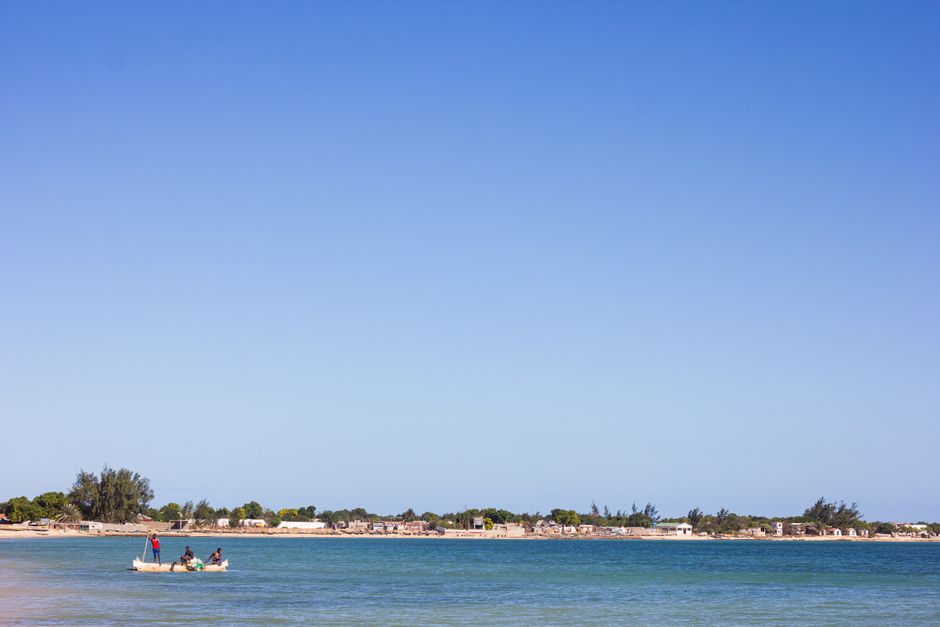
Morondava is a laid-back town on the west coast of Madagascar, facing the Mozambique Channel, and the gateway to one of the most famous landscapes in Africa: the Avenue of the Baobabs, where giant Grandidier’s baobabs, some about 30 m (100 ft) tall and many centuries old, line a red dirt road like the columns of a cathedral. At sunset, when the trunks glow orange and then turn to silhouettes against a pink sky, it is one of the most magical sights in Madagascar. Morondava is also the starting point for the dry forest of Kirindy, home to the fossa and the world’s smallest primate, and for the long overland journey to the Tsingy de Bemaraha, a UNESCO World Heritage Site of razor-sharp limestone pinnacles. The town itself, the capital of the Menabe region, has a sandy beach strip at Nosy Kely lined with bungalow hotels and seafood restaurants, a busy market and a fishing harbor where pirogues come and go. Life moves slowly in the heat. The west is one of the driest parts of Madagascar, and the dry season from April to November is the time to visit: many roads in the region, including the route to the Tsingy, become impassable in the rains from December to March.
Right now in Morondava
- Wed 24–28°C 75–83°F Clear
- Thu 22–27°C 72–81°F Clear
- Fri 24–28°C 75–83°F Clear
Weather: MET Norway (CC BY 4.0) · Sea temperature: NOAA CoastWatch
Top tours in Morondava
See all tours for Morondava →
From local operators, with prices and reviews; you check availability and book on Viator, our partner. We may earn a commission at no extra cost to you. How we earn money
Morondava at a glance
- Best months: April to November, when it is dry and the roads to Kirindy and the Tsingy are open; September to November for warm days and baobabs in leaf. December to March is hot and rainy, with a cyclone risk.
- Getting there: flights from Antananarivo take about 1 hour 15 minutes; by road, the journey via Antsirabe and Miandrivazo takes a long day or two.
- Where to stay: beach bungalows and small hotels at Nosy Kely; a few lodges near the Avenue of the Baobabs and in Kirindy Forest.
- Time needed: two to three nights for the town, the Avenue and Kirindy; five to seven nights to add the Tsingy de Bemaraha.
- Costs (as of October 2026): a car and driver for a sunset trip to the Avenue costs about Ar 90,000–180,000 (US$20–40); beach bungalows from about Ar 90,000 (US$20) a night.
- Before you go: the eVisa, malaria, money and getting around are covered in our Madagascar travel guide.
Morondava’s areas and who each one suits
Nosy Kely
A narrow sandy spit south of the town center, between the sea and the Morondava River estuary, with most of the town’s beach hotels, bungalows and restaurants. It is the best place to stay for sea views and sunsets. The beach is affected by coastal erosion, and some sections have sea walls.
The town center
Morondava’s center has the market, banks, shops, the post office and simple hotels and restaurants. It is practical but not scenic.
The baobab country
North of town, along the road to Belo-sur-Tsiribihina, a few lodges and campsites allow you to stay near the Avenue of the Baobabs for sunrise and sunset without driving back in the dark.
Kirindy Forest
About 60 km (37 miles) north of Morondava, Kirindy has simple bungalows in the forest, ideal for night walks to see nocturnal lemurs and the fossa.
Top things to see around Morondava
The Avenue of the Baobabs
About 15–20 km (10–12 miles) north of Morondava, on the dirt road to Belo-sur-Tsiribihina, a group of about two dozen Grandidier’s baobabs (Adansonia grandidieri, renala in Malagasy, “mother of the forest”) lines the road for a few hundred meters. These trees, endemic to the west of Madagascar, are survivors of a dense forest that was cleared for farming; today they stand among rice fields and ponds. The site has been protected as a natural monument since 2015 and is managed with the local communities, who collect small fees for access and parking. According to Madagascar’s National Tourism Office, the Avenue recorded 47,686 visitors between January and October 2024.
Sunset is the classic time to visit, when crowds gather; sunrise is quieter and just as beautiful, with reflections in the ponds in the rainy season. Allow at least an hour. Please stay on the road and paths, do not climb the trees or carve the bark, and respect the villagers living around the site. Small stalls sell baobab seeds and carvings.
The Baobabs Amoureux and the sacred baobab
A few kilometers beyond the Avenue, on a sandy track, the Baobabs Amoureux (“baobabs in love”) are two baobabs whose trunks twist around each other, a symbol of eternal love in local legend. Nearby, a huge sacred baobab is a place of offerings; local guides explain the fady (taboos) to respect. Most sunset tours combine these sites with the Avenue.
Kirindy Forest
Kirindy Forest, a dry deciduous forest about 60 km (37 miles) north of Morondava, managed by a forestry research center, is one of the best places in Madagascar to see the fossa, the island’s largest predator, especially from about October to December during its breeding season. It is also home to Madame Berthe’s mouse lemur, the world’s smallest primate, the giant jumping rat, Verreaux’s sifakas, red-fronted brown lemurs, and baobabs of several species. Day walks and night walks are led by local guides; stay overnight for the best night walk. The forest is about 1.5 to 2 hours by road from Morondava in the dry season.
Tsingy de Bemaraha National Park
About 200 km (125 miles) north of Morondava, the Tsingy de Bemaraha is a vast plateau of limestone eroded into forests of needle-sharp pinnacles, canyons and caves, protected since 1927 and inscribed by UNESCO in 1990. According to Madagascar National Parks, it covers 157,710 hectares (390,000 acres); its southern section is a national park open to visitors, and its northern section remains a strict nature reserve. The Grand Tsingy circuits use ladders, rope bridges, harnesses and cables to cross the pinnacles; the Petit Tsingy is easier; and pirogue trips run through the Manambolo Gorges. Look for Decken’s sifaka and the armored chameleon. The journey from Morondava to Bekopaka, the gateway village, takes a full day by 4×4, with ferry crossings over the Tsiribihina and Manambolo rivers, and the road is usually open only in the dry season, roughly May to November. Allow at least three days for the round trip.
Morondava market and the harbor
The town’s market is busy in the morning with fish, fruit, vegetables and household goods. On the riverfront and beach, fishermen build and repair pirogues and Vezo-style sailing boats; walk along Nosy Kely at dusk to watch them return.
Other things to do around Morondava
- Pirogue trips: short outings by traditional outrigger canoe in the mangroves and along the coast.
- Belo-sur-Mer: a remote fishing village about 70 km (45 miles) south, known for building large wooden sailing boats by hand, with salt pans and lagoons; reached by boat or 4×4.
- Kivalo village: a community tourism circuit north of town introduces village life, fishing and mangroves.
- Tsiribihina River: multi-day descents by pirogue or barge from Miandrivazo to Belo-sur-Tsiribihina; book only with a reputable operator and check current conditions before you go.
- Kirindy Mite National Park: south of Morondava, with dry forest, mangroves and lakes, for adventurous travelers.
- Sunset on the beach: Nosy Kely faces west over the Mozambique Channel.
Food and drink
Morondava’s restaurants specialize in seafood: grilled fish, prawns, crab, calamari and lobster, often cooked with coconut milk, garlic or green pepper, and served on terraces at Nosy Kely. Zebu steaks and brochettes are also popular. Simple hotely in town serve rice with zebu or fish for very little. Try mofo gasy and fried bananas for breakfast, fresh mango and tamarind juice, and THB beer at sunset. Drink only bottled water.
Day trips from Morondava
The Avenue of the Baobabs at sunset
The essential half-day trip: leave town in mid-afternoon, visit the Baobabs Amoureux and the sacred baobab, and arrive at the Avenue for sunset. Return to town after dark with your driver.
Kirindy Forest
A full day from Morondava, with an afternoon walk and an evening night walk; better as an overnight stay in the forest.
Belo-sur-Mer
An adventurous day or overnight trip south by 4×4 or boat to see traditional boat building and the coast.
Tsingy de Bemaraha
Not a day trip: plan at least three days, with overnight stays in Bekopaka. See above.
Getting there and getting around
By air
Morondava’s airport, just north of town, has flights from Antananarivo with Madagascar Airlines, taking about 1 hour 15 minutes. Flights are not daily, and schedules are often changed or canceled at short notice; reconfirm, and allow a spare day before any international flight.
By road
From Antananarivo, the road runs south to Antsirabe on the RN7, then west on the RN34 and RN35 via Miandrivazo, about 650–700 km (400–435 miles), taking a long day or two, with an overnight stop in Antsirabe or Miandrivazo. The road is paved but has potholed stretches. Most visitors travel with a car and driver-guide; taxi-brousses also run the route, but they are crowded and accidents are common. Avoid driving at night.
Getting around
- Tuk-tuks and taxis: cheap for short trips around town; agree on the fare first.
- Car with driver: essential for the Avenue of the Baobabs, Kirindy and the Tsingy; hotels and agencies arrange them. A 4×4 is needed for Kirindy in some seasons and for the Tsingy.
- Bicycle: you can cycle to the Avenue in the cooler hours, but the road is dusty and there is no lighting after sunset.
When to go and how long to stay
Morondava has a hot, semi-arid tropical climate. The dry season, from about April to November, brings sunny days, warm temperatures and very little rain; nights in June to August are pleasantly cool. The rainy season, from about December to March, brings heat, humidity and heavy downpours, especially in January and February, flooding many tracks, including the roads to Kirindy and the Tsingy, and the risk of tropical cyclones.
The table shows the 1991–2020 climate normals for Morondava, published by Météo Madagascar through the World Meteorological Organization (WMO).
| Month | Average high | Average low | Rain | Rain days (≥1 mm) |
|---|---|---|---|---|
| Jan | 32 °C (89 °F) | 24 °C (76 °F) | 292 mm (11.5 in) | 13.7 |
| Feb | 32 °C (89 °F) | 24 °C (75 °F) | 194 mm (7.6 in) | 10.5 |
| Mar | 32 °C (90 °F) | 24 °C (75 °F) | 75 mm (3.0 in) | 6.2 |
| Apr | 32 °C (90 °F) | 22 °C (71 °F) | 17 mm (0.7 in) | 1.6 |
| May | 31 °C (87 °F) | 19 °C (66 °F) | 3 mm (0.1 in) | 0.4 |
| Jun | 30 °C (85 °F) | 16 °C (62 °F) | 3 mm (0.1 in) | 0.5 |
| Jul | 29 °C (85 °F) | 16 °C (61 °F) | 2 mm (0.1 in) | 0.2 |
| Aug | 30 °C (85 °F) | 17 °C (63 °F) | 2 mm (0.1 in) | 0.4 |
| Sep | 30 °C (87 °F) | 19 °C (66 °F) | 2 mm (0.1 in) | 0.4 |
| Oct | 31 °C (88 °F) | 21 °C (70 °F) | 8 mm (0.3 in) | 1 |
| Nov | 32 °C (90 °F) | 23 °C (74 °F) | 24 mm (1.0 in) | 2.3 |
| Dec | 32 °C (90 °F) | 24 °C (76 °F) | 90 mm (3.5 in) | 7.2 |
| Year | 31 °C (88 °F) | 21 °C (69 °F) | 712 mm (28.0 in) | 44 |
From May to October, there is almost no rain: less than one rainy day a month on average.
Events worth planning around
- Independence Day (June 26): parades and celebrations in town.
- Fossa breeding season (about October to December): the best time to see fossas in Kirindy.
- Baobab flowering (about November to December): Grandidier’s baobabs flower, and the trees come into leaf with the first rains.
- Rainy season (December to March): many western roads close, and some lodges close.
How long to stay: 2, 3 and 6 nights
- Two nights: the Avenue of the Baobabs at sunset and sunrise, the Baobabs Amoureux and a morning in town.
- Three nights: add an overnight in Kirindy Forest for night walks.
- Six nights: add the Tsingy de Bemaraha, with two nights in Bekopaka and stops at Kirindy and the Avenue on the way back.
Where to stay in Morondava
- Beach bungalows at Nosy Kely: simple to comfortable bungalows and small hotels on the sand, with restaurants and sunset views.
- Town hotels: basic, cheaper rooms near the market.
- Baobab lodges: a few lodges and campsites near the Avenue, for sunrise and sunset.
- Kirindy Forest bungalows: basic accommodation for overnight wildlife visits.
- Bekopaka lodges: for the Tsingy de Bemaraha, from simple bungalows to comfortable lodges.
Book ahead in the high season from July to November.
Typical costs in Morondava
| Item (as of October 2026) | Ariary | About US dollars |
|---|---|---|
| Car and driver, sunset trip to the Avenue | Ar 90,000–180,000 | US$20–40 |
| Local fees at the Avenue (access, parking) | Ar 5,000–20,000 | US$1–4 |
| Kirindy entry, guided day and night walks | Ar 90,000–180,000 | US$20–40 |
| 4×4 with driver for the Tsingy, per day (plus fuel) | Ar 450,000–630,000 | US$100–140 |
| Tsingy de Bemaraha park entry and guide, one day | Ar 135,000–270,000 | US$30–60 |
| Flight from Antananarivo, one way | Ar 900,000–1,600,000 | US$200–350 |
| Grilled fish or zebu in a restaurant | Ar 25,000–50,000 | US$6–11 |
| Beach bungalow double | Ar 90,000–225,000 | US$20–50 |
| Comfortable lodge double | Ar 270,000–540,000 | US$60–120 |
Prices are typical ranges, not official figures; conversions use about Ar 4,500 per US dollar, an estimate. Check park fees with Madagascar National Parks.
Safety in Morondava
- Malaria: according to the CDC, malaria occurs throughout Madagascar except Antananarivo city; take antimalarial medicine as prescribed and use repellent and nets.
- Road safety: avoid traveling by road after dark, including returning from the Avenue on unlit roads without a driver; use a reputable driver and a well-maintained vehicle for the Tsingy.
- Rivers and boats: use reputable operators with life jackets for pirogue and river trips, and check current conditions before booking a Tsiribihina river descent.
- Heat: temperatures exceed 30 °C (86 °F) most of the year; carry water and avoid walking in the midday sun.
- The Tsingy: the Grand Tsingy circuits involve heights, ladders and sharp rock; wear gloves and sturdy shoes, use the harness, and follow your guide.
- Swimming: the sea at Nosy Kely can have currents near the river mouth; swim where locals do, in calm conditions.
- Cyclones (November to April): follow Météo Madagascar; roads can be cut for days.
- Emergencies: call 117 for police; for medical help, contact your hotel and insurer. Facilities are basic; serious cases go to Antananarivo.
Practical tips for Morondava
- Cash: ATMs in town are few and sometimes out of order; bring enough ariary, plus euros as a backup.
- Book drivers in advance: in high season, cars for the Tsingy are in demand.
- Dust: the red roads are dusty; protect cameras and wear a scarf.
- Flights: reconfirm the day before and keep your plans flexible.
- Respect fady: some baobabs and sites are sacred; follow your guide’s lead.
What to pack for Morondava
Light, breathable clothes, a hat, sunglasses and high-factor sunscreen, strong insect repellent and long sleeves for the evening, your antimalarial medicine, sturdy closed shoes and gloves for the Tsingy, a flashlight or headlamp for night walks, a dust-proof bag for your camera, a refillable water bottle and a European (type C/E) plug adapter.
Morondava travel FAQ
How far is the Avenue of the Baobabs from Morondava?
About 15–20 km (10–12 miles) north of town, on the road to Belo-sur-Tsiribihina, about 30–45 minutes by car.
When is the best time to see the Avenue of the Baobabs?
At sunset for the classic view, or at sunrise for fewer people. The dry season from April to November is best for access.
Is there an entrance fee for the Avenue of the Baobabs?
Small local fees for access and parking are collected at the site; check current amounts locally.
How do I get to Morondava?
By flight from Antananarivo, about 1 hour 15 minutes, or by road via Antsirabe and Miandrivazo, a long day or two.
Can I visit the Tsingy de Bemaraha from Morondava?
Yes, in the dry season (roughly May to November), by 4×4 with a driver. It takes a full day each way, so plan at least three days.
Where can I see a fossa?
In Kirindy Forest, about 60 km (37 miles) north of Morondava, especially from October to December.
Is Morondava worth visiting?
Yes, for the Avenue of the Baobabs, Kirindy’s wildlife, the Tsingy and the relaxed beach town of Nosy Kely.
Do I need malaria tablets for Morondava?
The CDC recommends antimalarial medicine for all of Madagascar except the city of Antananarivo, including Morondava.
Can I visit Morondava in the rainy season?
You can fly in and see the Avenue, but heavy rain from December to March floods roads, and the Tsingy and some lodges close.
How many days do I need in Morondava?
Two to three nights for the Avenue and Kirindy; six nights or more to add the Tsingy de Bemaraha.
Sources and last review
Researched and last reviewed on 5 October 2026. Climate: Météo Madagascar’s 1991–2020 normals for Morondava, via the World Meteorological Organization; the Tsingy de Bemaraha’s area, history, UNESCO status and zones: Madagascar National Parks; Avenue of the Baobabs visitor numbers: the Madagascar National Tourism Office; malaria: the US Centers for Disease Control and Prevention; road and river conditions: the UK government’s travel pages (factual content only); coordinates and population: Wikidata. The Avenue’s protection date, fees and tree facts, Kirindy’s management and wildlife seasons, travel times, flight schedules, emergency numbers, the exchange rate and all prices are general references or estimates and should be checked locally. For the eVisa, money and health, see our Madagascar travel guide.
Plan your trip
Partner links: TravelerCenter may earn a commission if you book, at no extra cost to you.
🇫🇷 Useful French phrases for Morondava
All 38 French phrases: restaurant, hotel, emergencies, romance (printable) →