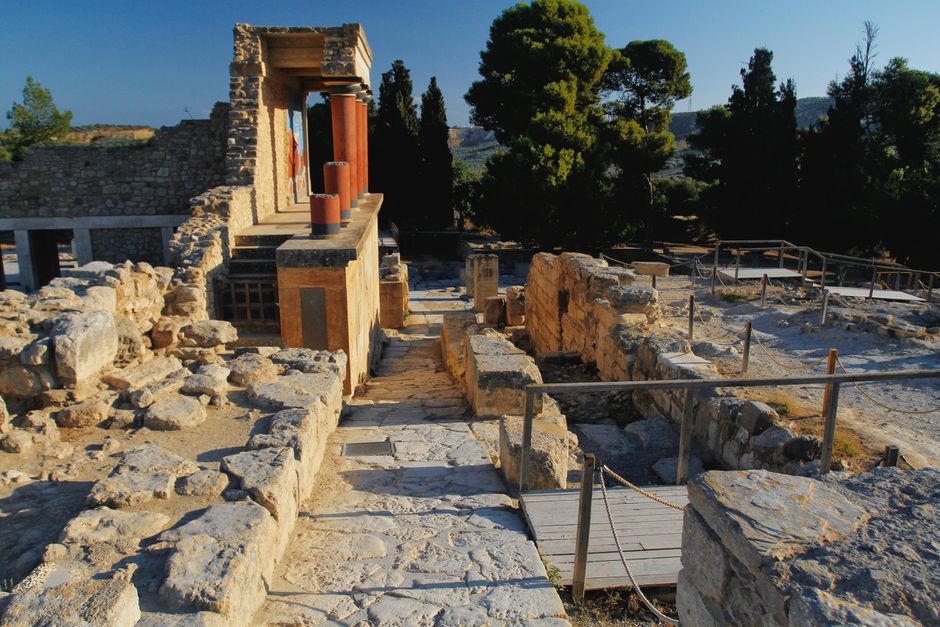
Knossos is the largest palace of the Minoans, Europe’s first great civilisation, on a hill five kilometres south of Heraklion in Crete: a maze of courtyards, staircases, storerooms and royal apartments linked to the legends of King Minos, the Labyrinth and the Minotaur. As of October 2026 a ticket costs €20 (€10 reduced), bought online through the Ministry of Culture’s Hellenic Heritage service or at the gate. It opens daily at 8:00; from 1 to 15 October it closes at 18:30 and from 16 October at 18:00. Come at opening time or late in the afternoon, and see the Heraklion Archaeological Museum too.
Right now in Knossos
- Wed15–22°C58–71°FClear
- Thu13–23°C55–74°FClear
- Fri13–22°C56–72°FClear
Tickets and tours for Knossos
See all tours for Knossos →
From local operators, with prices and reviews; you check availability and book on Viator, our partner. We may earn a commission at no extra cost to you. How we earn money
Why Knossos matters
People lived on this hill from the Neolithic to Roman times, but its heyday was the Minoan period, from about 2000 to 1350 BC. The first palace rose around 2000–1900 BC; after an earthquake destroyed it around 1700 BC, the Minoans built an even grander one, the largest on the island, covering about 22,000 square metres. It was the administrative, economic and religious centre of a complex society, with workshops, storerooms full of giant clay jars, shrines and a stone theatre.
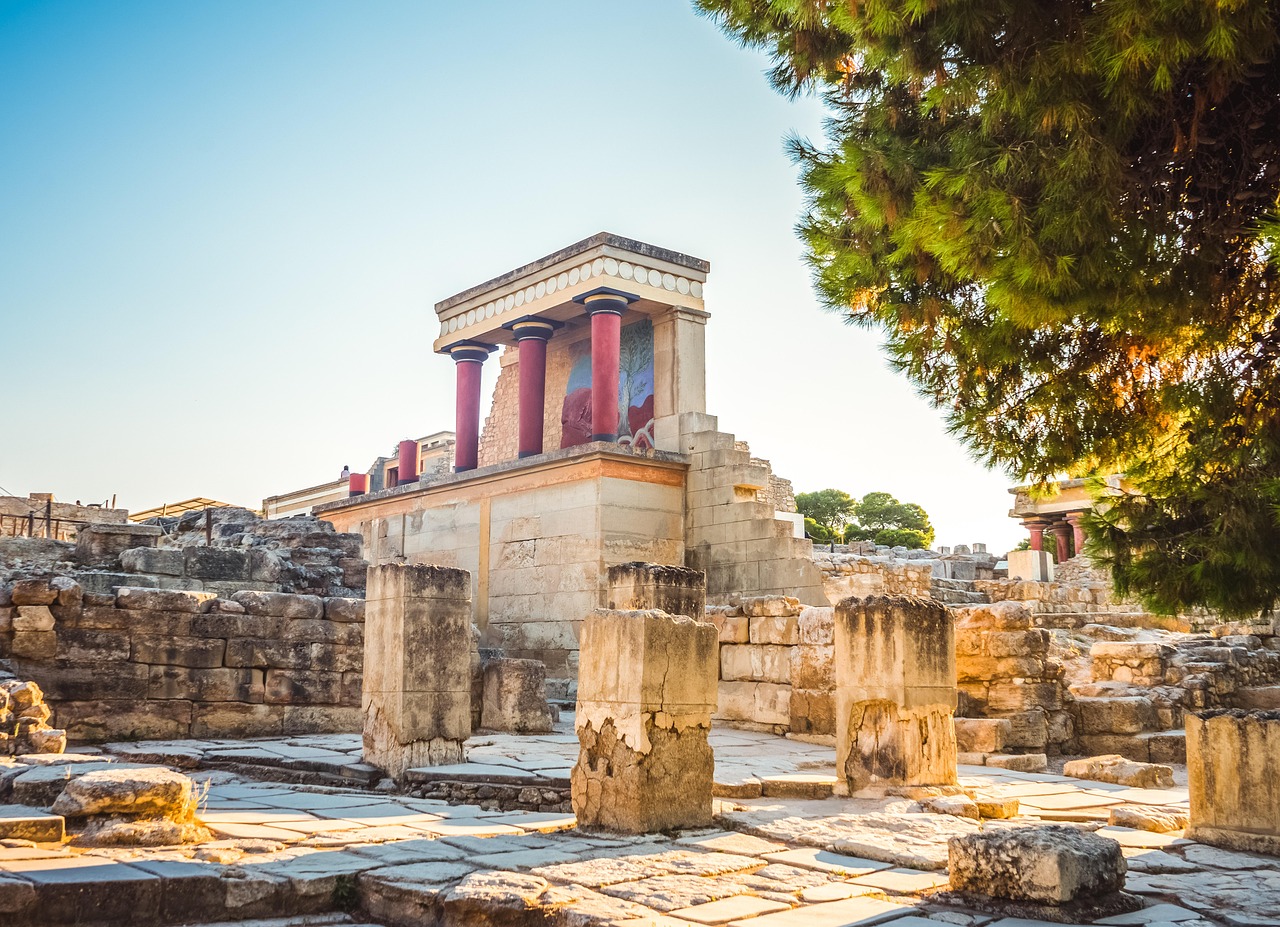
A local merchant with a fitting name, Minos Kalokairinos, dug the first trenches in 1878. The British archaeologist Arthur Evans excavated the palace and much of the town between 1900 and 1931, and boldly rebuilt parts in concrete, repainting columns and copying frescoes. Purists still argue about it, but without Evans there would be no red Minoan columns, and for most visitors his rebuilding is what makes the ruins readable. Knossos is now on the UNESCO World Heritage List together with five other Minoan palatial centres of Crete.
What you’ll see
- The Central Court: the big open rectangle at the heart of the palace, around which the four wings are arranged.
- The Throne Room: a small chamber with an alabaster throne, stone benches and painted griffins, seen from a viewing point at the door.
- The royal apartments: the Grand Staircase and the rooms known as the Queen’s Megaron, with the famous dolphin fresco (a copy).
- The north entrance: with a reconstructed portico and a copy of the charging-bull relief, one of the most photographed corners.
- The west magazines: long storerooms lined with huge pithoi, jars that held oil, wine and grain.
- The theatral area and Royal Road: steps for ceremonies and one of the oldest paved roads in Europe.
The frescoes on site are replicas. The originals, along with the Phaistos Disc, the snake goddesses and the bull-leaping fresco, are in the Archaeological Museum of Heraklion (€20, €12 reduced; from April to October 8:00–20:00, Wednesdays from 13:00).
Tickets and booking
Prices and rules from the Ministry of Culture, as of October 2026:
- Price: €20 full, €10 reduced. EU citizens under 25 and under-18s from any country enter free with ID.
- Booking: buy online through Hellenic Heritage (hh.gr), the Ministry’s official ticketing service, or at the site’s ticket office. Online tickets save queuing in summer.
- Free days: 6 March, 18 April, 18 May, the last weekend of September and 28 October, plus the first and third Sunday of each month from November to March.
- Holidays: closed 1 January, 25 March, 1 May, Easter Sunday and 25–26 December; Good Friday 12:00–17:00, Holy Saturday 8:00–16:00.
- Guides: licensed guides offer tours at the entrance, and many Heraklion agencies sell guided visits; a guide brings the confusing layout to life.
Opening hours
- April to August: daily 8:00–20:00.
- September: until 19:30 from 1 to 15 September, 19:00 from 16 to 30 September.
- October: until 18:30 from 1 to 15 October, 18:00 from 16 to 31 October.
- November to March: daily about 8:00–17:00 (Hellenic Heritage gives 8:00, the Ministry’s Odysseus portal 8:30).
- Last admission: 15–20 minutes before closing.
The site can close at short notice in severe weather: it shut from 14:00 on Saturday 3 October 2026 during the storm that placed Crete on red alert. Check the Ministry’s announcements before you set off.
Heat, shade and what to bring
Knossos is exposed, and from June to September the middle of the day is very hot. Take the first entry or the last two hours, wear a hat, sunscreen and comfortable shoes for the uneven stone and gravel paths, and carry water. Allow one and a half to two hours on site. There is a café, a shop, toilets and parking at the entrance.
Accessibility
Paths around the palace are a mix of gravel, ancient paving, ramps and steps, and some areas can only be seen from walkways. The Ministry lists the site as having accessibility facilities, but we could not confirm the route details; call the site on +30 2810 231940 before you go.
Getting there
Heraklion city bus No. 2 runs to Knossos from the centre and the port area in about 20 minutes; by car it is about 15 minutes, with a car park at the entrance. Taxis are easy from Heraklion. If you are based in Chania or Rethymno, it is a long day by car or KTEL bus; it is easier to spend a night in Heraklion.
Combine it with
Pair Knossos with the Heraklion Archaeological Museum on the same day, ideally the museum after the site. History lovers can continue south to the palace of Phaistos and the beaches of Matala, or west to Chania for the Samaria Gorge. Plan your trip with our Crete travel guide and our Greece travel guide, see the Acropolis of Athens for classical Greece a thousand years later, and see our sightseeing guide.
Knossos FAQ
How much does Knossos cost in 2026?
€20, or €10 reduced, as of October 2026. EU citizens under 25 and under-18s enter free. The Heraklion Archaeological Museum is a separate €20 ticket.
Do I need to book Knossos in advance?
It is not compulsory, but buying online through Hellenic Heritage avoids the summer queues at the ticket office.
What are the Knossos opening hours?
Daily from 8:00. Until 20:00 from April to August, closing earlier through September and October (18:00 from 16 October), and about 8:00–17:00 from November to March.
How long do you need at Knossos?
One and a half to two hours on site, or a full morning with a guide. Add two hours for the Heraklion Archaeological Museum.
How do I get from Heraklion to Knossos?
City bus No. 2 from central Heraklion takes about 20 minutes; by car or taxi it is about 15 minutes.
Are the frescoes at Knossos real?
No. The paintings on site are replicas; the originals are in the Archaeological Museum of Heraklion. Parts of the palace were also rebuilt in concrete by Arthur Evans.