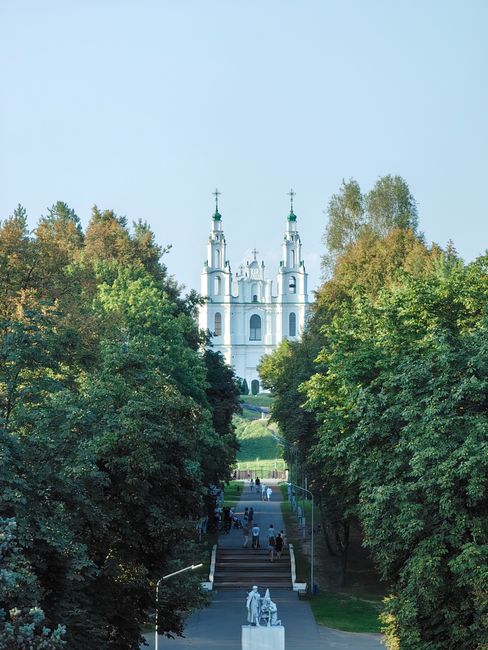
Belarus is a flat, green, thinly populated country of forests, rivers, lakes and marshes between Poland, Lithuania, Latvia, Russia and Ukraine. It is home to Europe’s largest surviving primeval lowland forest, Białowieża, where wild bison roam; to the Renaissance castles of Mir and Nesvizh; to old towns such as Polotsk, Grodno and Brest; and to Minsk, a capital rebuilt after the Second World War as a showcase of Soviet planning. Since the events that followed the 2020 presidential election and the start of the war in Ukraine in 2022, sanctions have cut flights and payment links, and conditions for visitors have changed a great deal. This guide describes the country, its history, landmarks and climate, and how things currently stand for visitors.
Right now in Belarus
- Wed 11–17°C 52–62°F Mostly clear
- Thu 12–20°C 53–68°F Clear
- Fri 10–14°C 50–57°F 4 mm Cloudy
Weather: MET Norway (CC BY 4.0)
Belarus at a glance
Belarus covers about 207,600 square kilometres and has no coastline. It is one of the flattest countries in Europe: the highest point, Dzyarzhynskaya Hara, is only 345 m above sea level. About 40% of the land is forest, and the north has thousands of glacial lakes, including Naroch, the largest, and the Braslav Lakes. The south, along the Pripyat river, is Polesia, one of Europe’s largest wetlands. The south-east was the area worst hit by fallout from the 1986 Chernobyl disaster across the border in Ukraine, and part of it remains a closed radiation reserve.
According to Belstat, the national statistics committee, about 9.06 million people lived in Belarus on 1 January 2026, and almost 2 million of them in Minsk. Belarusian and Russian are both official languages; Russian dominates in cities, the media and daily life, while Belarusian is heard more in the countryside and in culture. Most believers are Orthodox Christians, with a significant Catholic minority in the west. The currency is the Belarusian rouble (BYN). On 2 October 2026 the National Bank of Belarus’s official rate was 3.01 roubles to the US dollar and 3.39 to the euro. Belarus uses UTC+3 all year, the same as Moscow.
A short history
The lands of today’s Belarus were home to the medieval Principality of Polotsk, one of the oldest states of the Eastern Slavs, first recorded in 862. From the 13th and 14th centuries they formed the core of the Grand Duchy of Lithuania, whose official language was a form of old Belarusian, and from 1569 part of the Polish-Lithuanian Commonwealth. The partitions of Poland between 1772 and 1795 brought the region into the Russian Empire, and the western provinces became part of the Pale of Settlement, with a large Jewish population in towns such as Minsk, Pinsk, Vitebsk and Grodno.
A Belarusian People’s Republic was declared in March 1918 but did not survive, and in 1919 the Byelorussian Soviet Socialist Republic was founded; the west of the country belonged to Poland between the wars. In the Second World War, Belarus was occupied from 1941 to 1944 and lost around a quarter of its population, including almost all of its Jews; hundreds of villages were burned with their inhabitants, among them Khatyn. In December 1991 the agreement dissolving the Soviet Union was signed at Viskuli in the Białowieża forest, and Belarus became independent. Alexander Lukashenko has been president since 1994. After the presidential election of August 2020, which Western governments did not recognise as free or fair, mass peaceful protests were met with tens of thousands of arrests. In May 2021 the authorities forced a passenger flight to land in Minsk to arrest a journalist on board, and in February 2022 Russian forces invaded Ukraine partly from Belarusian territory.
Belarus’s regions
Belarus is divided into six regions (oblasts), named after their capitals, plus the city of Minsk:
- Minsk and Minsk region: the capital, the Khatyn memorial, the Radziwiłł palace at Nesvizh and Lake Naroch in the north-west.
- Brest region: the Brest Fortress, a symbol of the defence against the German invasion of 1941, the Belarusian side of the Białowieża Forest (Belovezhskaya Pushcha) and the marshes of western Polesia.
- Grodno region: the old city of Grodno on the Neman and Mir Castle.
- Vitebsk region: Polotsk, the oldest city in Belarus, Vitebsk, the birthplace of Marc Chagall, and the Braslav Lakes national park.
- Mogilev and Gomel regions: the east and south-east along the Dnieper, including the Polesie State Radiation-Ecological Reserve in the Chernobyl zone, where access is restricted.
Safety and current conditions
Belarus had begun to open up to tourists in the 2010s, with visa-free entry and new tourist programmes. Since 2020 the situation has changed sharply. The main points to know:
- Arrest and detention: visitors face a significant risk of arrest, questioning or detention if you have engaged in any political activity related to Belarus, including donations to organisations or support for activity now considered illegal, even if it took place outside Belarus, and laws can be applied retroactively. Tens of thousands of people have been detained for political activities since 2020, including foreign citizens, and detention conditions are extremely poor.
- Phones and “extremist” material: security forces, some in plain clothes, may stop and search people and ask them to unlock their phones. Belarus has designated BBC News Russian content as “extremist material”, so distributing, reposting or even storing it is an offence. Assume that electronic communications are monitored.
- Russian military activity: Russian and Belarusian military personnel and equipment are present at places including Mazyr, Zyabrovka, Vileyka, Hantsavichy, Asipovichy and Lida; keep away from military areas.
- Insurance: many travel insurance policies exclude Belarus, so check the wording of your policy. Belarus itself requires visitors to show medical insurance worth at least €10,000.
- Consular help: some Western embassies in Minsk are open with limited services; the US Embassy suspended operations in 2022. Belarus does not recognise dual nationality and is unlikely to allow consular access to detained dual nationals.
- Demonstrations: freedom of assembly and expression are not protected in practice. Bystanders, including foreigners, have been arrested near demonstrations.
- Dual nationals: Belarus does not recognise dual nationality and treats dual nationals as Belarusian, including for military service, which is compulsory for men aged 18 to 27.
Places travellers have known
These are the places most often visited in Belarus before 2020. They are described here as background.
Minsk
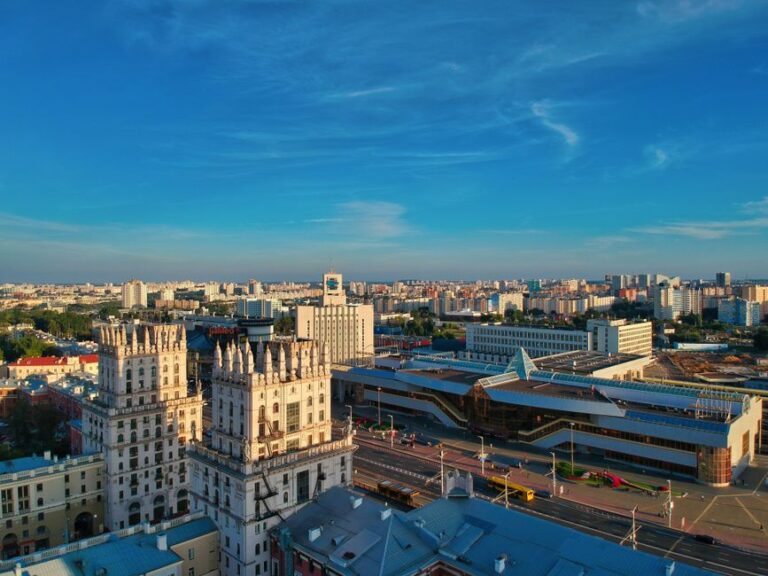
The capital, rebuilt after 1944 around the monumental Independence Avenue, with the Upper Town, the Trinity Suburb, the Museum of the Great Patriotic War and the diamond-shaped National Library. Read more in our page on Minsk.
Mir and Nesvizh
Two UNESCO World Heritage Sites south-west of Minsk: Mir Castle, a red-brick fortress begun around 1500, and the Radziwiłł palace, church and park at Nesvizh.
Brest and the Białowieża Forest
Brest, on the Polish border, is known for its 19th-century fortress and its war memorial. North of the city, the Białowieża Forest, shared with Poland and a UNESCO World Heritage Site, is the last large remnant of the primeval forest that once covered the European plain, and home to Europe’s largest herd of wild bison.
Polotsk, Vitebsk and Grodno
Polotsk, first mentioned in 862, has the 11th-century St Sophia Cathedral and the Convent of St Euphrosyne. Vitebsk, the city of Marc Chagall, has a museum in his childhood home and hosted the Slavianski Bazaar arts festival. Grodno, near the Polish and Lithuanian borders, has one of the best-preserved old towns in the country.
Lakes and wetlands
The Braslav Lakes and Lake Naroch in the north, and the rivers and marshes of Polesia in the south, are Belarus’s main nature areas.
Minsk Travel Guide
Minsk travel guide: Independence Avenue, the Upper Town and Trinity Suburb, the war museum and memorials, the National Library, Mir and Nesvizh, safety notes,…
Climate and seasons
Belarus has a moderate continental climate, milder than Russia’s but with cold, grey, snowy winters and warm summers. Summer, from June to August, is the warmest and wettest season, and winter temperatures often stay below freezing for weeks.
| Season | Average daily high | Average nightly low | Rain or snow per month |
|---|---|---|---|
| Winter (Dec–Feb) | −1.9 to −0.6 °C | −6.6 to −4.9 °C | 40–47 mm |
| Spring (Mar–May) | 4.5 °C rising to 18.9 °C | −3.1 °C rising to 7.2 °C | 41–66 mm |
| Summer (Jun–Aug) | 22.4–24.3 °C | 10.9–12.9 °C | 71–98 mm |
| Autumn (Sep–Nov) | 17.5 °C falling to 3.6 °C | 7.6 °C falling to −1.1 °C | 49–55 mm |
Minsk gets about 688 mm of rain and snow a year, according to the official 1991–2020 averages for the Minsk station that Belarus submitted to the World Meteorological Organization.
Entry rules
Entry rules are set by Belarus and can change at short notice. In summary:
- Visa-free entry by land: Belarus’s Ministry of Foreign Affairs says citizens of 38 European countries, including all EU countries, the UK, Switzerland and Norway, can enter visa-free through international road and rail crossings for up to 30 days (90 days for Poles, Lithuanians and Latvians) until 31 December 2026. Visa-free stays may not add up to more than 90 days in a calendar year, and onward travel to Russia is excluded.
- Visa-free entry by air: a separate scheme allows citizens of 76 countries, including the UK, Canada, Australia, Japan and the EU countries, up to 30 days through Minsk National Airport and five regional airports. It does not apply to flights from or to Russia. The United States is not on the list, so US citizens need a visa.
- Russia: if you travel directly from or to Russia, the visa-free rules do not apply and you need a visa. A Belarusian or Russian visa allows travel between the two countries only at designated crossings.
- Insurance and funds: you must show medical insurance worth at least €10,000 and money for your stay (the equivalent of €25 a day).
- Passport: it must be valid for at least three months from the date you arrive.
- Registration: hotels register foreign guests staying more than 10 days; if you stay privately, your host must do it, and there are fines for late registration.
- Customs: declare cash over US$10,000 and keep the form; you cannot take out more than you declared on arrival.
- Exit stamp: make sure you get one when you leave, or you may be refused entry next time.
Sanctions and everyday practicalities
- Flights: there are no direct flights between Belarus and the UK. All Belarusian airlines have been banned from flying to the UK since mid-2021, the EU has closed its airspace to Belarusian aircraft and sanctioned the state airline Belavia, and the UK has sanctioned Belarus’s air traffic control operator. The US bans its airlines and pilots from the Minsk flight information region. Because of sanctions, Belavia may lack parts for the safe maintenance of its aircraft.
- Payments: almost no major Belarusian banks accept foreign cards, many cash machines limit withdrawals, international money transfer services have largely suspended operations and UK banks may block cards used in Belarus. Bring US dollars or euros. Change money only at government-licensed exchange offices, with your passport; changing money elsewhere can lead to fines, arrest and confiscation. Belarusian roubles cannot be exchanged outside Belarus.
- Land borders: the border with Ukraine is closed to British nationals. Poland reopened the Terespol–Brest, Kuźnica–Bruzgi (cars only) and Bobrowniki–Bierastavitsa crossings in September 2025; Lithuania reopened Medininkai–Kamenny Log and Šalčininkai–Benyakoni in November 2025; and Latvia keeps only the Paternieki–Grigorovshchina crossing open, and does not admit cars registered in Belarus. All of these can close again at short notice, and queues can be long.
- Russia: foreigners may cross the land border between Belarus and Russia only with a Belarusian or Russian visa and only at designated crossing points, and flights between the two countries go through immigration control.
- Tolls: foreign-registered vehicles must pay for toll roads through the BelToll system.
Safety, health and the law
Ordinary crime levels are low, but watch for street crime and theft from cars and hotel rooms. Carry your passport, or a printed copy of its photo page, and any visa. Photographing police, soldiers, government buildings or infrastructure is illegal, and restricted areas may not be signposted. Drug offences, including possessing small amounts of cannabis, can bring up to five years in prison, and up to 25 years for trafficking, even in transit. Police can fine pedestrians for jaywalking, and transport police may scan bags at metro stations in Minsk. Bring all essential medication, drink bottled water rather than village well water, and be aware that healthcare is below Western European standards and that emergency staff may speak only Russian or Belarusian. Emergency numbers: 101 fire, 102 police, 103 ambulance.
Belarus travel FAQ
Is it safe to travel to Belarus now?
Visitors face real legal risks: people can be arrested for past political activity, donations or social-media posts, even outside Belarus, Russian military activity takes place in the country, and consular help is limited (the US has no embassy services in Belarus). See the safety section above for the details.
Does travel insurance cover Belarus?
Usually not. Many standard travel insurance policies exclude Belarus, so check yours. Belarus nonetheless requires visitors to hold medical insurance of at least €10,000.
Do I need a visa for Belarus?
It depends on your nationality and route. Citizens of the UK and 37 other European countries can enter visa-free for up to 30 days by road or rail until 31 December 2026, and citizens of 76 countries, including the UK and Canada, by air through Minsk; US citizens are not covered and need a visa. The visa-free rules do not apply if you arrive from or travel on to Russia. You need medical insurance worth €10,000.
Can I use my bank card in Belarus?
Usually not. Almost no major Belarusian banks accept foreign cards and UK banks may block cards used there because of sanctions. Visitors rely on US dollars or euros in cash, exchanged at licensed offices.
Are there flights to Minsk from Europe?
No direct flights operate between Minsk and the UK or the EU. EU airspace is closed to Belarusian aircraft, EU airlines avoid Belarusian airspace, and the few remaining commercial routes can disappear at short notice.
Can I cross the border from Poland or Lithuania?
Some crossings have reopened: three with Poland since September 2025 and two with Lithuania since November 2025, and one with Latvia remains open. All of them could close again at short notice.
What is Belarus known for?
Its forests, lakes and wetlands, including the primeval Białowieża Forest and its wild bison; the castles of Mir and Nesvizh; old towns such as Polotsk and Grodno; Marc Chagall’s home town of Vitebsk; and the Soviet-era architecture of Minsk.
Sources and last review
Researched and last reviewed on 4 October 2026. Entry rules, insurance and funds requirements, registration, borders, flights, money and safety from GOV.UK foreign travel information (updated 10 September 2026) and the US State Department’s country information (28 December 2025); visa-free schemes, insurance and funds rules from Belarus’s Ministry of Foreign Affairs; population from Belstat; exchange rates from the National Bank of Belarus; World Heritage listings from UNESCO; climate from the official 1991–2020 normals Belarus submitted to the World Meteorological Organization. The 2021 Ryanair diversion is from the US State Department. Area, highest point, forest cover and lake details come from general knowledge and are flagged for checking. History and geography are summarised from standard reference works. Sanctions and entry rules can change at short notice, so check the latest official information.
Plugs and power in Belarus
Belarus uses 220 V, 50 Hz and these plugs (left) and wall sockets (right):
All plug types and voltages by country → · Check what you need to pack →
Plan your trip
Partner links: TravelerCenter may earn a commission if you book, at no extra cost to you.
🇷🇺 Useful Russian phrases for Belarus
All 38 Russian phrases: restaurant, hotel, emergencies, romance (printable) →