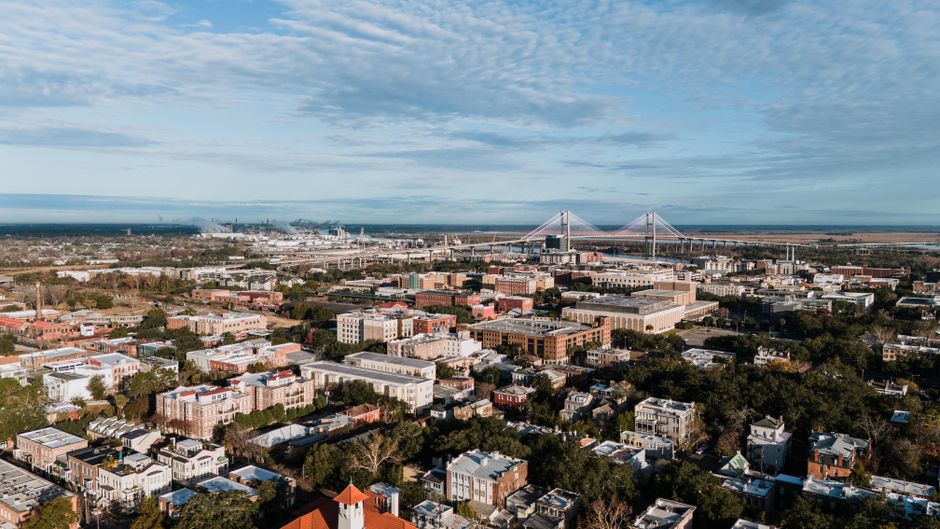
Savannah, Georgia’s oldest city, was laid out in 1733 around a grid of leafy public squares that still gives its historic center a gentle, walkable rhythm. Live oaks hung with Spanish moss shade cobbled lanes, church spires and grand 19th-century houses with iron balconies, and on the riverfront, old cotton warehouses now hold shops, bars and restaurants watching the giant container ships glide past. Add Forsyth Park and its famous fountain, art museums, ghost tours, Southern cooking and the beaches of Tybee Island half an hour away, and it is easy to see why visitors linger. The Historic District is compact and flat, with a free shuttle and a free ferry, so you can leave the car parked for days.

Right now in Savannah
- Wed19–28°C67–82°FPartly cloudy
- Thu20–28°C68–83°FPartly cloudy
- Fri22–27°C71–80°F2 mm rain
- Mon 12 Oct Columbus Day · regional holiday in Georgia
Top tours in Savannah
See all tours for Savannah →
From local operators, with prices and reviews; you check availability and book on Viator, our partner. We may earn a commission at no extra cost to you. How we earn money
Savannah at a glance
- Best months: March–May, when the azaleas bloom, and October–November, warm and drier; summer is hot and humid, and hurricane season runs from June to November.
- Time needed: two or three days for the Historic District, the riverfront and Bonaventure Cemetery; add a day for Tybee Island or Wormsloe.
- Getting there: Savannah/Hilton Head International Airport (SAV) is about 10 miles (16 km) northwest of downtown; Interstates 95 and 16 meet just west of the city.
- Costs (as of October 2026): the downtown DOT shuttle and Belles Ferry are free; a CAT bus fare is $1.50; hotel bills add 15% in taxes plus a $5 state fee per night.
- Before you go: entry rules, money, driving and general safety are on our United States travel guide.
Savannah neighborhoods and who each one suits
The Historic District and its squares
General James Oglethorpe’s town plan of wards built around open squares survives almost intact between the river and Forsyth Park. Today 22 squares, each with its own monuments, fountains and benches under the oaks, are linked by streets of townhouses, churches and small museums. Chippewa Square is where the bench scene in Forrest Gump was filmed; Madison, Monterey and Lafayette squares are among the prettiest. City Market, a few pedestrian blocks of restaurants, galleries and street musicians, is the lively center. Best for first-time visitors.
River Street and the riverfront
Below the bluff, steep stone steps and ramps lead down to River Street, a cobbled promenade of old cotton warehouses turned into pubs, candy shops, galleries and hotels. It is busy and fun at night and during festivals. Factors Walk, the iron bridges and alleys between the warehouses and Bay Street above, is the most atmospheric part. The free Savannah Belles Ferry crosses to Hutchinson Island.
Forsyth Park and the Victorian District
At the south end of the Historic District, 30-acre (12 ha) Forsyth Park is Savannah’s backyard, with its white 1858 fountain, oak-lined walks, a Saturday farmers market and lawns full of picnics. South of it, the Victorian District has colorful wooden houses, quieter streets and good cafes; the Starland District nearby has vintage shops, murals and bars. Best for a slower, local feel.
Top things to see in Savannah
Walking the squares
The best way to see Savannah is simply to walk, zigzagging from square to square. Highlights include the twin-spired Cathedral of St. John the Baptist on Lafayette Square, the Juliette Gordon Low Birthplace (the founder of the Girl Scouts), the Mercer-Williams House on Monterey Square, made famous by the book Midnight in the Garden of Good and Evil, and the First African Baptist Church, one of the oldest Black congregations in North America. Guided walking tours, trolley tours and evening ghost tours all start in the Historic District.
Telfair Museums
One ticket covers three sites: the Telfair Academy, a Regency mansion with 19th- and 20th-century American and European art; the modern Jepson Center, with contemporary exhibitions and a children’s art museum; and the Owens-Thomas House & Slave Quarters, an elegant 1819 house where guided tours tell the stories of both the owners and the enslaved people who lived and worked there. As of October 2026, all three are open from 10 a.m. to 5 p.m. and closed on Mondays; Owens-Thomas House tours leave every 15 minutes until 4 p.m. Tickets are valid for seven days at all three sites: $30 for adults, $27 for seniors 65+ and military, $20 for students aged 13–25 and $10 for children 6–12; under-6s are free.
Bonaventure Cemetery
On a bluff above the Wilmington River about 4 miles (6 km) east of downtown, this city cemetery is one of the most beautiful in America, with avenues of moss-draped live oaks, Victorian sculpture and the graves of the songwriter Johnny Mercer and the poet Conrad Aiken. Entry is free; it is open daily in daylight hours. Go in the morning or late afternoon for the light, and respect funerals in progress.
Wormsloe State Historic Site
About 9 miles (14 km) southeast of downtown, an avenue of more than 400 live oaks stretches for over a mile (1.6 km) to the tabby ruins of the colonial estate of Noble Jones, one of Georgia’s first settlers. It is one of the most photographed sights in the state. There is a museum, short nature trails and living-history demonstrations; admission is charged, so check Georgia State Parks before you go.
Fort Pulaski National Monument
On Cockspur Island, on the road to Tybee, this brick fort with a moat and drawbridge was bombarded by new rifled Union cannons in 1862, a battle that made masonry forts obsolete; the shell holes are still in the walls. The entrance fee is $10 per person aged 16 and over (free for younger visitors), valid for seven days, and the park accepts cards only, no cash; a $35 annual park pass and the America the Beautiful pass are also accepted. Trails lead along the marshes to the Cockspur Island Lighthouse view.
Other things to do in Savannah
- Food: Lowcountry cooking means shrimp and grits, she-crab soup, Southern fried chicken and family-style lunches at long shared tables; pralines are sold hot on River Street.
- Festivals: Savannah’s St. Patrick’s Day parade is one of the largest in the US, traditionally held on March 17 (dates for 2027 had not been announced in October 2026). The Savannah Music Festival runs from April 2 to 17, 2027, and SCAD’s Savannah Film Festival is held each fall.
- Art and design: the Savannah College of Art and Design (SCAD) owns dozens of historic buildings in town; the SCAD Museum of Art shows contemporary work.
- On the water: riverboat cruises leave from River Street, and dolphin-watching and kayak trips explore the marshes and creeks around Tybee; see our boat trips guide.
- Ghost tours: Savannah calls itself one of America’s most haunted cities, and evening walking, trolley and even hearse tours are a local institution.
Day trips from Savannah
Tybee Island
Savannah’s beach is about 18 miles (29 km) east, a 30-minute drive past Fort Pulaski. Tybee has wide sandy beaches, a fishing pier and pavilion, the black-and-white Tybee Island Light Station and museum, and laid-back seafood shacks. Parking is metered by the city and fills on summer weekends. Swim near lifeguard stands and watch the flags, as rip currents can be strong (see our beaches guide).
Hilton Head, Beaufort and Charleston
Across the state line in South Carolina, Hilton Head Island, about 45 minutes away, has bike paths, golf courses and 12 miles (19 km) of beaches. Beaufort, about an hour away, is a small antebellum town on the water, and Charleston, about 110 miles (177 km) and two hours northeast, is Savannah’s elegant rival, with its own historic district, plantations and Fort Sumter.
The Golden Isles and Atlanta
South along Interstate 95, about 80 miles (129 km) away, St. Simons and Jekyll islands have beaches, lighthouses and maritime forest. Atlanta, Georgia’s capital, is about 250 miles (400 km) and four hours inland on Interstate 16 and Interstate 75.
Nearby destinations
- Hilton Head Island37 km
- Charleston137 km
- St. Augustine241 km
- Myrtle Beach278 km
Getting there and getting around
From Savannah/Hilton Head International Airport
SAV has direct flights to many US cities. Rental car desks are in baggage claim, Uber and Lyft pick up at the north entrance of baggage claim, and taxis wait on the lower level outside baggage claim. Taxis use meters with rates set by city ordinance (as of October 2026, $3.23 for the first sixth of a mile and $2.69 a mile after the first mile, plus a possible fuel surcharge); the drive downtown takes about 20 minutes. Amtrak trains on the East Coast routes stop at Savannah’s station west of downtown.
The free DOT shuttle, ferry and CAT buses
Chatham Area Transit (CAT) and the City of Savannah run two free services that cover most visitor needs:
| Service | Fare | Hours and notes |
|---|---|---|
| DOT shuttle (Downtown and Forsyth loops) | Free | 18 stops in the Historic District, about every 10 minutes; Monday–Friday 7 a.m.–7 p.m., weekends 10 a.m.–6 p.m.; no service on Thanksgiving, Christmas or New Year’s Day |
| Savannah Belles Ferry | Free | River Street (City Hall and Waving Girl landings) to the Convention Center on Hutchinson Island, daily 7 a.m.–10 p.m. |
| CAT bus, one way | $1.50 | Free transfers; exact change only on board |
| CAT day pass | $3 | Buy from the driver before paying; a 7-day pass costs $14 |
| Young children | Free | Under 41 in (104 cm), up to two per paying rider |
The Historic District is about 1 mile (1.6 km) from the river to Forsyth Park, flat and shaded, so most people walk. Pedicabs and bike rentals are common. Parking downtown is metered and enforced; city garages are easier for overnight stays.
When to go and how long to stay
Savannah has a humid subtropical climate. Spring is the classic season, with azaleas and dogwoods in bloom in March and April and warm, sunny days, though hotels fill up around St. Patrick’s Day. Summer is hot and steamy, with thunderstorms most afternoons and plenty of mosquitoes and tiny biting gnats near the marshes. Fall brings lower humidity and pleasant days into November; winter is mild, with chilly nights and few crowds.
| Season | Average high | Average low | What it’s like |
|---|---|---|---|
| Spring (Mar–May) | 71–85 °F (22–29 °C) | 49–63 °F (9–17 °C) | Azaleas in bloom; St. Patrick’s Day and the Music Festival; busy. |
| Summer (Jun–Aug) | 90–92 °F (32–33 °C) | 71–74 °F (22–23 °C) | Hot and humid; the wettest months; afternoon storms; hurricane season. |
| Fall (Sep–Nov) | 86–70 °F (30–21 °C) | 69–48 °F (21–9 °C) | Warm and drier from October; film festival; peak of hurricane season in September. |
| Winter (Dec–Feb) | 61–65 °F (16–18 °C) | 40–43 °F (4–6 °C) | Mild days, cool nights; quiet and good value. |
Figures are NOAA 1991–2020 normals for Savannah/Hilton Head International Airport. The city gets about 48 inches (1,222 mm) of rain a year, most of it from June to September. The Atlantic hurricane season runs from June 1 to November 30, with most activity from mid-August to mid-October, according to NOAA’s National Hurricane Center. Savannah is low-lying, and storms and very high tides can flood streets near the marshes and on Tybee. In the season, follow the National Hurricane Center and the National Weather Service, know your evacuation zone through the Chatham Emergency Management Agency, obey evacuation orders and consider travel insurance.
How long to stay: 2, 3 and 4 days
- Two days: a walking or trolley tour of the squares; the Telfair Museums and the Owens-Thomas House; River Street at sunset; Forsyth Park and a ghost tour.
- Three days: add Bonaventure Cemetery and Wormsloe in the morning, and the Starland District in the evening.
- Four days: add Fort Pulaski and a beach day on Tybee Island, or a day trip to Beaufort or Hilton Head.
Where to stay in Savannah and the hotel tax
- Historic District: historic inns, B&Bs in old mansions and boutique hotels on the squares; the most atmospheric base, walkable to everything.
- Riverfront and Plant Riverside: larger hotels on River Street and Bay Street, with views of the ships; lively, sometimes noisy at night.
- Victorian District: guesthouses and rentals near Forsyth Park, quieter and often cheaper.
- Hutchinson Island: a resort hotel and golf course across the river, linked by the free ferry.
- Tybee Island: beach motels, inns and rentals, best in summer.
Hotel tax: room rates are quoted before tax. In the City of Savannah, hotel bills add the city’s 8% hotel-motel tax (raised from 6% in September 2023) and Chatham County’s 7% sales tax, a total of 15%, plus Georgia’s $5 per night State Hotel-Motel Fee. Tybee Island and areas outside the city have their own hotel-motel tax rates. Prices rise sharply around St. Patrick’s Day and on spring weekends, and many hotels charge for parking; check the total before you book.
Practical tips for Savannah
- Time zone: Savannah is on Eastern Time and uses daylight saving time.
- To-go drinks: in parts of the Historic District you may carry an alcoholic drink in a plastic cup on the street, but not in glass or cans; check the current rules and the boundaries before you do.
- Uneven ground: River Street’s cobbles and the steep stairs from the bluff are hard on ankles; wear flat shoes and use the ramps or the elevator at the hotels.
- Tipping and prices: sales tax is added at the till; tip about 18–22% in sit-down restaurants and bars.
- Safety: the squares, River Street and City Market are busy and generally safe, but some streets just outside the Historic District are quiet after dark, so stick to lit, busy routes or take a ride-share late at night. Lock cars and leave nothing visible inside.
- Emergencies: call 911.
What to pack for Savannah
Pack light cotton or linen clothes for the humid months, a hat, sunscreen and sunglasses, an umbrella or light rain jacket for summer storms, and insect repellent for the marshes, Bonaventure and evening ghost tours. Comfortable flat walking shoes are essential on the cobbles. For Tybee, bring swimwear and a beach towel; from December to February, add a sweater and a warm jacket for cool evenings by the river.
Savannah travel FAQ
Do I need a car in Savannah?
Not in the Historic District, which is easy to walk and has the free DOT shuttle and Savannah Belles Ferry. A car helps for Bonaventure, Wormsloe, Fort Pulaski and Tybee Island, though tours and ride-shares also go there.
Is the Savannah trolley or shuttle free?
The city’s DOT shuttle and the Savannah Belles Ferry are free. The narrated hop-on, hop-off trolley tours are private and charge a fare.
What is the hotel tax in Savannah?
15% in the City of Savannah: the 8% hotel-motel tax plus 7% sales tax. Georgia adds a $5 State Hotel-Motel Fee for each night.
When is hurricane season in Savannah?
The Atlantic hurricane season runs from June 1 to November 30, with most storms from mid-August to mid-October. Follow the National Hurricane Center and Chatham County’s emergency agency if you travel then, and consider travel insurance.
How much are the Telfair Museums?
$30 for adults, valid for seven days at all three sites: the Telfair Academy, the Jepson Center and the Owens-Thomas House & Slave Quarters. They are closed on Mondays.
How far is Tybee Island from Savannah?
About 18 miles (29 km) east, a 30-minute drive on US 80, passing Fort Pulaski National Monument ($10 per person, cards only) on the way.
When is the Savannah Music Festival in 2027?
From April 2 to 17, 2027, with concerts of jazz, classical, roots and world music in venues across the Historic District.
When is the best time to visit Savannah?
March to May and October to November, for warm days and lower humidity. Book early for St. Patrick’s Day and spring weekends.
Plan your trip
Partner links: TravelerCenter may earn a commission if you book, at no extra cost to you.
Sources
Researched and last reviewed on October 4, 2026. Bus fares, the DOT shuttle and the Savannah Belles Ferry come from Chatham Area Transit; airport transport and taxi rates from Savannah/Hilton Head International Airport; museum hours and prices from Telfair Museums; Fort Pulaski fees from the National Park Service; festival dates from the Savannah Music Festival and the Savannah St. Patrick’s Day organizers; the hotel-motel tax from the City of Savannah’s ordinance and the Georgia Department of Community Affairs; sales tax and the State Hotel-Motel Fee from the Georgia Department of Revenue; hurricane season from NOAA’s National Hurricane Center; climate from NOAA’s 1991–2020 normals for Savannah/Hilton Head International Airport; population from Wikidata. Bonaventure Cemetery, Wormsloe and Tybee details, the to-go cup rules, drive times and some neighborhood details are general references and flagged for checking. Prices and timetables change, so check the official sites before you go. For entry rules, money and general safety, see our United States travel guide.
Data: Weather: MET Norway (CC BY 4.0) · Sea temperature: NOAA CoastWatch · Rates: ECB · Holidays: Nager.Date · Costs: World Bank ICP and price levels · Wikidata (CC0)