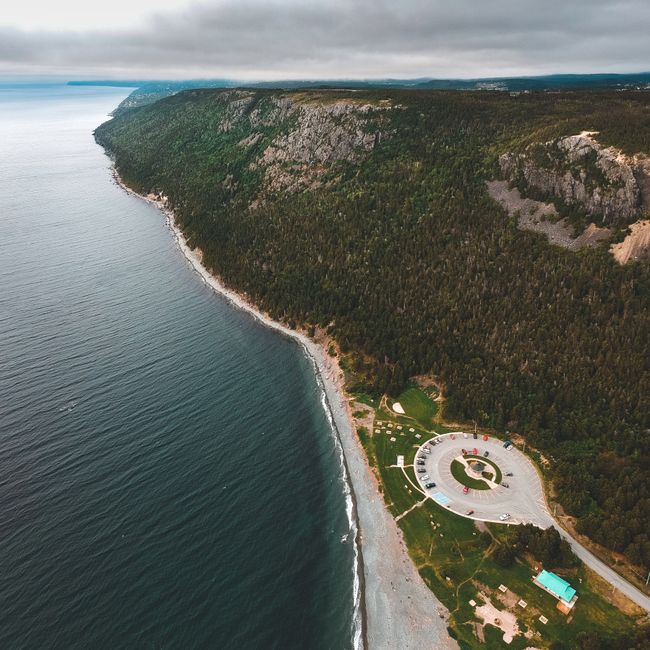
Cape Breton Island, the rugged northeastern end of Nova Scotia, is famous for the Cabot Trail, one of the world’s great coastal drives, which loops around its northern tip through Cape Breton Highlands National Park, climbing headlands high above the Gulf of St. Lawrence and the Atlantic. The island also has the vast inland sea of the Bras d’Or Lake, the reconstructed 18th-century French Fortress of Louisbourg, Alexander Graham Bell’s summer home at Baddeck, Acadian villages around Chéticamp, and the strongest Gaelic and Celtic music tradition in North America, celebrated each October at the Celtic Colours festival. Moose wander the highlands, bald eagles circle overhead and pilot whales feed offshore in summer. The island is joined to the mainland by the Canso Causeway, about three hours’ drive from Halifax, and most visitors spend three to five days, driving the trail slowly and stopping to hike, eat lobster and hear a fiddle. Late September and early October, when the hardwoods turn red and gold, is the most beautiful time to come.
Right now in Cape Breton Island (Baddeck)
- Wed 9–13°C 49–56°F Mostly clear
- Thu 9–16°C 49–60°F Cloudy
- Fri 11–16°C 52–61°F 1 mm Cloudy
- Mon 12 Oct Thanksgiving
Weather: MET Norway (CC BY 4.0) · Sea temperature: NOAA CoastWatch · Air quality: OpenAQ · Rates: ECB · Holidays: Nager.Date
Top tours in Cape Breton Island
See all tours for Cape Breton Island →
From local operators, with prices and reviews; you check availability and book on Viator, our partner. We may earn a commission at no extra cost to you. How we earn money
Cape Breton Island at a glance
- Best months: July and August for warm weather, whale watching and summer music; late September to mid-October for autumn colour and Celtic Colours. Many seasonal businesses close from late October to May.
- Time needed: one long day to drive the Cabot Trail; three to five days to hike, whale-watch and add Louisbourg and Baddeck.
- Getting there: by car over the Canso Causeway, about 280 km (175 miles) and 3 hours from Halifax; or fly to Sydney (YQY).
- Costs (as of October 2026): prices are in Canadian dollars; Cape Breton Highlands National Park is $10 a day for adults (about US$7) and the Fortress of Louisbourg $9.50 in autumn; Nova Scotia’s HST is 14%.
- Before you go: entry rules (eTA or visa), money and driving in Canada are in our Canada travel guide.
Cape Breton’s regions and who each one suits
Baddeck and the Bras d’Or Lake
Baddeck, a small resort village on the shore of the Bras d’Or Lake, is the traditional start and end point of the Cabot Trail, with inns, restaurants, sailing and the Alexander Graham Bell museum. The Bras d’Or itself is a huge, part-salt inland sea and a UNESCO Biosphere Reserve, ringed by quiet roads and Mi’kmaw communities such as Wagmatcook and Eskasoni. A good central base for a first visit.
The Ceilidh Coast and Chéticamp
The west coast, facing the Gulf of St. Lawrence, is the heartland of Cape Breton fiddle music, with summer ceilidhs in Mabou, Judique and Inverness, long sandy beaches, the Cabot Links golf courses and the Glenora whisky distillery. Farther north, Chéticamp is a proud Acadian fishing village, famous for hooked rugs, whale-watching boats and its position at the western gate of the national park.
The Highlands and the far north
Inside Cape Breton Highlands National Park, the Cabot Trail climbs over French, MacKenzie and North mountains, with lookoffs over the sea. At the top of the island, side roads lead to Pleasant Bay, Bay St. Lawrence and Meat Cove, among the most remote and dramatic spots in Nova Scotia. Best for hikers and wildlife watchers.
Ingonish and the Atlantic side
Ingonish, at the park’s eastern gate, has two of the island’s best beaches (Ingonish Beach, with both a freshwater lake and the ocean, and Black Brook), the Middle Head trail and the historic Keltic Lodge with the Highlands Links golf course. South of it, the trail drops past St. Ann’s Bay and the Gaelic College.
Sydney and Louisbourg
Sydney, the island’s only city, has the airport, cruise terminal and the world’s largest fiddle on its waterfront, and North Sydney is the port for ferries to Newfoundland. The Fortress of Louisbourg is about 35 minutes south. Good for travellers arriving by air or heading on to Newfoundland.
Top things to see on Cape Breton Island
Drive the Cabot Trail
The Cabot Trail is a paved loop of about 300 km (185 miles) from Baddeck through the Margaree Valley, Chéticamp, the national park, Pleasant Bay, Ingonish and back via St. Ann’s Bay. You can drive it in a day, about five to six hours without stops, but two or three days lets you hike, eat and watch for whales. Many people drive it anticlockwise (Baddeck to Chéticamp first), which puts you on the ocean side of the road with the best views on the west coast; clockwise suits early risers on the Atlantic side. The mountain sections have steep grades and hairpin bends, so use low gear on descents, and watch for moose, especially at dawn and dusk. Fuel up in Chéticamp or Ingonish; there are few gas stations in between.
Cape Breton Highlands National Park and the Skyline Trail
The park covers much of the island’s northern plateau, with 26 hiking trails, campgrounds, beaches and the famous red Adirondack chairs at scenic spots. It is open all year, with visitor services from 15 May to 25 October 2026. Its star is the Skyline Trail near Chéticamp: an easy, level walk to a boardwalk on a headland 400 m (1,300 ft) above the Gulf, with views of the Cabot Trail winding below and, often, pilot whales and moose. Choose the 6.5 km (4-mile) out-and-back route (about 2 hours) or the 8.2 km (5.1-mile) loop (2.5–3 hours). Dogs are not allowed on this trail.
New in 2026: Skyline Trail parking reservations. From 26 June to 25 October 2026 you must book a parking time slot in advance through the Parks Canada Reservation Service (online or 1-877-737-3783). Arrive no earlier than 10 minutes before and no later than one hour after your start time, or the booking is cancelled. Parking costs $9.50 per vehicle with a reservation, plus a $3.50 online booking fee, on top of park admission. From November to May no reservation is needed.
| Cape Breton Highlands pass (2026) | Adult | Senior (65+) | Family/group |
|---|---|---|---|
| Daily | $10.00 | $8.75 | $19.50 |
| Seasonal | $48.25 | $42.50 | $96.75 |
| Seasonal early bird (sold 1 November–30 June) | $24.50 | $22.00 | $60.50 |
| Parks Canada Discovery Pass (12 months) | $83.50 | $71.50 | $167.50 |
Youth 17 and under are free. You need a park pass to stop anywhere inside the park, including lookoffs on the Cabot Trail; buy it at the Chéticamp or Ingonish entrances. Free admission with the Canada Strong Pass ended on 7 September 2026.
Fortress of Louisbourg National Historic Site
On the Atlantic coast southeast of Sydney, Parks Canada has rebuilt a quarter of the 1740s French fortified town, the largest reconstruction of its kind in North America. In summer, costumed interpreters bake bread, fire muskets and cannons and serve 18th-century meals in the taverns. Admission and services change with the seasons:
| Season (2026–27) | Dates | Hours | Adult / senior |
|---|---|---|---|
| Peak | 1 July to 11 September 2026 | Daily 9:30 a.m.–5 p.m. | $22.00 / $18.75 |
| Shoulder | 12 September to 31 October 2026 | Daily 9:30 a.m.–5 p.m. | $9.50 / $7.75 |
| Low | 1 November 2026 to 17 May 2027 | Monday–Friday 9:30 a.m.–4 p.m. (closed holidays) | Free; buildings closed, grounds open for walks |
Youth are always free. Allow at least half a day, and bring a jacket: Louisbourg is often foggy and windy even in summer.
Alexander Graham Bell National Historic Site
The inventor of the telephone spent his summers at Baddeck for 37 years, and the museum there covers his work on flight, hydrofoils, kites and teaching the deaf, with a replica of the record-setting HD-4 hydrofoil. In 2026 it is open daily from 15 May to 30 October; adults pay $10, seniors $8.50. Kite-building workshops and “white glove” tours of archive objects cost a few dollars extra.
Chéticamp, the Margaree Valley and the Acadian coast
Chéticamp’s colourful church of Saint-Pierre and its hooked-rug museums tell the story of the Acadians who settled here in the 18th century. Inland, the Margaree Valley is famous for salmon fishing and autumn colour, and the coast road between Inverness and Chéticamp has some of the island’s finest sunsets.
Museums
- Alexander Graham Bell National Historic Site
- Fortress of Louisbourg
Peaks and mountains
- Franey Mountain
Protected areas
- Cape Breton Highlands National Park
Activities and best months
Other things to do on Cape Breton Island
Whale watching
Boats leave from Chéticamp, Pleasant Bay, Bay St. Lawrence and Ingonish, usually from June to early October. Long-finned pilot whales are the most common sighting, and minke, humpback and fin whales and dolphins are seen regularly; Zodiac trips get closer to the water, while larger boats are steadier. Whales can also be spotted from shore at the Skyline Trail and other headlands.
Celtic music and Celtic Colours
Cape Breton’s fiddle and step-dance traditions came with Scottish Highland settlers and are still everywhere: at weekly ceilidhs in community halls, the Red Shoe Pub in Mabou and the Celtic Music Interpretive Centre in Judique. The Celtic Colours International Festival brings hundreds of concerts, dances and workshops to communities all over the island for nine days each October; in 2026 it runs from 9 to 17 October. Book accommodation well ahead for festival week.
Hiking, beaches and golf
Beyond the Skyline Trail, try Franey for a steep climb to a fire-tower view over Ingonish, Middle Head for a gentle headland walk, the Acadian Trail above Chéticamp, or the short boardwalk at the Bog. Swim at Ingonish Beach, Black Brook, Inverness or Port Hood, where the Gulf side warms to around 20 °C (68 °F) in August. Golfers come for Cabot Links and Cabot Cliffs at Inverness and the historic Highlands Links at Ingonish.
Mi’kmaw, Gaelic and Acadian heritage
Cape Breton, Unama’ki in the Mi’kmaw language, has been Mi’kmaw land for thousands of years, and five Mi’kmaw First Nations communities are on the island today; Parks Canada co-manages the national park with the Mi’kmaq of Nova Scotia. Membertou Heritage Park in Sydney tells their story through exhibits and events. Scottish Highlanders arrived from the late 1700s, and Gaelic is still taught and sung here: visit the Gaelic College at St. Ann’s for summer courses and ceilidhs, and the Highland Village Museum at Iona, an open-air museum of Gaelic pioneer life above the Bras d’Or Lake. On the west coast, the Acadians of Chéticamp keep their French dialect, music and hooked-rug craft alive.
Seafood and local food
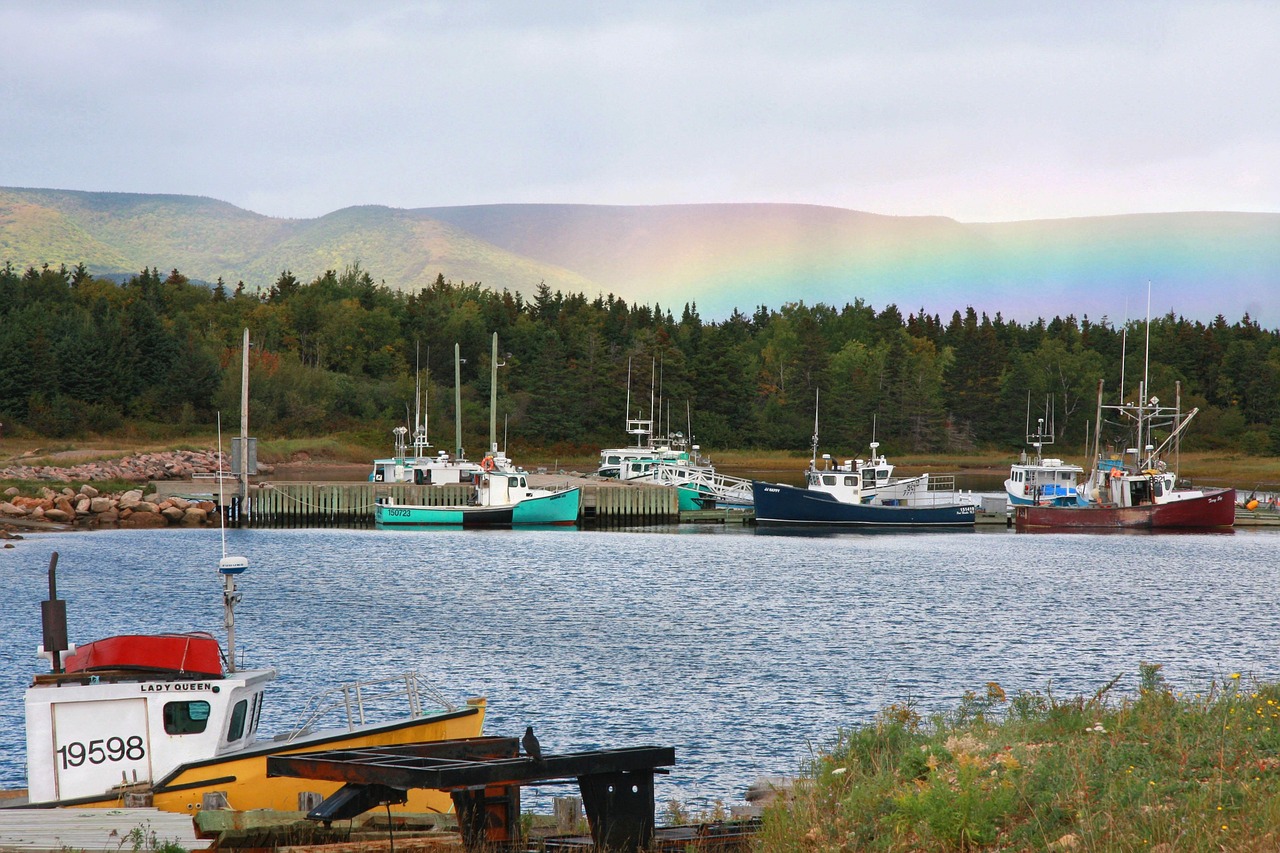
Lobster and snow crab are the island’s pride: fresh lobster is easiest to find in late spring and early summer, and many fishing harbours have a seafood shack or co-op shop. Try chowder, fresh mussels and oysters from the Bras d’Or, oatcakes and Scottish-style baking at tea rooms, Acadian meat pie and chicken fricot in Chéticamp, and a dram of single malt at Glenora, North America’s first single-malt whisky distillery. Many restaurants keep short hours outside July and August, so plan dinners ahead in the shoulder seasons.
Meat Cove and the far north
From the Cabot Trail at Cape North, a side road runs to Bay St. Lawrence and then, partly gravel, to Meat Cove, the northernmost settlement in Nova Scotia, with a clifftop campground and views where whales sometimes pass close to shore. Near Cape North, a monument at Cabot’s Landing Provincial Park marks the traditional landing site of explorer John Cabot in 1497. Allow at least half a day for the detour, and drive the gravel section slowly.
Day trips and onward travel
Newfoundland: Marine Atlantic ferries sail from North Sydney to Port aux Basques all year (about seven hours), and in summer to Argentia, near St. John’s; reserve ahead in summer. Prince Edward Island is about 3 hours’ drive to the Caribou ferry, and Halifax about 4 to 5 hours from Baddeck. See our Halifax and Prince Edward Island guides.
Nearby destinations
- Prince Edward Island188 km
- Halifax278 km
Getting there and getting around
By car: the island is joined to mainland Nova Scotia by the free Canso Causeway, opened in 1955. From Halifax Stanfield Airport it is about 3 hours to the causeway and about 4 hours to Baddeck along Highways 102, 104 and 105. A car is almost essential: there is no public transport around the Cabot Trail, and the best stops are spread out. By air: JA Douglas McCurdy Sydney Airport (YQY) has flights from Halifax and Toronto, with car rental. By bus: Maritime Bus runs between Halifax and Sydney via the causeway and Baddeck. Guided tours and cycling holidays also cover the Cabot Trail; cycling it is a serious challenge, with long, steep climbs over the mountains.
When to go and how long to stay
The island’s weather is maritime and changeable. Summers are warm rather than hot, with fog on the Atlantic side; July and August bring the warmest water and the busiest roads. Autumn is the highlight: the highland hardwoods usually peak in late September and the first half of October, the same weeks as Celtic Colours, so hotels fill up. By late October many restaurants, whale tours and inns close; winters are snowy, with heavy snowfalls on the highlands, and the Cabot Trail can be icy. Spring arrives late, and May can still be cold.
| Season | Average high | Average low | What it’s like |
|---|---|---|---|
| Spring (Mar–May) | 2–13 °C (35–56 °F) | −7 to 3 °C (20–37 °F) | Cold, late spring; snow into April. |
| Summer (Jun–Aug) | 19–23 °C (65–74 °F) | 8–13 °C (46–56 °F) | Pleasant, sometimes foggy; whale season. |
| Autumn (Sep–Nov) | 19 °C falling to 7 °C (66 to 45 °F) | 9 to 0 °C (48–32 °F) | Autumn colour; Celtic Colours; storms possible. |
| Winter (Dec–Feb) | −1 to 2 °C (29–36 °F) | −5 to −10 °C (13–23 °F) | Snowy: about 280 cm (110 in) a season at Sydney. |
Figures are Environment and Climate Change Canada’s 1981–2010 climate normals for Sydney Airport, which records about 1,500 mm (60 in) of rain and melted snow a year. The highland plateau is cooler, windier and snowier.
How long to stay: 2, 3 and 5 days
- Two days: drive the Cabot Trail anticlockwise from Baddeck, with an overnight in Chéticamp or Pleasant Bay and the Skyline Trail at sunset.
- Three days: add a whale-watching trip, a beach afternoon at Ingonish and the Alexander Graham Bell museum.
- Five days: add the Fortress of Louisbourg, a ceilidh on the Ceilidh Coast, a hike up Franey and a detour to Meat Cove.
Where to stay on Cape Breton Island and the taxes on your bill
- Baddeck: inns and lodges on the Bras d’Or; central for the whole loop.
- Chéticamp, Margaree and Inverness: motels, cottages and golf resorts on the Gulf side; great sunsets.
- Pleasant Bay and Ingonish: small motels, cabins and the Keltic Lodge, closest to the park’s trails.
- Sydney: chain hotels, handy for the airport, Louisbourg and the Newfoundland ferry.
- Camping: Parks Canada campgrounds such as Chéticamp, Broad Cove and Ingonish Beach, from $22 a night for basic sites.
Taxes: prices are shown before tax. Nova Scotia’s HST is 14% (since 1 April 2025) on most goods, meals and rooms; some municipalities and accommodations add their own marketing levy, so check the final price when booking. Book months ahead for July, August and the Celtic Colours weeks, when the island’s limited rooms fill up.
Practical tips for Cape Breton Island
- Time zone: Atlantic Time, one hour ahead of Toronto and Montreal (Newfoundland is a further 30 minutes ahead).
- Wildlife on the road: moose are large, dark and hard to see at night; slow down at dusk. Coyotes and black bears live in the park: keep food stored, hike in groups and keep children close.
- Coast safety: stay back from cliff edges at lookoffs, and watch for rip currents and cold water at Atlantic beaches.
- Phone signal: patchy in the highlands and the far north; download maps before you leave Baddeck or Sydney.
- Emergencies: call 911, including inside the national park.
What to pack for Cape Breton Island
Layers, a windproof and waterproof jacket, a warm hat for whale-watching boats and headlands, sturdy walking shoes or light boots for the trails, binoculars for whales, moose and eagles, insect repellent for June and July, and sunscreen. In autumn add a warm sweater for chilly evenings at concerts; in winter, full snow gear and a winter car kit.
What to pack
- Day packs and anti-theft bagsA 20–30 litre pack carries layers, water, a head torch and snacks on full-day levada walks.
- Fleeces and warm layersSummits like Pico do Areeiro averaged about 11 °C over 2024, so a fleece is needed even in summer.
- HeadlampsLevada routes such as PR1 and PR9 pass through long, dark, wet tunnels.
- Hiking shoes and bootsMadeira's levadas and the Azores' crater rims are wet, rocky and slippery, so grippy shoes matter more than anywhere else in Portugal.
- Rain jacketsMountain and island weather changes fast; a real shell beats an umbrella in the wind.
- Trekking polesLong stone staircases and steep descents on Madeira's peaks and the Azores' crater rims are easier on the knees with poles.
- Water bottles and hydration packsAlgarve and Alentejo trails are hot and exposed with few refill points.
Cape Breton Island travel FAQ
How long does it take to drive the Cabot Trail?
The loop is about 300 km (185 miles), five to six hours of driving without stops. Most people take two or three days to enjoy the hikes, lookoffs and whale watching.
Should I drive the Cabot Trail clockwise or anticlockwise?
Anticlockwise (Baddeck to Chéticamp first) is popular because you drive on the ocean side of the road along the west coast. Both directions are fine; pick the one that suits your overnight stops.
Do I need a reservation for the Skyline Trail?
Yes, from 26 June to 25 October 2026 you must book a parking slot in advance with Parks Canada: $9.50 per vehicle plus a $3.50 online fee, on top of park admission. From November to May, no reservation is needed.
How much does Cape Breton Highlands National Park cost?
$10 per adult per day, $8.75 for seniors and $19.50 for a family or group in one vehicle; youth 17 and under are free. A Discovery Pass also covers it.
Is the Fortress of Louisbourg open in winter?
From 1 November 2026 to 17 May 2027 the grounds are open free on weekdays from 9:30 a.m. to 4 p.m. for self-guided walks, but the buildings are closed and there are no services. Full programs run in summer.
When is Celtic Colours 2026?
9 to 17 October 2026, with concerts and events in communities across the island. Book rooms early.
When is the best time for whale watching in Cape Breton?
From June to early October, from Chéticamp, Pleasant Bay, Bay St. Lawrence and Ingonish. Pilot whales are seen most often, with minke, humpback and fin whales too.
When do the leaves change on the Cabot Trail?
Usually from late September to mid-October, peaking around the first half of October; colour comes first on the highland plateau.
Do I need a car on Cape Breton Island?
Yes, realistically. There is no public transport around the Cabot Trail; buses only link Halifax with Baddeck and Sydney. Without a car, join a guided tour or a supported cycling trip.
How far is Cape Breton from Halifax?
About 280 km (175 miles) to the Canso Causeway, roughly 3 hours by car, and about 4 hours to Baddeck.
Sources
- © OpenStreetMap contributors · ODbL · fetched 4 Oct 2026
- Wikidata · CC0 · fetched 4 Oct 2026
Sources and last review
Researched and last reviewed on 4 October 2026. National park fees, visitor-service dates, the Skyline Trail parking reservations, trail lengths and rules come from Cape Breton Highlands National Park (Parks Canada); Fortress of Louisbourg seasons, hours and fees and Alexander Graham Bell National Historic Site dates and fees from Parks Canada; festival dates from Celtic Colours International Festival; HST from the Canada Revenue Agency; climate from Environment and Climate Change Canada’s 1981–2010 normals for Sydney Airport. The Cabot Trail’s length and driving times, the ferry crossing time, whale species and seasons, autumn-colour timing, and some place details are general references and flagged for checking. Seasonal services change, so check the official sites before you go. For entry rules, money and general safety, see our Canada travel guide.
Plan your trip
Partner links: TravelerCenter may earn a commission if you book, at no extra cost to you.