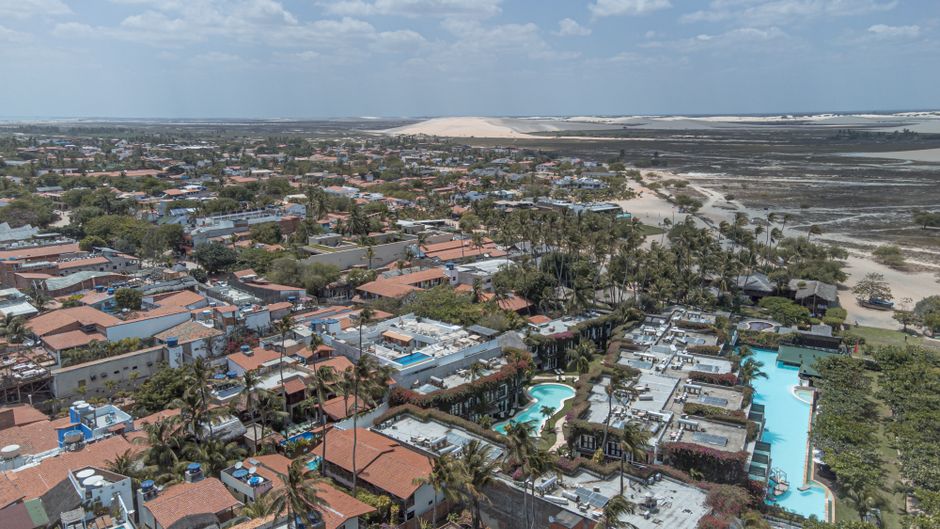
Jericoacoara, “Jeri” to Brazilians, is a former fishing village on the north-west coast of Ceará, set among dunes inside Jericoacoara National Park, with sandy streets and no paved roads in. It became famous with backpackers in the 1980s and is now one of Brazil’s favorite beach getaways, and among the world’s top kitesurfing and windsurfing spots, thanks to steady trade winds from about July to January. Days follow a ritual: kitesurfing or a buggy trip to the lagoons, a walk to the Pedra Furada rock arch, then the whole village climbs the Sunset Dune to watch the sun drop into the sea, followed by caipirinhas, forró and capoeira on the beach. Jeri belongs to the municipality of Jijoca de Jericoacoara, whose inland town gives access to the famous lagoons, and it is about 300 km (186 miles) from Fortaleza. The weather is hot and sunny, with rain concentrated from about February to May.
Right now in Jericoacoara
- Wed26–34°C78–94°F1 mm rain
- Thu26–35°C78–95°FClear
- Fri26–32°C79–89°FMostly clear
- Mon 12 Oct Our Lady of Aparecida (Nossa Senhora Aparecida)
Top tours in Jericoacoara
See all tours for Jericoacoara →
From local operators, with prices and reviews; you check availability and book on Viator, our partner. We may earn a commission at no extra cost to you. How we earn money
Jericoacoara at a glance
- Best for: kitesurfing and windsurfing, dunes and lagoons, sunsets, beach life and nightlife.
- How long: 3–4 days; a week or more for kitesurfers.
- Best time: July to January for wind and sun; the rainy season, about February to May, is quieter and greener, with fuller lagoons.
- Getting there: fly to Jericoacoara Regional Airport, in the town of Cruz, about 40 minutes from the village, or to Fortaleza, about 5–6 hours by road; the last stretch into the village is by licensed 4×4 vehicle.
- Fee to know: the municipality of Jijoca de Jericoacoara charges visitors a Sustainable Tourism Fee (Taxa de Turismo Sustentável), paid online through the municipality’s portal.
- Before you go: the e-visa, money and general safety are in our Brazil travel guide; for the city, see our Fortaleza travel guide.
Jericoacoara’s areas: where things are
The village
A grid of sand streets between the beach and the dunes, with pousadas, restaurants, bars, shops and kite schools; the main streets are Rua Principal and Rua São Francisco, and the beach strip faces north toward the sea.
The national park
Jericoacoara National Park, created in 2002 and run by ICMBio, covers 8,863 hectares (21,900 acres) of dunes, beaches, mangroves and the rocky headland of Serrote around the village, according to ICMBio. Its visitor services are operated by a private concession company. Vehicles in the park follow set tracks, and the village is reached only by 4×4.
Preá and the coast to the east
Preá, about 12 km (7.5 miles) east, is the kitesurfers’ base, with a long, flat beach and strong wind; farther east lie the lagoons of Jijoca and the coast toward Fortaleza.
Tatajuba and the coast to the west
West of Jeri, across the Guriú River (crossed by raft), the shifting dunes of Tatajuba and the Lagoa da Torta lie on the way toward Camocim.
Jericoacoara in brief
Jericoacoara was an isolated fishing village of a few hundred people, without electricity or roads, until the 1980s, when Brazilian and foreign travelers began arriving by truck over the dunes, drawn by the landscapes, the dunes and the isolation. To stop the dunes and village being overrun, an environmental protection area was created in 1984 and the national park in 2002, and the village kept its sand streets. Electricity arrived in the late 1990s. Today Jeri is a cosmopolitan resort with Italian, Argentine and European residents, but fishermen still launch their boats from the beach, and the sunset gathering on the dune remains the ritual of every day.
Top things to see in Jericoacoara
Sunset Dune (Duna do Pôr do Sol)
The big dune at the west end of the village is where everyone gathers at sunset; from about July to January, when skies are clearest, the sun sets over the sea. Some parts of the dune are fenced to let vegetation recover; use the marked paths.
Pedra Furada
A rock arch on the shore about 3 km (2 miles) east of the village, reached on foot over the Serrote hill or along the beach at low tide; around July, the sun sets inside the arch when seen from the beach.
Lagoa do Paraíso and Lagoa Azul
Freshwater lagoons near the town of Jijoca, about 30 minutes by buggy, with clear blue water, hammocks strung in the shallows and beach restaurants. They are fullest after the rains.
Árvore da Preguiça and the Mangue Seco
The “lazy tree”, bent flat by the wind, is a classic stop on the eastern buggy tour, together with the mangroves of Mangue Seco and the seahorses of the Guriú estuary.
More to see
- Malhada beach: a cove just east of the village, popular with surfers.
- Serrote and the lighthouse: a walk up the headland for views over the dunes.
- Tatajuba: moving dunes and a lagoon west of Jeri, on the western buggy tour.
- Capoeira on the beach: most evenings near the dune at sunset.
Other things to do in Jericoacoara
Kitesurfing and windsurfing
From about July to January, constant trade winds blow along the coast, making Jeri and Preá among the best kitesurfing spots in the world, with flat water in lagoons and waves offshore. Many schools offer lessons for beginners; book a certified instructor.
Sandboarding, horseback riding and kayaking
Sandboards are rented for the big dunes near the village and on the western tour; horseback rides follow the beach toward the Serrote and the dunes at sunset; and kayaks and stand-up paddleboards are rented on the lagoons.
Buggy and 4×4 tours
Licensed buggies and 4x4s run two classic tours: east to the Árvore da Preguiça, Pedra Furada viewpoint, Lagoa do Paraíso and Lagoa Azul, and west to Mangue Seco, the Guriú raft crossing and Tatajuba. Choose drivers licensed for the park.
Food and nightlife
Seafood, tapioca crepes, and street carts selling caipirinhas on the main street; nightlife runs late, with forró nights at clubs in the village.
Where to eat and drink
- The main streets: Rua Principal and Rua São Francisco have most restaurants, from seafood and Brazilian dishes to Italian, Japanese and Argentine grills; book in high season.
- Beachfront kiosks: fresh coconut water, grilled fish and caipirinhas by day; at night, caipirinha carts line the street near the beach.
- Tapioca stalls: sweet and savory tapioca crepes, a cheap Ceará favorite, at stalls and cafés.
- The lagoons: restaurants at Lagoa do Paraíso and Lagoa Azul serve fish and shrimp with tables in the water.
Nightlife peaks after sunset, with forró nights at clubs several times a week, live music in bars and parties on the beach in high season.
Kitesurfing spots
Preá’s long beach has onshore and side-shore winds and many schools and kite resorts; the Guriú and Tatajuba lagoons and the Barrinha lagoon offer flat water for freestyle; and downwind trips follow the coast for 20–100 km (12–60 miles) with support vehicles. Beginners usually need about 9–12 hours of lessons to ride independently; book with schools that use radio helmets and offer insurance.
Day trips from Jericoacoara
- Lagoa do Paraíso and Lagoa Azul: a half or full day.
- Tatajuba: a full-day western buggy tour.
- Camocim and the Rota das Emoções: the coast west toward the Parnaíba Delta and the Lençóis Maranhenses, better as a multi-day trip.
Nearby destinations
- Fortaleza244 km
- Lençóis Maranhenses National Park271 km
Getting there and getting around
By air
Jericoacoara Regional Airport, in the municipality of Cruz, has domestic flights from São Paulo and other cities; transfers to the village take about 40 minutes, the last part by 4×4. Fortaleza (FOR) has many more flights.
By road from Fortaleza
Buses and shared and private transfers run from Fortaleza, about 300 km (186 miles), 5–6 hours. Regular vehicles stop at Jijoca or the edge of the park, where passengers change to licensed 4×4 trucks or buggies for the last stretch over the sand. Ask whether your ticket or transfer includes the 4×4.
Routes in detail
- From Fortaleza by bus: regular buses run from Fortaleza’s bus station and airport to Jijoca, where passengers transfer to 4×4 trucks (jardineiras) for the last stretch to the village; the whole trip takes 6–7 hours.
- Shared and private transfers: vans pick up at Fortaleza hotels and the airport and change to 4x4s at the park edge; private transfers in a 4×4 go door to door and can stop at beaches on the way.
- From Jericoacoara airport: taxis and transfers from Cruz take about 40 minutes, the last part by 4×4.
- Driving yourself: rental cars must be left in a guarded parking lot in Jijoca or at the park entrance; only licensed vehicles may cross into the village.
- Heading west: 4×4 transfers continue along the coast to Camocim, the Parnaíba Delta and Barreirinhas for the Rota das Emoções.
In the village
Walk everywhere on the sand; buggies, quad bikes with licensed drivers and 4x4s go to the beaches and lagoons.
When to go and how long to stay
Jeri is hot and sunny for most of the year, with average highs around 30–32 °C (86–90 °F). Like Fortaleza, where INMET’s 1991–2020 normals record most of the year’s 1,580 mm (62 in) of rain from February to May and almost none from August to December, the coast has a short rainy season in the first half of the year and a long dry, windy season after it. The wind is strongest from about August to December, the high season for kitesurfers; July, the December–January holidays and Carnival are the busiest times. In the rainy season, the lagoons fill and prices drop, but some days are wet.
Jericoacoara’s weather month by month
There is no long-term official station at Jeri. The table shows INMET’s 1991–2020 averages for Fortaleza, about 300 km (186 miles) east on the same coast, which has a similar pattern of a short rainy season and a long dry, windy season.
| Month | Average high | Average low | Rain (Fortaleza) |
|---|---|---|---|
| January | 31 °C (88 °F) | 24 °C (76 °F) | 156 mm (6.2 in) |
| February | 31 °C (88 °F) | 24 °C (76 °F) | 187 mm (7.4 in) |
| March | 31 °C (87 °F) | 24 °C (75 °F) | 337 mm (13.3 in) |
| April | 31 °C (87 °F) | 24 °C (75 °F) | 385 mm (15.2 in) |
| May | 31 °C (87 °F) | 24 °C (75 °F) | 229 mm (9.0 in) |
| June | 30 °C (87 °F) | 23 °C (74 °F) | 130 mm (5.1 in) |
| July | 31 °C (87 °F) | 23 °C (73 °F) | 70 mm (2.7 in) |
| August | 31 °C (88 °F) | 23 °C (73 °F) | 20 mm (0.8 in) |
| September | 31 °C (89 °F) | 24 °C (74 °F) | 14 mm (0.5 in) |
| October | 32 °C (89 °F) | 24 °C (76 °F) | 10 mm (0.4 in) |
| November | 32 °C (89 °F) | 25 °C (76 °F) | 10 mm (0.4 in) |
| December | 32 °C (89 °F) | 25 °C (77 °F) | 37 mm (1.5 in) |
- January: hot, with the first rains; New Year and summer holiday crowds.
- February to May: the rainy season, with heavy showers, green landscapes, fuller lagoons and lower prices; Carnival is busy.
- June: rains ease; quiet and good value.
- July to December: dry, sunny and windy; kitesurfing season, with the strongest winds from about August to December; July and December are the busiest months.
3 days in Jericoacoara
Day 1: arrive, walk the village and climb the Sunset Dune. Day 2: the eastern buggy tour with the Lagoa do Paraíso and the Árvore da Preguiça. Day 3: walk to Pedra Furada in the morning, a kitesurfing or windsurfing lesson in the afternoon.
5 days in Jericoacoara
Days 1–3 as above, then a full day on the western tour to Tatajuba with the Guriú raft crossing, and a final day of rest at Lagoa do Paraíso or a horseback ride to the Serrote at sunset.
A week in Jericoacoara
Add the western tour to Tatajuba, a few more days of lessons or riding in Preá, and a day of rest at the lagoons.
Jericoacoara for families and non-kiters
Jeri suits families and travelers who don’t kitesurf: the lagoons have calm, shallow water and restaurants with shade, the buggy tours are fun for children, and the beach in front of the village is usually calm at low tide. Strong wind can make the main beach sandy and choppy in the afternoon from August to December, so plan lagoon trips for those hours, and bring sunglasses and a buff to protect against blowing sand.
Where to stay in Jericoacoara
- The village center: pousadas close to restaurants, the beach and nightlife.
- The edges of the village: quieter pousadas toward the dunes or Malhada.
- Preá: kite resorts and pousadas on the wind beach, 20 minutes from the village.
- Jijoca: cheaper stays beside the lagoons.
What things cost in Jericoacoara
Our estimates for planning, as of October 2026:
| Item | Typical price |
|---|---|
| Eastern or western buggy tour (shared per buggy, up to 4 people) | about R$400–600 (US$75–115) per buggy |
| Kitesurfing lesson (per hour, private) | about R$300–450 (US$60–85) |
| 4×4 transfer from Jijoca to the village | about R$30–60 (US$6–12) per person |
| Shared transfer Fortaleza–Jeri | about R$150–250 (US$30–50) one way |
| Dinner for two with drinks | about R$200–400 (US$40–75) |
| Caipirinha from a street cart | about R$15–25 (US$3–5) |
| Double room, mid-range pousada | about R$350–700 (US$65–135) a night; more in July, December and January |
Responsible visiting
The dunes are moving and fragile, and parts of the Sunset Dune are fenced to let plants recover. Stay on marked paths, take your rubbish back, don’t ride quad bikes or buggies off the licensed tracks, and respect the fishermen’s working beach. Water and energy are limited in the village, so use them sparingly.
Practical tips for Jericoacoara
- Sustainable Tourism Fee: pay the municipality’s fee online on its official portal before you arrive, and keep the receipt; the amount and rules are set by the municipality.
- Licensed transport: use licensed 4x4s and buggies, which are allowed on the park’s tracks.
- Money: cards are widely accepted, but ATMs are few; carry some cash.
- Sun and sand: the sun is fierce near the Equator; use high-factor sunscreen and avoid walking the dunes at midday.
- Health: the CDC doesn’t list Ceará among the areas where yellow fever vaccination is recommended.
- Safety: Jeri is relaxed and busy at night; keep valuables in your pousada, watch drinks in bars, and take care walking to Pedra Furada at high tide.
- Emergencies: call 190 for police, 192 for an ambulance and 193 for the fire department.
What to pack for Jericoacoara
Pack swimwear, light clothes, a wide-brimmed hat that won’t blow away, sunglasses, high-factor sunscreen, a windbreaker for the evenings, flip-flops or sandals (shoes are pointless on sand streets), a dry bag for buggy rides and a headlamp. Bring a plug adapter for Brazil’s type N sockets.
Jericoacoara travel FAQ
How do I get to Jericoacoara?
Fly to the Jericoacoara Regional Airport in Cruz, about 40 minutes away, or to Fortaleza, 5–6 hours by road. The last stretch is by 4×4 over the sand.
Is there a tourist tax in Jericoacoara?
Yes. The municipality of Jijoca de Jericoacoara charges a Sustainable Tourism Fee, paid online on its official portal.
When is the best time to visit Jericoacoara?
July to January for sun and wind; the rainy months, about February to May, are quieter and fill the lagoons.
When is the kitesurfing season in Jericoacoara?
About July to January, with the strongest winds from about August to December.
Can you drive a car to Jericoacoara?
Not into the village: regular cars stop outside the national park, and licensed 4x4s cover the last stretch.
How many days do I need in Jericoacoara?
Three or four days for the lagoons, Pedra Furada and sunsets; a week for kitesurfing.
Do I need a yellow fever vaccine for Jericoacoara?
It isn’t required, and the CDC doesn’t list Ceará among the areas where it is recommended.
Is Jericoacoara worth visiting?
Yes, for dunes, lagoons, sunsets and kitesurfing in a village without paved streets; it is busier and pricier than it was, but still special.
What is the Rota das Emoções?
A multi-day overland route from Jericoacoara through the Parnaíba Delta to Lençóis Maranhenses, sold as packages with transfers.
Can I learn to kitesurf in Jericoacoara?
Yes. Many schools in Jeri and Preá teach beginners from about July to January; most people need about 9–12 hours of lessons.
Plan your trip
Partner links: TravelerCenter may earn a commission if you book, at no extra cost to you.
🇵🇹 Useful Portuguese phrases for Jericoacoara
All 38 Portuguese phrases: restaurant, hotel, emergencies, romance (printable) →
Sources · last reviewed 4 October 2026
Researched and last reviewed on 4 October 2026. The national park’s creation, area and concession: ICMBio; the Sustainable Tourism Fee portal: the municipality of Jijoca de Jericoacoara; Fortaleza rainfall: INMET’s 1991–2020 normals; yellow fever: the US CDC; exchange rate: the Central Bank of Brazil. The fee’s amount was not available on the portal and is not given here. Village history, sights and distances, the sunset in Pedra Furada, wind seasons, buggy tours, the airport and flights, transfer times and the 4×4 rule come from secondary sources or general knowledge and are flagged for checking. Rules change, so check the official sites before you go. For entry rules and money, see our Brazil travel guide.
Data: Weather: MET Norway (CC BY 4.0) · Sea temperature: NOAA CoastWatch · Rates: ECB · Holidays: Nager.Date · Costs: World Bank ICP and price levels · Wikidata (CC0)