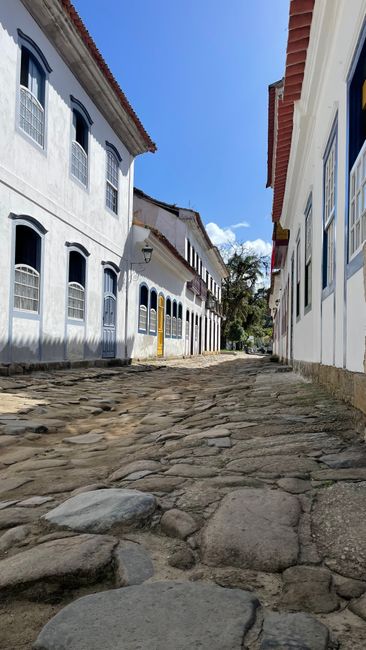
Paraty is a small colonial town on the Costa Verde, the “green coast” between Rio de Janeiro and São Paulo, where the forested mountains of the Serra do Mar drop straight into a bay scattered with islands. In the 18th century it was the port that shipped gold from Minas Gerais to Portugal; when the gold road moved, the town was left almost untouched, and today its car-free historic center of whitewashed houses with colored doors, white churches and big, uneven cobblestones is one of the best-preserved in Brazil. Together with Ilha Grande and the surrounding forest, it was listed by UNESCO in 2019 as a World Heritage Site for both culture and nature. Come for the old town, schooner trips to islands and beaches, waterfalls and cachaça distilleries in the hills, the beaches of Trindade, and festivals such as the FLIP literary festival. Paraty has about 45,000 residents and a humid tropical climate, with a wet, hot summer.
Right now in Paraty
- Wed 21–26°C 70–78°F 4 mm Rain
- Thu 21–27°C 71–80°F Mostly clear
- Fri 22–29°C 71–84°F Cloudy
- Mon 12 Oct Our Lady of Aparecida (Nossa Senhora Aparecida)
Weather: MET Norway (CC BY 4.0) · Sea temperature: NOAA CoastWatch · Holidays: Nager.Date
Top tours in Paraty
See all tours for Paraty →
From local operators, with prices and reviews; you check availability and book on Viator, our partner. We may earn a commission at no extra cost to you. How we earn money
Paraty at a glance
- Best for: colonial architecture, boat trips, beaches, waterfalls, hiking, cachaça and food.
- How long: 3–4 days; a week to add Trindade or Ilha Grande.
- Best time: April to June and August to October, with mild, drier weather; December to March is hot and rainy and busy around the holidays.
- Getting there: about 4–5 hours by road from Rio de Janeiro or São Paulo, by car or long-distance bus; there is no commercial airport.
- Getting around: walking in the historic center (no cars), local buses and taxis to the beaches and hills, and boats on the bay.
- Before you go: the e-visa, money and general safety are in our Brazil travel guide; for the cities at either end of the coast, see our Rio de Janeiro and São Paulo guides.
Paraty’s areas: where things are
The historic center
A grid of about 30 blocks between the river and the sea, closed to cars, with the main churches, the old houses, shops, galleries and restaurants. The streets were laid with large stones and slope toward the center so that spring tides could wash them; on some full and new moons, the sea still floods the lowest streets.
Jabaquara and the town beaches
Short walks or rides from the center, small beaches such as Pontal and Jabaquara face the bay; they are calm but not the clearest water.
The hills (Serra)
Inland, the road toward Cunha climbs into the Atlantic Forest of the Serra da Bocaina, with waterfalls, natural pools, cachaça distilleries and the old gold road (Caminho do Ouro).
Trindade and the south
About 25 km (16 miles) south, the village of Trindade has surf beaches, a natural pool in the rocks and trails into the Serra da Bocaina National Park; nearby, Paraty-Mirim has a colonial chapel on a quiet beach.
Paraty in brief: history and culture
Paraty was founded in the 17th century on land of the Guaianá people, and its bay sheltered the start of the Caminho do Ouro, the stone-paved gold road that climbed the Serra do Mar toward the mines of Minas Gerais. Gold and diamonds came down it by mule, enslaved Africans and supplies went up, and the town prospered, building its churches for different social groups: Santa Rita for free people of mixed descent, Rosário for enslaved people, Dores for the elite. When a new road was opened from Rio to the mines in the 18th century, and later when the railway bypassed the coast, Paraty slipped into isolation, which is why so much of the colonial town survived. It was only reconnected by the coastal highway in the 1970s, when it was rediscovered by artists and visitors.
Today Paraty mixes colonial heritage with the culture of the Caiçara fishing communities of the coast, Guarani villages in the hills and Quilombola communities descended from people who escaped slavery, some of which welcome visitors on community tourism trips. Local crafts include wooden canoes and boats, ceramics and the town’s long tradition of cachaça making, which once made “parati” a byword for cane spirit in Brazil.
Top things to see in Paraty
The historic center and churches
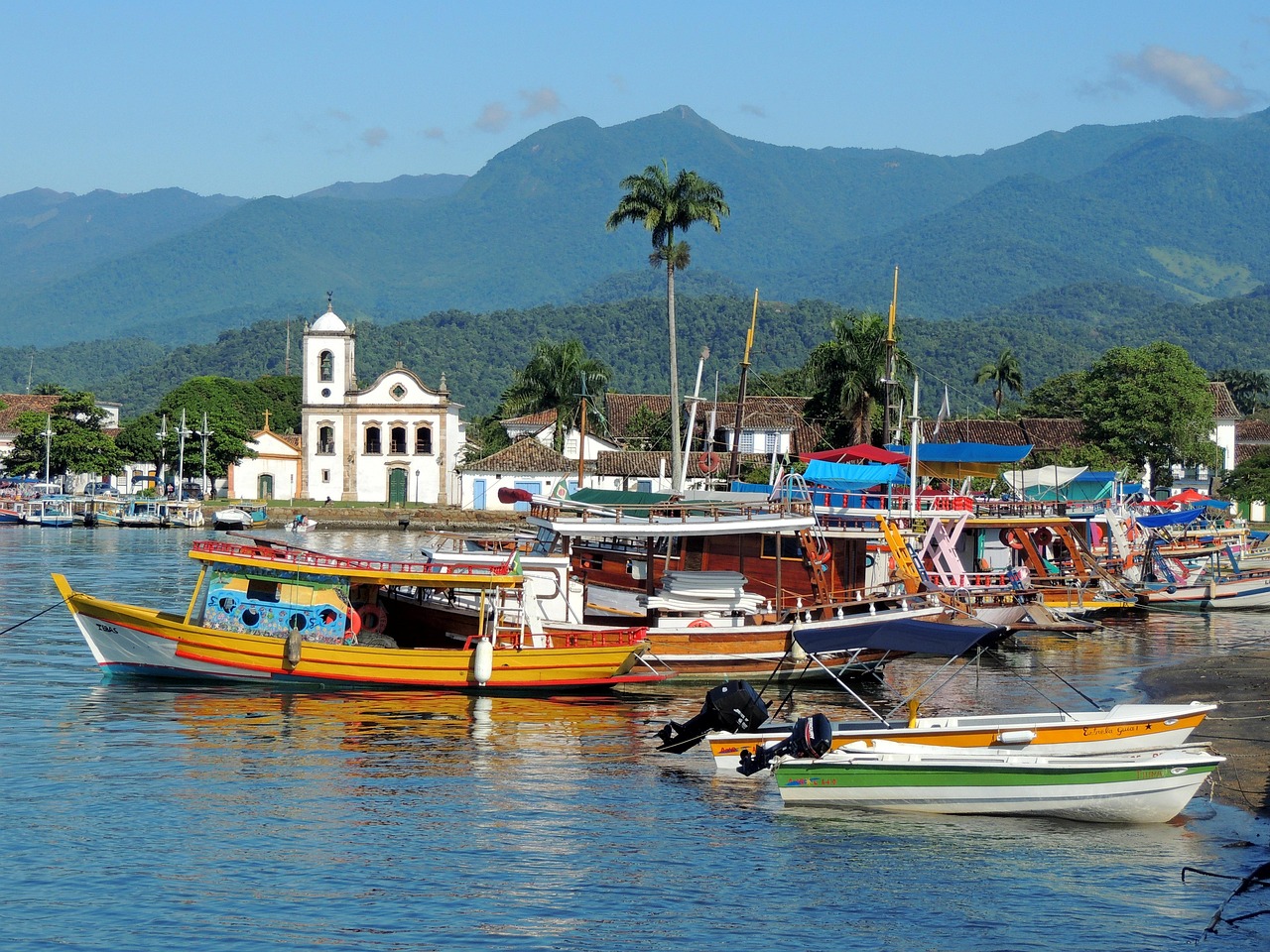
Wander the cobbled streets, best in the early morning or at dusk, and visit the 18th-century churches: Santa Rita, the whitewashed waterfront church that appears in most photos of Paraty; Nossa Senhora do Rosário, built by and for enslaved people; Nossa Senhora das Dores; and the parish church, the Matriz. Wear flat, sturdy shoes: the stones are large and slippery.
Schooner trips on the bay
Wooden schooners leave the town pier each morning for a day trip to several islands and beaches, with stops for swimming and snorkeling; smaller private boats reach quieter coves such as Saco do Mamanguá, a fjord-like inlet.
Waterfalls and cachaça
Up the Cunha road, the Tobogã waterfall has a natural rock slide, and the Pedra Branca and Toca do Ouro falls have pools. Paraty is famous for cachaça; several distilleries offer tours and tastings.
Trindade
Beaches between granite boulders, the clear natural pool of the Piscina Natural do Cachadaço reached by trail or boat, and a laid-back village.
More to see
- Forte Defensor Perpétuo: a small 18th-century fort on a headland, a short walk from the center.
- The Caminho do Ouro: a restored stretch of the old stone gold road through the forest, walked with a guide.
- Saco do Mamanguá: a long, narrow inlet surrounded by mountains, reached by boat.
- Paraty-Mirim: a colonial chapel and beach south of town.
Other things to do in Paraty
Festivals
Paraty is known for its festivals: FLIP, the International Literary Festival of Paraty, one of Latin America’s main literary events; the Festa do Divino, a religious festival; and a cachaça festival. Dates change each year; check the organizers’ sites.
Trails worth knowing
- Trindade to Praia do Sono and Antigos: from the end of the road at Laranjeiras, a forest trail of about an hour leads to Praia do Sono, a fishing community with a long beach, and on to the empty beaches of Antigos and Antiguinhos.
- Pico do Corisco: one of the highest points around Paraty, with views over the bay, reached with a 4×4 and a hike; go with a guide.
- The Caminho do Ouro: guided walks on the restored stone road, with history of the gold trade and the enslaved people who built it.
- Saco do Mamanguá’s Pão de Açúcar: a short, steep climb to a viewpoint over the inlet, reached by boat.
Trails can be slippery after rain; wear proper shoes, start early and carry water.
Hiking
Trails lead from Trindade and Paraty-Mirim to empty beaches, and the Serra da Bocaina National Park has longer treks; hike with a guide on remote routes.
Kayaking, diving and stand-up paddle
The sheltered bay suits sea kayaking and paddleboarding among islands and mangroves, with rentals and guided trips from the town beaches and Paraty-Mirim; the Saco do Mamanguá is a favorite overnight kayak trip. Dive centers run trips to the islands, with turtles and reef fish in warm, sheltered water, and introductory dives for beginners.
Community tourism
The Quilombo do Campinho da Independência, on the road to Trindade, is a community descended from formerly enslaved people that welcomes visitors with a restaurant, crafts and guided walks about its history; Guarani villages and Caiçara fishing communities in the region also offer visits through community tourism programs.
Food
Paraty has excellent restaurants for its size, serving seafood and dishes from the Caiçara fishing tradition, such as azul-marinho (fish cooked with green bananas), alongside local cachaça and its liqueurs.
Where to eat and drink
- The historic center: restaurants in colonial houses serving Caiçara seafood, contemporary Brazilian cooking and international dishes, many with live music in the evening; it is the most atmospheric place to dine.
- The pier and Jabaquara: simpler fish restaurants and beach kiosks.
- The Serra: distillery restaurants and country kitchens on the Cunha road, good for lunch after the waterfalls.
- Street carts: in the evening, carts in the historic center sell cocktails made with local cachaça, sweets and crepes.
Try azul-marinho, the Caiçara fish stew with green bananas that turn the broth blue-gray, fresh shrimp, and the town’s cachaças, from crystal-clear to barrel-aged, and the gabriela, a cachaça liqueur with cinnamon and clove.
Ilha Grande in more depth
Across the bay to the east, Ilha Grande is a mountainous, car-free island covered in Atlantic Forest, with a former prison, the main village of Abraão and more than a hundred beaches, the best known being Lopes Mendes, a long white-sand beach reached by trail or boat. Boats leave from Angra dos Reis, Conceição de Jacareí and Mangaratiba, about 1.5–2 hours by road from Paraty, and transfers from Paraty combine van and boat. Trails cross the island; some require a guide. Spend at least two nights.
Trindade in more depth
Trindade, about 25 km (16 miles) south, is a village of fishermen and surfers inside the Serra da Bocaina National Park’s buffer, with a string of beaches: Praia do Cepilho for surfers, Praia de Fora and Praia do Meio in front of the village, and Cachadaço, where a short trail leads over the rocks to the Piscina Natural, a clear pool sheltered by boulders, best at low tide. Boats also run to the pool and to Praia do Caixa d’Aço. Local buses run from Paraty’s bus station.
Day trips from Paraty
- Trindade: beaches and the natural pool, about 40 minutes by road.
- Ilha Grande: by road to Angra dos Reis or Conceição de Jacareí and then a boat; better for two or three nights.
- Cunha: a mountain town of pottery studios and lavender fields, about 1.5 hours up the Serra.
Nearby destinations
- Rio de Janeiro158 km
- São Paulo199 km
- Armação dos Búzios295 km
Getting there and getting around
By road
Paraty is on the BR-101 coastal highway, about 250 km (155 miles) from Rio de Janeiro and about 300 km (186 miles) from São Paulo, 4–5 hours each way. Long-distance buses run from both cities’ main bus stations, and private and shared transfers run from Rio and from the Ilha Grande ferry ports. The coastal road is winding, so avoid driving it at night or in heavy rain.
Road and bus details
From Rio, the BR-101 (Rio–Santos road) runs along the Costa Verde past Itaguaí, Mangaratiba and Angra dos Reis, with sea views and many curves; from São Paulo, drivers usually take the Carvalho Pinto/Ayrton Senna highways to Taubaté and then the descent through Cunha, or the coast road via Ubatuba. Several bus companies run daily from Rio’s Novo Rio station and São Paulo’s Tietê station to Paraty’s bus station, a short walk from the historic center; there are also buses from Angra dos Reis and Ubatuba. Shared transfers connect Paraty with Rio’s airports and Ilha Grande ports.
In and around Paraty
Walk in the historic center: cars aren’t allowed. Local buses from the bus station serve Trindade and other beaches; taxis and ride-hailing cars are available. Boats leave from the pier for the islands.
When to go and how long to stay
Paraty has a humid tropical climate. Summer, from December to March, is hot and very wet, with frequent heavy rain, and the busiest season around Christmas, New Year and Carnival. From April to October it is cooler and drier, with mild days that suit walking and boat trips; June to August evenings can be cool. No official long-term climate station is near the town; for Rio de Janeiro’s mountain station, see our Rio de Janeiro guide.
Paraty month by month
- December to March: hot and humid, with frequent heavy rain and occasional landslides on mountain roads; busy around Christmas, New Year and Carnival, which Paraty celebrates with street blocos.
- April and May: warm, drier and quieter; a good time for boat trips and walking.
- June to August: mild, mostly dry winter with cool evenings and calm seas; the cachaça festival is usually in August, and festivals of the Divino take place around Pentecost.
- September to November: spring, with warming weather and more rain returning toward November; several cultural festivals fall in these months.
2 days in Paraty
Day 1: the historic center in the morning, a cachaça distillery and waterfalls in the afternoon, and dinner in the old town. Day 2: a schooner trip, back in time for sunset at the Santa Rita church.
3 days in Paraty
Day 1: the historic center and churches, and sunset by Santa Rita. Day 2: a schooner trip on the bay. Day 3: waterfalls and a cachaça distillery in the hills, or Trindade’s beaches.
A week in Paraty and around
Add Saco do Mamanguá by boat, a hike on the Caminho do Ouro, and two or three nights on Ilha Grande.
Where to stay in Paraty
- The historic center: pousadas in colonial houses, close to everything; streets are lively at night in season.
- Just outside the center: cheaper pousadas with parking, a short walk away.
- Trindade: simple pousadas and campsites near the beaches.
- The bay and the hills: boutique lodges on the water or in the forest, for longer stays.
What things cost in Paraty
Our estimates for planning, as of October 2026:
| Item | Typical price |
|---|---|
| Schooner day trip on the bay | about R$80–150 (US$15–30) per person, lunch extra |
| Private boat for a day (small group) | about R$800–1,500 (US$155–290) |
| Distillery tour and tasting | about R$20–60 (US$4–12), some free |
| Bus from Rio’s main bus station | about R$100–150 (US$20–30) one way |
| Dinner for two in the historic center | about R$250–450 (US$50–85) |
| Double room, pousada in the historic center | about R$350–800 (US$65–155) a night; more at holidays and festivals |
Paraty for families
Paraty is easy with children: the car-free center is safe to explore, schooner trips stop at calm beaches with shallow water, the Tobogã waterfall’s rock slide is a favorite with older children, and Jabaquara beach has calm water close to town. Bring a stroller with big wheels or a carrier, as the cobblestones are rough.
Practical tips for Paraty
- Cobblestones: wear flat, sturdy shoes and watch your step, especially when wet.
- Tides: the lowest streets can flood at spring tides; it is part of the town’s design.
- Money: cards are widely accepted; carry cash for boats, buses and small purchases.
- Health: the CDC recommends yellow fever vaccination for Rio de Janeiro state; use repellent, especially at dusk near the water and forest.
- Safety: Paraty is calm; take normal care with valuables, and avoid the coastal highway at night.
- Emergencies: call 190 for police, 192 for an ambulance and 193 for the fire department.
What to pack for Paraty
Pack sturdy walking shoes for the cobblestones, sandals, swimwear, light clothes, a rain jacket (especially from December to March), a hat, sunscreen and insect repellent, and a light sweater for winter evenings. Bring a plug adapter for Brazil’s type N sockets.
Paraty travel FAQ
How do I get from Rio de Janeiro to Paraty?
By road, about 250 km and 4–5 hours, by long-distance bus from Rio’s main bus station, car or transfer.
Can you drive in Paraty’s historic center?
No. The historic center is closed to cars; park outside and walk.
What is the best time to visit Paraty?
April to October, when it is cooler and drier. December to March is hot, wet and busy.
How many days do I need in Paraty?
Three or four days for the town, a schooner trip, waterfalls and Trindade.
Is Paraty a UNESCO World Heritage Site?
Yes. Paraty and Ilha Grande were listed together in 2019 for their culture and biodiversity.
Why do Paraty’s streets flood?
The streets were built to let spring tides wash in and drain out, so the lowest ones flood on some high tides.
What is there to do in Paraty?
Walk the colonial center, take a schooner trip to the islands, swim at waterfalls, visit cachaça distilleries and spend a day at Trindade’s beaches.
How do I get from Paraty to Ilha Grande?
By road to Angra dos Reis, Conceição de Jacareí or Mangaratiba, about 1.5–2 hours, then a boat; combined van-and-boat transfers run from Paraty.
How do I get from São Paulo to Paraty?
By road, about 300 km and 5 hours, by car or long-distance bus from São Paulo’s Tietê bus station.
Is Paraty good for families?
Yes: the car-free center is safe to explore, schooner trips stop at calm beaches, and the waterfall slides are fun for older children.
Sources and last review
Researched and last reviewed on 4 October 2026. Population: IBGE’s 2022 census; yellow fever: the US CDC; exchange rate: the Central Bank of Brazil. History, the UNESCO listing, churches, tides, schooner trips, waterfalls, distilleries, Trindade, festivals, distances and travel times, and the seasons, plus the history and culture section, come from secondary sources or general knowledge and are flagged for checking; no official long-term climate normals exist for a station near Paraty. Check the official sites before you go. For entry rules and money, see our Brazil travel guide.
Plan your trip
Partner links: TravelerCenter may earn a commission if you book, at no extra cost to you.
🇵🇹 Useful Portuguese phrases for Paraty
All 38 Portuguese phrases: restaurant, hotel, emergencies, romance (printable) →