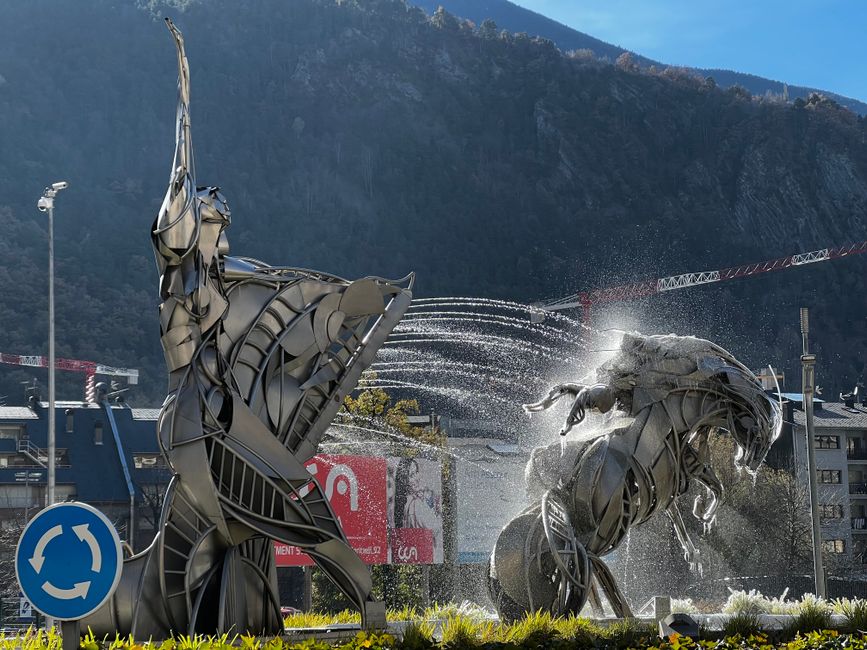
Andorra is a small, mountainous principality high in the eastern Pyrenees, wedged between Spain and France: about 468 km² of steep valleys, granite peaks, pine forests and glacial lakes, with roughly 85,000 inhabitants. Most visitors come for one of three things. In winter, it is one of southern Europe’s best-value ski destinations, led by Grandvalira, the largest ski area in the Pyrenees. In summer, it is a hiking and cycling country, with hundreds of kilometres of marked trails, mountain refuges and the UNESCO-listed Madriu-Perafita-Claror valley. All year round, its low taxes make it a shopping stop for perfume, electronics, alcohol and tobacco. Andorra uses the euro, but it is not in the European Union or the Schengen area, so there are real border and customs checks when you come back out. There is no airport and no railway: you arrive by road, most often by bus from Barcelona or Toulouse, about three hours away. Come from mid-December to March to ski, or from late June to September to hike, and give it three or four days, or a week in season.
Right now in Andorra
- Wed 11–17°C 52–63°F 2 mm Showers
- Thu 9–16°C 49–61°F Mostly clear
- Fri 5–19°C 42–66°F Partly cloudy
Weather: MET Norway (CC BY 4.0) · Air quality: OpenAQ
Multi-day tours of Andorra
Multi-day tours from local operators. You check dates and book on Viator, our partner; we may earn a commission at no extra cost to you. How we earn money
Andorra at a glance: overview and geography
Andorra is the sixth-smallest country in Europe and the largest of its microstates. The whole country is mountains: the lowest point, on the Spanish border, is around 840 m above sea level, the highest peak, Coma Pedrosa, reaches 2,942 m, and the capital, Andorra la Vella, at about 1,023 m, is the highest capital city in Europe. Two rivers, the Valira del Nord and the Valira d’Orient, meet near the capital to form the Gran Valira, which flows south into Catalonia. According to the national tourism board, only about 8% of the land is built up; the rest is forest, pasture and high mountain. The 2023 census counted 85,101 residents, many of them Spanish, Portuguese and French.
Andorra’s political system is unique. Since a medieval agreement of 1278, the country has had two co-princes, today the Bishop of Urgell in Catalonia and the President of France, who are joint heads of state. In practice Andorra has been a parliamentary democracy since its first written constitution in 1993, with a 28-member parliament, the Consell General, and its own government. The country is divided into seven parishes (parròquies): Canillo, Encamp, Ordino, La Massana, Andorra la Vella, Sant Julià de Lòria and Escaldes-Engordany. Catalan is the only official language, though Spanish is spoken everywhere, and French and Portuguese are very common.
For centuries Andorra was a poor, isolated farming valley. The first proper road arrived in the early 20th century, and tourism, duty-free shopping and banking transformed it from the 1950s onwards. Today trade and tourism account for around 60% of the economy, and the valley floors between Sant Julià and Encamp are a nearly continuous ribbon of shops, hotels and apartment blocks. Go up any side valley, though, and you are quickly among Romanesque chapels, stone hamlets and open mountainside.
Time zone: Andorra runs on Central European Time (UTC+1, UTC+2 in summer), the same as Spain and France.
The parishes and areas
- Andorra la Vella and Escaldes-Engordany: the twin towns at the heart of the country, with the old quarter, Casa de la Vall, the main shopping streets (Avinguda Meritxell and Avinguda Carlemany), the Caldea thermal spa and the national bus station. TravelerCenter has a separate Andorra la Vella guide.
- Canillo and Encamp: the central valley towards France, with gondolas up into Grandvalira, the Meritxell sanctuary, the Roc del Quer viewpoint and a long suspension footbridge above Canillo.
- Soldeu, El Tarter and Pas de la Casa: the main ski villages of Grandvalira. Pas de la Casa, at about 2,080 m on the French border, is the liveliest party and shopping resort.
- La Massana and Ordino: the quieter north-west, with the Pal Arinsal and Ordino Arcalís ski areas, the Comapedrosa and Sorteny nature parks, the Tristaina lakes and the best preserved villages.
- Sant Julià de Lòria: the southern gateway from Spain, with the Naturlandia adventure park, tobacco-farming heritage and the border at La Farga de Moles.
Where to go in Andorra: valleys, ski areas and the capital
Distances are short, about 40 km from the Spanish border to the French one, but roads are winding and the main valley is often congested at weekends, so choose your base by what you want to do. Andorra la Vella and Escaldes suit shoppers, spa visitors and anyone relying on buses; Soldeu, El Tarter, Canillo and Pas de la Casa suit skiers on Grandvalira; La Massana and Ordino suit families, hikers and skiers heading to Pal Arinsal or Arcalís.
Andorra la Vella and Escaldes-Engordany
The capital’s small old quarter, the Barri Antic, holds Casa de la Vall, the stone manor house that was Andorra’s parliament from 1702 to 2011 and is now open to visitors (€5 as of October 2026), the church of Sant Esteve and the Plaça del Poble viewpoint. Around it spread the busy shopping avenues, and next door in Escaldes is Caldea, the glass-spired thermal spa that opened in 1994 and is still Andorra’s best rainy-day option. Santa Coloma, at the southern edge of the capital, has one of the country’s finest Romanesque churches, with its rare round bell tower, and the Espai Columba museum of Romanesque murals. See our Andorra la Vella guide for the details.
Grandvalira: Soldeu, El Tarter, Canillo, Encamp and Pas de la Casa
Grandvalira links six sectors across the eastern half of the country, from Encamp and Canillo over Soldeu and El Tarter to Grau Roig and Pas de la Casa on the French border, with about 215 km of marked pistes. Soldeu is the most popular base for British and Irish ski groups, with a long ski school tradition and plenty of English spoken; El Tarter is quieter; Canillo and Encamp, linked to the slopes by gondola and the Funicamp cable car, are cheaper and closer to the capital; Pas de la Casa is high, snow-sure and lively at night. In summer, parts of the area open for mountain biking, hiking, golf at Soldeu and family activities.
Pal Arinsal and Ordino Arcalís
In the north-west, the Pal Arinsal area, above La Massana and Arinsal, is family-friendly and forested, linked to La Massana by a gondola. Ordino Arcalís, at the head of the Ordino valley, is higher and wilder, known for good snow, freeride terrain and, in summer, the Tristaina lakes and a solar viewpoint on the ridge. Both belong to the same group as Grandvalira, and multi-day passes cover all three.
Ordino and La Massana
The parish of Ordino is the prettiest in Andorra, with stone houses, the Casa d’Areny-Plandolit museum, a 19th-century noble home, and the Sorteny valley nature park, famous for its alpine flowers in June and July. La Massana and the neighbouring villages of Anyós, Sispony and Arinsal are popular bases for the Comapedrosa nature park and the climb up Andorra’s highest summit.
Canillo, Meritxell and the central valley
The sanctuary of Our Lady of Meritxell, Andorra’s patron saint, between Encamp and Canillo, was rebuilt in a striking modern style after a fire in 1972. Close by, the Roc del Quer viewpoint has a glass-floored platform jutting over the valley, and Canillo has a long Tibetan-style suspension footbridge. Romanesque churches such as Sant Joan de Caselles dot the roadside. Encamp has the Museu Nacional de l’Automòbil and the Holy Art Museum.
The Madriu-Perafita-Claror valley
This glacial valley south-east of Escaldes, a UNESCO World Heritage Site since 2004, has no roads, only footpaths, stone shepherds’ huts, terraced fields and mountain refuges, and shows how people farmed the high Pyrenees for centuries. A popular trail starts close to Escaldes and climbs past stone huts and the Fontverd refuge towards the lakes around the Estany de l’Illa; you can walk a section in a day or cross the valley over two or three days.
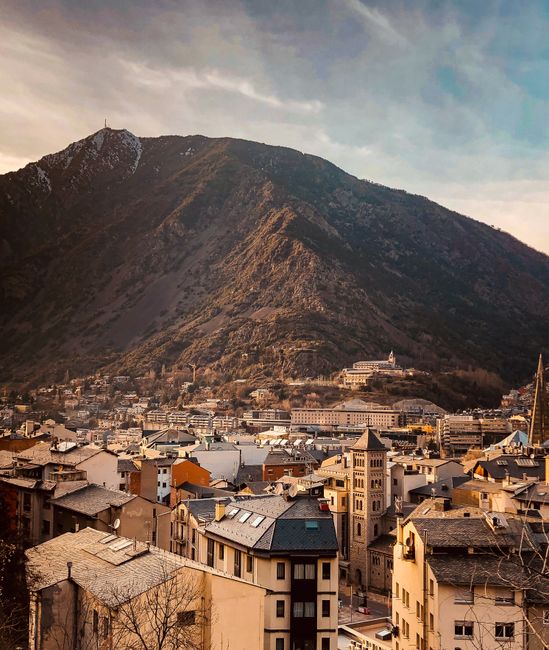
Andorra la Vella Travel Guide
Plan a visit to Andorra la Vella, Europe's highest capital: Casa de la Vall and the old quarter, Santa Coloma and the Espai Columba…
Best time to visit Andorra
Andorra has a high-mountain climate with Mediterranean influences: cold, snowy winters, sunny, warm summer days with cool nights, and thunderstorms on summer afternoons. Conditions change quickly with altitude, from about 1,000 m in the capital to more than 2,500 m on the ski slopes, so temperatures up there are much lower. The table uses averages for Andorra la Vella (Roc de Sant Pere, about 1,075 m, 1971–2000), as published on Wikipedia from Andorran weather service data; we could not read an official normals table, so treat them as a guide.
| Season (Andorra la Vella) | Average afternoon high | Average night low | What it’s like |
|---|---|---|---|
| Spring (Mar–May) | 12–18 °C | 0–5 °C | Spring skiing until early April, then snowmelt, wet days and flowering meadows from May; high trails still snowy. |
| Summer (Jun–Aug) | 22–26 °C | 9–11 °C | Warm, sunny days and fresh nights; afternoon thunderstorms; best for hiking, cycling and lakes. |
| Autumn (Sep–Nov) | 21 °C falling to 11 °C | 9 °C falling to 1 °C | Golden forests and clear days in September and October; many hotels and lifts close in November. |
| Winter (Dec–Feb) | 7–9 °C | −2 to −3 °C | Cold and snowy, especially above 1,500 m; ski season from early December; chains or winter tyres required. |
For skiing, the best snow and the cheapest weeks are usually in January (outside the New Year and Spanish and French school holidays) and in March. For hiking, late June to late September is ideal: the high passes are usually free of snow by early July, and wildflowers peak in June and July. Late September and early October bring stable weather and autumn colours. Many mountain restaurants, hotels and lifts close between the seasons, from mid-April to June and from October to early December.
Ski season 2026/27
As of October 2026, Grandvalira and Ordino Arcalís have announced that the 2026/27 season runs from 4 December 2026 to 4 April 2027, with lifts open from 9:00 to 17:00, both dates depending on snow. Pal Arinsal also opens on 4 December 2026. Day passes use dynamic pricing: Grandvalira says buying online in advance saves up to 15%, and prices vary through the season, so check the official sites for your dates. Day passes valid for two or more consecutive days also give access to Pal Arinsal and Ordino Arcalís. Night skiing at Pas de la Casa costs €28.50, seniors aged 70–74 pay around €25 a day at ticket offices, and skiers aged 75 and over ski free (as of October 2026).
Public holidays and festivals
Andorra’s national day, Our Lady of Meritxell, is on 8 September, and Constitution Day on 14 March. Each parish holds its own summer festival (festa major), with music, dances and fireworks, mostly in July and August; Andorra la Vella’s is in early August. Many shops open on Sundays and most public holidays, which is part of the country’s appeal for day trippers.
Andorra itineraries
A weekend in Andorra
Arrive from Barcelona or Toulouse, check in in Andorra la Vella or Escaldes and spend the first afternoon in the old quarter and at Casa de la Vall, then evening hours at Caldea. On day two, take the bus or drive up to Canillo for the Roc del Quer viewpoint and a walk, or ski at Grandvalira in winter, and finish with dinner in a borda, a converted stone barn serving mountain food.
Four days in summer
Day one: Andorra la Vella and Santa Coloma. Day two: hike into the Madriu-Perafita-Claror valley from Escaldes. Day three: Ordino and the Sorteny valley, or the Tristaina lakes from Arcalís. Day four: Canillo, Meritxell and the Roc del Quer, or a mountain-bike day at Pal Arinsal. Fit climbers can swap one day for Coma Pedrosa, Andorra’s highest peak.
A ski week
Base yourself in Soldeu, El Tarter or Pas de la Casa and ski the whole of Grandvalira; spend one day at Ordino Arcalís or Pal Arinsal with a multi-day pass; and save an afternoon for shopping in Andorra la Vella and Caldea. With small children, Arinsal, La Massana or Canillo are calmer bases.
Entry rules, borders, customs and money
Is Andorra in the EU or the Schengen area?
No to both. Andorra has close agreements with the EU and uses the euro, but it is not a member of the European Union or the Schengen area. Andorra itself does not require a visa for tourists. However, the only ways in are through Spain or France, both Schengen countries, so in practice you must meet the Schengen entry rules for your nationality. Your passport must have been issued less than 10 years before you arrive and be valid for at least three months after you plan to leave the Schengen area. EU and Swiss citizens can travel with a national ID card. ETIAS, the EU’s planned travel authorisation, is not in operation as of October 2026; there is no start date yet, the fee will be €20, and press reports point to 2027.
Schengen visas: you need a double or multiple-entry visa
Entering Andorra means leaving the Schengen area, and coming back means entering it again. If your nationality needs a Schengen visa, Andorra’s tourism board says the visa must allow at least two entries; if you plan to go in and out of Andorra more than once, you need a multiple-entry visa. A single-entry visa is used up when you cross into Andorra, and you would not be allowed back into Spain or France. Apply to the consulate of the country through which you will enter the Schengen area.
The Entry/Exit System at the Andorran border
Since 10 April 2026 the EU’s Entry/Exit System (EES) has been fully operational at all Schengen external borders, and the road crossings from Andorra into Spain (at La Farga de Moles, below Sant Julià de Lòria) and France (at Pas de la Casa) are external borders. For non-EU visitors such as British, American, Canadian or Australian travellers, this means your exit from Spain or France into Andorra and your re-entry are border crossings recorded in the EES, the same as at an airport: the first time, your passport is scanned, a photo taken and fingerprints recorded (not for under-12s); on later crossings, you are checked against that record. It is free, it replaces passport stamps, and the record lasts three years. Days spent in Andorra are outside the Schengen area, so they do not count towards your 90 days in any 180. Andorran citizens are exempt from the EES. Expect slower checks and queues at the border posts on busy weekends and at the end of holiday periods, and allow extra time if you have a bus connection or flight to catch.
Customs: what you can take back to Spain and France
Andorra is outside the EU’s VAT area, so customs checks on the way out are routine, and Spanish and French customs officers regularly search cars and buses. The allowances below are per person for goods bought in Andorra, as published by Andorra’s tourism board in 2026; tobacco and alcohol allowances apply only from age 17, and for under-15s EU countries can halve the other limits.
- Tobacco: 300 cigarettes, or 150 cigarillos (under 3 g each), or 75 cigars (over 3 g each), or 400 g of smoking tobacco.
- Alcohol: 1.5 litres of spirits over 22%, or 3 litres of spirits, aperitifs or sparkling wine under 22%, or 5 litres of table wine.
- Perfume: 75 g of perfume and 375 ml of eau de toilette.
- Coffee and tea: 1,000 g of coffee or 400 g of extract; 200 g of tea or 80 g of extract.
- Other goods: up to €900 of other industrial products (electronics, clothes and so on), and up to €300 of other agricultural products, within limits such as 1 kg of butter, 4 kg of cheese and 5 kg of meat.
Declare anything over these limits. Excess tobacco is the most common problem: officers can seize it, fine you and even impound the vehicle carrying it. Keep receipts, especially for expensive electronics, watches and cameras.
Money, prices and the tourist tax
Andorra uses the euro under a monetary agreement with the EU and has minted its own euro coins since 2014. Its three banks, Andbank, Creand and MoraBanc, have cash machines in every parish, and cards are widely accepted. Instead of VAT, Andorra charges a general indirect tax (IGI) of 4.5%, which is why shopping is cheaper than in Spain or France. Andorra has had a tourist tax since 1 July 2022: it applies at officially registered accommodation, varies by category, is charged per person aged 16 and over, per night, for a maximum of seven nights, and has 4.5% IGI added. Your hotel collects it.
The figures below are our estimates for one person per day, sharing a double room, as of October 2026. Ski passes, lessons and equipment hire come on top in winter.
| Style | Estimated cost per day | What that looks like |
|---|---|---|
| Budget | about €70–110 | A simple hotel or apartment in Andorra la Vella, Encamp or Sant Julià, menus of the day, buses, free hikes |
| Mid-range | about €130–220 | A 3- or 4-star hotel, restaurant dinners, Caldea or a museum, bus or car hire |
| High-end | about €300+ | A spa hotel in Soldeu or Escaldes, fine dining, private ski lessons or guides |
Getting there and getting around
By air
Andorra has no international airport of its own. The nearest airport, Andorra–La Seu d’Urgell (LEU), lies just across the border in Catalonia, near La Seu d’Urgell, with a small number of Air Nostrum flights to Spanish cities such as Madrid and Palma. Most visitors fly into Barcelona-El Prat or Toulouse-Blagnac, both about three hours away by road, or into Girona, Reus, Lleida-Alguaire, Perpignan or Carcassonne. See our Barcelona guide if you want to combine the two, and our Spain guide and our France guide for the rest of each country.
By bus
Scheduled coaches connect Andorra la Vella with more than twenty destinations in Spain, France and Portugal, including Barcelona, La Seu d’Urgell, Lleida, Zaragoza and Toulouse. Andorra Direct Bus, for example, runs 16 departures a day between Barcelona Airport (T1 and T2), Barcelona Sants station and Andorra la Vella, with single fares from €35 as of October 2026 and shareable 4-, 10- and 20-trip passes. Other companies, including Alsa, also run on the route, and seasonal shuttles serve the ski resorts in winter. Most coaches arrive at the Estació Nacional d’Autobusos in Andorra la Vella.
By train
There is no railway in Andorra. From France, trains from Toulouse run to L’Hospitalet-près-l’Andorre, about 11 km by road from the border at Pas de la Casa, with connecting buses. From Spain, high-speed trains from Madrid and Barcelona stop at Lleida Pirineus, from where buses run to Andorra.
By car
From Spain, the N-145 runs from La Seu d’Urgell to the border at La Farga de Moles and on to Sant Julià and the capital. From France, you come over the Col de Puymorens (or through its tunnel) to Pas de la Casa and then over the 2,408 m Port d’Envalira, the highest paved pass in the Pyrenees, or through the Envalira tunnel, which charges a toll. In winter, winter tyres or chains are mandatory in Andorra from early November to mid-May, and the passes can close in heavy snow; check the Andorran mobility service before you set off. Traffic in the main valley is heavy at weekends and holiday times, and border queues can be long on Sunday evenings.
Getting around Andorra
Andorra’s buses are frequent and simple. Seven numbered lines, an express line and a night bus run from Andorra la Vella and Escaldes to Sant Julià, Encamp, Canillo and Soldeu (line 3), Pas de la Casa (line 4), Arinsal (line 5), Ordino (line 6) and La Massana (line 7). Fares are by zone: as of the fares in force since 1 September (checked October 2026), a single ticket costs €1.90 in zone 1, €3.45 in zone 2 and €4.80 in zone 3, a 10-trip card shareable between several people €12.40, and a 7-day pass €24.30. Children under three travel free. The bus to Pas de la Casa runs every 30 minutes from early morning to the evening. A car is useful for remote trailheads and villages, but parking in the capital is limited and paid.
Hiking, cycling and the outdoors
Andorra is one of the best hiking countries in the Pyrenees. Waymarked routes range from flat valley walks, such as the irrigation-channel paths of the Rec del Solà above the capital, to the long-distance GR11 trans-Pyrenean path and the Coronallacs circuit linking lakes and refuges. Many unstaffed mountain huts are free to use. Popular day hikes include the Estanys de Tristaina from Arcalís, the Sorteny valley, the Estany de l’Illa through the Madriu valley and the climb to Coma Pedrosa. Weather turns fast in the mountains: start early in summer to avoid afternoon storms. See our hiking guide.
Cycling is the other big summer draw: Andorra markets itself as a training country, and many professional riders live here. Road cyclists climb the Port d’Envalira, the Coll d’Ordino and the Collada de Beixalis, and the bike parks at Pal Arinsal and Grandvalira offer lift-served mountain biking. The Bici Lab museum of cycling culture is in Andorra la Vella. See our cycling guide.
Other activities include via ferrata routes, canyoning, horse riding, fishing in mountain lakes, the Naturlandia adventure park in Sant Julià with its long toboggan run, and, in winter, snowshoeing, ski touring, dog-sledding and night skiing.
Safety, health and staying connected
Andorra is one of the safest countries in Europe, with very low crime. The main risks are in the mountains: sudden storms, snow on high paths into early summer, avalanches in winter and icy roads. Check the weather and avalanche forecasts, carry layers, water and a map, and tell someone your route.
Emergency numbers: 112 for general emergencies, 110 for the police, 116 for medical emergencies and 118 for the fire brigade, which also runs mountain rescue. The main hospital is Nostra Senyora de Meritxell in Escaldes-Engordany. Because Andorra is not in the EU, do not count on a European Health Insurance Card: Andorra has health agreements with Spain, France and Portugal, but they do not cover everyone, and treatment and mountain rescue can be costly. Take travel insurance that covers skiing or hiking. Hotels must register guests with the police, so you will be asked for your passport or ID at check-in.
Andorra is outside the EU’s roam-like-at-home rules, so mobile data from EU, UK and other plans can be expensive; check your plan, use the free “Andorra Wi-Fi” hotspots on the main shopping streets and in ski areas, or buy a local eSIM (from about €4.95 as of October 2026). Plugs are the European two-pin type at 230 V, and tap water is good to drink.
Food and culture
Andorran cooking is Catalan mountain food, hearty and seasonal. Try trinxat, a fried cake of cabbage, potato and bacon; escudella, a rich winter stew of meats and vegetables; snails cooked in a tin (cargols a la llauna); grilled lamb and sausages (embotits); wild mushrooms in autumn; trout from the rivers; and crema catalana for dessert. The best places are the bordes, old stone hay barns converted into rustic restaurants, mostly in the side valleys. A set lunch menu (menú del dia) is the best value. Andorra also makes cheese, honey and a little high-altitude wine.
Andorra’s cultural highlight is its Romanesque heritage: about 40 small stone churches from the 11th and 12th centuries, with slender bell towers and, in some, painted murals. Sant Joan de Caselles near Canillo, Santa Coloma in Andorra la Vella, Sant Miquel d’Engolasters above Escaldes and Sant Climent de Pal are among the best. The Andorra PassMuseu gives 50% off entry to three museums of your choice.
Things to do in Andorra
- Ski or snowboard across Grandvalira’s six sectors, or the quieter slopes of Pal Arinsal and Ordino Arcalís.
- Soak in the lagoons and baths of Caldea in Escaldes-Engordany.
- Visit Casa de la Vall, Andorra’s old parliament, in the capital’s old quarter.
- Hike into the UNESCO-listed Madriu-Perafita-Claror valley.
- Walk to the Tristaina lakes or see the flowers of the Sorteny valley in early summer.
- Stand on the glass platform of the Roc del Quer viewpoint and cross the suspension bridge in Canillo.
- Tour the Romanesque churches of Santa Coloma, Sant Joan de Caselles and Sant Miquel d’Engolasters.
- Climb Coma Pedrosa, the country’s highest peak, at 2,942 m.
- Ride the cols of the Tour de France and the Vuelta, or the lift-served bike park at Pal Arinsal.
- Eat trinxat and grilled lamb in a borda.
- Shop on Avinguda Meritxell and Avinguda Carlemany, keeping an eye on your customs allowances.
What to pack
For summer hiking, bring proper boots, layers (nights are cool even in August), a waterproof jacket for afternoon storms, a sun hat, sunglasses and high-factor sunscreen for the strong mountain sun, and a refillable water bottle. In winter, bring warm, waterproof clothing, gloves, a hat, goggles and sunglasses, and, if you are driving, chains or winter tyres. Swimwear and flip-flops are needed for Caldea and hotel spas. Carry your passport or ID card: you will need it at the border and at check-in.
Andorra travel FAQ
Is Andorra in the EU or the Schengen area?
No. Andorra uses the euro but is not in the EU or Schengen. You reach it through Spain or France, so you must meet Schengen entry rules, and there are border and customs checks when you leave Andorra.
Do I need a visa to visit Andorra?
Andorra itself requires no visa. If your nationality needs a Schengen visa, you must have a visa valid for at least two entries, or a multiple-entry visa if you will go in and out more than once, because entering Andorra means leaving Schengen.
Does the EES apply when I leave Andorra?
Yes, for non-EU visitors. The road borders with Spain and France are Schengen external borders, so your exit to and re-entry from Andorra are recorded in the Entry/Exit System, which has been fully operational since April 2026. Andorran citizens are exempt.
Do I need a passport to go to Andorra from Spain or France?
Yes, or a national ID card if you are an EU or Swiss citizen. Expect passport and customs checks, especially on the way back out.
How much can I bring back from Andorra?
Per adult: 300 cigarettes, 1.5 litres of spirits or 5 litres of wine, 75 g of perfume and up to €900 of other goods, among other limits. Tobacco and alcohol allowances start at age 17. Declare anything above the limits.
How do I get to Andorra from Barcelona?
By bus, in about three hours, from Barcelona Airport or Sants station. Andorra Direct Bus has 16 departures a day, with single fares from €35 as of October 2026, and other companies also run the route.
What is the nearest airport to Andorra?
Andorra–La Seu d’Urgell, just across the Spanish border, has a few domestic flights. Most visitors fly to Barcelona or Toulouse, both about three hours away by road.
When is the ski season in Andorra?
For 2026/27, Grandvalira and Ordino Arcalís plan to open from 4 December 2026 to 4 April 2027, and Pal Arinsal from 4 December, depending on snow.
Is shopping in Andorra really cheaper?
Often, yes. Andorra charges a 4.5% indirect tax instead of VAT, so perfume, alcohol, tobacco, electronics and fuel are usually cheaper than in Spain or France. Compare prices first and remember the customs limits.
Is there a tourist tax in Andorra?
Yes, since July 2022. It is charged per person aged 16 and over per night, up to seven nights, varies by accommodation category and has 4.5% IGI added. Your hotel collects it.
Do I need winter tyres or chains in Andorra?
Yes, from early November to mid-May you must have winter tyres or carry chains. The mountain passes can close in heavy snow.
What language is spoken in Andorra?
Catalan is the official language. Spanish is understood everywhere, French is common, especially near the French border, and English is widely spoken in ski resorts and hotels.
Does my phone roam for free in Andorra?
Usually not. Andorra is outside the EU’s roaming rules, so check your plan, use free Wi-Fi or buy a local eSIM.
What is the best time to visit Andorra?
January to March for skiing, and late June to September for hiking and cycling. Late September and early October are lovely for walking, with autumn colours.
Sources and last review
Researched and last reviewed on 4 October 2026. Entry, visa, customs allowances, the tourist tax, money, emergency numbers and transport links come from Andorra’s official tourism board (Andorra Turisme); the EES exemption for Andorran citizens from the Government of Andorra’s foreign ministry; Schengen and EES rules from the European Commission and the UK Foreign Office; ski season dates and pass details from Grandvalira, Ordino Arcalís and Pal Arinsal; bus fares from Andorra’s national bus network; Casa de la Vall and Espai Columba prices from Andorra Turisme and the national museums service; the Barcelona bus fare from Andorra Direct Bus. The climate averages, the Toulouse and Barcelona journey times, the Envalira tunnel toll and some history come from secondary sources and are flagged for checking; daily costs are our estimates. Prices, timetables and rules change, so check the official sites before you travel.
Plan your trip
Partner links: TravelerCenter may earn a commission if you book, at no extra cost to you.
🇦🇩 Useful Catalan phrases for Andorra
All 38 Catalan phrases: restaurant, hotel, emergencies, romance (printable) →