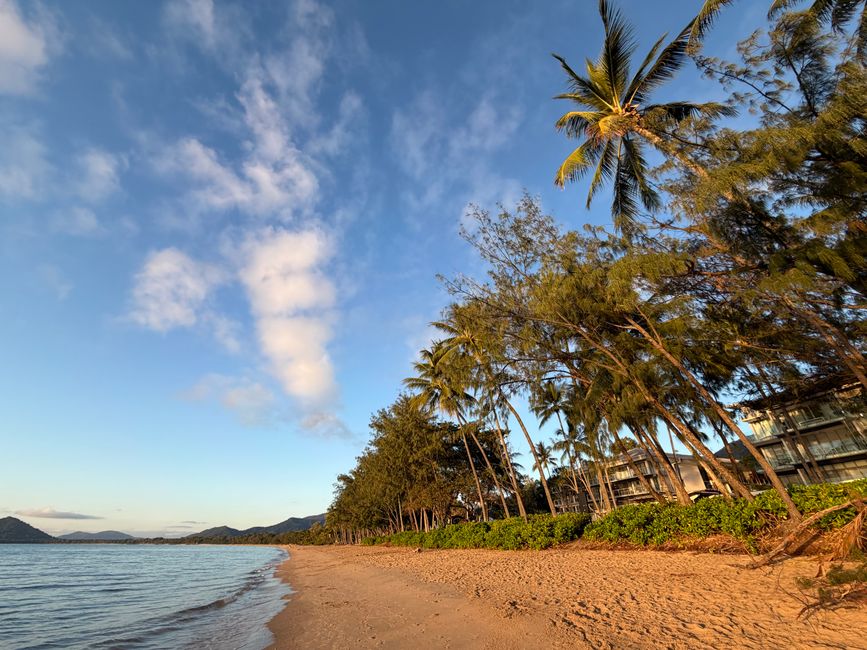
Cairns is the capital of Tropical North Queensland and the busiest gateway to the Great Barrier Reef. Every morning, dozens of boats leave its marina for coral cays and outer-reef pontoons, while trains and cable cars climb into the World Heritage–listed rainforest of the Wet Tropics behind the city. Cairns itself is a relaxed, low-rise tropical town of about 160,000 people, on the lands of the Gimuy Walubara Yidinji and Yirrganydji peoples, with a palm-lined Esplanade, a free saltwater swimming lagoon, night markets and a backpacker buzz. It is the base for trips to Kuranda, the Atherton Tablelands, Port Douglas and the Daintree, where two World Heritage Areas, the reef and the rainforest, meet. Cairns sits in the tropics, so instead of the four southern hemisphere seasons it has two: a warm, dry season from about May to October, the best time to visit, and a hot, humid wet season from about December to April, which brings heavy rain, the risk of cyclones and marine stingers in the sea.
Right now in Cairns
- Wed 18–27°C 64–81°F Clear
- Thu 17–28°C 63–82°F Mostly clear
- Fri 18–27°C 65–81°F Mostly clear
Weather: MET Norway (CC BY 4.0) · Sea temperature: NOAA CoastWatch · Air quality: OpenAQ
Top tours in Cairns
See all tours for Cairns →
From local operators, with prices and reviews; you check availability and book on Viator, our partner. We may earn a commission at no extra cost to you. How we earn money
Cairns at a glance
- Best months: June to October, the dry season, with sunny days around 26–30 °C (79–86 °F), low humidity and calm seas for reef trips. November to April is hot and humid, with monsoon rain from about December to March.
- Time needed: four days for a reef day, Kuranda and the city; a week with the Daintree, Cape Tribulation and the Atherton Tablelands.
- Getting there: Cairns Airport (CNS) is about 7 km (4 miles) north of the city center, with flights from all Australian capitals and some Asian cities.
- Costs (as of October 2026): Cairns city buses cost a flat 50 cents (about US$0.35) a trip. Every Great Barrier Reef tour adds the Reef Authority’s environmental management charge of $8.50 per person for a full day.
- Before you go: visitors need an ETA, eVisitor or visa, and strict biosecurity rules apply on arrival; see our Australia travel guide.
Cairns areas and who each one suits
The city and the Esplanade
The compact city center sits on the shore of Trinity Inlet, a tidal bay with mudflats rather than a swimming beach. The Esplanade runs along the waterfront with a boardwalk, parks, the free Esplanade Lagoon and many hotels, hostels and restaurants, a short walk from the Reef Fleet Terminal where most reef boats leave. It is the easiest base if you don’t have a car.
The Northern Beaches
Between 15 and 30 minutes north of the city, a string of quieter beach villages, Yorkeys Knob, Trinity Beach, Clifton Beach and Palm Cove, face the Coral Sea. Palm Cove is the most upmarket, with resorts, spas and restaurants under paperbark and palm trees along a pretty beach. These are good for couples and families who want a resort feel, but you will need a car, the bus or tour pickups to get around.
Port Douglas
About an hour north on the scenic Captain Cook Highway, Port Douglas is a smart resort town with Four Mile Beach and its own reef boats to the Low Isles and the outer reef. It is closer to the Daintree and Mossman Gorge and makes a good second base.
Top things to see in Cairns
The Great Barrier Reef
Most visitors come to Cairns for the reef. Options include fast catamarans to outer-reef pontoons with underwater observatories, semi-submersibles and snorkeling platforms; smaller dive and snorkel boats that visit two or three reef sites a day; Green Island, a coral cay with rainforest about 45 minutes away, ideal for families; and Fitzroy Island, a national park island with walking tracks and a resort. Michaelmas Cay is a seabird nesting cay with excellent snorkeling. Liveaboard trips of two to four days reach the Ribbon Reefs and the Coral Sea. Every tour adds the Reef Authority’s environmental management charge, which pays for managing the marine park; see our Great Barrier Reef guide for zoning, reef health and choosing a trip.
Esplanade Lagoon and boardwalk
This free, lifeguard-patrolled saltwater swimming lagoon on the waterfront is the safest place to swim in the city all year, with lawns, barbecues and shade. The Esplanade boardwalk is good for birdwatching at low tide, when pelicans and waders feed on the mudflats.
Kuranda by railway and Skyrail
The village of Kuranda sits in the rainforest on the edge of the Barron Gorge. The Kuranda Scenic Railway, which celebrated 135 years in June 2026, climbs 327 meters (1,073 feet) over 37 km (23 miles), crossing 55 bridges and passing through 15 tunnels, with views of Barron Falls. The Skyrail Rainforest Cableway usually glides 7.5 km (4.7 miles) over the canopy between Smithfield and Kuranda, but from 19 August to 1 November 2026, during upgrade works, it operates only a Kuranda to Barron Falls loop, Wednesday to Sunday, so plan a return by train or road. In Kuranda, visit the markets, the butterfly sanctuary and Koala Gardens.
Cairns Botanic Gardens
North of the center, the Cairns Botanic Gardens display tropical plants, a rainforest boardwalk and Aboriginal plant-use trails; entry is free. Mount Whitfield Conservation Park, next door, has steep walks with views over the city.
Cairns Aquarium and the night markets
The Cairns Aquarium focuses on the reef and the rivers of Far North Queensland and is a good option on a rainy day. In the evening, the Cairns Night Markets on the Esplanade sell souvenirs, massages and cheap food.
Other things to do in Cairns
- Scuba diving: Cairns is one of the world’s biggest dive-training centers, with open-water courses that combine pool sessions and reef dives.
- Skydiving and ballooning: tandem skydives over Mission Beach or Cairns and hot-air balloon flights over the Atherton Tablelands at dawn.
- White-water rafting: the Barron River (short trips) and the Tully River (full-day trips with bigger rapids), about 1.5 to 2 hours south.
- Fishing: Cairns is famous for black marlin from about September to December.
Food and drink
Try tropical fruit at Rusty’s Markets (Friday to Sunday), mud crab, barramundi and coral trout, and bugs (a kind of slipper lobster). The Atherton Tablelands produce coffee, cheese, chocolate and tropical fruit wines. Tipping is optional.
Day trips from Cairns
The Daintree and Cape Tribulation
North of Port Douglas, the Daintree is one of the oldest rainforests on Earth. Cross the Daintree River on the cable ferry and follow the road to Cape Tribulation, where the rainforest meets the reef. Take a river cruise on the Daintree River to look for estuarine crocodiles, walk the rainforest boardwalks at the Daintree Discovery Centre or Jindalba, and visit Mossman Gorge, where Kuku Yalanji guides lead Dreamtime walks. It’s about 2.5 hours’ drive each way to Cape Tribulation, so a guided tour or an overnight stay works best. Don’t swim in rivers or on beaches here: crocodiles and stingers live in these waters.
The Atherton Tablelands
The cool, green plateau west of Cairns has the “waterfall circuit” (Millaa Millaa, Zillie and Ellinjaa Falls), crater lakes such as Lake Eacham, where swimming is popular, the giant Curtain Fig Tree, platypus spotting at Yungaburra and dairies, coffee farms and chocolate makers. Allow a full day by car.
Port Douglas, Palm Cove and Mission Beach
Drive the coast road to Port Douglas for lunch, Four Mile Beach and the Sunday market. Palm Cove is a short drive for a beach afternoon. Mission Beach, about 1.5 to 2 hours south, is known for its long, quiet beaches, skydiving and wild cassowaries; Paronella Park, a Spanish-style ruin in the rainforest, is on the way.
Nearby destinations
- Great Barrier Reef59 km
- Port Douglas59 km
Getting there and getting around
Cairns Airport (CNS)
Cairns Airport has a domestic terminal with flights from Sydney, Melbourne, Brisbane, Darwin, Adelaide, Perth and Ayers Rock (Uluru), and an international terminal with flights to Asia, Papua New Guinea and New Zealand. The airport is about 7 km from the center; taxis and rideshares take about 15 minutes, and private shuttle services run to city hotels, the Northern Beaches and Palm Cove. Translink public buses do not serve the terminals.
Buses and getting around
The Cairns bus network, run by Kinetic Cairns for Translink, links the city, the Northern Beaches, Smithfield and the southern suburbs. Like all Translink services in Queensland, it costs a flat 50 cents for a single trip with two hours of transfers, $1 for a day ticket or $5 for a week, paid on board by credit or debit card or cash. Buses are fine for the city and the beaches, but to explore the Tablelands, the Daintree or Mission Beach you need a car or a tour; many tours include hotel pickups. Drive on the left. Long-distance coaches and Queensland Rail’s Spirit of Queensland train run south toward Townsville and Brisbane.
When to go and how long to stay
Cairns has a tropical monsoon climate. The dry season (May to October) brings warm, sunny days, cooler nights and the calmest seas, making it peak season for reef trips; book tours and hotels ahead for June to September and Australian school holidays. The wet season (December to April) is hot and humid, with heavy downpours, especially from January to March, when the rainforest waterfalls are at their best but roads can flood. Tropical cyclones can affect the region from about November to April. Marine stinger season, when box jellyfish and Irukandji are most common in coastal waters, generally runs from about November to May.
| Month | Average high | Average low | Rain | Rain days (≥1 mm) |
|---|---|---|---|---|
| Jan | 32 °C (89 °F) | 24 °C (75 °F) | 391 mm (15.4 in) | 16 |
| Feb | 32 °C (89 °F) | 24 °C (75 °F) | 476 mm (18.7 in) | 16 |
| Mar | 31 °C (88 °F) | 23 °C (74 °F) | 367 mm (14.5 in) | 15 |
| Apr | 30 °C (85 °F) | 22 °C (72 °F) | 178 mm (7.0 in) | 14 |
| May | 28 °C (82 °F) | 20 °C (68 °F) | 81 mm (3.2 in) | 10 |
| Jun | 27 °C (80 °F) | 18 °C (65 °F) | 43 mm (1.7 in) | 7 |
| Jul | 26 °C (79 °F) | 17 °C (63 °F) | 36 mm (1.4 in) | 6 |
| Aug | 27 °C (81 °F) | 17 °C (63 °F) | 27 mm (1.0 in) | 4 |
| Sep | 29 °C (84 °F) | 19 °C (66 °F) | 28 mm (1.1 in) | 4 |
| Oct | 30 °C (86 °F) | 21 °C (69 °F) | 63 mm (2.5 in) | 6 |
| Nov | 31 °C (88 °F) | 22 °C (72 °F) | 85 mm (3.4 in) | 8 |
| Dec | 32 °C (89 °F) | 24 °C (75 °F) | 186 mm (7.3 in) | 11 |
| Year | 29 °C (85 °F) | 21 °C (70 °F) | 1,961 mm (77 in) | 119 |
Figures are the Bureau of Meteorology’s 1991–2020 averages for Cairns Aero, the airport weather station. Port Douglas and the Daintree are wetter.
Events and seasons worth planning around
- Coral spawning (usually October to December): the mass spawning of corals happens a few nights after full moons; some dive boats run special night trips.
- Cairns Festival (late August to early September): music, art and food in the city.
- Cairns Indigenous Art Fair (usually July): contemporary art from Queensland’s First Nations artists.
- Port Douglas Carnivale (May) and Cairns Amateurs horse-racing carnival (September).
- Minke whale season (June and July): swim-with programs run on some Ribbon Reef liveaboards.
Dates vary from year to year; check with the organizers.
How long to stay: 4, 5 and 7 days
- Four days: a full day on the outer reef, Kuranda by train, the Esplanade and night markets, and a beach day at Palm Cove.
- Five days: add a second reef trip or Green Island, or the Atherton Tablelands.
- Seven days: add two nights in Port Douglas or the Daintree, with Mossman Gorge and Cape Tribulation.
Where to stay in Cairns
- City and Esplanade: the widest range, from backpacker hostels to waterfront hotels, close to the reef terminal.
- Palm Cove and Trinity Beach: resorts and holiday apartments by the beach, 25 to 30 minutes north.
- Port Douglas: boutique resorts and the Low Isles boats; good for the Daintree.
- The Daintree and Cape Tribulation: eco-lodges and rainforest retreats; limited mobile coverage.
Queensland has no hotel tax; the 10% GST is included in prices. Hotel rates are highest from June to September and over Christmas.
Typical costs in Cairns
| Item (as of October 2026) | Australian dollars | About US dollars |
|---|---|---|
| Cairns bus, single / day / week ticket | $0.50 / $1.00 / $5.00 | $0.35 / $0.70 / $3.45 |
| Reef environmental management charge, full day / part day (per person) | $8.50 / $4.25 | $5.90 / $2.95 |
| Outer-reef day trip with snorkeling | about $250–300 | about $175–210 |
| Kuranda Scenic Railway one way | about $60–75 | about $40–50 |
| Taxi from the airport to the city | about $25–35 | about $17–24 |
| Mid-range hotel room, per night | about $170–300 | about $120–210 |
Bus fares and the reef charge are official; tours, rail, taxis and hotels are typical ranges, not official prices. Conversions use about US$0.69 to A$1.
Safety in Cairns
- Marine stingers: box jellyfish and the tiny Irukandji can cause severe or even life-threatening stings in tropical waters, mainly from about November to May. Swim at patrolled beaches inside stinger nets where provided, between the red and yellow flags, wear a full-body stinger suit (reef operators supply them) and follow lifeguards’ instructions. Bottles of vinegar stand on many beaches for first aid; call 000 for any suspected box jellyfish or Irukandji sting.
- Crocodiles: estuarine (saltwater) crocodiles live in rivers, estuaries, mangroves, beaches and the sea from Gladstone north, including around Cairns. Obey warning signs, never swim in rivers, creeks or estuaries, stay well back from the water’s edge, and don’t clean fish or leave food near the water. Just because you can’t see a crocodile doesn’t mean there isn’t one nearby.
- Sun and heat: UV is extreme most of the year; use SPF 50+, a hat and long sleeves, and drink plenty of water in the humidity.
- Cyclones and floods: from about November to April, follow Bureau of Meteorology warnings and local authorities; roads to the Daintree and the Tablelands can close after heavy rain.
- Cassowaries: these large flightless birds live around Mission Beach and the Daintree. Never feed or approach them, and drive slowly where signs warn of them.
- Reef trips: declare any medical conditions before snorkeling or diving, wear a flotation vest if you are not a strong swimmer and follow crew briefings.
- Emergencies: call 000 (112 also works from mobile phones).
Practical tips for Cairns
- Time zone: Australian Eastern Standard Time (UTC+10) all year; no daylight saving, so in summer Cairns is one hour behind Sydney.
- Swimming: the city has no swimming beach; use the Esplanade Lagoon or the netted Northern Beaches.
- Plugs and money: type I plugs at 230 V; cards accepted almost everywhere.
- Shopping: claim GST back on purchases of $300 or more from one business through the Tourist Refund Scheme when you leave Australia.
What to pack for Cairns
Light, breathable clothes, a wide-brimmed hat, sunglasses, reef-friendly SPF 50+ sunscreen, a rash vest or stinger suit, insect repellent and sandals, plus closed shoes for rainforest walks and a light rain jacket or umbrella for the wet season. Bring a light sweater for the Tablelands, where nights are cooler.
Cairns travel FAQ
When is the best time to visit Cairns?
June to October, in the dry season, when days are sunny and warm, humidity is low and the sea is calmest for reef trips. The wet season, roughly December to April, is hot and rainy.
When is stinger season in Cairns?
Box jellyfish and Irukandji are most common from about November to May. Swim in stinger nets at patrolled beaches, wear a stinger suit and follow lifeguards’ instructions.
Can you swim in the sea in Cairns?
Not in the city, which faces mudflats. Swim in the free Esplanade Lagoon or at patrolled Northern Beaches such as Palm Cove, between the flags and inside stinger nets in season. Never swim in rivers or estuaries because of crocodiles.
How much is the Great Barrier Reef charge?
The Reef Authority’s environmental management charge is $8.50 per person for a full-day trip and $4.25 for trips under three hours, collected by your tour operator; it rises to $9.00 and $4.50 from 1 April 2027.
Is Skyrail open in October 2026?
Partly. Because of upgrade works from 19 August to 1 November 2026, Skyrail runs only a Kuranda to Barron Falls loop, Wednesday to Sunday. The Kuranda Scenic Railway operates as normal.
How do I get from Cairns Airport to the city?
Take a taxi or rideshare, about 15 minutes, or a pre-booked shuttle. Public buses don’t serve the airport terminals.
How much is the bus in Cairns?
A flat 50 cents for a single trip with two hours of transfers, $1 for a day ticket and $5 for a weekly ticket, paid on board by card or cash.
Is Green Island or the outer reef better?
Green Island suits families and non-swimmers, with a beach, glass-bottom boats and easy snorkeling. The outer reef has clearer water and more coral and fish, and is better for keen snorkelers and divers.
How far is the Daintree from Cairns?
Cape Tribulation is about 2.5 hours’ drive north, including the Daintree River cable ferry. Mossman Gorge is about 1 hour 20 minutes away.
Are there crocodiles in Cairns?
Yes. Estuarine crocodiles live in the rivers, estuaries and coastal waters of the region. Obey warning signs and never swim where crocodiles may live.
Sources and last review
Researched and last reviewed on 5 October 2026. Bus fares and payment methods come from Translink’s Cairns fares page and its airport-services page (Queensland Government); the environmental management charge and its April 2027 rise from the Great Barrier Reef Marine Park Authority (its page as captured by the Internet Archive on 6 September 2026, because the site was unreachable directly); crocodile habitat and Be Crocwise guidance from the Queensland Government; the Skyrail upgrade dates and the Kuranda Scenic Railway’s statistics from Skyrail and Kuranda Scenic Railway; climate from the Bureau of Meteorology’s 1991–2020 statistics for Cairns Aero; population from Wikidata. Stinger-season months, cyclone season, attraction details, drive times, events, tour and taxi prices and hotel rates are general references and flagged for checking. For entry rules, biosecurity and money, see our Australia travel guide.
Plan your trip
Partner links: TravelerCenter may earn a commission if you book, at no extra cost to you.