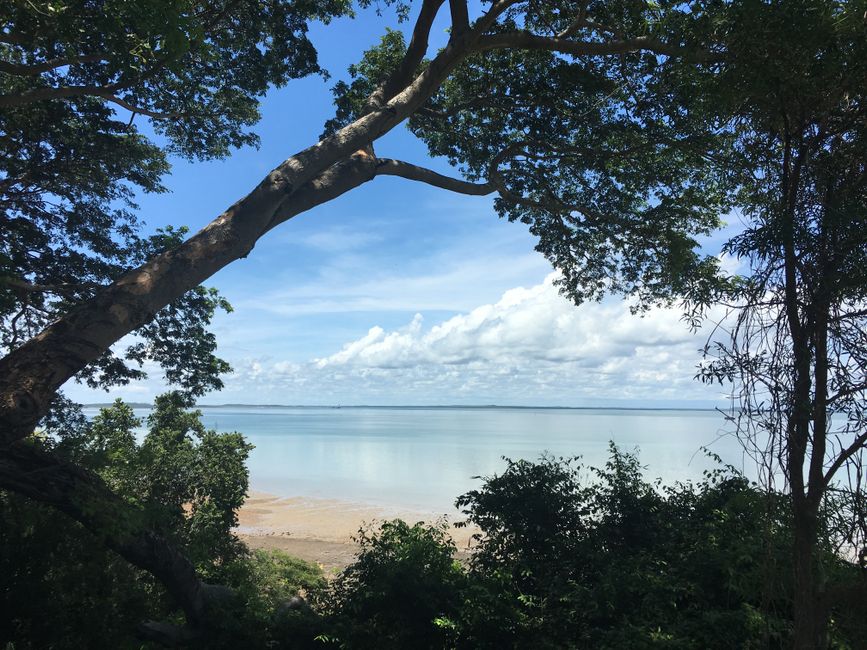
Darwin, the capital of the Northern Territory, is Australia’s most tropical and most Asian-facing capital: a relaxed harbor city of about 140,000 people on Larrakia country, closer to Bali and Singapore than to Sydney. Founded in 1869, it has been rebuilt twice, after Japanese air raids in World War II and after Cyclone Tracy flattened it on Christmas Day 1974, so most of the city is modern, low-rise and laid out for outdoor living. Darwin is the gateway to the Top End’s great national parks, Kakadu and Litchfield, but it’s worth a few days in its own right for sunset markets on the beach, fine collections of Aboriginal art, wartime history, saltwater crocodiles and a food scene shaped by Southeast Asian, Greek and Aboriginal cultures. The city has two seasons. The dry season (about May to October) brings blue skies, low humidity and warm days, and it is the peak time to visit. The wet season (about November to April) brings monsoon rain, spectacular storms, high humidity and the risk of cyclones.
Right now in Darwin
- Wed 26–31°C 80–87°F Mostly clear
- Thu 27–31°C 81–87°F Partly cloudy
- Fri 27–31°C 80–87°F 1 mm Partly cloudy
Weather: MET Norway (CC BY 4.0) · Sea temperature: NOAA CoastWatch · Air quality: OpenAQ
Top tours in Darwin
See all tours for Darwin →
From local operators, with prices and reviews; you check availability and book on Viator, our partner. We may earn a commission at no extra cost to you. How we earn money
Darwin at a glance
- Best months: May to September for dry, sunny weather, the Mindil Beach Sunset Market and outdoor festivals. October and November are hot and humid; December to April is the wet season, quieter and greener, with lower prices.
- Time needed: two to three days for the city; add two to four days for Litchfield and Kakadu national parks.
- Getting there: Darwin International Airport (DRW) is about 13 km (8 miles) from the city center, around 15 minutes by road, with flights from Australian cities and some Asian hubs. The Ghan train runs from Adelaide via Alice Springs.
- Costs (as of October 2026): the Mindil Beach Sunset Market is free to enter; a Kakadu park pass is $25 per adult until 31 October 2026.
- Before you go: entry rules (ETA, eVisitor or visa), biosecurity and money are covered in our Australia travel guide.
Darwin areas and who each one suits
City center and the Esplanade
The compact center runs along Smith Street Mall and Mitchell Street, with backpacker bars, restaurants and most hotels. The Esplanade’s parkland and Bicentennial Park look over the harbor. Stay here for walking access to everything.
Darwin Waterfront
A short walk downhill from the center, the Waterfront precinct has apartments, hotels, restaurants, a Wave Lagoon, a netted recreation lagoon and a man-made beach, plus the convention center and Stokes Hill Wharf. It suits families and travelers who want to swim safely.
Cullen Bay and Mindil
Cullen Bay is a marina with waterside restaurants and ferries to the Tiwi Islands. Next door, Mindil Beach hosts the famous sunset market, beside the casino and the George Brown Darwin Botanic Gardens.
Fannie Bay, Parap and Nightcliff
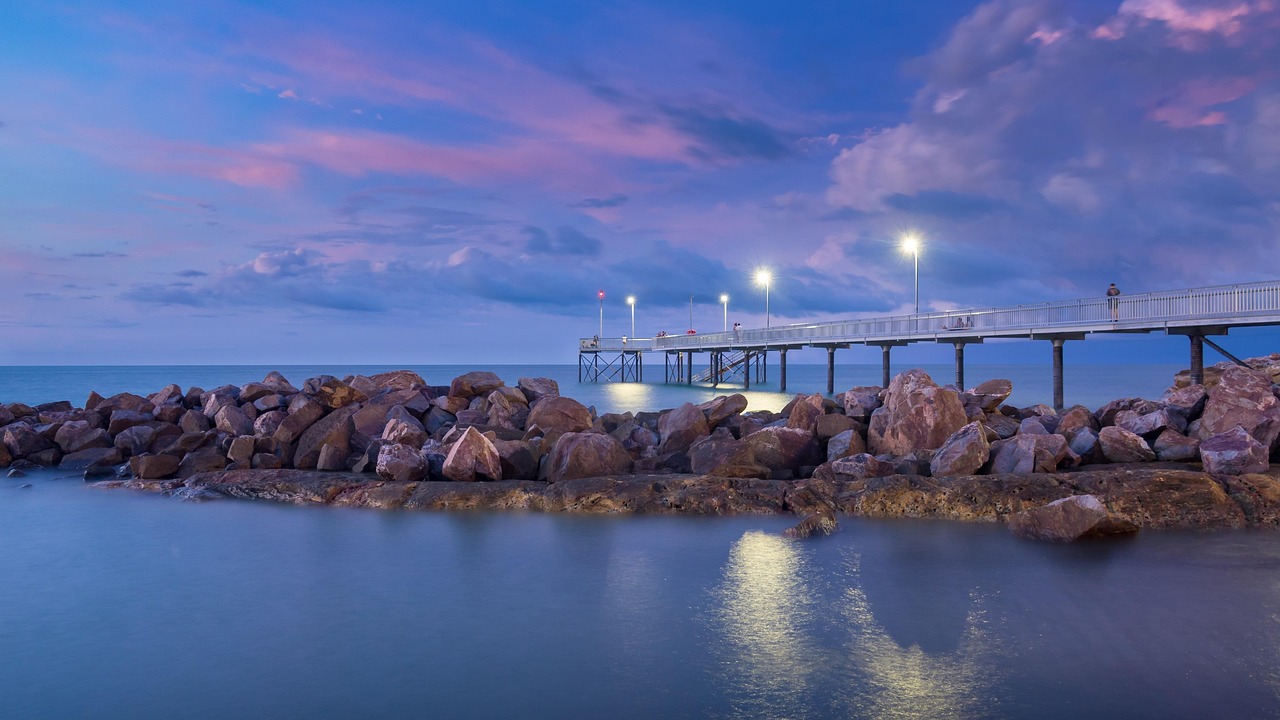
These leafy suburbs have the museum, East Point Reserve, the Saturday Parap Village Market, and Nightcliff’s foreshore and jetty, popular for sunset walks and Sunday markets.
Top things to see in Darwin
Mindil Beach Sunset Market
Darwin’s best-known experience: hundreds of food and craft stalls set up on the edge of Mindil Beach, with buskers and the sun dropping into the Timor Sea. The market runs every Thursday and Sunday from 4 p.m., from the last Thursday of April to the last Thursday of October. In 2026 the season ends on Thursday 29 October. Bring a picnic blanket, grab laksa, satay or barramundi, and head to the sand for sunset. Entry is free.
Museum and Art Gallery of the Northern Territory (MAGNT)
At Fannie Bay, MAGNT Darwin is open every day from 10 a.m. to 4 p.m. (closed Good Friday, Christmas Day and New Year’s Day). Highlights include Aboriginal and Torres Strait Islander art, a gallery on Cyclone Tracy with a chilling sound recording of the storm, and “Sweetheart,” a five-meter (16-foot) stuffed saltwater crocodile. In August, MAGNT hosts the National Aboriginal and Torres Strait Islander Art Awards.
Darwin’s World War II history
On 19 February 1942, Japanese aircraft bombed Darwin, the first of dozens of raids on northern Australia. Learn the story at the Darwin Military Museum at East Point, at the immersive bombing exhibition on Stokes Hill Wharf and in the WWII oil storage tunnels below the city.
Darwin Waterfront
The Waterfront has a Wave Lagoon (paid entry), a free netted recreation lagoon, lawns and restaurants, linked to the city by an elevator and skywalk. A free Waterfront shuttle runs around the precinct.
Crocodiles in the city
At Crocosaurus Cove in the city center you can see huge saltwater crocodiles up close, and brave visitors can be lowered into a croc pool in the “Cage of Death.” Outside the city, jumping-crocodile cruises run on the Adelaide River, about an hour’s drive away.
George Brown Darwin Botanic Gardens and East Point
The tropical botanic gardens, near Mindil Beach, have rainforest walks, baobabs and palms and are free. East Point Reserve has walking and cycling paths, wallabies at dusk and views of sunset over Fannie Bay.
Aboriginal art and culture
Darwin sits on the country of the Larrakia, the saltwater people of the Darwin region, and it is one of the best places in Australia to see and buy Aboriginal art. Beyond MAGNT’s collection, commercial galleries in the city center sell work from remote art centers across the Top End, Arnhem Land and the Tiwi Islands, from bark paintings and woven pandanus to carved ironwood. Look for galleries that buy directly from Aboriginal-owned art centers and supply a certificate of authenticity, so more of the money reaches the artists. In August, the Darwin Aboriginal Art Fair brings dozens of art centers to the city at once.
Wartime tunnels and Stokes Hill Wharf
Stokes Hill Wharf, where ships were sunk in the 1942 raids, is now a casual dining spot over the water, with views back to the city. Below the Esplanade, the WWII oil storage tunnels, dug to protect fuel from air raids, are open for self-guided visits in the dry season. Together with East Point’s gun emplacements and the Darwin Military Museum, they make a half-day history trail.
Other things to do in Darwin
- Outdoor cinema: the Deckchair Cinema near the Waterfront screens films under the stars in the dry season.
- Markets: Parap Village Market on Saturdays, Nightcliff and Rapid Creek markets on Sundays, with tropical fruit and Asian food stalls.
- Fishing: charters chase barramundi and reef fish in the harbor and rivers.
- Tiwi Islands: day tours by ferry or plane visit the Tiwi people’s art centers.
Food and drink
Darwin’s food is multicultural: laksa (a Darwin obsession), satay and Thai, Greek, Indonesian and Filipino dishes, barramundi and mud crab, and tropical fruit such as mango (in season around October to December). Eat at the markets, on Cullen Bay’s waterfront or at the Waterfront. Tipping is optional.
Day trips from Darwin
Litchfield National Park
About 1.5 hours south, Litchfield has Florence Falls, Wangi Falls and Buley Rockhole, with swimming in some plunge pools when rangers declare them open, plus magnetic termite mounds, tall, thin mounds aligned north to south to control their temperature. The main sights are on a sealed loop road, so a 2WD is fine in the dry season; Wangi Falls is often closed to swimming early in the dry season while rangers check for crocodiles, and swimming areas close in the wet. Litchfield is managed by the Northern Territory Government; check NT Park Bookings for entry and camping requirements, and swim only where signs allow.
Kakadu National Park
About three hours east, Kakadu National Park has rock art, wetlands and the Yellow Water cruise. It’s a very long day trip; stay at least one night. A park pass is required, and the Jim Jim and Twin Falls area is closed for 2026.
Adelaide River and Berry Springs
The Adelaide River, about an hour east on the Arnhem Highway, is known for jumping-crocodile cruises. Berry Springs, about 45 minutes south, has the Territory Wildlife Park.
Tiwi Islands
Bathurst and Melville islands, home to the Tiwi people, are reached by ferry from Cullen Bay or by a short flight; tours visit art centers and communities.
Nearby destinations
- Kakadu National Park193 km
Getting there and getting around
Darwin International Airport (DRW)
Darwin’s airport, about 15 minutes from the city, has flights from all major Australian cities (about 4 to 4.5 hours from Sydney or Melbourne) and international services to Asian hubs including Singapore and Bali. Taxis, rideshares and an airport shuttle run to the city.
The Ghan and driving
The Ghan train links Adelaide and Darwin via Alice Springs and Katherine, a three-night journey. By road, Darwin is about 1,500 km (930 miles) from Alice Springs on the Stuart Highway. Many visitors rent a car or campervan in Darwin for a Top End loop to Litchfield, Kakadu and Katherine.
Buses and getting around the city
Public buses connect the center with the suburbs, Casuarina and Palmerston; pay with a contactless card or ticket on board. The center and Waterfront are walkable, though the heat makes short distances tiring. Rent a car for day trips and the national parks, or join a tour.
When to go and how long to stay
Darwin is warm to hot all year, with average highs of 31–34 °C (88–93 °F). The dry season (May to September) has clear skies, low humidity and comfortable nights around 19–23 °C (66–73 °F); it is peak season. The build-up (October to November) is hot and very humid, with afternoon storms. The wet season (December to April) brings monsoon rain, about 470 mm (18.5 in) in January, lightning storms, waterfalls in full flow and the risk of tropical cyclones.
The season also changes what you can do. In the dry, national park roads and swimming holes open, the markets and outdoor cinema run, and tours depart daily; it’s also the busiest and most expensive time. In the wet, Mindil’s market and some tours stop, unsealed roads close and park sites may be shut by flooding, but the waterfalls are at their most dramatic, scenic flights are spectacular, and hotel prices fall. Storms tend to build in the afternoon, so plan outdoor activities for the morning.
| Month | Average high | Average low | Rain | Rain days (≥1 mm) |
|---|---|---|---|---|
| Jan | 32 °C (90 °F) | 25 °C (77 °F) | 471 mm (18.5 in) | 20 |
| Feb | 32 °C (89 °F) | 25 °C (77 °F) | 412 mm (16.2 in) | 18 |
| Mar | 32 °C (90 °F) | 25 °C (77 °F) | 314 mm (12.4 in) | 17 |
| Apr | 33 °C (91 °F) | 24 °C (76 °F) | 105 mm (4.1 in) | 8 |
| May | 32 °C (90 °F) | 22 °C (72 °F) | 21 mm (0.8 in) | 2 |
| Jun | 31 °C (88 °F) | 20 °C (68 °F) | 2 mm (0.1 in) | 0 |
| Jul | 31 °C (88 °F) | 19 °C (67 °F) | 1 mm (0.0 in) | 0 |
| Aug | 32 °C (89 °F) | 20 °C (68 °F) | 1 mm (0.0 in) | 0 |
| Sep | 33 °C (92 °F) | 23 °C (73 °F) | 14 mm (0.6 in) | 2 |
| Oct | 34 °C (93 °F) | 25 °C (77 °F) | 69 mm (2.7 in) | 6 |
| Nov | 34 °C (93 °F) | 25 °C (78 °F) | 144 mm (5.6 in) | 10 |
| Dec | 33 °C (91 °F) | 26 °C (78 °F) | 279 mm (11.0 in) | 15 |
| Year | 32 °C (90 °F) | 23 °C (74 °F) | 1,832 mm (72 in) | 96 |
Figures are the Bureau of Meteorology’s 1991–2020 statistics for Darwin Airport.
Events worth planning around
- Mindil Beach Sunset Market (late April to late October): Thursday and Sunday evenings.
- Darwin Festival (August): arts, music and food.
- Darwin Beer Can Regatta (dry season): boats made from cans race at Mindil Beach.
- Bombing of Darwin commemoration (19 February).
Dates vary; check the organizers’ websites.
How long to stay: 3, 5 and 7 days
- Three days: the city, MAGNT, the Waterfront, Crocosaurus Cove and, on a Thursday or Sunday in season, the Mindil market.
- Five days: add Litchfield and an Adelaide River crocodile cruise.
- Seven days: add two or three nights in Kakadu.
Where to stay in Darwin
- City center: hotels, apartments and hostels, close to bars and restaurants.
- Waterfront: apartment hotels near the lagoons, good for families.
- Mindil and Cullen Bay: the casino resort and waterside apartments.
- Palmerston and the airport area: cheaper motels and caravan parks.
Prices are highest in the dry season and much lower in the wet season. Book ahead for July and August.
Typical costs in Darwin
| Item (as of October 2026) | Australian dollars | About US dollars |
|---|---|---|
| — | — | — |
| Mindil Beach Sunset Market entry | Free | Free |
| Kakadu park pass, adult (to 31 Oct 2026) | $25 | $17 |
| Adult bus fare | about $3 | about $2 |
| Crocosaurus Cove, adult | about $45–50 | about $31–35 |
| Market dinner (laksa or satay) | about $15–25 | about $10–17 |
| Litchfield day tour | about $180–250 | about $125–170 |
| Mid-range hotel room, per night | about $180–300 | about $125–205 |
The market’s free entry and the Kakadu pass are official; other prices are typical ranges, not official prices. Conversions use about US$0.69 to A$1.
Safety in Darwin
Darwin is a friendly city; most risks come from the tropical environment.
- Crocodiles: saltwater crocodiles live in Darwin Harbour, the beaches, rivers and billabongs of the Top End. Rangers trap them in the harbor, but a crocodile can turn up anywhere. Don’t swim in the sea, rivers or creeks unless an area is clearly signed as safe, stay back from the water’s edge and obey all signs. Swim in pools or the Waterfront lagoons.
- Box jellyfish and stingers: dangerous jellyfish are present in Top End waters mainly from about October to May, but they can occur year-round; another reason to swim in the Waterfront lagoons.
- Heat and humidity: drink plenty of water, wear a hat and sunscreen, and avoid hard exercise in the middle of the day.
- Cyclones and storms: the cyclone season is November to April. Follow Bureau of Meteorology warnings and instructions from emergency services.
- Bushfire season: in the Top End, bushfires and planned burns happen during the dry season; check fire danger ratings and obey fire bans.
- Emergencies: call 000 (112 also works from mobile phones).
Practical tips for Darwin
- Time zone: Australian Central Standard Time (UTC+9:30), with no daylight saving.
- Alcohol rules: the Northern Territory has stricter takeaway alcohol rules than other states, including ID scanning at bottle shops.
- Dress: casual; light clothing works everywhere, though some venues ask for closed shoes.
- Plugs and money: type I plugs at 230 V; cards accepted almost everywhere.
- Road trips: distances in the Top End are long and fuel stops sparse; carry water, check road reports in the wet season, and avoid driving at night, when cattle, wallabies and buffalo wander onto roads.
- Wet-season bookings: some tours and lodges close or run reduced schedules from about December to March; confirm before you book.
- Sunsets: the best spots are Mindil Beach, Cullen Bay, East Point and the Nightcliff Jetty, all facing west over the water.
What to pack for Darwin
Pack light, breathable clothing, a broad-brimmed hat, sunscreen, sunglasses, insect repellent and sandals, plus sturdy shoes for walks in the national parks. In the wet season, a light rain jacket or umbrella helps; in the dry season, a light layer for air-conditioned rooms.
Darwin travel FAQ
When is the Mindil Beach Sunset Market on?
Every Thursday and Sunday from 4 p.m., from the last Thursday of April to the last Thursday of October. The 2026 season ends on 29 October.
What is the best time to visit Darwin?
May to September, in the dry season, for sunny days, low humidity and markets and festivals.
Can you swim at Darwin’s beaches?
It’s not recommended: saltwater crocodiles and box jellyfish are present. Swim in the Darwin Waterfront lagoons or a pool.
How far is Kakadu from Darwin?
About three hours’ drive east. Plan at least one night in the park.
How far is Litchfield National Park from Darwin?
About 1.5 hours’ drive south, making it the easiest national park day trip from Darwin.
Is the Museum and Art Gallery of the Northern Territory free?
General entry to MAGNT Darwin is free; it is open daily from 10 a.m. to 4 p.m. except on Good Friday, Christmas Day and New Year’s Day.
Where can I see crocodiles in Darwin?
At Crocosaurus Cove in the city center, at MAGNT (Sweetheart), and on jumping-crocodile cruises on the Adelaide River.
What is the wet season like in Darwin?
Hot and humid, with heavy monsoon rain, thunderstorms and possible cyclones from about December to April. Some roads and park sites close.
How do I get from Darwin Airport to the city?
By taxi, rideshare or the airport shuttle, about 15 minutes.
Is Darwin a good base for the Top End?
Yes. Darwin has the region’s main airport, rental cars and tours to Litchfield, Kakadu, Katherine and the Tiwi Islands.
Sources and last review
Researched and last reviewed on 5 October 2026. The Mindil Beach Sunset Market season and days come from the market’s official website; MAGNT Darwin’s opening hours from MAGNT; the Waterfront’s Wave Lagoon, shuttle and facilities from Darwin Waterfront; Kakadu pass prices and the Jim Jim and Twin Falls closure from Parks Australia; climate from the Bureau of Meteorology’s 1991–2020 statistics for Darwin Airport; population and founding year from Wikidata. Northern Territory Government pages on buses, crocodile safety and parks could not be read from this environment, so bus fares, crocodile and stinger guidance, MAGNT free entry, Litchfield details, WWII sites, flight times, The Ghan, festivals, alcohol rules and typical prices are general references and flagged for checking. For entry rules, biosecurity and money, see our Australia travel guide.
Plan your trip
Partner links: TravelerCenter may earn a commission if you book, at no extra cost to you.