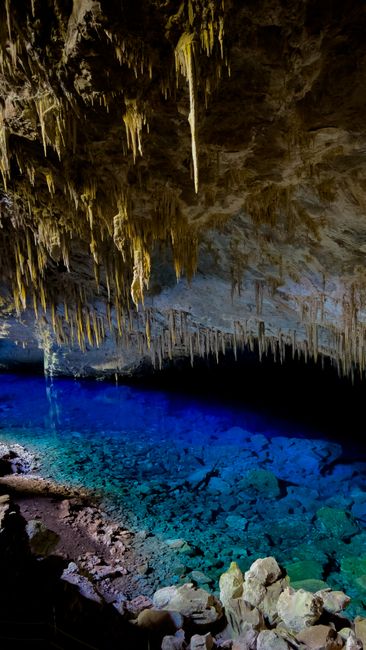
Bonito, a small town of about 24,000 people in the south-west of Mato Grosso do Sul, is Brazil’s model of ecotourism. Its rivers flow over limestone, which filters the water so clear that snorkelers float downstream among shoals of dourado and piraputanga fish as if in an aquarium. Around the town are blue-water caves, a sinkhole full of red-and-green macaws, waterfalls, and the forests of the Serra da Bodoquena. Almost everything is on private farms, and visits are tightly organized: every attraction has a daily limit, and you book through a licensed local travel agency, which issues the municipality’s single voucher (voucher único). Since December 2025, visitors also pay a small municipal environmental fee. Bonito is warm most of the year, and the water is clearest from about May to September; it also makes an easy add-on to a trip to the southern Pantanal.
Right now in Bonito
- Wed 21–31°C 69–88°F Mostly clear
- Thu 23–31°C 74–88°F 11 mm Showers
- Fri 22–31°C 72–88°F 11 mm Cloudy
- Mon 12 Oct Our Lady of Aparecida (Nossa Senhora Aparecida)
Weather: MET Norway (CC BY 4.0) · Holidays: Nager.Date
Top tours in Bonito
See all tours for Bonito →
From local operators, with prices and reviews; you check availability and book on Viator, our partner. We may earn a commission at no extra cost to you. How we earn money
Bonito at a glance
- Best for: river snorkeling, caves, waterfalls, birds and family nature trips.
- How long: 3–5 days; most visitors do one or two attractions a day.
- Best time: about May to September for the clearest water and dry weather (cool nights in June and July); December to March is hot and rainy, and rivers can cloud after storms.
- Getting there: direct flights to Bonito’s regional airport (BYO) from São Paulo and Campinas, or fly to Campo Grande and drive about 300 km (186 miles), roughly 4 hours.
- How bookings work: through licensed local agencies, which issue the voucher único; pay the municipal Environmental Conservation Fee (TCA), R$15 (about US$2.90) per person per day of visits, online.
- Before you go: the e-visa, money and health are in our Brazil travel guide; for wildlife to the north, see our Pantanal guide.
How Bonito’s voucher system works
Bonito’s attractions are run by private landowners under municipal and state environmental licenses, and each has a daily carrying capacity. To control the numbers, the municipality created the voucher único, a single voucher issued only through the town’s licensed travel agencies, which book your place at each attraction, at a set date and time, with the guide and insurance included. The voucher is now digital: since September 2021, visitors at the Gruta do Lago Azul and the Municipal Swimming Area check in on their phones, according to the municipality.
- Book with a licensed agency in Bonito (the tourism department lists them), in person or online, as early as possible for July and holidays; popular trips such as Rio da Prata and Abismo Anhumas sell out.
- Prices are set by each attraction and are the same at every agency.
- Many attractions need you to arrive by your own transport; agencies sell transfers if you don’t have a car.
- Most river snorkeling trips ban sunscreen and repellent in the water and require you to follow the guide, wear a life jacket or wetsuit and never stand on the riverbed.
The Environmental Conservation Fee (TCA)
Since December 20, 2025, the municipality has charged a Taxa de Conservação Ambiental (TCA) of R$15 (about US$2.90) per person for each day on which you visit attractions, for Brazilian and foreign visitors alike, under municipal laws from 2021 and 2022, according to the municipality. You pay online on the Turista por Natureza portal, entering everyone in your group and your dates, and the agency then issues your vouchers. Children under 7, residents and people working in Bonito are exempt. The fee includes visitor insurance and funds an ambulance for attractions and environmental projects. Local tourism associations challenged the fee in court in December 2025; as of the municipality’s January 2026 update it was being charged.
Bonito’s areas: where things are
The town is compact, with hotels, agencies and restaurants along and around Rua Coronel Pilad Rebuá, the main street. The attractions are spread over farms up to about 60 km (37 miles) away on dirt and paved roads: river trips to the south and south-east toward Jardim, caves and waterfalls to the west and north, and the Serra da Bodoquena National Park to the west.
Bonito in brief: why the water is so clear
Bonito sits on the limestone plateau of the Serra da Bodoquena. Rainwater filters slowly through the rock and emerges at springs rich in dissolved calcium carbonate, which makes particles clump together and settle on the riverbed, leaving the water astonishingly transparent, often with visibility of 30 m (100 ft) or more. The same chemistry builds the travertine waterfalls and dams of the region’s rivers and carved its caves. The clarity is fragile: soil washing off farmland after heavy rain can cloud rivers, which is why Bonito pioneered strict limits on visitor numbers, sunscreen bans and rules against touching the riverbed, and why farms work to protect the riverside forest.
From the 1990s, ranchers began opening their springs and caves to visitors with local guides, and the town built its model of licensed agencies, guides trained by the municipality, daily caps and the single voucher, which has been studied by other Brazilian destinations.
Top things to see in Bonito
River snorkeling: Rio da Prata and Rio Sucuri
The classic Bonito experience: put on a wetsuit and mask and float gently downstream for one to two hours through a crystal-clear river among fish, plants and springs where sand bubbles from the bottom. Rio da Prata, near Jardim, and Rio Sucuri, near town, are the best known; several other farms offer similar trips.
Gruta do Lago Azul
A cave whose entrance opens onto a deep lake of intense blue, lit by the sun’s rays in the morning, especially from about December to February; visitors walk down a staircase to a viewing platform. It is a protected natural monument, and swimming is not allowed.
Abismo Anhumas
A sinkhole entered by rappelling 72 m (236 ft) down a rope into a cavern with a lake, where you can snorkel or dive among limestone cones; it needs a training session the day before and has very few places a day.
Buraco das Araras
A huge sinkhole in Jardim, about an hour away, where red-and-green macaws nest in the cliffs; walk the rim trail and watch them fly in and out.
Waterfalls and the Municipal Swimming Area
Farms such as Estância Mimosa and the Boca da Onça trail have chains of waterfalls and natural pools; the Balneário Municipal, close to town, is a river swimming area with fish, popular with families.
More to see
- Serra da Bodoquena National Park: the forested limestone hills west of town, which protect the springs of many of Bonito’s rivers.
- Gruta de São Miguel: a smaller cave reached by a suspended walkway through the forest.
- Lagoa Misteriosa: a flooded sinkhole for snorkeling and diving in deep blue water.
- Horseback rides and boia-cross: horseback trips at Rio da Prata and Rio Formoso, and floating down the Rio Formoso on inner tubes.
Which snorkeling trip to choose
- Rio da Prata (Jardim): the longest and most varied float, about 2 km (1.2 miles) from a spring through forest, with big fish and occasional anacondas basking on the banks; about an hour from town.
- Rio Sucuri: close to town, with gentle current, very clear water and a carpet of aquatic plants; good for beginners.
- Nascente Azul and Barra do Sucuri: spring-fed pools and short floats with diving platforms.
- Aquário Natural / Baía Bonita: a short, easy float from a spring, popular with families.
- Rio Formoso: float trips, rafting in inflatable boats over small waterfalls, and the municipal swimming area.
All include wetsuits, masks and life jackets, a guide, and usually a buffet lunch at the farm; children have minimum ages on some trips.
Other things to do in Bonito
Diving
Certified divers can dive in Lagoa Misteriosa, Abismo Anhumas and some rivers, with operators working under the attractions’ licenses.
Horseback riding, cycling and adventure
Farms such as Rio da Prata and Rio Formoso offer horseback rides through pasture and forest; there are cycling routes on the quiet rural roads, zip lines and tree-top circuits, rafting on the Rio Formoso, and rappelling and caving trips with licensed operators.
Birdwatching
Toucans, macaws, rheas and many smaller birds live around the farms; early morning is best.
Food
Try river fish such as pacu and pintado, often served grilled or as “ventrecha”, along with Pantanal beef and the regional sopa paraguaia (a cornbread). Many farm visits include lunch.
Where to eat in Bonito
Restaurants line Rua Coronel Pilad Rebuá and the streets around the central square, serving pacu and pintado fish, Pantanal beef, pizza and regional dishes; the craft-beer and ice-cream shops stay busy in the evening, and a weekly market sells local food and crafts. Many visitors eat their main meal at the farm buffets included in the day trips and keep dinner light.
Day trips from Bonito
- Jardim: Buraco das Araras and Rio da Prata, about an hour away.
- The southern Pantanal: lodges and wildlife around Miranda and the Estrada Parque, about 2–3 hours away; better for two or three nights.
Getting there and getting around
Arriving
Bonito Regional Airport (BYO) has direct flights from São Paulo (Congonhas) with Gol and Campinas with Azul, and LATAM flights too, of about 2 hours, according to Bonito’s tourism department. Campo Grande, the state capital, has more flights and lower fares; from there it is about 300 km (186 miles), about 4 hours, by rental car, bus (the Cruzeiro do Sul company) or shared transfer, via the BR-419 and MS-382.
Driving and distances
Many attractions are 15–60 km (10–37 miles) from town, some on gravel roads that can be dusty in the dry season and slippery after rain; a regular car is fine for most, but drive slowly and avoid driving at night, when animals cross the roads. Rio da Prata and Buraco das Araras are near Jardim, about an hour south; Gruta do Lago Azul is about 20 km (12 miles) west; Rio Sucuri and Rio Formoso are within half an hour. Agencies sell shared and private transfers if you don’t want to drive.
In Bonito
The town is walkable, but the attractions are not: rent a car or buy transfers from your agency. Some roads to the farms are unpaved and dusty or muddy.
When to go and how long to stay
Bonito has a hot, rainy season from about October to March and a drier, milder season from about April to September. The water is usually clearest in the dry months, especially from May to September; heavy rain can cloud rivers for a few days. June and July nights can be cool, even cold during cold fronts, which makes snorkeling chilly (wetsuits are provided). The busiest times are the July school holidays, Christmas to Carnival and long weekends; Bonito’s tourism department lists the July holiday season as July 11 to August 2.
Bonito month by month
- December to February: hot and rainy summer, with afternoon storms that can cloud some rivers for a day or two; Christmas, New Year and Carnival are very busy. The light shines into the Gruta do Lago Azul most strongly from about December to February.
- March to May: the rains ease, the water clears and crowds thin out after Easter; a very good time.
- June to August: dry and sunny, with the clearest water, but cold fronts bring chilly mornings and cool water; July school holidays fill the town, so book early.
- September to November: warm and still mostly dry until the rains return around November; good for birds and waterfalls, with lower prices outside holidays.
3 days in Bonito
Day 1: Gruta do Lago Azul in the morning and a waterfall trail in the afternoon. Day 2: snorkeling on Rio da Prata and Buraco das Araras in Jardim. Day 3: Rio Sucuri and an afternoon at the Municipal Swimming Area.
5 days in Bonito
Add Abismo Anhumas (with the training session), Lagoa Misteriosa or a dive, and a horseback ride or boia-cross on the Rio Formoso.
Bonito for families
Bonito is one of Brazil’s best family nature destinations: the Municipal Swimming Area, Baía Bonita, Rio Sucuri and waterfall parks with easy trails suit children, while caves and rappelling have minimum ages. Life jackets and child-size wetsuits are provided on river trips, and many farm lunches are buffets with simple food. Plan one attraction a day with young children, as transfers and safety briefings take time.
Where to stay in Bonito
- In town: pousadas and hotels at every price near the main street, restaurants and agencies.
- On farms and in eco-lodges: quieter stays in nature, best with a car.
- Jardim: a cheaper base for Rio da Prata and Buraco das Araras.
What things cost in Bonito
Each attraction sets its own price, the same at every licensed agency. Our estimates, as of October 2026, plus the official fee:
| Item | Typical price |
|---|---|
| Environmental Conservation Fee (TCA) | R$15 (about US$2.90) per person per day of visits, official |
| Gruta do Lago Azul | about R$80–120 (US$15–23) |
| River snorkeling (Rio da Prata, Rio Sucuri) with lunch | about R$300–550 (US$60–105) |
| Waterfall trail (Estância Mimosa, Boca da Onça) | about R$200–400 (US$40–75) |
| Buraco das Araras | about R$80–130 (US$15–25) |
| Abismo Anhumas (contemplation or snorkel) | about R$900–1,500 (US$170–290) |
| Transfer to an attraction (shared) | about R$60–150 (US$12–30) per person |
| Double room, mid-range pousada | about R$300–600 (US$60–115) a night |
Doing two attractions a day for four days, a couple can easily spend R$3,000–5,000 (about US$575–960) on activities alone; budget accordingly.
Practical tips for Bonito
- Book early: the voucher system has daily limits, so reserve attractions as soon as you know your dates.
- TCA: pay the R$15-per-day fee on the official Turista por Natureza portal, not through unofficial sites.
- No sunscreen in the rivers: most snorkeling trips forbid sunscreen and repellent in the water to protect the clarity.
- Money: cards are widely accepted; carry some cash for small purchases.
- Health: the CDC recommends yellow fever vaccination for Mato Grosso do Sul.
- Safety: Bonito is a calm small town; the main risks are road driving at night, heat and following the rules on the water.
- Emergencies: call 190 for police, 192 for an ambulance and 193 for the fire department.
What to pack for Bonito
Pack swimwear, quick-drying clothes, sandals that stay on in water, closed shoes for trails, a hat, insect repellent for the trails (not the water), a light jacket for June and July evenings, and a dry bag. Bring a waterproof phone case or camera for the rivers, and a plug adapter for Brazil’s type N sockets.
Bonito travel FAQ
What is the voucher único in Bonito?
The municipality’s single booking voucher, issued only by Bonito’s licensed travel agencies, which reserve your time at each attraction under its daily limit.
How much is the Bonito tourist tax?
The Environmental Conservation Fee (TCA) is R$15 per person per day of attraction visits, paid online on the Turista por Natureza portal. Children under 7 and residents are exempt.
When is the best time to visit Bonito?
About May to September, for the clearest water and drier weather. December to March is hot and rainy.
How do I get to Bonito?
Fly direct to Bonito from São Paulo or Campinas, or fly to Campo Grande and drive or take a bus about 300 km, around 4 hours.
Can I visit Bonito’s attractions without an agency?
No. Attractions are booked through licensed local agencies, which issue the voucher, although you can travel to the attractions by your own car.
How many days do I need in Bonito?
Three to five days, doing one or two attractions a day.
Do I need a yellow fever vaccine for Bonito?
It isn’t required to enter Brazil, but the CDC recommends it for travelers going to Mato Grosso do Sul.
Is Bonito worth visiting?
Yes, for clear-water river snorkeling, caves and waterfalls unlike anywhere else in Brazil; it is well organized but not cheap.
What is the best snorkeling trip in Bonito?
Rio da Prata, near Jardim, is the classic; Rio Sucuri is closest to town and gentle for beginners.
Can you swim in the Gruta do Lago Azul?
No. The cave lake is a protected natural monument, seen from a viewing platform at the bottom of a staircase.
Sources and last review
Researched and last reviewed on 4 October 2026. The TCA, its amount, exemptions, portal, insurance and legal background: the municipality of Bonito’s notices of November 2025 and January 2026; the voucher único and digital check-in: the municipality; flights, the road from Campo Grande, bus company and July holiday dates: Bonito’s tourism department; population: IBGE’s 2022 census; yellow fever: the US CDC; exchange rate: the Central Bank of Brazil. Attraction descriptions, distances, carrying capacities, rules on the water, the best months for water clarity, the Lago Azul light season, Abismo Anhumas details and food come from secondary sources or general knowledge and are flagged for checking. Prices and rules change, so check with Bonito’s tourism department and your agency before you go. For entry rules and money, see our Brazil travel guide.
Plan your trip
Partner links: TravelerCenter may earn a commission if you book, at no extra cost to you.
🇵🇹 Useful Portuguese phrases for Bonito
All 38 Portuguese phrases: restaurant, hotel, emergencies, romance (printable) →