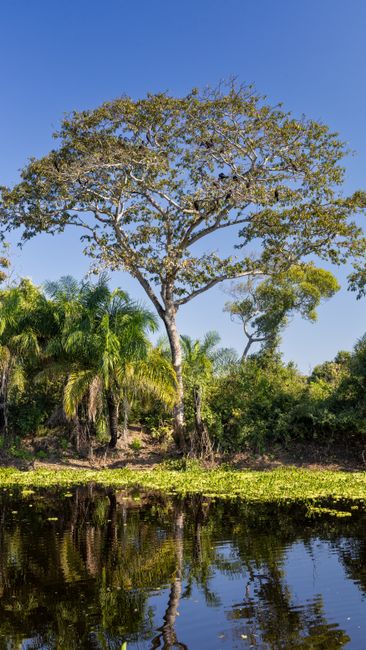
The Pantanal is the world’s largest tropical wetland, a vast, flat floodplain in the heart of South America, most of it in the Brazilian states of Mato Grosso and Mato Grosso do Sul and the rest in Bolivia and Paraguay. Every year the rains swell the Paraguay River and its tributaries until much of the plain floods, then the water slowly drains away, concentrating fish, birds and animals along the rivers and shrinking pools. That rhythm makes it the best place in the Americas to see wildlife: jaguars hunting along the riverbanks, giant otters, caimans by the thousand, capybaras, marsh deer, giant anteaters, and hyacinth macaws, jabirú storks and hundreds of other birds. Most of the land is private cattle ranches (fazendas), many of which double as lodges, and part of it is protected as the Pantanal Matogrossense National Park and a UNESCO World Heritage Site. Visit in the dry season, from about July to October, for the most wildlife.
Right now in Pantanal
- Tue 21–32°C 70–90°F 2 mm Showers
- Wed 23–34°C 74–94°F 1 mm Light showers
- Thu 25–37°C 76–98°F Clear
- Mon 12 Oct Our Lady of Aparecida (Nossa Senhora Aparecida)
Weather: MET Norway (CC BY 4.0) · Holidays: Nager.Date
Top tours in Pantanal
See all tours for Pantanal →
From local operators, with prices and reviews; you check availability and book on Viator, our partner. We may earn a commission at no extra cost to you. How we earn money
The Pantanal at a glance
- Best for: jaguars, birds, giant otters and other wildlife, river safaris, horseback riding and ranch life.
- How long: 3–5 nights; a week to combine the north and south, or the southern Pantanal with Bonito.
- Best months: about July to October, the dry season, for wildlife and jaguars; the plain floods from about December to March.
- Getting there: the northern Pantanal from Cuiabá (CGB), along the Transpantaneira road; the southern Pantanal from Campo Grande (CGR) or Corumbá, via Miranda and the Estrada Parque.
- Health: the CDC recommends yellow fever vaccination for both Mato Grosso and Mato Grosso do Sul.
- Before you go: the e-visa, money and health are in our Brazil travel guide; for clear-water rivers to the south, see our Bonito guide.
The seasons: flood and dry
The Pantanal’s year follows the water. The rains fall mainly from about October to March: at Nhumirim, an official weather station in the middle of the southern Pantanal, INMET’s 1991–2020 normals record about 1,085 mm (43 in) of rain a year, with 140–170 mm (5.5–7 in) a month from November to February and only 14–22 mm (about 0.5–0.9 in) a month from June to August. The flood builds after the rains, because water drains slowly across the flat plain, so the highest water usually comes from about February to April in the north and later, into May or June, farther south along the Paraguay River.
- About July to October (dry season): the best time for wildlife. Animals gather at the remaining water, roads are passable, and jaguar boat trips from Porto Jofre see cats almost daily in a good year. It gets very hot in September and October, and smoke and wildfires are a risk late in the season.
- About November to January: the rains return, the plain turns green, and birds nest; some roads become muddy.
- About February to June (flood and receding water): much of the plain is under water, lodges are reached by boat or on raised roads, and wildlife is more spread out, but the landscape is beautiful and fishing season reopens as the water falls.
Northern and southern Pantanal
The northern Pantanal (Mato Grosso)
From Cuiabá, it is about 100 km (62 miles) to Poconé, where the Transpantaneira begins: a dirt road of about 145 km (90 miles) built on an embankment, with more than 100 wooden bridges, running south to Porto Jofre on the Cuiabá River. Lodges line the road, and wildlife is visible from the car in the dry season. Porto Jofre is the base for boat trips to see jaguars on the Cuiabá River and its side channels, in and around the Encontro das Águas State Park.
The southern Pantanal (Mato Grosso do Sul)
Larger and more remote, reached from Campo Grande, Miranda, Aquidauana or Corumbá. The Estrada Parque, a dirt road from the BR-262 near Miranda toward Corumbá, crosses the Nhecolândia and Paraguay River areas, and big working ranches offer safaris on foot, by truck, on horseback and by boat, with good chances of seeing giant anteaters, ocelots and, in places, jaguars. The south is easy to combine with Bonito.
Top things to see in the Pantanal
Jaguars
The Pantanal has one of the densest jaguar populations anywhere. In the dry season, boat trips from Porto Jofre and nearby floating hotels search the riverbanks, where jaguars rest and hunt caimans and capybaras. Boats should keep their distance and not crowd the animals; choose operators that follow good practice.
The Transpantaneira
Drive or ride slowly in the early morning or late afternoon: herons, storks, kingfishers, caimans and capybaras crowd the pools beside the road, and hyacinth macaws feed in the palms near the lodges.
Giant otters and river safaris
River trips by boat or canoe look for giant otters, which live in noisy family groups, as well as caimans, river birds and, from some lodges, the chance to fish for piranhas.
Photography
The Pantanal is one of the world’s great wildlife-photography destinations. A telephoto lens of 300–600 mm is ideal for jaguars and birds; boats move, so use fast shutter speeds, and protect gear from dust in the dry season and from rain and humidity in the wet. The best light is in the first and last two hours of the day.
The national park
The Pantanal Matogrossense National Park, at the confluence of the Paraguay and Cuiabá rivers, and the private reserves around it form the core of the UNESCO-listed Pantanal Conservation Area; access is by boat and visits are limited.
More to see
- Hyacinth macaws: the world’s largest parrots, easy to see near many lodges.
- Ranch life: cattle drives with the Pantanal cowboys (pantaneiros) and horseback rides through the shallows.
- Night drives: spotlighting for ocelots, foxes, owls and tapirs.
- Chapada dos Guimarães: sandstone cliffs and waterfalls near Cuiabá, an easy add-on.
Wildlife you can expect to see
- Mammals: capybaras (the world’s largest rodent) and yacare caimans everywhere near water; giant otters, marsh deer, coatis, howler and capuchin monkeys, giant anteaters (especially in the south), tapirs, peccaries, and with luck jaguars, ocelots and pumas.
- Birds: more than 600 species are recorded in the Pantanal, including the hyacinth macaw, the jabiru stork (the Pantanal’s symbol, nesting from about July), toucans, rheas, herons, kingfishers, spoonbills and the hyacinth’s cousins, blue-and-yellow macaws.
- Reptiles and fish: caimans, anacondas, river turtles, and fish such as piranhas, pacu and dourado, which feed the whole food web.
Wildlife is easiest to see in the early morning and late afternoon; the midday heat sends animals into the shade.
Choosing a lodge or tour
- Location: lodges on the Transpantaneira and at Porto Jofre are best for jaguars; big ranches in the south offer more variety and walking and riding safaris.
- Guides: a naturalist guide who speaks your language makes the trip; ask whether guides are shared with large groups.
- Jaguar boats: check that the operator follows distance rules, limits the number of boats at each sighting and doesn’t bait animals.
- Packages: most lodges include meals and activities; transfers, drinks and boat trips may be extra.
- Season: in the wet season ask how the lodge is reached and which activities run.
Getting there
- Northern Pantanal: fly to Cuiabá’s Marechal Rondon International Airport (CGB), from São Paulo, Brasília and other cities, then drive or take a lodge transfer to Poconé and down the Transpantaneira; Porto Jofre is about 4–5 hours from Cuiabá in the dry season.
- Southern Pantanal: fly to Campo Grande (CGR) or Corumbá (CMG), then drive or take a transfer to Miranda, Aquidauana or the Estrada Parque, about 3–4 hours from Campo Grande to most lodges.
- Driving: high-clearance vehicles are best on the Transpantaneira and Estrada Parque; avoid driving at night, watch for animals and narrow bridges, and check road conditions in the wet season. Most visitors use lodge transfers or tours.
Around the Pantanal
- Bonito: clear-water rivers, caves and waterfalls, about 2–3 hours from the southern lodges.
- Chapada dos Guimarães: cliffs, waterfalls and viewpoints about an hour from Cuiabá.
- Corumbá: a river port on the Bolivian border, base for fishing boats and Paraguay River trips.
When to go and how long to stay
The Pantanal is hot for most of the year. At Cuiabá, the gateway to the north, INMET’s 1991–2020 normals record average highs of 32–33 °C (89–91 °F) from April to July and 35–36 °C (95–96 °F) in September and October, the hottest months; nights average about 17–18 °C (63–65 °F) in July, and cold fronts from the south can bring a few chilly days from May to August. July is the main holiday month for Brazilians; August to October is the peak for jaguar trips, so book lodges and boats early.
The Pantanal’s weather month by month
The table combines INMET’s 1991–2020 temperature averages for Cuiabá, the gateway to the northern Pantanal, with rainfall at its Nhumirim station, in the southern Pantanal.
| Month | Average high | Average low | Rain (Nhumirim, southern Pantanal) |
|---|---|---|---|
| January | 33 °C (91 °F) | 24 °C (75 °F) | 172 mm (6.8 in) |
| February | 33 °C (91 °F) | 24 °C (74 °F) | 145 mm (5.7 in) |
| March | 33 °C (92 °F) | 24 °C (74 °F) | 138 mm (5.4 in) |
| April | 33 °C (92 °F) | 23 °C (73 °F) | 77 mm (3.0 in) |
| May | 32 °C (89 °F) | 20 °C (68 °F) | 63 mm (2.5 in) |
| June | 32 °C (89 °F) | 18 °C (65 °F) | 22 mm (0.9 in) |
| July | 32 °C (90 °F) | 17 °C (63 °F) | 14 mm (0.5 in) |
| August | 35 °C (94 °F) | 19 °C (66 °F) | 20 mm (0.8 in) |
| September | 36 °C (96 °F) | 22 °C (71 °F) | 45 mm (1.8 in) |
| October | 35 °C (95 °F) | 24 °C (74 °F) | 92 mm (3.6 in) |
| November | 34 °C (93 °F) | 24 °C (75 °F) | 144 mm (5.7 in) |
| December | 33 °C (92 °F) | 24 °C (75 °F) | 154 mm (6.1 in) |
- January to March: hot and wet, with heavy storms; the plain floods and some lodges close or switch to boat access.
- April to June: the water slowly drains; fishing season usually reopens, birdlife is excellent and temperatures ease.
- July to October: the dry season and peak for wildlife and jaguars; very hot in September and October, with smoke risk late in the season.
- November and December: the first rains bring green growth and nesting birds, with fewer visitors.
Three nights in the northern Pantanal
Night 1: a lodge on the Transpantaneira, with an evening and early-morning safari. Nights 2–3: Porto Jofre, with full-day boat trips to look for jaguars and giant otters.
Five nights in the southern Pantanal and Bonito
Three nights at a ranch lodge near Miranda or on the Estrada Parque, with walks, horseback rides, boat trips and night drives, then two or more nights in Bonito.
A week across the Pantanal
Fly into Cuiabá for three nights on the Transpantaneira and at Porto Jofre, then fly or drive to Campo Grande for three nights at a southern ranch and a final night in Bonito or the city, flying out from Campo Grande.
Where to stay in the Pantanal
- Ranch lodges (fazendas): working cattle ranches with rooms, all meals and guided activities, the classic Pantanal stay.
- Lodges on the Transpantaneira: from simple to comfortable, all with wildlife on the doorstep.
- Porto Jofre: hotels and floating hotels for jaguar trips, priced at a premium in the dry season.
- Towns: Poconé, Miranda and Corumbá have simple hotels for budget travelers who join day trips.
Most lodges sell full-board packages with activities and transfers; check what is included.
Food and ranch life
Lodge meals are hearty ranch cooking: rice, beans, farofa, grilled beef from the farm, river fish such as pacu, pintado and piranha soup, and fruits from the cerrado such as pequi, which locals love and visitors find pungent. Many ranches still work cattle, and the pantaneiro cowboys move herds across flooded fields on horseback; at some lodges you can join a cattle drive, watch the morning milking or share tereré, cold mate tea, the drink of the region.
Gateway cities
- Cuiabá: the capital of Mato Grosso and gateway to the north, a hot city with a riverside promenade and a good base for a night before or after the Transpantaneira and for Chapada dos Guimarães.
- Campo Grande: the capital of Mato Grosso do Sul, a planned city with parks, a large Japanese-Okinawan community and its famous sobá noodle soup, and the gateway to the southern Pantanal and Bonito.
- Corumbá: a historic river port on the Paraguay River, opposite Bolivia, the traditional base for fishing boats.
What things cost in the Pantanal
Our estimates for planning, as of October 2026:
| Item | Typical price |
|---|---|
| Lodge on the Transpantaneira, full board with activities | about R$900–2,000 (US$170–385) per person per night |
| Porto Jofre jaguar boat trip (full day, shared) | about R$900–1,600 (US$170–305) per person |
| Southern ranch lodge, full board with activities | about R$1,000–2,500 (US$190–480) per person per night |
| Private transfer Cuiabá–Porto Jofre | about R$1,500–2,500 (US$290–480) per vehicle |
| Budget tour from Campo Grande or Cuiabá (3 nights, shared) | about R$2,000–3,500 (US$385–670) per person |
| Car rental per day (economy) | about R$150–300 (US$30–60) |
Practical tips for the Pantanal
- Book ahead: lodges and jaguar boats fill up from July to October.
- Guides: a good naturalist guide makes a huge difference; ask lodges about English-speaking guides.
- Fires: wildfires can break out in the late dry season, often August to October, and smoke can close roads or cause poor air; check conditions with your lodge before you travel.
- Health: the CDC recommends yellow fever vaccination for Mato Grosso and Mato Grosso do Sul, and lists malaria as present in Mato Grosso (rare in Cuiabá) with rare cases in Mato Grosso do Sul; use repellent, especially at dusk.
- Wildlife: keep your distance from caimans, jaguars and herds; don’t swim except where your guide says it is safe.
- Money: lodges take cards, but carry cash for tips and small purchases.
- Safety: crime is rarely an issue in the lodges; the main risks are heat, dehydration, sunburn, insects, driving on dirt roads and wildlife.
- Emergencies: call 190 for police, 192 for an ambulance and 193 for the fire department; medical care is hours away from most lodges, so buy insurance with evacuation cover.
What to pack for the Pantanal
Pack lightweight long-sleeved shirts and trousers in neutral colors, a wide-brimmed hat, sunglasses, high-factor sunscreen, strong insect repellent, closed shoes or boots and sandals, a light rain jacket, a warm layer for cold fronts and early boat trips, binoculars, a camera with a zoom lens, a headlamp and a refillable water bottle. Bring a plug adapter for Brazil’s type N sockets.
Pantanal travel FAQ
When is the best time to visit the Pantanal?
About July to October, the dry season, for the most wildlife and the best chance of jaguars. The plain floods from about December to March.
Where is the best place to see jaguars in the Pantanal?
Porto Jofre, at the end of the Transpantaneira in the northern Pantanal, where boat trips search the Cuiabá River and its channels in the dry season.
Northern or southern Pantanal?
The north (from Cuiabá) is best for jaguars and easy wildlife along the Transpantaneira; the south (from Campo Grande) has big ranches, more variety of activities and combines well with Bonito.
How do I get to the Pantanal?
Fly to Cuiabá for the north or Campo Grande or Corumbá for the south, then take a lodge transfer or drive.
How many days do I need in the Pantanal?
Three to five nights; at least two nights at Porto Jofre for jaguars.
Do I need a yellow fever vaccine for the Pantanal?
It isn’t required to enter Brazil, but the CDC recommends it for Mato Grosso and Mato Grosso do Sul.
Is the Pantanal affected by fires?
Wildfires can occur in the late dry season, often August to October. Check conditions with your lodge before you go.
What animals can I see in the Pantanal?
Capybaras, caimans, giant otters, marsh deer, monkeys, giant anteaters and with luck jaguars and ocelots, plus hundreds of birds, including hyacinth macaws and jabiru storks.
Is the Transpantaneira road paved?
No. It is a dirt road of about 145 km from Poconé to Porto Jofre, with many wooden bridges; drive slowly and by day, and check conditions in the wet season.
How much does a Pantanal trip cost?
Lodges with full board and activities typically cost from about R$900 to R$2,500 per person per night, with jaguar boat trips extra; budget tours are cheaper.
Sources and last review
Researched and last reviewed on 4 October 2026. Rainfall at Nhumirim and temperatures at Cuiabá: INMET’s 1991–2020 normals; yellow fever and malaria: the US CDC; exchange rate: the Central Bank of Brazil. The flood timing, wildlife and jaguar seasons, the Transpantaneira and Estrada Parque, distances and travel times, the national park and UNESCO listing, fire season, lodges and activities come from secondary sources or general knowledge and are flagged for checking. Conditions change with each year’s rains and fires, so check with your lodge before you go. For entry rules and money, see our Brazil travel guide.
Plan your trip
Partner links: TravelerCenter may earn a commission if you book, at no extra cost to you.
🇵🇹 Useful Portuguese phrases for Pantanal
All 38 Portuguese phrases: restaurant, hotel, emergencies, romance (printable) →