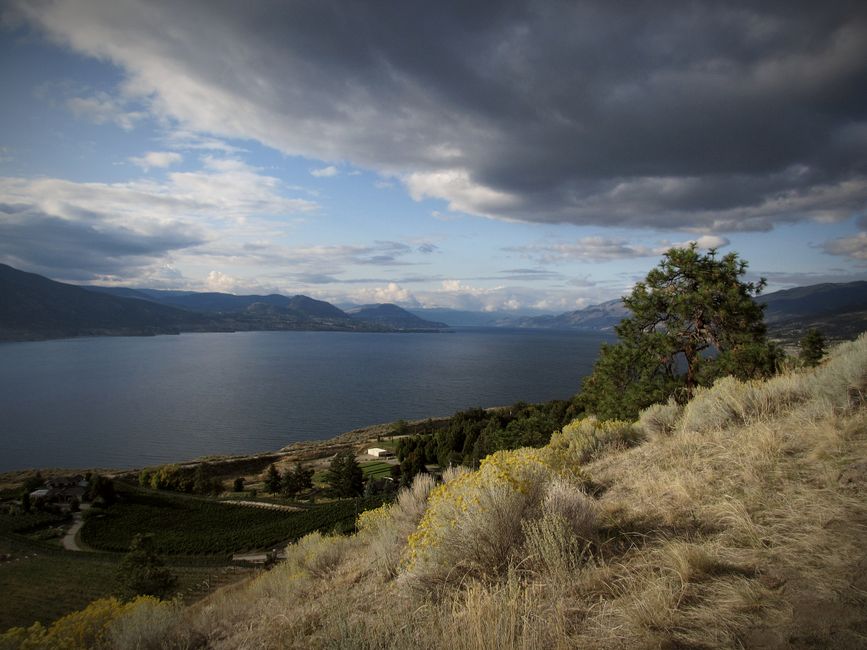
The Okanagan is British Columbia’s warm, sunny interior valley, a 200 km (125-mile) chain of long lakes, orchards, vineyards and dry hills running north from the US border at Osoyoos through Oliver, Penticton and Kelowna to Vernon. With Ontario’s Niagara Peninsula, it is one of Canada’s two great wine regions, with tasting rooms on almost every bench above Okanagan Lake, and its summers are the hottest and driest in the country’s west: sandy beaches, houseboats, paddleboards, fruit stands piled with cherries and peaches, and cycling on old railway trestles. The valley is the traditional territory of the syilx/Okanagan people, whose desert cultural centre at Osoyoos is one of the region’s best stops. Kelowna, with its airport and lakefront downtown, is the main base. In winter, three ski resorts in the hills above the valley, Big White, SilverStar and Apex, are known for dry powder. Come from June to early October for lake days, harvest and wine; be ready for heat and, in some summers, wildfire smoke.
Right now in Okanagan (Kelowna)
- Tue 10–21°C 49–70°F Partly cloudy
- Wed 11–22°C 52–71°F Mostly clear
- Thu 12–22°C 54–72°F Partly cloudy
- Mon 12 Oct Thanksgiving
Weather: MET Norway (CC BY 4.0) · Rates: ECB · Holidays: Nager.Date
Top tours in Okanagan
See all tours for Okanagan →
From local operators, with prices and reviews; you check availability and book on Viator, our partner. We may earn a commission at no extra cost to you. How we earn money
Okanagan at a glance
- Best months: late May to June for green vineyards and cherries without the peak crowds; July and August for beaches (hot, busy and sometimes smoky); September and early October for the grape harvest, apples and warm, clear days.
- Time needed: a long weekend for Kelowna and one wine area; five days to a week to drive the whole valley from Vernon to Osoyoos.
- Getting there: fly to Kelowna International Airport (YLW) or Penticton (YYF), or drive about 4 hours from Vancouver via the Coquihalla Highway. You will want a car for wineries and lakes.
- Costs (as of October 2026): prices are in Canadian dollars; a Kelowna bus ride is $3 (about US$2.15); the Nk’Mip Desert Cultural Centre is $19 for adults; winery tastings typically cost about $10 to $25 a person and are often waived if you buy wine. Accommodation carries about 16% in taxes.
- Before you go: entry rules (eTA or visa), money and driving in Canada are in our Canada travel guide. Winter tires or chains are required on the mountain highways into the valley from 1 October.
The Okanagan’s towns and who each one suits
Kelowna and West Kelowna
The valley’s biggest city (about 150,000 people) spreads along both sides of Okanagan Lake, joined by a floating bridge. Downtown has a lakeside boardwalk, City Park’s beach, Bernard Avenue’s restaurants and the Cultural District’s galleries and breweries; the Mission, south of downtown, has more beaches and some of the oldest wineries; West Kelowna’s Westside Wine Trail climbs the slopes across the water, and Lake Country, north of the airport, has more vineyards on the way to Vernon. Best for first-timers, families and anyone flying in.
Vernon and the North Okanagan
Vernon sits between three lakes: Okanagan, Kalamalka, famous for its bands of turquoise and green water, and Swan. It is a quieter, more affordable base, with Kalamalka Lake Provincial Park’s coves, the paved and gravel Okanagan Rail Trail, Davison Orchards’ farm stand and SilverStar Mountain Resort 30 minutes up the hill. Good for families, cyclists and winter skiers.
Penticton, Naramata and Summerland
Penticton lies between two lakes, with a long beach on each: Okanagan Beach to the north and Skaha Beach to the south, joined by a channel where summer visitors float in rafts and tubes. The Naramata Bench, just north, is a road of boutique wineries above the lake, and Summerland, across the water, has its own wine trail and a historic steam railway. Best for wine lovers who want a beach town, and for cyclists.
Oliver and Osoyoos
The southern Okanagan is the warmest part of the valley: an arid landscape of sagebrush and antelope-brush, with irrigated vineyards in every direction. Oliver calls itself the wine capital of Canada, and its Golden Mile Bench and Black Sage Road have dozens of tasting rooms. Osoyoos, on the US border, has the valley’s warmest swimming lake, desert resorts and the Nk’Mip Desert Cultural Centre. Best for serious wine touring and lake holidays; very hot in July and August.
Top things to see in the Okanagan
Wineries and tasting rooms
British Columbia has more than 300 wineries, and the Okanagan Valley is the province’s largest and oldest wine region. Expect everything from family farm wineries with a tasting bar in a barn to architectural estates with restaurants, terraces and lake views. The valley is known for crisp whites, Pinot Noir and, in the hot south, Merlot, Syrah and blends, plus icewine in cold winters. Most wineries charge a tasting fee, commonly about $10 to $25, often refunded if you buy bottles, and many ask you to book ahead in summer. Popular routes are the Lakeshore and Westside wine trails in Kelowna, the Naramata Bench near Penticton and the Golden Mile and Black Sage Road around Oliver. Tasting rooms keep shorter hours from November to April. Don’t drink and drive: B.C. police enforce impaired-driving rules strictly, so use a designated driver, a tour company or a bicycle tour.
Okanagan Lake and the beaches
Okanagan Lake, about 135 km (84 miles) long, is the centrepiece of the valley. Kelowna’s City Park and the Mission’s Gyro and Rotary beaches are the busiest; Penticton has Okanagan Beach and Skaha Beach; Vernon’s Kalamalka Lake Provincial Park has quieter coves; and Osoyoos Lake, the warmest, is lined with sandy beaches and resorts. Rent a paddleboard, kayak or boat, or join locals on a houseboat. Lake water warms to swimming temperatures from July to early September. Look out, too, for the Ogopogo, the lake’s legendary monster, on Kelowna’s waterfront.
Myra Canyon trestles on the Kettle Valley Rail Trail
High in the hills southeast of Kelowna, the abandoned Kettle Valley Railway curls around Myra Canyon on 18 historic trestles and through rock tunnels, now part of Myra-Bellevue Provincial Park and the Trans Canada Trail. The flat, 12 km (7.5-mile) section between the Myra and June Springs (Ruth Station) access points is a superb walk or bike ride with views across the valley; 14 benches mark the viewpoints. Many trestles burned in the 2003 Okanagan Mountain Park wildfire and were rebuilt. The main Myra access is up 8 km (5 miles) of rough gravel forest road with about 75 parking spots, toilets and, in season, bike rentals; there is no parking beyond. Motor vehicles are banned on the trail, helmets are required for cyclists in B.C., and BC Parks asks cyclists to walk their bikes across the trestles. Go early in summer; the road and trail are snowbound in winter.
The Okanagan Rail Trail
This newer rail trail follows a former railway line along the shores of Wood and Kalamalka lakes from Kelowna towards Coldstream near Vernon. When finished it will be 52 km (32 miles) long, but it is not yet continuous: a section of nearly 7 km north of Kelowna International Airport has not been built. The Kelowna section is paved; the Lake Country and North Okanagan sections have a compact gravel surface suitable for hybrid bikes. The lakeside stretch around Kalamalka Lake is the prettiest.
Nk’Mip Desert Cultural Centre, Osoyoos
Run by the Osoyoos Indian Band, this striking rammed-earth building set into the hillside tells the story of the syilx/Okanagan people and of one of Canada’s rarest ecosystems, the dry shrub-steppe often called Canada’s only desert. Indoor galleries and two multimedia theatres share the legends of Sen’klip (Coyote); outside, about 1 km of trails lead through sage and antelope-brush to a reconstructed village, and you can see a western rattlesnake up close. It is open daily 9 a.m. to 4 p.m.; admission is $19 for adults, $17 for seniors and students, $14 for under-18s and $43 for a family, plus tax. Allow 1.5 to 2 hours, wear walking shoes and a hat, and leave pets at home (they are not allowed on the trail).
Fruit stands and harvest seasons
The valley’s orchards make road trips delicious. Roughly: cherries from late June to July, apricots and peaches in July and August, plums, pears and early apples in August, grapes and apples from September into October. Roadside stands along Highway 97, especially between Oliver and Osoyoos and around Kelowna and Summerland, sell fruit, juice and preserves; many farms offer U-pick in season. Kelowna’s and Penticton’s farmers’ markets run from spring to autumn.
Protected areas
- Bear Creek Provincial Park
- Kalamalka Lake Provincial Park
- Okanagan Mountain Provincial Park
- sẁiẁs Park
Peaks and mountains
- Mount Boucherie
Nature
- Okanagan Lake
Museums
- Nk'Mip Desert Cultural Centre, Osoyoos
Activities and best months
- CyclingThe Okanagan Rail Trail will be 52 km when complete (not yet continuous): crushed aggregate in the North Okanagan and Lake Country, paved in Kelowna, along Kalamalka and Wood lakes; the Myra Canyon section of the Kettle Valley Rail line crosses 18 historic trestles in Myra-Bellevue Park. · source
- Wine tastingWine BC: British Columbia has more than 300 wineries, and the Okanagan Valley is its largest and oldest wine region. · source
Other things to do in the Okanagan
Skiing at Big White, SilverStar and Apex
The hills above the valley catch far more snow than the valley floor, famously light and dry. Big White, 56 km (35 miles) east-southeast of Kelowna, has 119 trails, 17 lifts, 777 m (2,550 feet) of vertical and about 7.5 m (25 feet) of snow a year; its 2026/27 season runs from 26 November 2026 to 4 April 2027. SilverStar, about 30 minutes above Vernon, has 133 marked runs, 760 m of vertical and a colourful village with excellent cross-country trails. Apex, about 30 minutes from Penticton, is smaller and steeper, with 85 runs, four lifts, 2,000 feet (610 m) of vertical and about 5 m of snow a year. SilverStar and Apex had not posted 2026/27 opening dates when we checked; they usually open from late November to mid-December.
Cycling, hiking and golf
Beyond the rail trails, there are steep hikes to viewpoints such as Knox Mountain in Kelowna and Giant’s Head in Summerland, lakeside parks with short trails, and dozens of golf courses with a long season. The Kettle Valley Rail Trail continues south of Myra Canyon towards Penticton, Naramata and beyond, with more tunnels and lake views.
Food and drink
Farm-to-table restaurants, winery dining rooms, craft breweries, cideries and distilleries are everywhere; Kelowna’s Cultural District, Penticton’s Ale Trail breweries and the wineries of Oliver and Naramata are the hubs.
Day trips and onward travel
Similkameen Valley
West of Osoyoos, Highway 3 drops into the Similkameen Valley around Keremeos and Cawston, a quieter farming valley with organic orchards, fruit stands and small wineries under dramatic rock walls.
Kamloops and the Shuswap
North of Vernon, the Shuswap lakes around Salmon Arm are another summer houseboat and beach region, and Kamloops, an hour and a half from Kelowna, has desert hills and wineries of its own. Banff and the Rockies are about six hours east of Kelowna by car; see our Banff National Park guide.
Vancouver and Whistler
Most visitors combine the Okanagan with Vancouver, four hours’ drive or a one-hour flight away, and some with Whistler; see our Vancouver and Whistler guides. For a comparison with California wine country, see our Napa Valley guide.
Getting there and getting around
By air
Kelowna International Airport (YLW), about 20 minutes north of downtown Kelowna, is the valley’s main airport, with flights across Canada and to some US destinations; it handled a record 2.3 million passengers in 2025. Penticton Airport (YYF) has direct flights to Vancouver, Calgary and Edmonton and is closer to Naramata and the south. Car rentals, taxis and shuttles operate at both; in Kelowna, BC Transit buses also serve the airport.
Driving from Vancouver
The fastest route, about 390 km (240 miles) and four hours, follows the Trans-Canada Highway to Hope, the Coquihalla Highway (Highway 5) over the mountains to Merritt and the Okanagan Connector (Highway 97C) down to West Kelowna. For Penticton, Oliver and Osoyoos, Highway 3 through Manning Park and the Similkameen Valley is slower but scenic. These are high mountain passes: from 1 October to 30 April, B.C. requires winter tires or chains on most highways, marked by roadside signs, and a legal winter tire has at least 3.5 mm of tread and the mountain-snowflake or M+S symbol. The Coquihalla can see heavy snow and closures from October to April; check DriveBC before you set off. Within the valley, Highway 97 links all the towns.
Getting around
A car is the easiest way to reach wineries, beaches and Myra Canyon. Kelowna has the valley’s main BC Transit system; Vernon and Penticton have smaller local networks.
| BC Transit Kelowna fare | Adult price | Notes |
|---|---|---|
| Single ride | $3 | Most routes |
| Single ride, Route 90 | $6 | Regional route |
| DayPASS | $6 | Unlimited local travel that day |
| 30 Day Adult Pass | $80 |
Wine-tour companies, bike-tour operators and e-bike rentals are the best way to visit tasting rooms without driving.
When to go and how long to stay
The Okanagan has a semi-arid climate, sheltered from Pacific storms by the Coast and Cascade mountains: hot, sunny summers, cool and often cloudy winters, and little rain. Kelowna gets about 390 mm (15 in) of rain and snow a year, roughly a third of Vancouver’s; Osoyoos, in the south, is even drier and hotter, with July highs averaging about 29 °C (85 °F). Valley inversions can keep winter days grey and foggy while the ski hills above sit in sunshine.
| Season | Average high | Average low | What it’s like |
|---|---|---|---|
| Spring (Mar–May) | 10–20 °C (50–68 °F) | −2 to 5 °C (28–42 °F) | Blossom in April and May; quiet wineries; cool nights |
| Summer (Jun–Aug) | 24–28 °C (75–82 °F) | 9–11 °C (48–52 °F) | Hot, dry and sunny; heat waves above 35 °C (95 °F) occur; wildfire smoke possible |
| Autumn (Sep–Nov) | 22 °C falling to 6 °C (71 to 42 °F) | 6 to −2 °C (43–28 °F) | Harvest and crush in September and October; golden hills |
| Winter (Dec–Feb) | 1–4 °C (33–38 °F) | −6 to −5 °C (21–22 °F) | Grey valley, about 90 cm (35 in) of snow; sunny powder days at the ski resorts |
Figures are Environment and Climate Change Canada’s 1981–2010 climate normals for Kelowna airport (and Osoyoos West for the south).
Events worth planning around
- Spring and fall wine festivals: the Okanagan’s wine festivals traditionally run in spring and in early October, with tastings, winery dinners and events across the valley.
- Summer in Penticton: the channel float, beach days and big summer sporting events.
- Harvest season (September and October): grape picking and crush, apple harvest and harvest dinners at wineries.
- Winter in Wine Country weekends in Oliver and Osoyoos before Christmas, and ski season from late November.
Dates change every year; check the organizers’ sites before you book.
How long to stay: 3, 5 and 7 days
- Three days: Kelowna’s waterfront and a beach, a day of wineries on one trail, and Myra Canyon’s trestles by bike or on foot.
- Five days: add Penticton, the Naramata Bench and Skaha Beach, then drive south to Oliver and Osoyoos for the Golden Mile and the Nk’Mip Desert Cultural Centre.
- A week: add Vernon, Kalamalka Lake and the Okanagan Rail Trail, or a lazy lake day on a rented boat; in winter, swap in two or three days at Big White or SilverStar.
Where to stay in the Okanagan and the taxes on your bill
- Kelowna downtown and waterfront: the widest choice of hotels, close to the beach, restaurants and the airport.
- West Kelowna and the Mission: resorts and B&Bs near wineries and quieter beaches.
- Penticton: lakefront motels and hotels between two beaches; good value outside summer.
- Naramata, Oliver and Osoyoos: winery guesthouses and desert lake resorts; book well ahead for July, August and harvest weekends.
- Vernon and SilverStar: family-friendly lake and mountain stays; ski-in lodges in winter.
Taxes: prices are shown before tax. B.C. charges 8% PST on short-term accommodation (7% on most other goods) plus, in Kelowna, Vernon, Penticton, Summerland, Oliver, Osoyoos, Big White, SilverStar and Naramata, a 3% Municipal and Regional District Tax (MRDT), plus the federal 5% GST: about 16% in total. Some resorts add resort or parking fees.
Safety: heat, wildfire smoke, water and rattlesnakes
- Heat: summer heat waves can push temperatures above 35 °C (95 °F), especially around Oliver and Osoyoos. Drink plenty of water, wear a hat, avoid hiking at midday and never leave children or pets in cars.
- Wildfire and smoke: fire season usually runs from about July to September. In August 2023, in British Columbia’s worst wildfire season on record, the McDougall Creek wildfire, discovered on 15 August next to West Kelowna, burned about 13,970 hectares (34,500 acres) and forced large evacuations; the same summer the Eagle Bluff fire burned near Osoyoos. Most summers bring at least some smoky days. Check the BC Wildfire Service map and air-quality reports, follow evacuation alerts and orders, and obey campfire bans.
- Rattlesnakes: western rattlesnakes live in the dry grasslands and rocky slopes of the south Okanagan. They are shy; stay on trails, watch where you step and put your hands, and give any snake plenty of room. Bites are rare but need immediate medical help.
- Water: the lakes are big and windy afternoons can bring sudden waves; wear a life jacket when paddling. Blue-green algae advisories occasionally close beaches in hot weather.
- Roads: watch for deer on valley roads at dusk, and for snow and ice on mountain highways in the cold months.
- Emergencies: call 911.
Practical tips for the Okanagan
- Time zone: Pacific Time, the same as Vancouver; clocks go back on 1 November 2026.
- Book tastings in summer: popular wineries limit groups and walk-ins on summer weekends; weekdays are calmer.
- Shipping wine: buying a case is common; rules for shipping or carrying wine out of Canada vary, so check your home country’s limits.
- Tipping: 15–20% in restaurants, calculated before tax; tip tour drivers.
- Water restrictions: in dry summers, towns such as Oliver impose water restrictions; use water carefully.
What to pack for the Okanagan
Summer means light clothes, a wide-brimmed hat, high-factor sunscreen, sunglasses, a refillable water bottle, swimwear and water shoes for stony beaches, plus a light layer for cool evenings. Bring closed shoes for desert trails, a bike helmet if you plan to ride, and a mask that filters smoke in fire season. Autumn needs layers for chilly mornings; winter needs warm, waterproof clothes, and ski gear for the resorts. If you are driving between October and April, your car needs winter tires.
What to pack
- City walking shoesQuinta visits and harvest days mean steep terraces, gravel and cellar floors.
- Rain jacketsA packable shell covers showers and wind on coastal routes outside summer.
- Water bottles and hydration packsRiding in the Algarve and Alentejo heat needs more water than you expect.
- Wine bottle travel protectorsPort and Douro wines bought at the quintas travel home safely in checked luggage with padded bottle protectors.
Okanagan travel FAQ
What is the best time to visit the Okanagan?
June to early October. July and August are hottest and busiest; September and early October bring the harvest, warm days and fewer crowds.
How do I get to the Okanagan from Vancouver?
Fly to Kelowna (about an hour) or Penticton, or drive about four hours via the Coquihalla Highway and the Okanagan Connector. From 1 October to 30 April, winter tires or chains are required on these mountain highways.
How much does wine tasting cost in the Okanagan?
Most wineries charge about $10 to $25 a person for a tasting, often waived or refunded when you buy wine. Book ahead at popular wineries in summer, and arrange a driver or a tour.
Which town is best for wineries in the Okanagan?
Kelowna for variety and easy access, Naramata near Penticton for boutique wineries on one scenic road, and Oliver and Osoyoos for the largest concentration of vineyards in the hot south.
How long are the Myra Canyon trestles?
The popular section of the Kettle Valley Rail Trail through Myra Canyon is about 12 km (7.5 miles) one way between the Myra and June Springs access points, crossing 18 trestles. It is flat, so it suits walkers, families and cyclists.
When is ski season at Big White in 2026/27?
Big White plans to open on 26 November 2026 and close on 4 April 2027. SilverStar and Apex usually open between late November and mid-December.
Are there rattlesnakes in the Okanagan?
Yes, western rattlesnakes live in the dry south Okanagan around Osoyoos and Oliver. They avoid people; stay on trails and watch your step.
Is wildfire smoke a problem in the Okanagan?
In some summers, yes, usually between July and September. Check the BC Wildfire Service and air-quality reports before you travel and be flexible; autumn is usually clear.
What taxes are added to hotel bills in the Okanagan?
8% provincial sales tax on accommodation, a 3% municipal and regional district tax in the main towns and resorts, and 5% GST, about 16% in total.
How much is the Nk’Mip Desert Cultural Centre?
$19 for adults, $17 for seniors and students, $14 for under-18s and $43 for a family, plus tax. It is open daily from 9 a.m. to 4 p.m.
Sources and last review
Researched and last reviewed on 4 October 2026. Myra Canyon access, trestle rules and park information come from BC Parks (Myra-Bellevue Park and its advisories); the rail trail’s length and gap from the Okanagan Rail Trail initiative; winter tire rules from the Government of British Columbia and DriveBC; accommodation PST and MRDT rates from the B.C. Ministry of Finance; the McDougall Creek wildfire figures from the BC Wildfire Service; Kelowna bus fares from BC Transit; airport facts from Kelowna International Airport and the City of Penticton; ski facts and dates from Big White, SilverStar and Apex; desert centre hours and prices from the Nk’Mip Desert Cultural Centre; the number of BC wineries from Wine BC; climate from Environment and Climate Change Canada’s 1981–2010 normals for Kelowna airport and Osoyoos West. Tasting fees, fruit seasons, beach names, distances and drive times, festival timing, Kelowna’s population and the lake’s length are general references and flagged for checking. Prices and seasons change, so check the official sites before you go. For entry rules, money and general safety, see our Canada travel guide.
Plan your trip
Partner links: TravelerCenter may earn a commission if you book, at no extra cost to you.