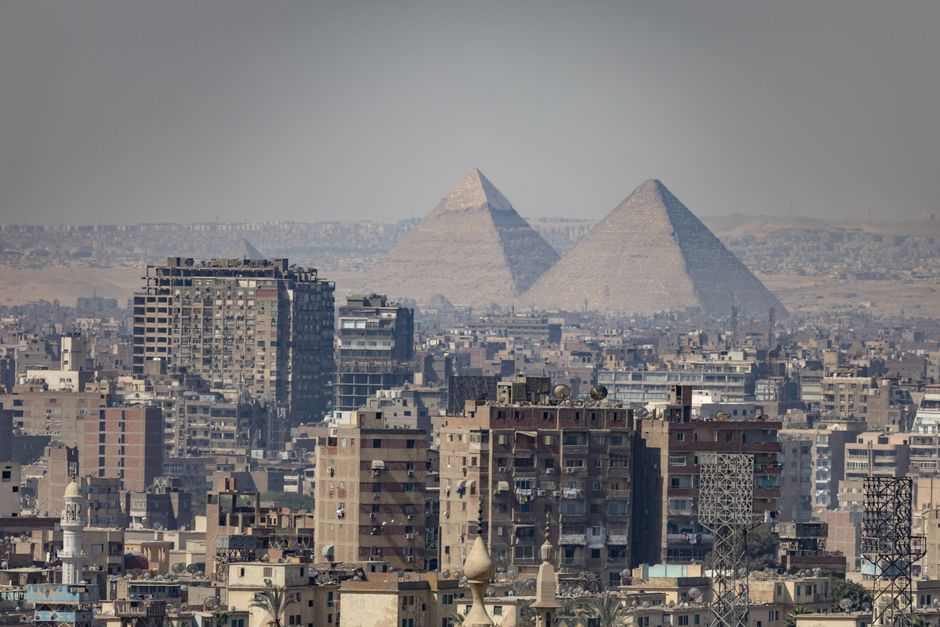
Giza, on the west bank of the Nile opposite Cairo, is a city of several million people in its own right, but for travelers it means one thing: the Pyramids of Giza, the only survivor of the Seven Wonders of the Ancient World. On a limestone plateau at the edge of the desert stand the Great Pyramid of Khufu, built around 2560 BC and for almost 4,000 years the tallest structure on Earth, the pyramids of Khafre and Menkaure, the smaller queens’ pyramids, rows of nobles’ tombs and the Great Sphinx. About 2 km (1.2 miles) away, the Grand Egyptian Museum (GEM), fully opened in late 2025, is the world’s largest museum devoted to a single civilization, with the complete treasures of Tutankhamun displayed together for the first time. The plateau itself has been transformed: visitors now enter through a new visitor center on the desert side and ride electric shuttles between the main viewpoints, and private cars and tour buses no longer drive among the monuments. South of Giza lie the older pyramid fields of Saqqara and Dahshur, and the ruins of Memphis. Give Giza at least a full day, ideally two, and sleep in a hotel with a pyramid view if you can. As everywhere in Egypt, start early, pay for tickets by card and keep a polite distance from the touts.
Right now in Giza
- Wed 19–31°C 66–87°F Clear
- Thu 19–31°C 67–88°F Clear
- Fri 21–31°C 70–87°F Clear
- Today Armed Forces Day (عيد القوات المسلحة)
Weather: MET Norway (CC BY 4.0) · Holidays: Nager.Date
Top tours in Giza
See all tours for Giza →
From local operators, with prices and reviews; you check availability and book on Viator, our partner. We may earn a commission at no extra cost to you. How we earn money
Giza at a glance
- Best for: the pyramids and the Sphinx, the Grand Egyptian Museum, Saqqara and Dahshur.
- How long: 1 day for the plateau and the museum at a rush; 2–3 days with Saqqara, Dahshur and Memphis.
- Best time: October to April; go at opening time in any season.
- Getting there: Sphinx International Airport (SPX) is about 30 minutes away; Cairo International (CAI) is 60–90 minutes; sleeper trains to Luxor and Aswan stop at Giza station.
- Getting around: by Uber, Careem or a hired driver; electric shuttles on the plateau.
- Good to know: buy Grand Egyptian Museum tickets online in advance, and bring a card for the plateau.
- Before you go: visas, money and general safety are in our Egypt travel guide; the rest of the capital is in our Cairo guide.
Giza’s areas and where to stay
Giza stretches from the Nile at the Giza metro station west along Pyramids Road (Al-Haram Street) for about 10 km (6 miles) to the plateau.
Nazlet el-Samman, by the Sphinx
The village at the foot of the plateau, facing the Sphinx, is packed with small hotels and guesthouses whose rooftop terraces look straight at the pyramids, especially beautiful at sunrise and during the evening sound and light show. It is noisy and the streets are full of horse and camel stables, but the views are unbeatable.
Around the Mena House and the old gate
The northern edge of the plateau, around the historic Mena House hotel, has large hotels with gardens and pyramid views, close to the old northern entrance.
Near the Grand Egyptian Museum
New hotels are opening along the Cairo–Alexandria desert road near the museum and around Remaya Square, convenient for the GEM and the airport.
Pyramids Road, Sheikh Zayed and 6th of October
Pyramids Road is a long, busy commercial avenue with mid-range hotels; the newer western suburbs of Sheikh Zayed and 6th of October have malls and business hotels near Sphinx International Airport.
Where to stay in Giza
- Nazlet el-Samman: rooftop pyramid views from budget and mid-range guesthouses.
- Mena House area: larger hotels with gardens and views.
- Near the GEM: new hotels for the museum and the airport.
- Central Cairo: for a longer stay, see our Cairo guide; the plateau is 45–90 minutes away by road.
Top things to see in Giza
The Giza Plateau
According to the Ministry of Tourism and Antiquities, the Giza Plateau opens daily at 7 a.m., with last entry at 4 p.m. The area ticket costs EGP 700 (about US$13) for foreign adults and EGP 350 for students, and covers the plateau, the Sphinx area and the outsides of the pyramids, but not the interiors of the pyramids or the special tombs, which need extra tickets. Tickets are sold online on the ministry’s site, in the Experience Egypt app and at the gate by card. Under the plateau’s redevelopment, the main entrance and visitor center are now on the desert side, off the Fayoum road, and electric shuttle buses with hop-on stops link the entrance, the Great Pyramid, the panorama point and the Sphinx; walking between them is possible but long in the heat. Allow at least three to four hours.
The Great Pyramid of Khufu
The largest pyramid, built for King Khufu of the 4th dynasty, was originally about 146 m (479 ft) high and is still about 138 m (453 ft), with some 2.3 million limestone blocks. A narrow passage climbs through the Grand Gallery to the bare granite King’s Chamber, with Khufu’s empty sarcophagus. It is hot, humid and steep, and not for the claustrophobic. The ministry’s page lists the interior ticket at EGP 1,000 for foreign adults, on top of the area ticket; numbers inside are limited, so buy early in the day.
Khafre, Menkaure and the queens’ pyramids
The Pyramid of Khafre, Khufu’s son, looks taller because it stands on higher ground and still has some of its original casing at the top; you can descend to its burial chamber on a separate ticket when it is open. The smaller Pyramid of Menkaure, with its partial granite casing, can also be entered (EGP 280 according to the ministry). Around them are queens’ pyramids and the mastaba tombs of officials; the painted Tomb of Queen Meresankh III (EGP 200) is one of the most colorful.
The Great Sphinx and the Valley Temple
The Great Sphinx, a lion with a king’s head carved from the bedrock, probably for Khafre, is about 73 m (240 ft) long and 20 m (66 ft) high. You view it from a terrace beside Khafre’s granite Valley Temple, where the king’s body was received after the journey across the Nile; the area is included in the plateau ticket.
The panorama point
The classic photo of all nine pyramids lined up is from the panorama point on the desert ridge southwest of the pyramids, a shuttle stop. Camel and horse owners wait here; if you want a ride, agree the full price, the duration and the route before you get on.
The Grand Egyptian Museum (GEM)
The GEM, at Remaya Square on the Cairo–Alexandria desert road, is a huge glass-and-stone building aligned with the pyramids. A colossal 11 m (36 ft) statue of Ramesses II greets you in the Grand Hall, and the Grand Staircase climbs past kings’ statues to a window framing the pyramids. The 12 main galleries tell Egypt’s story from prehistory to Roman times, and the Tutankhamun Galleries display more than 5,000 objects from the boy king’s tomb, from the gold mask and coffins to chariots, beds, jewelry and sandals. A separate building holds Khufu’s Boats, including the 4,500-year-old cedar barge found beside the Great Pyramid. According to the museum, tickets are sold only online, with a timed entry slot, on its official ticketing site; the ticket covers the Tutankhamun Galleries, the main galleries, the Grand Hall and Staircase, Khufu’s Boats Museum and the gardens. The galleries open daily from 9 a.m. to 6 p.m., and until 9 p.m. on Wednesdays and Saturdays, with last entry an hour before closing. Until October 31, 2026, a foreign adult ticket costs EGP 1,590 (about US$30); from November 1, 2026, the foreign price rises by US$5, to about US$35 charged in Egyptian pounds. Only phone photography is allowed in the Tutankhamun Galleries, and tripods, selfie sticks and drones are banned; large bags go to the free lockers. Allow at least three to four hours, and consider the official guided tour (about two hours) or the audio guide.
Saqqara
About 20 km (12 miles) south, Saqqara was the cemetery of ancient Memphis for 3,000 years. Its centerpiece, the Step Pyramid of Djoser, built around 2650 BC by the architect Imhotep, is the oldest monumental stone building in the world. Around it are Old Kingdom tombs with superb painted reliefs, such as those of Mereruka and of the “two brothers” Niankhkhnum and Khnumhotep, and the Serapeum, a gallery of vast granite coffins for the sacred Apis bulls. According to the ministry, the Saqqara ticket costs EGP 600 for foreign adults, with extra tickets for the inside of the Step Pyramid (EGP 150) and the Serapeum (EGP 180).
Dahshur and Memphis
At Dahshur, a few kilometers south (EGP 200), King Sneferu, Khufu’s father, experimented with the shape of pyramids: the Bent Pyramid, whose angle changes halfway up, and the Red Pyramid, the first true smooth-sided pyramid, which you can enter down a long, steep passage. The site is quiet compared with Giza. On the way, Memphis (EGP 200), Egypt’s first capital, has an open-air museum with a fallen colossus of Ramesses II and an alabaster sphinx.
Other things to do in Giza
Food and drink
Rooftop restaurants in Nazlet el-Samman serve grills, koshari, molokhia and mezze with pyramid views; the GEM has cafés and restaurants with terraces facing the pyramids; and Pyramids Road is lined with local grill houses, juice bars and bakeries. Alcohol is served in the larger hotels.
The sound and light show
Most evenings, a sound and light show projects the story of the pharaohs onto the pyramids and the Sphinx, with seating in front of the Sphinx in Nazlet el-Samman and shows in several languages. You can also watch it free from many hotel rooftops.
Riding and walking
Horse and camel rides around the desert edge of the plateau are popular at sunset; choose healthy animals, agree the price in advance, and wear long trousers. See our guide to city sightseeing.
Day trips from Giza
- Saqqara, Memphis and Dahshur: a full day with a driver, south of Giza.
- Central Cairo: the Egyptian Museum, the Citadel, Islamic and Coptic Cairo; see our Cairo guide.
- Fayoum and Wadi El Hitan: the lake, waterfalls and the fossil whales of the “Valley of the Whales”, about 2 hours southwest.
- Alexandria: about 3 hours by the desert road; see our Alexandria guide.
Nearby destinations
- Cairo7 km
- Alexandria185 km
Getting there and getting around
By air
Sphinx International Airport (SPX), about 30 km (19 miles) west of the pyramids, has domestic and international flights and is the closest airport. Cairo International (CAI) is about 40 km (25 miles) away across the city, 60–90 minutes by road.
By train
Giza station, next to the Giza metro station on Line 2, is a stop for the Abela sleeper trains to Luxor and Aswan; according to the operator’s October 2026 timetable, evening departures from Giza run from about 19:50 to 23:10, reaching Luxor early the next morning.
From Cairo
The cheapest way from central Cairo is metro Line 2 to Giza station and then an Uber or taxi along Pyramids Road (20–40 minutes). Most visitors take an Uber, Careem or a hired driver directly; the trip from Downtown or Zamalek takes 45–90 minutes depending on traffic. Tours from Cairo often combine Giza with the GEM or Saqqara.
On the plateau
Private cars and tour buses now stop at the visitor center, and electric shuttle buses run between the plateau’s stops. Wear good shoes: the ground is sandy and uneven.
When to go and how long to stay
Giza shares Cairo’s hot desert climate, but the open plateau has no shade, so the heat and the glare off the sand feel stronger. October to April is the best time, with sunny days around 20–30 °C (68–86 °F); winter mornings can be cool and occasionally hazy. From May to September, highs average 32–35 °C (90–95 °F); be at the gate at 7 a.m. and spend the afternoon in the air-conditioned GEM. Fridays and Egyptian holidays are busiest. The table uses the 1991–2020 climate normals for the Cairo airport station of the Egyptian Meteorological Authority (EMA), as published by the World Meteorological Organization (WMO): average daily highs and lows, total precipitation, and days with at least 1 mm of rain.
| Month | Average high / low | Rain (days with 1 mm or more) | What to expect |
|---|---|---|---|
| January | 19 °C (66 °F) / 10 °C (50 °F) | 5 mm (0.2 in), 1 day | Cool mornings, sunny days; busy |
| February | 21 °C (69 °F) / 11 °C (52 °F) | 4 mm (0.1 in), 2 days | Mild and sunny; good for photos |
| March | 24 °C (75 °F) / 13 °C (56 °F) | 6 mm (0.2 in), 1 day | Warm; occasional dust storms |
| April | 28 °C (83 °F) / 16 °C (61 °F) | 1 mm (under 0.1 in), 1 day | Warm; Easter crowds |
| May | 32 °C (90 °F) / 19 °C (67 °F) | under 1 mm, 1 day | Hot by midday |
| June | 35 °C (94 °F) / 22 °C (72 °F) | under 1 mm, 1 day | Hot; go at opening time |
| July | 35 °C (95 °F) / 24 °C (75 °F) | under 1 mm, 1 day | Hot; GEM in the afternoon |
| August | 35 °C (95 °F) / 24 °C (76 °F) | under 1 mm, 1 day | The hottest month |
| September | 33 °C (92 °F) / 23 °C (73 °F) | under 1 mm, 1 day | Hot; quieter |
| October | 30 °C (86 °F) / 20 °C (68 °F) | 1 mm (under 0.1 in), 0 days | Warm; season starts |
| November | 25 °C (77 °F) / 16 °C (60 °F) | 4 mm (0.2 in), 1 day | Excellent; clear days |
| December | 21 °C (69 °F) / 12 °C (53 °F) | 3 mm (0.1 in), 1 day | Mild; busy over the holidays |
Rain is rare, about 25 mm (1 in) a year, mostly in short winter showers.
One day in Giza
Be at the plateau at 7 a.m.: the Great Pyramid, the panorama point and the Sphinx by late morning; lunch with a view; the Grand Egyptian Museum in the afternoon; and the sound and light show or a rooftop dinner in the evening.
Two to three days
Spend a full day at the GEM, add Saqqara, Memphis and Dahshur on another day, and use the third to see more of the plateau’s tombs or the pyramids at sunrise.
What a trip to Giza costs
Prices are approximate, for October 2026, converted at about EGP 52.3 to the US dollar. Site tickets are the ministry’s foreign adult prices; the GEM price is the museum’s, checked from secondary sources.
| Item | Typical cost |
|---|---|
| Giza Plateau area ticket | EGP 700 (about US$13) |
| Inside the Great Pyramid | EGP 1,000 (about US$19) |
| Grand Egyptian Museum | EGP 1,590 (about US$30); about US$35 from Nov 1, 2026 |
| Saqqara ticket | EGP 600 (about US$11.50) |
| Dahshur ticket | EGP 200 (about US$3.80) |
| Uber from Zamalek to the plateau | EGP 200–400 (about US$3.80–7.65) |
| Driver for Saqqara and Dahshur, full day | EGP 1,500–3,000 (about US$29–57) |
| Pyramid-view guesthouse double, per night | EGP 2,000–5,000 (about US$38–96) |
Practical tips for Giza
- Book the GEM first: timed slots sell out on busy days, and there are no tickets at the door.
- Carry a card: plateau tickets are paid by card at the gate or bought online.
- Go at 7 a.m.: fewer crowds, softer light and cooler air.
- Decide on the interiors: the Great Pyramid costs more than the area ticket; Menkaure or the Red Pyramid at Dahshur are cheaper alternatives.
- Keep your ticket: it is checked at several points.
- Take water and a hat: there is little shade on the plateau.
Safety
The Giza Plateau is heavily policed, but it is also the place in Egypt where visitors meet the most touts. Men on camels and horses, “official” guides without badges, children selling postcards and photographers offering help with “perspective” pictures will approach you; a firm “la, shukran” and walking on usually works. If you accept a ride or a photo, agree the price, the currency and what is included before you start, and pay only at the end. Buy tickets only at the official counters or online, and ignore anyone who says the entrance has moved or is closed. The heat on the plateau is intense from May to September: carry water, wear a hat and sunscreen, and rest in the shade. The ground is uneven and the pyramid passages are steep, low and stuffy, so think twice if you have heart, breathing or mobility problems. Climbing the pyramids is forbidden. Road traffic on Pyramids Road is heavy; cross carefully. In an emergency, call 122 for the police, 123 for an ambulance and 126 for the tourist police, which has an office on the plateau.
What to pack for Giza
Sturdy, closed shoes for sand and steps, a wide-brimmed hat, sunglasses, sunscreen, a refillable water bottle, light clothes that cover shoulders and knees, a scarf against dust, a small bag that fits the GEM’s 40 × 40 cm (16 × 16 in) limit, and a phone with plenty of storage. See our hiking shoes and travel adapters guides.
Giza travel FAQ
How much is the ticket for the pyramids of Giza?
According to the Ministry of Tourism and Antiquities, the plateau area ticket costs EGP 700 (about US$13) for foreign adults and EGP 350 for students; going inside the Great Pyramid and some other monuments costs extra.
What time do the pyramids open?
The plateau opens daily at 7 a.m., with last entry at 4 p.m.; hours can be shorter during Ramadan.
Can you go inside the Great Pyramid?
Yes, with a separate ticket, listed by the ministry at EGP 1,000 for foreign adults. The passage is steep, narrow and hot.
Is the Grand Egyptian Museum fully open?
Yes. All galleries, including the Tutankhamun Galleries, are open daily from 9 a.m. to 6 p.m., and until 9 p.m. on Wednesdays and Saturdays.
Do I need to book the Grand Egyptian Museum in advance?
Yes. Tickets are sold only online on the museum’s official ticketing site, with a timed entry slot.
How far is the Grand Egyptian Museum from the pyramids?
About 2 km (1.2 miles), a few minutes by car; you can easily visit both on the same day.
Can I pay cash at the pyramids?
Plan to pay by card: the ministry sells tickets online, in its app and at the gate, accepting Visa and Mastercard.
Can I ride a camel at the pyramids?
Yes, at the edge of the plateau, but agree the price, the duration and the route before you mount, and pay at the end.
Is it better to stay in Giza or Cairo?
Stay in Giza for a night or two for the pyramids and the GEM, and in central Cairo for the museums, Islamic Cairo and restaurants.
How do I get to Saqqara and Dahshur?
By a hired driver or Uber from Giza, about 30–45 minutes to Saqqara and another 15–20 minutes to Dahshur; there is no practical public transport.
Sources and last review
Researched and last reviewed on 6 October 2026. Giza Plateau ticket prices, hours and what the area ticket excludes; interior tickets for the Great Pyramid, Menkaure and Meresankh III; Saqqara, the Step Pyramid interior, the Serapeum, Dahshur and Memphis tickets; and card payment: the Ministry of Tourism and Antiquities (egymonuments.com and egymonuments.gov.eg); Grand Egyptian Museum hours, online-only timed tickets, what the ticket covers, photography and bag rules: the Grand Egyptian Museum’s official sites; sleeper train times: Abela Trains; metro: Cairo Metro; climate normals: the Egyptian Meteorological Authority via the World Meteorological Organization’s 1991–2020 normals (Cairo airport station); the exchange rate: the Central Bank of Egypt. The GEM’s foreign ticket price, the new plateau entrance and shuttles, the sound and light show, pyramid dimensions, transport times and typical prices are general references or estimates, flagged for checking. Prices and rules change, so check locally before you go. For visas, money and general safety, see our Egypt travel guide.
Plan your trip
Partner links: TravelerCenter may earn a commission if you book, at no extra cost to you.
🇪🇬 Useful Arabic phrases for Giza
All 38 Arabic phrases: restaurant, hotel, emergencies, romance (printable) →