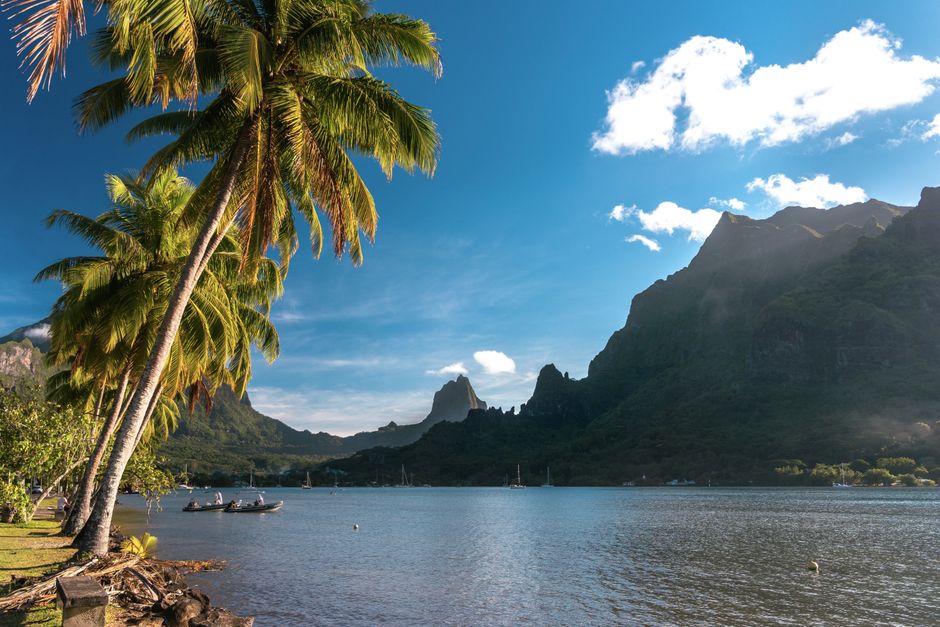
Moorea lies just 17 km (11 miles) across the Sea of the Moon from Tahiti, close enough that its jagged skyline dominates the view from Papeete. Up close, the island is even more dramatic: volcanic peaks and needles rise straight out of pineapple fields and rainforest, two deep bays, Cook’s Bay and Opunohu Bay, cut into the north coast, and a turquoise lagoon wraps the whole island, dotted with sandy motus. Moorea is the easiest outer island to reach, half an hour by fast ferry from Papeete, yet it feels relaxed and rural: one road loops the coast, villages keep their churches and fruit stands, and evenings are quiet. It suits every budget, from family guesthouses and campsites to resorts with overwater bungalows that cost far less than in Bora Bora. Days are spent snorkeling with rays and blacktip reef sharks, picnicking on a motu, hiking to mountain passes, driving up to the Belvedere lookout, visiting ancient marae in the Opunohu Valley and, from about August to October, watching humpback whales just outside the reef. The dry season from May to October is the best time to visit.
Right now in Moorea
- Tue 23–24°C 73–75°F Partly cloudy
- Wed 23–25°C 73–77°F Mostly clear
- Thu 23–26°C 74–78°F 2 mm Light showers
Weather: MET Norway (CC BY 4.0) · Sea temperature: NOAA CoastWatch
Top tours in Moorea
See all tours for Moorea →
From local operators, with prices and reviews; you check availability and book on Viator, our partner. We may earn a commission at no extra cost to you. How we earn money
Moorea at a glance
- Best months: May to October for drier weather; August to October for humpback whales. November to April is hotter and wetter.
- Getting there: fast ferries from Papeete to Vaiare several times a day, about 30 to 45 minutes; Aremiti’s tourist fare is 2,350 XPF (about US$22) one way.
- Where to stay: the northwest around Hauru Point for beaches and snorkeling; Cook’s Bay for restaurants and views; the east near Temae for the best white-sand beach; overwater bungalows at several resorts.
- Time needed: a day trip from Tahiti at minimum; three to five nights to relax and explore.
- Getting around: rental car, scooter or e-bike; the coast road is about 60 km (37 miles) around.
- Before you go: entry rules, ETIAS, money and Air Tahiti passes are covered in our French Polynesia travel guide.
Moorea’s areas and who each one suits
Vaiare and Temae (east)
Ferries arrive at Vaiare on the east coast. Just north, near the small airport, Temae Beach is Moorea’s best white-sand beach, with clear water over a wide lagoon; a resort with overwater bungalows sits nearby. Choose this area for quick ferry access and beach days.
Cook’s Bay and Maharepa (north)
Cook’s Bay (Paopao Bay) is the classic Moorea view, a deep bay framed by Mount Mouaroa, known as Bali Hai mountain, and Mount Rotui. The village of Paopao and nearby Maharepa have restaurants, shops, art galleries, a pharmacy and supermarkets. Stay here for convenience, dining and the views.
Opunohu Bay
West of Mount Rotui, Opunohu Bay is wilder and quieter, with no hotels on its shores. The valley behind it leads to the Belvedere lookout, pineapple plantations and archaeological sites. The public beach of Ta’ahiamanu at the mouth of the bay has calm, shallow water.
Haapiti and Hauru Point (northwest)
The northwest tip around Hauru Point and Tiahura has the island’s longest stretch of sandy beaches, several resorts and guesthouses, and the best snorkeling, with coral gardens and two motus just offshore. Sunsets face west toward the open ocean. This is the best base for water lovers.
The south and west coasts
The south coast around Afareaitu, Haumi and Maatea is the least developed part of the island, with villages, churches, waterfalls and a few guesthouses; the west coast at Haapiti has a surf break and a striking twin-towered church.
Top things to see on Moorea
The Belvedere lookout
A steep road climbs from the Opunohu Valley to the Belvedere, a lookout perched between the two bays with Mount Rotui rising between them. Arrive early in the morning for the clearest light and fewer tour buses. The road passes the island’s agricultural high school, which sells fruit, jams and ice cream made on its farm and has walking trails through its plantations.
The marae of the Opunohu Valley
On the way up to the Belvedere, the valley floor holds dozens of restored archaeological sites, including Marae Titiroa and Marae Ahu-o-Mahine, stone temple platforms and archery platforms where nobles once competed, in the shade of giant chestnut (mape) trees. Short trails link the sites; treat them with respect and don’t climb on the stones.
Stingrays and blacktip sharks
In the lagoon off Tiahura, boat tours stop at a shallow sandbank where friendly southern stingrays and blacktip reef sharks gather. You stand in waist-deep water as they glide around you. Choose operators who don’t encourage touching or riding the animals and who follow the lagoon management rules.
Motu picnics and lagoon tours
A half-day or full-day lagoon tour usually combines the stingrays, snorkeling at a coral garden and a picnic on a motu, with poisson cru, grilled fish and fruit served under the palms, often with a demonstration of how to open coconuts and tie a pareo.
Temae and Ta’ahiamanu beaches
Temae, near the airport, is the most beautiful public beach, with white sand and clear water over a reef; there are no facilities. Ta’ahiamanu, at the mouth of Opunohu Bay, is calm, shaded and popular with local families on weekends.
Magic Mountain
A short but steep drive or hike near Papetoai, Magic Mountain gives a panoramic view of the northwest lagoon, the motus and the reef. Access is through private land and may require a fee or a tour; check locally.
Other things to do on Moorea
- Hiking: the Three Coconuts Pass (Col des Trois Cocotiers) trail from the Belvedere climbs through forest to a ridge with views over both bays, about three hours round trip; Mount Rotui is a much harder ridge climb for experienced hikers with a guide; easier walks lead to the Afareaitu waterfalls.
- Whale watching: from about August to October, and sometimes from July to November, humpback whales calve and sing just outside the reef. Only licensed operators can take visitors out, and they follow strict approach distances and time limits.
- Snorkeling and diving: coral gardens off Hauru Point, and dive sites in the passes with lemon sharks, blacktips, turtles and rays.
- Kayaking and paddleboarding: paddle to the motus off Hauru Point or around the calm waters of the bays.
- 4×4 and quad tours: guided tours climb the Opunohu Valley, pineapple plantations and the Belvedere.
- Juice factory and distillery: taste fruit juices and spirits made from local pineapples and other fruit near Cook’s Bay.
- Polynesian dance shows: resorts host dinner shows with fire dancing and ori Tahiti.
Food and drink
Moorea has a good mix of beach snacks, roulotte food trucks, family-run Polynesian restaurants and French cuisine at the resorts. Try poisson cru, mahi-mahi with vanilla sauce, pineapple fresh from the fields and coconut bread from the village bakeries. Many restaurants around Cook’s Bay and Hauru Point offer free pickup from your hotel. Shop at the supermarkets in Maharepa and Haapiti if your guesthouse has a kitchen. Tipping is not expected.
Getting there and getting around
Ferries from Papeete
Fast ferries leave from the ferry terminal on Papeete’s waterfront for Vaiare several times a day, from early morning to early evening, and the crossing takes about 30 to 45 minutes.
- Aremiti (Aremiti 5 and Aremiti 6) carries passengers, cars and scooters. Tourist adult fares are 2,350 XPF one way and 4,700 XPF return; children under 12 pay 1,500 XPF, babies under 2 travel free, and a small car costs 5,440 XPF one way. Tickets are valid for 360 days.
- Terevau runs a fast, frequent service that is popular with commuters.
Buy tickets online or at the terminal. Book vehicle space ahead on Friday afternoons, Sunday evenings and holidays.
By air
Moorea has a small airport near Temae. Because the ferry is so quick, most visitors don’t fly, but Air Tahiti’s multi-island passes can include Moorea as a starting point.
Getting around the island
- Rental cars, scooters and e-bikes: available at Vaiare, in Maharepa and at Hauru Point; the coast road is about 60 km (37 miles) long and easy to drive in two hours without stops. Drive on the right.
- Buses: a limited public bus service meets some ferries and runs along the coast.
- Taxis: few and expensive; ask your hotel to book.
- Hotel transfers: many resorts and guesthouses pick guests up at the ferry.
When to go and how long to stay
Moorea’s climate is the same as Tahiti’s: warm all year, with highs of 29 to 32 °C (84 to 89 °F). The dry season (May to October) has more sunshine and cooler nights; the wet season (November to April) brings heavy showers, higher humidity and a risk of tropical cyclones. The mountains catch rain, so the southeast coast is wetter than the northwest.
| Month | Average high | Average low | Rain | Rain days (≥1 mm) |
|---|---|---|---|---|
| Jan | 31 °C (88 °F) | 24 °C (76 °F) | 268 mm (10.5 in) | 13 |
| Feb | 31 °C (88 °F) | 25 °C (76 °F) | 245 mm (9.6 in) | 12 |
| Mar | 32 °C (89 °F) | 25 °C (76 °F) | 167 mm (6.6 in) | 10 |
| Apr | 31 °C (88 °F) | 25 °C (76 °F) | 99 mm (3.9 in) | 8 |
| May | 30 °C (87 °F) | 24 °C (74 °F) | 104 mm (4.1 in) | 8 |
| Jun | 30 °C (85 °F) | 23 °C (73 °F) | 75 mm (2.9 in) | 5 |
| Jul | 29 °C (85 °F) | 22 °C (72 °F) | 44 mm (1.7 in) | 5 |
| Aug | 29 °C (84 °F) | 22 °C (71 °F) | 41 mm (1.6 in) | 5 |
| Sep | 29 °C (85 °F) | 22 °C (72 °F) | 50 mm (2.0 in) | 5 |
| Oct | 30 °C (85 °F) | 23 °C (73 °F) | 103 mm (4.0 in) | 7 |
| Nov | 30 °C (87 °F) | 24 °C (75 °F) | 105 mm (4.1 in) | 8 |
| Dec | 31 °C (87 °F) | 24 °C (76 °F) | 279 mm (11.0 in) | 14 |
| Year | 30 °C (87 °F) | 24 °C (74 °F) | 1,579 mm (62 in) | 98 |
Figures are Météo-France’s 1991–2020 normals for Faa’a on Tahiti, about 20 km (12 miles) east across the channel, as submitted to the World Meteorological Organization; Moorea’s own airport station has no published normals in the WMO collection. Temperatures are almost identical; rainfall on Moorea varies with exposure to the trade winds.
Events worth planning around
- Whale season (about August to October): book whale-watching trips ahead.
- Moorea Blue Marathon (usually February): a popular road race around part of the island.
- Heiva (July): dance and sports events also take place on Moorea, alongside the main festival in Papeete.
- French school holidays and Christmas: ferries and guesthouses fill with Tahiti residents on long weekends.
How long to stay: 1, 3 and 5 days
- Day trip from Tahiti: take an early ferry, rent a car, drive to the Belvedere and around the island, and swim at Temae before the evening ferry.
- Three nights: add a lagoon tour with the stingrays and a motu picnic, the Opunohu marae and a sunset at Hauru Point.
- Five nights: add the Three Coconuts Pass hike, a dive or whale-watching trip and a day of doing nothing in an overwater bungalow.
Where to stay on Moorea
- Overwater bungalows: several resorts around Hauru Point, Temae and Cook’s Bay have them, usually at much lower prices than in Bora Bora.
- Beach resorts and hotels: along the northwest and north coasts.
- Family guesthouses (pensions): all around the island, many with beachfront bungalows, kitchens and kayaks; the best value on Moorea.
- Holiday rentals and campsites: good for families and budget travelers, with a car.
Book ahead for July, August, whale season and holidays.
Typical costs on Moorea
| Item (as of October 2026) | CFP francs | About US dollars |
|---|---|---|
| Aremiti ferry, tourist adult one way / return | 2,350 XPF / 4,700 XPF | US$22 / US$44 |
| Aremiti ferry, child under 12 one way | 1,500 XPF | US$14 |
| Aremiti ferry, small car one way | 5,440 XPF | US$51 |
| Lagoon tour with stingrays and motu picnic | about 9,000–14,000 XPF | about US$85–130 |
| Whale-watching trip | about 10,000–15,000 XPF | about US$95–140 |
| Rental car, per day | about 8,000–12,000 XPF | about US$75–115 |
| Lunch at a beach snack or roulotte | about 1,500–2,500 XPF | about US$14–24 |
| Family guesthouse bungalow, per night | about 12,000–25,000 XPF | about US$115–235 |
| Overwater bungalow, per night | about 50,000–120,000 XPF | about US$470–1,130 |
Ferry fares are Aremiti’s published prices as of 19 July 2026. Other prices are typical ranges, not official figures. Conversions use the euro peg of 119.33 XPF to €1 and the European Central Bank’s euro–dollar rate of 2 October 2026, about US$9.40 per 1,000 XPF.
Safety on Moorea
- Cyclone season (November to April): follow Météo-France warnings; ferries stop in rough seas, and heavy rain can cause flash floods on trails.
- Currents: strong currents flow through the reef passes and around the motus; stay inside the lagoon, keep near your boat and don’t swim across boat channels.
- Boats: lagoon traffic is heavy around Hauru Point; use a snorkel buoy or swim in marked areas.
- Reef cuts and stonefish: wear reef shoes and don’t stand on coral.
- Marine life: don’t touch or feed the rays and sharks.
- Sun and heat: start hikes early, carry water and wear reef-safe sunscreen.
- Dengue: use repellent day and night.
- Roads: the coast road is narrow, with dogs, cyclists and pedestrians; take care on scooters.
- Emergencies: 15 for medical emergencies, 17 for police, 18 for fire; 112 from mobile phones. Moorea has a hospital at Afareaitu; serious cases go to Papeete.
Practical tips for Moorea
- Cash and cards: there are ATMs in Maharepa, Paopao and Haapiti and at the ferry terminal, but fruit stands, roadside snacks and some guesthouses take cash only.
- Groceries: supermarkets close early on Sunday, and many restaurants close one or two days a week; reserve dinner, especially if you need a pickup.
- Ferry timing: arrive at the terminal 30 minutes before departure with a car, and check the last ferry back to Papeete if you have an evening flight; leave a generous buffer, as sailings can be canceled in strong winds.
- Combining islands: Moorea pairs well with Bora Bora or Huahine on an Air Tahiti pass. Some passes start from Moorea, so you can take the ferry from Tahiti and fly onward from Moorea’s airport.
- Responsible lagoon use: don’t anchor or stand on coral, and avoid sunscreen with oxybenzone; Moorea’s lagoon is a managed marine area with zones where fishing is restricted.
- Language: French is used day to day; staff in hotels, tour companies and many restaurants speak English.
What to pack for Moorea
Swimwear, a rash vest, reef shoes, a mask and snorkel, hiking shoes for the trails, a light rain jacket, insect repellent, reef-safe sunscreen, a hat and sunglasses, a dry bag for lagoon tours, cash for fruit stands and small shops, and a Type E plug adapter.
Moorea travel FAQ
How do I get from Tahiti to Moorea?
By fast ferry from Papeete to Vaiare with Aremiti or Terevau, about 30 to 45 minutes. Aremiti’s tourist fare is 2,350 XPF one way and 4,700 XPF return.
Can I visit Moorea as a day trip from Tahiti?
Yes. Take an early ferry, rent a car or join a tour, and return on an evening ferry. Staying a few nights is much more relaxing.
Do I need a car on Moorea?
It is the easiest way to explore, as buses are limited. Scooters and e-bikes are alternatives; many guesthouses and restaurants offer pickups.
Where is the best beach on Moorea?
Temae Beach, near the airport, has the whitest sand and clearest water. Ta’ahiamanu, at Opunohu Bay, is calmer and shadier, and the Hauru Point area has the best snorkeling.
When can I see whales in Moorea?
From about August to October, sometimes from July to November. Only licensed operators can take visitors whale watching, and they follow strict rules.
Can you swim with stingrays in Moorea?
Yes. Lagoon tours stop at a sandbank off Tiahura where stingrays and blacktip reef sharks gather in shallow water. Don’t touch or feed them.
Is Moorea cheaper than Bora Bora?
Generally yes. Overwater bungalows, guesthouses and meals cost less on Moorea, and the ferry from Tahiti is much cheaper than a flight to Bora Bora.
How long should I stay on Moorea?
Three to five nights is ideal for lagoon tours, hiking, the Belvedere and beach time.
What is the best hike on Moorea?
The Three Coconuts Pass trail from the Belvedere, about three hours round trip, with views over Cook’s Bay and Opunohu Bay. Mount Rotui is much harder and best done with a guide.
When is the best time to visit Moorea?
May to October, the dry season. August to October adds whale season. November to April is hotter and wetter, with a cyclone risk.
Sources and last review
Researched and last reviewed on 5 October 2026. Ferry fares and conditions come from Aremiti; climate from Météo-France’s 1991–2020 normals for Faa’a, as published by the World Meteorological Organization; coordinates, area and population from Wikidata; the euro–dollar rate from the European Central Bank. Descriptions of Moorea’s bays, beaches, the Belvedere, marae, hikes, lagoon tours, whale season, events, the hospital and all tour, rental, meal and room prices are general references or estimates and should be checked locally. For entry rules, ETIAS, money and Air Tahiti passes, see our French Polynesia travel guide.
Plan your trip
Partner links: TravelerCenter may earn a commission if you book, at no extra cost to you.
🇫🇷 Useful French phrases for Moorea
All 38 French phrases: restaurant, hotel, emergencies, romance (printable) →