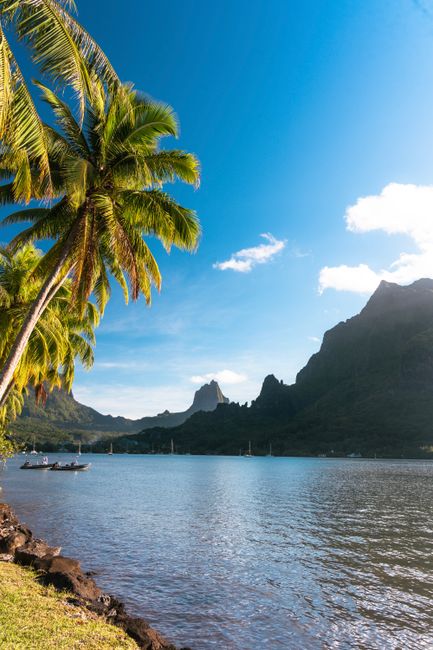
Tahiti is the largest island in French Polynesia and the place where nearly every trip begins. Shaped like a figure eight, it is made of two old volcanoes joined by a narrow isthmus: big, round Tahiti Nui and the smaller, wilder peninsula of Tahiti Iti. Its interior is a tangle of steep, jungle-covered ridges, waterfalls and valleys rising to Mount Orohena at 2,241 m (7,352 feet), while the coast is ringed by a road, villages, black-sand surf beaches and a lagoon protected by a reef. Most visitors know only Papeete, the capital, and the airport hotels before hopping on a ferry to Moorea or a flight to Bora Bora, but Tahiti deserves a few days of its own: the covered market and the waterfront food trucks of Papeete, the history of Matavai Bay, where Captain Cook observed the transit of Venus in 1769, the blowhole and waterfalls of the east coast, the Museum of Tahiti and Its Islands, 4×4 trips into the Papenoo Valley and, at the end of the road on Tahiti Iti, the legendary wave of Teahupo’o. The dry season from May to October is the most pleasant time to visit.
Right now in Tahiti
- Tue 14–19°C 58–66°F 16 mm Heavy rain
- Wed 14–21°C 57–69°F 2 mm Partly cloudy
- Thu 15–21°C 59–70°F 1 mm Cloudy
Weather: MET Norway (CC BY 4.0) · Sea temperature: NOAA CoastWatch
Top tours in Tahiti
See all tours for Tahiti →
From local operators, with prices and reviews; you check availability and book on Viator, our partner. We may earn a commission at no extra cost to you. How we earn money
Tahiti at a glance
- Best months: May to October for drier, sunnier weather; humpback whales from about August to October; Heiva festival in July. November to April is hotter and wetter.
- Where to stay: Papeete for city life and short stopovers; the west coast (Faa’a and Punaauia) for resorts and sunsets over Moorea; Tahiti Iti for guesthouses, surf and nature.
- Getting there: Faa’a International Airport (PPT) is 5 km (3 miles) from central Papeete; flights from Los Angeles take about eight hours.
- Time needed: one or two nights between flights; three or four days to see the island properly.
- Costs (as of October 2026): the Aremiti ferry to Moorea costs 2,350 XPF (about US$22) one way for tourists; 1,000 XPF = about US$9.40.
- Before you go: entry rules, ETIAS, money and Air Tahiti passes are covered in our French Polynesia travel guide.
Tahiti’s areas and who each one suits
Papeete
The capital is a busy port town of about 26,000 people, with traffic, shops, government buildings and a lively waterfront. It is not a beach destination, but it is the island’s cultural and culinary center, the hub for ferries to Moorea and the best place to experience everyday Polynesian life. Stay here for a night of market browsing, waterfront dining and easy ferry access.
The west coast: Faa’a, Punaauia and Paea
South of the airport, the sheltered west coast has Tahiti’s main resorts, several with overwater bungalows facing Moorea, white-sand beaches built or improved by the hotels, and good snorkeling over the lagoon, for example at the public beach at PK 18 in Punaauia. It has the island’s best sunsets and is convenient for the airport.
The north and east coasts
East of Papeete, the coast road passes Point Venus at Matavai Bay, the surf beaches of Papenoo, the Arahoho blowhole and the Faarumai waterfalls. This windward side is greener, wetter and more rural, with black-sand beaches and big waves.
Tahiti Iti
Across the isthmus at Taravao, the peninsula of Tahiti Iti is quieter and more traditional. The road ends at the surf village of Teahupo’o on the south side and at Tautira on the north, with the untouched cliffs and valleys of the Te Pari coast between them, reachable only by boat or on foot. Family guesthouses, surf camps and small restaurants make it a good place to slow down.
Top things to see on Tahiti
Papeete Market
The Marché de Papeete, a covered market in the heart of the city, is the place for tropical fruit, fresh fish, flowers, vanilla, monoï oil, pareos, hats woven from pandanus and black pearls. Go early in the morning, especially on Sunday, when the market is at its busiest, with families shopping for the traditional Sunday meal; the upstairs galleries sell crafts and souvenirs.
The roulottes and the waterfront
In the evening, food trucks called roulottes set up on Place Vai’ete on the waterfront, serving poisson cru, chow mein, crêpes, grilled fish and steak frites at picnic tables. It is a cheap and cheerful dinner with locals and sailors. The waterfront park nearby, Paofai Gardens, is a good place to watch outrigger canoe crews training at sunset.
Point Venus and Matavai Bay
On a black-sand point northeast of Papeete, a lighthouse and monuments mark the spot where Captain James Cook set up his observatory to observe the transit of Venus in 1769, and where the first missionaries of the London Missionary Society landed in 1797. The beach is popular for picnics, and the view back across the bay to the mountains is superb.
The Arahoho blowhole and Faarumai waterfalls
On the east coast, waves force water up through a lava tube at the Arahoho blowhole, next to the road; keep clear of the rocks, as the jet can be powerful. A little farther on, a short path through the forest leads to the three Faarumai waterfalls, the tallest dropping about 80 m (260 feet) into a pool.
Museum of Tahiti and Its Islands
In Punaauia, on the west coast, the Musée de Tahiti et des Îles (Te Fare Iamanaha) is French Polynesia’s main museum, with galleries on the islands’ geology, natural history, Polynesian navigation, tapa, tiki and contact with Europeans, reopened after a major renovation.
Teahupo’o
At the end of the road on Tahiti Iti, Teahupo’o is one of the heaviest waves in the world, breaking over a shallow reef just offshore, and it hosted the surfing competition of the Paris 2024 Olympic Games. From the village, boats take spectators out to watch from the channel on big days. Even when the wave is small, the drive and the scenery of Tahiti Iti are worth it.
The Papenoo Valley and the interior
The Papenoo River cuts the island’s largest valley, a deep green caldera of waterfalls, ferns and archaeological sites. Guided 4×4 tours drive up the valley to Lake Vaihiria and the marae in the interior; it is not a road for ordinary rental cars. Hikers can tackle the Fautaua Valley trail to a tall waterfall above Papeete; check access rules, as permission is usually needed.
Marae Arahurahu and the Grotto of Maraa
On the west coast at Paea, the restored Marae Arahurahu is a stone temple platform in a peaceful valley, used for reenactments during the Heiva. Nearby, the Grottoes of Maraa are fern-draped caves with freshwater pools beside the road.
Other things to do on Tahiti
- Snorkeling and diving: the lagoon off Punaauia has coral gardens, a sunken Catalina seaplane and a shipwreck dive site; dive centers also visit outer reef walls where sharks and turtles are common.
- Whale watching: from about August to October, humpback whales come close to Tahiti’s reef; licensed operators follow strict approach rules.
- Surfing: beginner schools at Papenoo and Taharuu; experts head for Teahupo’o and Papara.
- Hiking: guided treks to waterfalls, the Fautaua valley and, for the very fit, Mount Aorai.
- Black pearls: shops and the pearl museum in Papeete explain how Tahitian pearls are farmed and graded.
- Heiva i Tahiti (July): dance, song and traditional sports competitions in Papeete.
Food and drink
Tahiti has the widest choice of restaurants in French Polynesia, from French bistros and Chinese-Tahitian canteens to sushi and fine dining. Try poisson cru, ma’a Tahiti cooked in an underground oven (often on Sundays), firi firi (coconut doughnuts) for breakfast, fresh baguettes and coconut bread from bakeries, and fruit from the market. Hinano is the local beer. Prices are high, so mix restaurants with roulottes and snack bars.
Getting there and getting around
By air
Faa’a International Airport (PPT) is French Polynesia’s international gateway, with flights from Los Angeles, San Francisco, Seattle, Paris, Tokyo, Auckland and other cities. Domestic Air Tahiti flights to Moorea, Bora Bora and other islands leave from the same airport. Many international flights land late at night or very early in the morning, so book a hotel near the airport or in Papeete.
By ferry to Moorea
Ferries to Moorea leave from the ferry terminal on Papeete’s waterfront several times a day. Aremiti carries passengers and cars, with a tourist fare of 2,350 XPF one way and 4,700 XPF return; Terevau runs a fast passenger service. The crossing takes about 30 to 45 minutes. See our Moorea guide.
Getting around the island
- Rental car: the best way to see the island. The coast road around Tahiti Nui is about 115 km (70 miles); drive on the right, and watch for traffic jams around Papeete at rush hour.
- Buses: public buses run along the coast from Papeete, but services are limited in the evening and on Sundays.
- Taxis: available at the airport and in Papeete, but expensive; fares rise at night.
- Tours: 4×4 safari tours to the Papenoo Valley, circle-island tours and boat trips to Te Pari and Teahupo’o.
When to go and how long to stay
Tahiti is warm all year, with highs of 29 to 32 °C (84 to 89 °F). The dry season (May to October) is sunnier, less humid and cooler at night, around 22 °C (71 to 72 °F) in July and August. The wet season (November to April) brings heavy showers and thunderstorms, especially from December to February, and the possibility of tropical cyclones. The mountains and the windward east coast are much wetter than the west.
| Month | Average high | Average low | Rain | Rain days (≥1 mm) |
|---|---|---|---|---|
| Jan | 31 °C (88 °F) | 24 °C (76 °F) | 268 mm (10.5 in) | 13 |
| Feb | 31 °C (88 °F) | 25 °C (76 °F) | 245 mm (9.6 in) | 12 |
| Mar | 32 °C (89 °F) | 25 °C (76 °F) | 167 mm (6.6 in) | 10 |
| Apr | 31 °C (88 °F) | 25 °C (76 °F) | 99 mm (3.9 in) | 8 |
| May | 30 °C (87 °F) | 24 °C (74 °F) | 104 mm (4.1 in) | 8 |
| Jun | 30 °C (85 °F) | 23 °C (73 °F) | 75 mm (2.9 in) | 5 |
| Jul | 29 °C (85 °F) | 22 °C (72 °F) | 44 mm (1.7 in) | 5 |
| Aug | 29 °C (84 °F) | 22 °C (71 °F) | 41 mm (1.6 in) | 5 |
| Sep | 29 °C (85 °F) | 22 °C (72 °F) | 50 mm (2.0 in) | 5 |
| Oct | 30 °C (85 °F) | 23 °C (73 °F) | 103 mm (4.0 in) | 7 |
| Nov | 30 °C (87 °F) | 24 °C (75 °F) | 105 mm (4.1 in) | 8 |
| Dec | 31 °C (87 °F) | 24 °C (76 °F) | 279 mm (11.0 in) | 14 |
| Year | 30 °C (87 °F) | 24 °C (74 °F) | 1,579 mm (62 in) | 98 |
Figures are Météo-France’s 1991–2020 normals for Faa’a, at the international airport on the west coast, as submitted to the World Meteorological Organization; Faa’a gets about 2,660 hours of sunshine a year. On Tahiti Iti, the Taiarapu station records about 3,230 mm (127 in) of rain a year, more than twice as much.
Events worth planning around
- Heiva i Tahiti (July): French Polynesia’s biggest cultural festival.
- Tahiti Pearl Regatta (usually May): a sailing regatta in the Leeward Islands, with events in Raiatea and Taha’a.
- Surf contests at Teahupo’o: usually between May and October, when the biggest swells arrive.
- Hawaiki Nui Va’a (October or November): the great outrigger canoe race through the Leeward Islands, followed closely in Tahiti.
How long to stay: 1, 2 and 4 days
- One day: Papeete Market in the morning, the Museum of Tahiti and Its Islands and the west-coast beaches, and dinner at the roulottes.
- Two days: add a circle-island drive with Point Venus, the Arahoho blowhole, the Faarumai waterfalls and the gardens and grottoes of the south coast.
- Four days: add a 4×4 tour of the Papenoo Valley, a day on Tahiti Iti with a boat trip to Teahupo’o or Te Pari, and a dive or whale-watching trip in season.
Where to stay on Tahiti
- West coast resorts: large hotels with pools, overwater bungalows and views of Moorea, five to twenty minutes from the airport.
- Papeete hotels: business and mid-range hotels close to the market, waterfront and ferry terminal.
- Family guesthouses (pensions): on both coasts and especially on Tahiti Iti, with simple rooms or bungalows and often breakfast.
- Surf camps: around Teahupo’o and on the south coast.
Typical costs on Tahiti
| Item (as of October 2026) | CFP francs | About US dollars |
|---|---|---|
| Aremiti ferry to Moorea, tourist adult one way / return | 2,350 XPF / 4,700 XPF | US$22 / US$44 |
| Meal at a roulotte | about 1,500–2,500 XPF | about US$14–24 |
| Coffee and pastry in a café | about 700–1,200 XPF | about US$7–11 |
| Taxi, airport to Papeete | about 2,000–3,500 XPF | about US$19–33 |
| Rental car, per day | about 8,000–12,000 XPF | about US$75–115 |
| Papenoo Valley 4×4 half-day tour | about 9,000–15,000 XPF | about US$85–140 |
| Family guesthouse room, per night | about 10,000–20,000 XPF | about US$95–190 |
| Resort room on the west coast, per night | about 30,000–70,000 XPF | about US$280–660 |
The ferry fare is Aremiti’s published price as of 19 July 2026. Other prices are typical ranges, not official figures. Conversions use the euro peg of 119.33 XPF to €1 and the European Central Bank’s euro–dollar rate of 2 October 2026, about US$9.40 per 1,000 XPF.
Safety on Tahiti
- Cyclone season (November to April): follow Météo-France warnings; heavy rain can also cause flash floods and landslides in the valleys, so don’t hike or cross rivers after downpours.
- Surf and currents: the black-sand beaches of the north and east coasts have powerful waves and rip currents; swim only where locals do and in calm conditions. Teahupo’o is for expert surfers only.
- Reef cuts: wear reef shoes in the lagoon and treat coral cuts promptly.
- Sun: UV is extreme; use reef-safe sunscreen, a hat and a rash vest.
- Dengue: mosquito-borne dengue circulates in French Polynesia; use repellent.
- Roads: traffic around Papeete is heavy, and scooters are vulnerable; drive carefully, especially in rain and at night.
- Theft: don’t leave valuables in cars at beaches, viewpoints and trailheads.
- Emergencies: 15 for medical emergencies, 17 for police, 18 for fire; 112 from mobile phones.
Practical tips for Tahiti
- Opening hours: many shops close at lunchtime and on Sunday afternoons; the market is busiest early on Sunday.
- Cash and cards: ATMs are plentiful in Papeete and at the airport.
- Language: French is the main language; English is spoken in hotels and tourist businesses.
- Arrivals at night: pre-book your hotel and transfer if your flight lands after dark.
What to pack for Tahiti
Light clothes, swimwear and a rash vest, reef shoes, hiking shoes for waterfall walks, a light rain jacket, insect repellent, reef-safe sunscreen, a hat and sunglasses, a dry bag for boat trips and a Type E plug adapter. A smart-casual outfit is useful for restaurants in Papeete and at the resorts.
Tahiti travel FAQ
Is Tahiti worth visiting or should I go straight to the other islands?
Spend at least a day or two. Papeete’s market and roulottes, the east-coast waterfalls and blowhole, the museum and Tahiti Iti are very different from the resort islands, and a night on Tahiti makes international connections easier.
How far is the airport from Papeete?
About 5 km (3 miles), 10 to 20 minutes by car depending on traffic.
Does Tahiti have good beaches?
Tahiti’s beaches are mostly black sand, with surf on the north and east coasts. The west coast has calmer lagoon beaches and snorkeling, such as the public beach at PK 18 in Punaauia; for classic white sand, head to Moorea or Bora Bora.
Can you drive around Tahiti in a day?
Yes. The coast road around Tahiti Nui is about 115 km (70 miles); allow a full day with stops, and more if you also explore Tahiti Iti.
How do I get from Tahiti to Moorea?
By fast ferry from Papeete to Vaiare, about 30 to 45 minutes, with Aremiti or Terevau.
Where can I see Teahupo’o?
Drive to the end of the road on Tahiti Iti, about 1.5 hours from Papeete, and take a boat from the village to watch from the channel when the swell is up, usually between May and October.
When is the best time to visit Tahiti?
May to October, the dry season, with less rain and humidity. July brings the Heiva festival, and humpback whales are around from about August to October.
Is there public transport on Tahiti?
Yes, buses run along the coast roads from Papeete, but they are infrequent in the evening and on Sundays. A rental car is easier for exploring.
Is Tahiti expensive?
Yes, like all of French Polynesia. Eat at roulottes and snack bars, stay in family guesthouses and shop at the market to save money.
Is Tahiti safe?
Generally yes. Watch for strong surf and rip currents, flash floods in the valleys after heavy rain, mosquitoes and petty theft from cars.
Sources and last review
Researched and last reviewed on 5 October 2026. Ferry fares come from Aremiti; climate from Météo-France’s 1991–2020 normals for Faa’a and Taiarapu, as published by the World Meteorological Organization; coordinates, area and population from Wikidata; the euro–dollar rate from the European Central Bank. Descriptions of Papeete, the market, roulottes, Point Venus, the east-coast sights, the museum, Teahupo’o, the Papenoo Valley and Paea, distances, drive times, event dates and all taxi, rental, tour, meal and room prices are general references or estimates and should be checked locally. For entry rules, ETIAS, money and Air Tahiti passes, see our French Polynesia travel guide.
Plan your trip
Partner links: TravelerCenter may earn a commission if you book, at no extra cost to you.
🇫🇷 Useful French phrases for Tahiti
All 38 French phrases: restaurant, hotel, emergencies, romance (printable) →