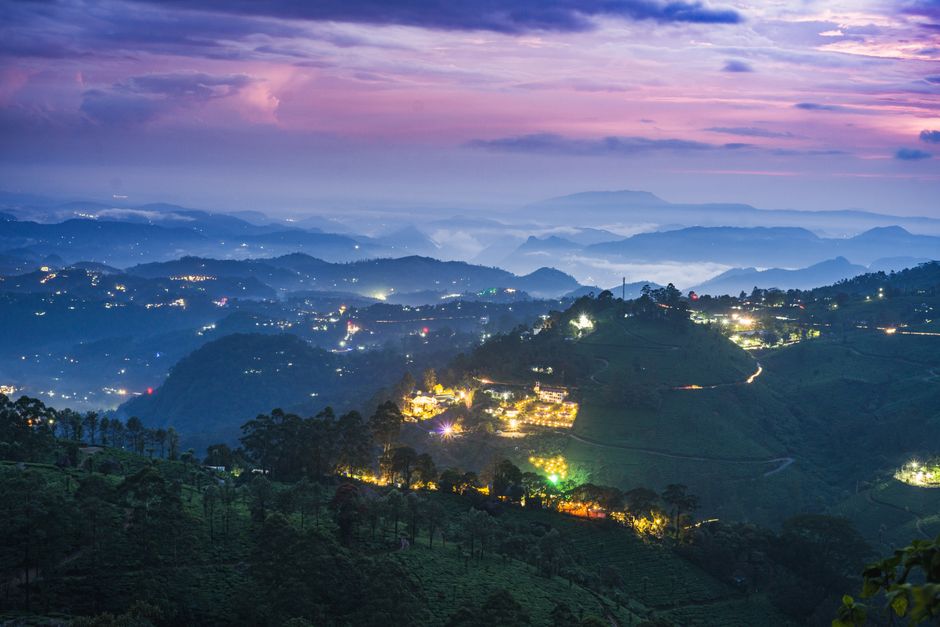
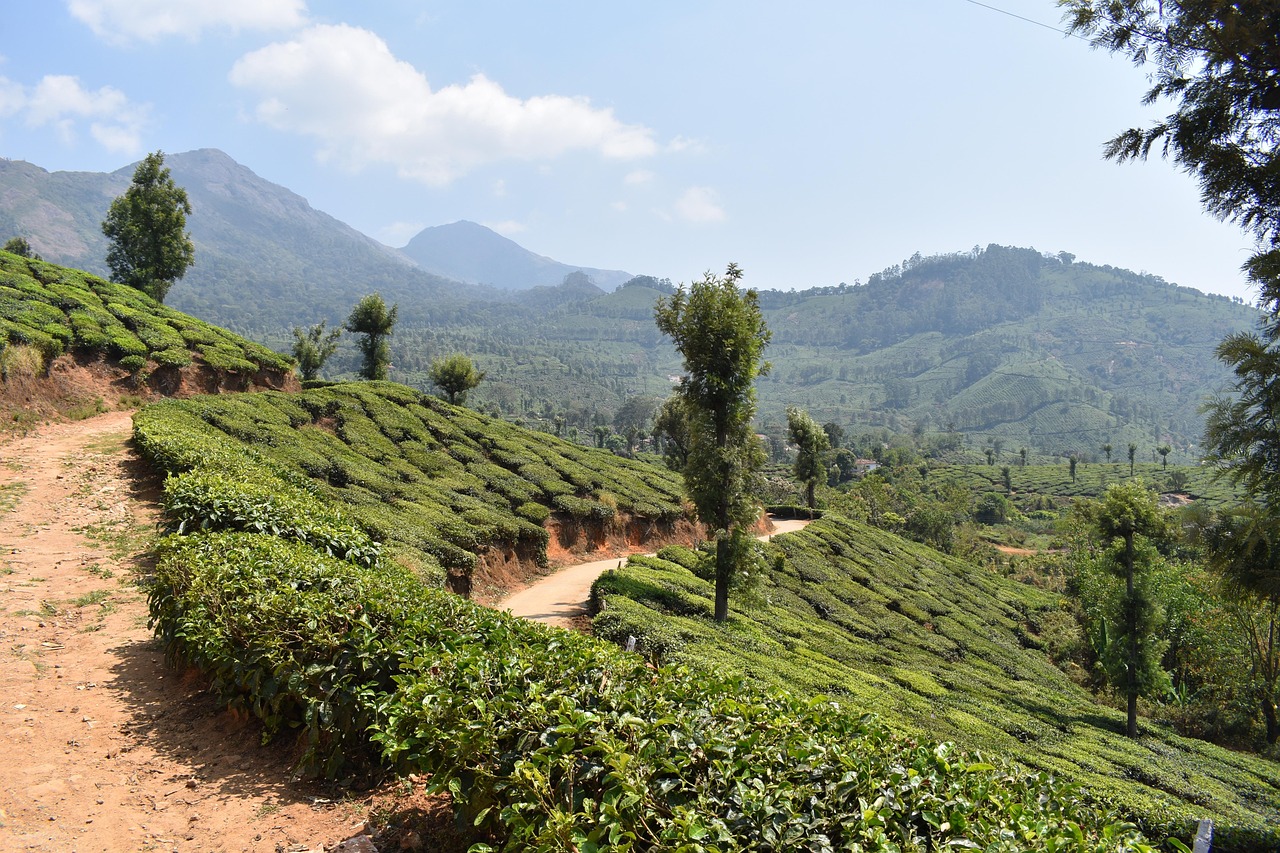
Munnar sits at about 1,600 m (5,200 ft) in the Western Ghats of Kerala, where three mountain streams meet, surrounded by an endless rolling carpet of tea bushes clipped into neat green waves over the hills. Originally home to Indigenous communities such as the Muthuvans, the high ranges of the Idukki district attracted British planters in the late 19th century, who cleared forest for tea, and Munnar grew into a company town for the estates, which still produce some of India’s best-known teas. Today it is Kerala’s most popular hill station, a cool escape from the coast with misty mornings, waterfalls, lakes and viewpoints, spice gardens and some of the highest tea plantations in the world. Just north of town, Eravikulam National Park protects the endangered Nilgiri tahr, a sure-footed mountain goat, on the slopes of Anamudi, the highest peak in South India, and once every 12 years the grasslands turn blue with the flowering of neelakurinji. Munnar is about 3½ to 4 hours by road from Kochi. The best time to visit is from September to May, though Eravikulam closes for the tahr calving season in February and March; the southwest monsoon, from June to August, brings very heavy rain.
Right now in Munnar
- Wed 16–24°C 60–76°F 3 mm Showers
- Thu 16–23°C 60–73°F 31 mm Heavy rain
- Fri 16–23°C 60–73°F 29 mm Heavy rain
Weather: MET Norway (CC BY 4.0)
Top tours in Munnar
See all tours for Munnar →
From local operators, with prices and reviews; you check availability and book on Viator, our partner. We may earn a commission at no extra cost to you. How we earn money
Munnar at a glance
- Best for: tea plantations and factory tours, Eravikulam National Park and the Nilgiri tahr, mountain viewpoints, waterfalls, walks and treks, and a cool climate.
- How long: 2 to 3 days; 4 with Marayoor, Chinnar or Kolukkumalai.
- Best time: September to May; avoid February and March if Eravikulam is your priority, as it closes for the calving season.
- Getting there: Cochin International Airport, about 110 km (70 miles) and 3½ to 4 hours by road; buses from Kochi, Alappuzha and Madurai.
- Getting around: by hired car or jeep with driver, auto-rickshaw in town, and the park’s own buses within Eravikulam.
- Good to know: Cochin is a designated e-Visa entry airport, and Eravikulam tickets can be booked online, though foreign card payments may not work on the park’s site.
- Before you go: the e-Visa, the online e-Arrival card, money, trains and general safety are in our India travel guide.
Munnar’s hills: where things are
Munnar is less a town than a cluster of small settlements, tea factories and estates spread across the hills, linked by winding roads.
Munnar town
The small, busy town center, at the confluence of the Muthirappuzha, Nallathanni and Kundala streams, has the bus stand, market, banks, simple restaurants and budget hotels. It is practical rather than pretty, and most visitors stay outside it.
Old Munnar and the Eravikulam road
Just south and north of the center, Old Munnar and the road toward Eravikulam have mid-range hotels, homestays and the Tata Tea Museum, with easy access to the national park.
Chithirapuram, Pallivasal and Anachal
South of town, on the roads down toward Kochi and Thekkady, resorts, spice-garden homestays and boutique hotels sit on valley slopes with views over the tea estates and the Pallivasal hydroelectric project, Kerala’s first.
Mattupetty, Kundala and Top Station
Northeast of town, the road to Top Station passes Mattupetty dam, Echo Point and Kundala lake, with a few lodges and campsites in quieter, higher country.
Chinnakanal and Suryanelli
East of Munnar, the area around Chinnakanal and Suryanelli, with the Anayirangal reservoir, has resorts, tents and homestays and is the base for the Kolukkumalai tea estate.
Top things to do in Munnar
Eravikulam National Park
Kerala’s first national park, established in 1978, Eravikulam covers about 97 sq km (37 sq miles) of rolling grassland and shola forest on the high plateau north of Munnar, and was created to protect the endangered Nilgiri tahr. According to Incredible India, the park is divided into a core area, a buffer area and a tourism area, and visitors may only enter the tourism zone at Rajamala, about 13 km (8 miles) from Munnar. Visitors buy tickets, then ride the park’s buses up through the tea estate to a walking trail along the slopes, where tahr often graze close to the path, with views over the hills and toward Anamudi.
According to the park’s official booking site, run by the Anaimudi Forest Development Agency, entry is from 8 a.m. to 2 p.m., and fees are ₹200 for Indian adults and ₹500 for foreign nationals, plus ₹50 for a camera and ₹350 for a video camera, with a ₹50 reservation fee. Tickets can be booked online at the park’s website, and the reservation counter at the information center in Munnar is open from 9 a.m. to 3 p.m.; the site notes that its international payment gateway is not working, and asks foreign visitors to contact the park by email for online booking. Arrive early: daily numbers are limited and queues are long on weekends and holidays.
The calving season closure
Eravikulam closes every year for the Nilgiri tahr calving season. The Munnar Wildlife Division announced closures from 1 February to 31 March in 2023, 2024 and 2025, and the park’s booking site says it would be closed from February 1 to April 1 to ensure a safe calving season. Plan to visit outside February and March, and check the dates for the year before traveling.
Tea estates and the Tea Museum
Tea is everywhere in Munnar, and the estates date back to the late 19th century. The Tata Tea Museum (Kannan Devan Hills tea museum), near town, shows antique processing machinery, old photographs of the planters’ era and a working demonstration of how leaves become black tea, followed by tastings. Walk through the estates on the quiet back roads, or stay on an estate to watch the pickers at work. Tea tours at Kolukkumalai, one of the highest tea plantations in the world, are reached by jeep from Suryanelli and are famous for sunrise views; some bushes there are more than a century old.
Anamudi and the neelakurinji
Anamudi, at about 2,695 m (8,842 ft), is the highest peak in South India, rising inside Eravikulam National Park. Climbing it requires permission from the forest department and is not open to casual visitors. The park’s slopes are also famous for neelakurinji (Strobilanthes kunthiana), a shrub that flowers only once every 12 years, turning hillsides purple-blue; the last mass flowering around Munnar was in 2018, so the next is expected around 2030.
Mattupetty, Echo Point and Top Station
The scenic road northeast of Munnar passes Mattupetty dam and its lake, with boating, the Echo Point lakeshore, where voices bounce back from the hills, and Kundala lake, with pedal boats and shikaras. At the end of the road, about 32 km (20 miles) from Munnar, Top Station, at the edge of the Kerala–Tamil Nadu border, has dramatic views down to the plains when the mist clears. Wild elephants are sometimes seen near Mattupetty and Kundala.
Waterfalls and viewpoints
Attukal and Lakkam waterfalls are at their best after the monsoon, and the Chinnakanal falls, also called Power House waterfalls, cascade beside the road toward Thekkady. Viewpoints such as Lockhart Gap and Pothamedu look over terraced estates and valleys. Thommankuthu, a series of falls in forest, lies farther away on the road down toward the plains.
More classic sights
- Mount Carmel Church: the first Catholic church in the high ranges, in town.
- CSI Christ Church: a stone church from the planters’ era, with old graves.
- Blossom International Park: a hydel park with flower gardens and walks along the river.
- Pampadum Shola National Park: a small national park of montane shola forest on the road to Kodaikanal.
- Spice gardens: cardamom, pepper and coffee plantations on the lower slopes, with guided walks.
Other things to do in Munnar
Walks and treks
Munnar is a lovely place to walk: along estate roads, through cardamom forest, and up to viewpoints. The forest department runs guided programs such as the Tree Fern Trail in Anamudi Shola National Park, a two-hour walk that, according to the Munnar Wildlife Division, costs ₹300 for Indians and ₹700 for foreigners and starts every morning at 8 a.m. from the forest station at Kanthalloor Perumala. Longer treks to Meesapulimala, among the highest peaks of the Western Ghats, are organized through the Kerala Forest Development Corporation. Book treks with licensed guides; do not enter forests without permission. See our hiking guide.
Food and drink
Munnar’s restaurants serve Kerala staples such as appam with vegetable stew, puttu with chickpea curry, Kerala parotta with beef or chicken fry, and meen curry (fish curry), along with Tamil-style meals on banana leaves and North Indian dishes for visitors. Don’t miss fresh tea and coffee, local cardamom and spices, and homemade chocolate, a Munnar specialty sold in shops all over town. Drink bottled or filtered water.
Shopping
Buy tea at the tea museum or estate outlets, spices from cooperatives and spice gardens, and homemade chocolates and essential oils, such as eucalyptus and lemongrass, from the town’s shops.
Wildlife and birdwatching
Beyond the tahr, the hills are home to elephants, gaur (Indian bison), Nilgiri langurs and many endemic birds, such as the Nilgiri pipit and the black-and-orange flycatcher. The best birding is in the shola forests and grasslands early in the morning.
Day trips from Munnar
- Marayoor: sandalwood forests, ancient dolmens and jaggery-making villages in a drier rain-shadow valley, about 40 km (25 miles) north.
- Chinnar Wildlife Sanctuary: dry forest and scrub on the Tamil Nadu border, beyond Marayoor, with treks and a chance of seeing the grizzled giant squirrel.
- Kolukkumalai: sunrise over the tea estate and the plains, by jeep from Suryanelli, about 35 km (22 miles) east.
- Thekkady (Periyar): the Periyar Tiger Reserve, spice gardens and boat rides on the Periyar lake, about 90 km (56 miles) and 3 hours south.
- Alappuzha: the backwaters and houseboats, about 5 hours away; many travelers combine the two. See our Alappuzha travel guide.
Nearby destinations
- Kochi86 km
- Alappuzha (Kerala Backwaters)103 km
- Mysuru251 km
Getting there and getting around
By air
Cochin International Airport (COK), a designated e-Visa entry airport, is the nearest major airport, about 110 km (70 miles) and 3½ to 4 hours by road from Munnar. Taxis can be booked at the airport. Coimbatore and Madurai airports, in Tamil Nadu, are farther away. See our Kochi travel guide.
By train
There is no railway to Munnar. The nearest stations are Aluva, about 110 km (70 miles) away, and Ernakulam in Kochi, both on the main line along the Kerala coast; continue by taxi or bus.
By road
Munnar is reached from Kochi on the road through Kothamangalam and Adimali, climbing through forest and spice gardens with waterfalls at Cheeyappara and Valara. Kerala state buses (KSRTC) and private buses run from Kochi, Aluva, Kottayam and Thekkady, and from Madurai and Coimbatore in Tamil Nadu. Many travelers combine Munnar with Kochi, Thekkady and Alappuzha on a hired-car tour of Kerala.
Around Munnar
Distances between sights are long and roads are winding, so most visitors hire a car or jeep with a driver for the day. Auto-rickshaws cover short trips in town. Within Eravikulam, only the park’s buses run beyond the entry point.
When to go and how long to stay
Munnar has a cool, wet mountain climate. September to November is green and fresh, with some northeast-monsoon showers in October and November. December to February is the driest, clearest time, with cold, sometimes frosty nights. March to May is warm and pleasant during the day, a popular escape from the heat of the plains. The southwest monsoon, from June to August, brings torrential rain, mist and landslides, though the hills are at their greenest. Munnar has no long-term international weather station, so the table shows 1991–2020 normals for Valparai, in the Anamalai Hills of Tamil Nadu about 25 km (15 miles) north-northwest as the crow flies, at about 1,040 m (3,410 ft), from the India Meteorological Department (IMD), as published by the World Meteorological Organization (WMO). Munnar town, some 500 m higher, is typically 3 to 4 °C (5 to 7 °F) cooler, with a similar pattern of rain. Rainy days are days with at least 2.5 mm of rain.
| Month | Average high / low | Rain (rainy days) | What to expect |
|---|---|---|---|
| January | 28 °C (82 °F) / 10 °C (50 °F) | 10 mm (0.4 in), under 1 day | Dry and clear; cold nights in Munnar |
| February | 29 °C (84 °F) / 11 °C (52 °F) | 15 mm (0.6 in), 1 day | Dry; Eravikulam closed for calving |
| March | 29 °C (84 °F) / 14 °C (57 °F) | 95 mm (3.7 in), 5 days | Warm days; Eravikulam closed for calving |
| April | 28 °C (83 °F) / 16 °C (62 °F) | 135 mm (5.3 in), 7 days | Pre-monsoon showers; school holidays |
| May | 27 °C (81 °F) / 18 °C (64 °F) | 233 mm (9.2 in), 11 days | Thunderstorms; busy with Indian visitors |
| June | 24 °C (75 °F) / 18 °C (64 °F) | 672 mm (26.5 in), 24 days | Southwest monsoon; very heavy rain |
| July | 23 °C (73 °F) / 18 °C (64 °F) | 801 mm (31.5 in), 26 days | Wettest month; landslide risk |
| August | 23 °C (74 °F) / 18 °C (64 °F) | 691 mm (27.2 in), 22 days | Very wet; Onam in some years |
| September | 24 °C (76 °F) / 17 °C (63 °F) | 418 mm (16.5 in), 18 days | Rains easing |
| October | 26 °C (78 °F) / 17 °C (62 °F) | 300 mm (11.8 in), 15 days | Green; northeast monsoon showers |
| November | 26 °C (79 °F) / 15 °C (59 °F) | 137 mm (5.4 in), 8 days | Showers; Diwali in some years |
| December | 26 °C (80 °F) / 13 °C (55 °F) | 32 mm (1.2 in), 3 days | Dry, clear; peak season |
The Valparai station gets about 3,540 mm (139 in) of rain a year, more than 80% of it from June to October.
Two days in Munnar
Day one: Eravikulam National Park first thing in the morning, then the Tata Tea Museum and a walk through the estates in the afternoon. Day two: Mattupetty, Echo Point, Kundala lake and Top Station, with stops at viewpoints and waterfalls.
Four days with the high ranges
Add a sunrise jeep trip to Kolukkumalai, a day in Marayoor and Chinnar, or a guided forest trek, and continue to Thekkady or Alappuzha.
Where to stay in Munnar
- Munnar town: budget hotels near the bus stand, practical but noisy.
- Old Munnar and the Eravikulam road: mid-range hotels and homestays close to the park.
- Chithirapuram, Pallivasal and Anachal: resorts and spice-garden homestays with valley views.
- Chinnakanal and Suryanelli: quieter resorts and tents near Kolukkumalai.
- Tea estate bungalows: colonial-era planters’ houses in the estates.
Many resorts are on steep, narrow roads; check access and road conditions, especially in the monsoon. Book early for Christmas, New Year, Onam and the April to May school holidays.
What a trip to Munnar costs
Prices are approximate, for October 2026, converted at about 96 rupees (₹) to the US dollar. Eravikulam and Tree Fern Trail fees are from the park’s booking site and the Munnar Wildlife Division; the rest are estimates.
| Item | Typical cost |
|---|---|
| Eravikulam National Park, foreign national | ₹500 (about US$5.20) |
| Eravikulam camera fee / reservation fee | ₹50 / ₹50 (about US$0.50 each) |
| Tree Fern Trail, foreigners | ₹700 (about US$7.30) |
| Tata Tea Museum | ₹150–300 (about US$1.60–3) |
| Kolukkumalai sunrise jeep and estate entry | ₹2,500–4,000 per jeep (about US$26–42) |
| Car and driver for a day of sightseeing | ₹2,500–4,000 (about US$26–42) |
| Kerala meal in a local restaurant | ₹150–400 (about US$1.60–4) |
| Mid-range resort double, per night | ₹3,500–9,000 (about US$36–94) |
Practical tips for Munnar
- Go to Eravikulam early: the park opens at 8 a.m., and queues build quickly on weekends.
- Check the calving closure: the park is shut in February and March; confirm the year’s dates.
- Book a driver: sights are spread out, and local drivers know the roads and elephant crossings.
- Pack for rain: showers can come at any time of year, and mist can roll in fast.
- Buy chocolate and tea fresh: local shops and estate outlets sell both.
Safety
Munnar is safe and relaxed, but the hills have real hazards. Monsoon: from June to August, and during the northeast monsoon in October and November, heavy rain can cause landslides, road collapses and floods; Kerala’s high ranges have been hit hard in recent monsoons, so follow local warnings and avoid traveling after dark in heavy rain. Mountain roads are narrow and winding, with sharp bends and fog; travel with experienced drivers and by day. Wild elephants cross roads around Mattupetty, Chinnakanal and Marayoor, especially at dusk; keep your distance and never approach or photograph them on foot. Wildlife areas: stay on marked trails, and enter forests only with permits and licensed guides. Leeches are common on wet trails. In an emergency, call 112.
What to pack for Munnar
A warm fleece or jacket for cool evenings and early mornings, especially from December to February; a rain jacket and umbrella; good walking shoes with grip for wet trails; leech socks in the monsoon; and sunscreen for the strong mountain sun. India uses 230 V, with round-pin plugs of types C, D and M. See our rain jackets, hiking shoes and travel adapters guides.
Munnar travel FAQ
When is Eravikulam National Park closed?
Every year for the Nilgiri tahr calving season, usually from 1 February to 31 March; the park’s site says it would be closed from February 1 to April 1. Check the dates for the year.
How much is the Eravikulam ticket?
According to the park’s booking site, ₹500 for foreign nationals and ₹200 for Indian adults, plus ₹50 for a camera and a ₹50 reservation fee.
How do I book Eravikulam tickets?
Online at the park’s official booking site or at the reservation counter in Munnar. The site says foreign card payments are not working, so foreigners may need to email the park or buy at the counter.
What are the Eravikulam timings?
Entry is from 8 a.m. to 2 p.m. Go early, as tickets are limited and queues are long on holidays.
What is the best time to visit Munnar?
September to May for drier weather. Avoid February and March if you want to visit Eravikulam.
How far is Munnar from Kochi?
About 110 km (70 miles), or 3½ to 4 hours by road from Cochin International Airport.
How many days do I need in Munnar?
Two to three days for Eravikulam, the tea museum and the Top Station road; four with Kolukkumalai and Marayoor.
When will the neelakurinji bloom again?
The shrub flowers every 12 years; after the mass flowering of 2018, the next is expected around 2030.
Is Munnar worth visiting in the monsoon?
The hills are spectacular and green, but heavy rain, mist and landslide risks make travel slow and sometimes unsafe. September to May is easier.
Is Munnar safe for tourists?
Yes. Take care on mountain roads, especially in the monsoon, and keep your distance from wild elephants.
Sources and last review
Researched and last reviewed on 4 October 2026. Eravikulam entry hours, fees, reservation counter, online booking and the international payment notice: the park’s official booking site, run by the Anaimudi Forest Development Agency; the calving closures of 2023, 2024 and 2025, the Tree Fern Trail and the park’s distance from Munnar: the Munnar Wildlife Division (Kerala Forest and Wildlife Department); Munnar’s history, Eravikulam’s founding, area and zones, the Nilgiri tahr, Anamudi, the neelakurinji’s 12-year cycle, the tea museum, Kolukkumalai, Pallivasal, waterfalls, lakes and sights, and access: Incredible India (Ministry of Tourism); Cochin as a designated e-Visa entry airport: the Bureau of Immigration; climate normals for the Valparai station: the India Meteorological Department, via the World Meteorological Organization (1991–2020 normals archived by NOAA’s National Centers for Environmental Information); altitude: Wikidata; the exchange rate: the Reserve Bank of India (FBIL reference rate). Kerala Tourism’s Munnar pages and the Kerala Forest Department website could not be read, so Anamudi’s height, the 2018 bloom, trekking arrangements, distances, travel times and typical prices are general references or estimates, flagged for checking. Prices and hours change, so check locally before you go. For the e-Visa, money and trains, see our India travel guide.
Plan your trip
Partner links: TravelerCenter may earn a commission if you book, at no extra cost to you.
🇮🇳 Useful Hindi phrases for Munnar
All 38 Hindi phrases: restaurant, hotel, emergencies, romance (printable) →