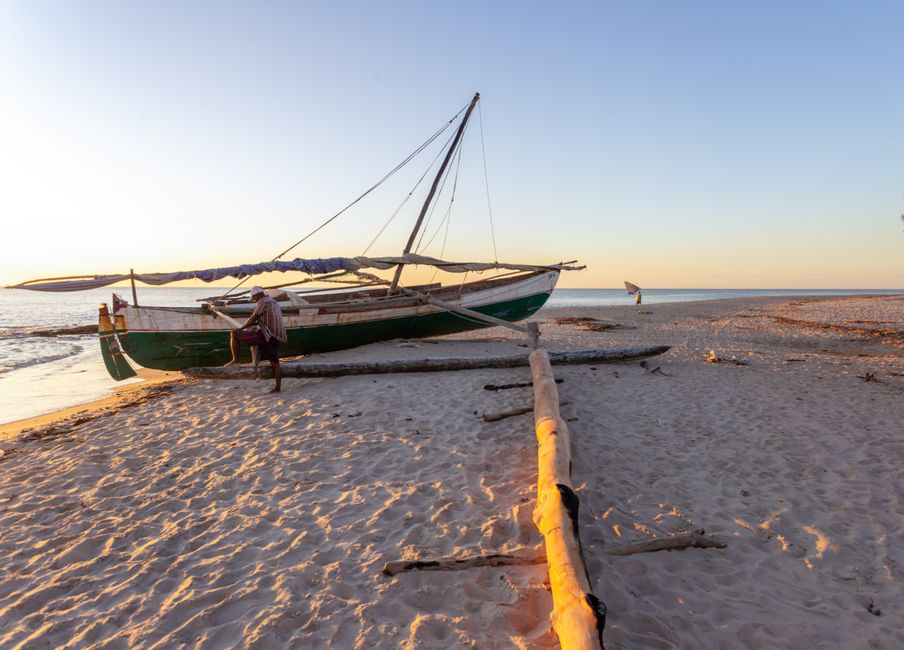
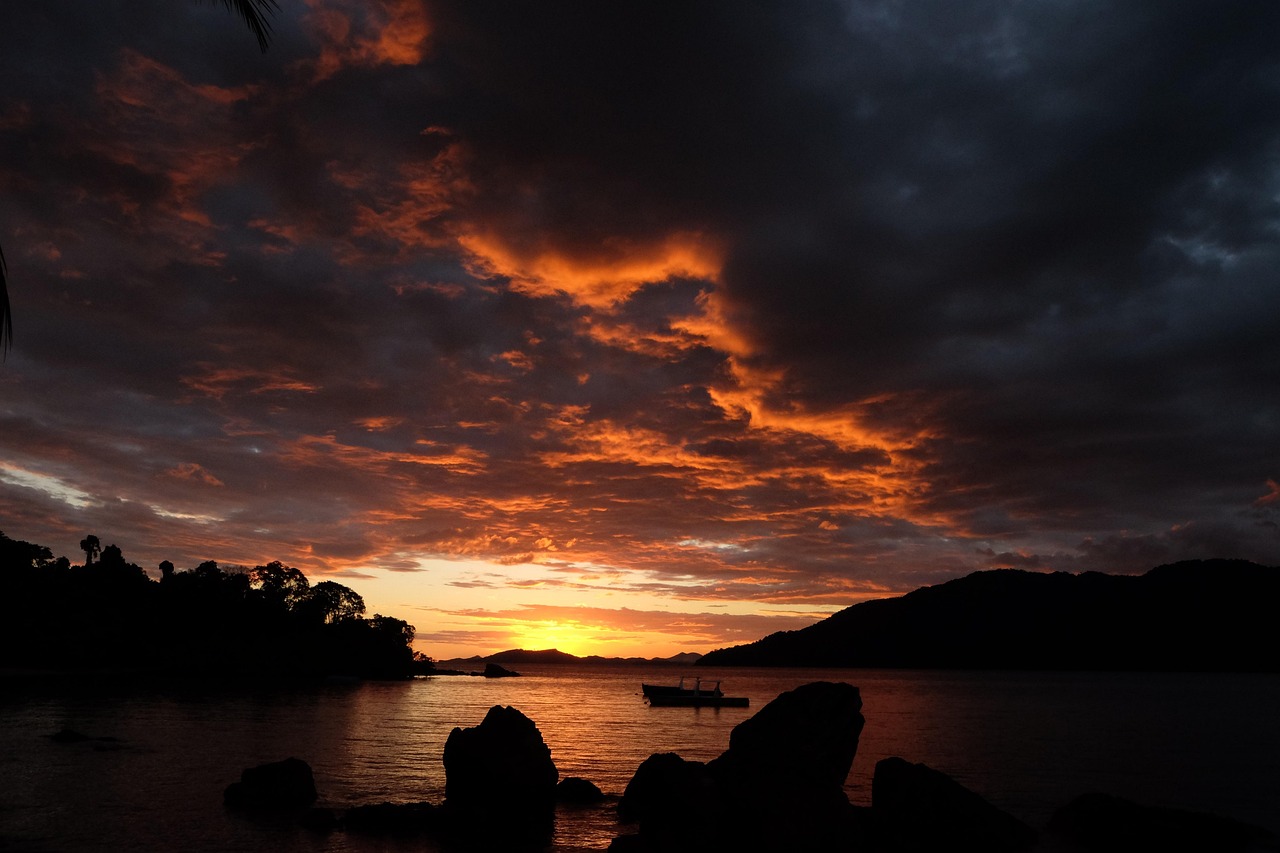
Nosy Be, “the big island” in Malagasy, is Madagascar’s main beach destination, a lush volcanic island of about 290 km² (112 sq miles) off the northwest coast, in the warm, sheltered waters of the Mozambique Channel. It is nicknamed the “perfumed island” for the ylang-ylang, vanilla, pepper and cocoa plantations that scent its hills, and its coast is a string of sandy bays with calm water and spectacular sunsets. Nosy Be is the easiest part of Madagascar to visit: it has its own international airport, a good choice of hotels from simple bungalows to luxury resorts, restaurants serving fresh seafood, and a relaxed holiday atmosphere. Yet Madagascar’s wildlife is close at hand. In Lokobe National Park, one of the last fragments of the island’s original rainforest, you can see black lemurs, sleeping nocturnal lemurs and some of the world’s smallest chameleons. Around the island, boat trips visit Nosy Komba, with its lemurs and craft villages; the marine park of Nosy Tanikely, for snorkeling with turtles; and the sandbar of Nosy Iranja. From about October to December, whale sharks gather offshore. The dry season from April to November is the best time to go, and it is warm and sunny for most of the year.
Right now in Nosy Be
- Wed 23–32°C 73–89°F 1 mm Clear
- Thu 24–32°C 74–90°F 1 mm Clear
- Fri 25–30°C 76–87°F 2 mm Mostly clear
Weather: MET Norway (CC BY 4.0) · Sea temperature: NOAA CoastWatch
Top tours in Nosy Be
See all tours for Nosy Be →
From local operators, with prices and reviews; you check availability and book on Viator, our partner. We may earn a commission at no extra cost to you. How we earn money
Nosy Be at a glance
- Best months: April to November for dry, sunny weather; October to December for whale sharks. December to March is the rainy season, with a cyclone risk.
- Getting there: fly to Fascene Airport (NOS), with international flights and domestic flights from Antananarivo, or take a boat from Ankify on the mainland.
- Where to stay: beach hotels and guesthouses at Ambatoloaka, Madirokely and Andilana; luxury resorts on the north coast and the surrounding islands.
- Time needed: four to seven nights.
- Costs (as of October 2026): a boat trip to Nosy Komba and Nosy Tanikely costs about Ar 135,000–270,000 (US$30–60) per person; beach bungalows from about Ar 135,000 (US$30) a night.
- Before you go: the eVisa, malaria, money and getting around are covered in our Madagascar travel guide.
Nosy Be’s areas and who each one suits
Ambatoloaka and Madirokely
The busiest beach area on the west coast, with hotels, guesthouses, restaurants, bars, dive centers and boat operators along a sandy bay. Ambatoloaka is lively at night; Madirokely, next door, is a little calmer. Good for independent travelers who want everything within walking distance.
Andilana and the north
At the northwest tip of the island, Andilana has one of Nosy Be’s most beautiful beaches, long and white with clear, calm water, and several all-inclusive resorts. It is quieter and more resort-focused, about 45 minutes from the airport.
Hell-Ville (Andoany)
The island’s main town, on the southeast coast, has a busy market, colonial buildings, banks, shops and the port where boats from Ankify and the islands arrive. It is not a beach destination, but it is worth a visit for its market and street life.
The surrounding islands
Upscale lodges and private-island resorts on Nosy Komba, Nosy Sakatia, Tsarabanjina and the Mitsio and Radama archipelagos offer seclusion, diving and pristine beaches, reached by boat.
Top things to see on Nosy Be
Lokobe National Park
On the southeast of the island, Lokobe protects 862 hectares (2,130 acres) of land and sea, according to Madagascar National Parks: one of the last remnants of Nosy Be’s primary lowland rainforest, with beaches of pebbles and white sand. A reserve since 1927 and a national park since 2011, it is home to the black lemur, whose males are black and females chestnut, the nocturnal Nosy Be sportive lemur and mouse lemur, the tiny Brookesia minima chameleon, panther chameleons, leaf-tailed geckos, boa constrictors and many birds. Access is by car from the airport or town, then by trail or traditional outrigger canoe (pirogue) to the forest. Visits are with a licensed local guide; many tours combine a forest walk with lunch in the village of Ampasipohy.
Nosy Komba
A short boat ride from Nosy Be, the steep, forested island of Nosy Komba (Nosy Ambariovato) is known for its black lemurs, which live around the village of Ampangorinana, and for its embroidery and woodcarving stalls. A short walk leads to the lemur park and beaches. Please do not feed or handle the lemurs.
Nosy Tanikely
A small island surrounded by a protected marine area managed by Madagascar National Parks, Nosy Tanikely has some of the best snorkeling around Nosy Be, with sea turtles, colorful reef fish and coral in clear water. A short walk to the lighthouse gives views over the reef. Boat trips usually combine Nosy Tanikely with Nosy Komba, and a park fee is charged.
Nosy Iranja
About 1.5 hours by boat to the south, Nosy Iranja is two islands joined at low tide by a long, curving sandbar, one of Madagascar’s most photographed sights. Hawksbill and green turtles nest on its beaches. Full-day trips include swimming, snorkeling and lunch.
Mont Passot and the crater lakes
The island’s highest point, Mont Passot, offers sweeping views over a cluster of volcanic crater lakes, the coast and the nearby islands, especially at sunset. The lakes are sacred, and swimming is forbidden. It is reached by road on a 4×4 or quad tour.
The sacred tree of Mahatsinjo and Hell-Ville market
Near Hell-Ville, a huge sacred banyan tree planted in the 19th century by the Sakalava queen is still a place of offerings and rituals; respect the dress and behavior rules, which may include removing shoes and covering legs with a sarong. In Hell-Ville, the covered market overflows with spices, vanilla, fruit and fish.
The “perfumed island”: ylang-ylang and plantations
Nosy Be’s nickname comes from ylang-ylang, a tree whose yellow, star-shaped flowers are distilled into an essential oil prized by the perfume industry. Flowers are picked by hand early in the morning, when their scent is strongest, and distilled in copper stills on plantations around the island; several distilleries welcome visitors, especially around Dzamandzar (Djamandjary) in the west. The island also grows vanilla, black and green pepper, cinnamon and cocoa, and many tours stop at a plantation for tastings and to buy spices directly from producers. The old sugar factory at Dzamandzar is a reminder of the island’s colonial plantation economy.
Other things to do on Nosy Be
- Diving: dive centers in Ambatoloaka and on the islands visit reefs, pinnacles and wrecks, with turtles, rays, reef sharks and, in season, whale sharks; liveaboard trips go to the Mitsio and Radama islands.
- Whale sharks and whales: whale sharks are often seen from about October to December, and humpback whales from about July to October. Choose operators that follow responsible encounter rules: few swimmers, no touching and no chasing.
- Snorkeling: Nosy Tanikely, Nosy Sakatia and the reefs off Andilana.
- Ylang-ylang and vanilla plantations: distilleries show how essential oils are produced for the perfume industry, with tastings of rum and local products.
- Quad, 4×4 and bicycle tours: to Mont Passot, plantations and villages.
- Fishing: big-game fishing for sailfish, tuna and barracuda.
- Sailing: catamaran and dhow trips to the islands and sunset cruises.
Responsible travel on Nosy Be
Nosy Be’s reefs, forests and lemurs are under pressure from tourism and development. Never feed or hold lemurs, chameleons or other animals for photos, even when guides or villagers offer it; do not buy shells, coral or turtle products; and use reef-safe sunscreen. Choose dive and whale shark operators that follow encounter rules, pay park fees, which fund rangers and local communities, and hire local guides. Lokobe and Nosy Komba villages sell crafts such as embroidered tablecloths, woodcarvings and raffia; buying directly supports families.
Food and drink
Nosy Be is the best place in Madagascar for seafood: grilled fish, lobster, crab, prawns, octopus and calamari, often prepared with coconut milk, vanilla or green pepper. Try akoho sy voanio (chicken in coconut sauce), romazava, mofo gasy for breakfast and fresh tropical fruit from the market. Beach restaurants in Ambatoloaka and Madirokely serve Malagasy, French and Italian dishes; Hell-Ville has simple hotely with cheap rice dishes. Drink THB beer, rhum arrangé infused with vanilla, ginger or fruit, and fresh fruit juices. Drink only bottled water.
Day trips from Nosy Be
Ankify and the mainland
A 30–45-minute boat ride brings you to Ankify on the mainland, the gateway to the cocoa plantations of the Sambirano valley around Ambanja, and the road north to Ankarana and Antsiranana.
Ankarana and Antsiranana
On a longer trip, travel by road from Ankify to the Ankarana Special Reserve, with its gray tsingy pinnacles, caves and crowned lemurs, and on to Antsiranana (Diego Suarez), its bay and the Montagne d’Ambre National Park. Allow at least two or three days.
Nosy Sakatia and the Radama islands
Boat trips head west to Nosy Sakatia, known for turtles and snorkeling, and on longer excursions to the remote Radama archipelago for diving and empty beaches.
Getting there and getting around
By air
Fascene Airport (NOS), in the east of the island, has international flights from Addis Ababa, Réunion and other regional hubs, seasonal charters from Europe, and domestic flights with Madagascar Airlines from Antananarivo (about 1.5 hours) and Antsiranana. Domestic schedules change often, so reconfirm and leave a buffer before international connections. The airport is about 30 minutes by road from Ambatoloaka.
By boat
Speedboats and slower ferries link Ankify on the mainland with Hell-Ville in about 30–45 minutes; Ankify is reached by road from Antsiranana or Ambanja. Boats can be crowded; choose a reputable operator with life jackets, and avoid crossing in bad weather.
Getting around
- By taxi: yellow taxis and tuk-tuks (bajaj) run between Hell-Ville, the airport and the beaches; agree on the fare before you set off, especially at night.
- By rental scooter, quad or car: available in Ambatoloaka; roads are narrow, potholed in places and unlit at night.
- By boat: hotels and operators run excursions to the surrounding islands; check the boat’s condition and life jackets.
- On foot: the beaches of Ambatoloaka and Madirokely are walkable.
When to go and how long to stay
Nosy Be has a tropical climate, hot all year, with a pronounced rainy season from about December to March, when heavy downpours, high humidity and the risk of tropical cyclones are greatest, and a dry season from about April to November, with sunny days, lower humidity and calm seas. October and November bring the warmest seas and whale sharks.
The table shows the 1991–2020 climate normals for Nosy Be’s Fascene Airport, from Météo Madagascar via the World Meteorological Organization (WMO).
| Month | Average high | Average low | Rain | Rain days (≥1 mm) |
|---|---|---|---|---|
| Jan | 32 °C (89 °F) | 24 °C (75 °F) | 393 mm (15.5 in) | 19.5 |
| Feb | 32 °C (89 °F) | 24 °C (75 °F) | 334 mm (13.2 in) | 17.3 |
| Mar | 32 °C (89 °F) | 24 °C (75 °F) | 281 mm (11.1 in) | 16.5 |
| Apr | 32 °C (90 °F) | 24 °C (75 °F) | 106 mm (4.2 in) | 9.3 |
| May | 31 °C (89 °F) | 22 °C (72 °F) | 35 mm (1.4 in) | 4.7 |
| Jun | 30 °C (86 °F) | 21 °C (69 °F) | 29 mm (1.2 in) | 4.5 |
| Jul | 30 °C (85 °F) | 20 °C (67 °F) | 21 mm (0.8 in) | 3.4 |
| Aug | 30 °C (86 °F) | 20 °C (67 °F) | 27 mm (1.1 in) | 3.6 |
| Sep | 31 °C (87 °F) | 20 °C (69 °F) | 35 mm (1.4 in) | 4.2 |
| Oct | 32 °C (89 °F) | 22 °C (72 °F) | 30 mm (1.2 in) | 4 |
| Nov | 32 °C (89 °F) | 23 °C (74 °F) | 135 mm (5.3 in) | 9.8 |
| Dec | 32 °C (89 °F) | 24 °C (75 °F) | 302 mm (11.9 in) | 15.8 |
| Year | 31 °C (88 °F) | 22 °C (72 °F) | 1,728 mm (68.0 in) | 113 |
From May to October, rain falls on only three to five days a month. The sea is warm all year, about 26–30 °C (79–86 °F).
Events worth planning around
- Donia festival (around Pentecost, May or June): Nosy Be’s music festival brings bands from Madagascar and the Indian Ocean islands.
- Independence Day (June 26): celebrations across the country.
- Whale shark season (about October to December): the best time for encounters, depending on plankton.
- Christmas and European holidays: resorts are busiest in July, August and December.
How long to stay: 4, 5 and 7 nights
- Four nights: Lokobe National Park, a boat trip to Nosy Komba and Nosy Tanikely, and sunset at Mont Passot.
- Five nights: add a full-day trip to Nosy Iranja or a dive.
- Seven nights: add a stay on one of the smaller islands, or a road trip to Ankarana and Antsiranana.
Where to stay on Nosy Be
- Beach bungalows and guesthouses: simple, often family-run, in Ambatoloaka, Madirokely and Ambondrona.
- Mid-range beach hotels: along the west coast, many with pools, restaurants and dive centers.
- All-inclusive resorts: at Andilana and on the north coast.
- Island lodges: on Nosy Komba, Nosy Sakatia and the private islands of the archipelago, for luxury and seclusion.
Book early for July, August and the Christmas holidays.
Typical costs on Nosy Be
| Item (as of October 2026) | Ariary | About US dollars |
|---|---|---|
| Lokobe National Park tour with guide and lunch | Ar 225,000–360,000 | US$50–80 |
| Boat trip to Nosy Komba and Nosy Tanikely | Ar 135,000–270,000 | US$30–60 |
| Full-day trip to Nosy Iranja | Ar 225,000–450,000 | US$50–100 |
| Two-tank dive | Ar 450,000–630,000 | US$100–140 |
| Taxi from the airport to Ambatoloaka | Ar 45,000–70,000 | US$10–16 |
| Scooter rental, per day | Ar 70,000–110,000 | US$15–25 |
| Grilled fish in a beach restaurant | Ar 30,000–60,000 | US$7–13 |
| Beach bungalow double | Ar 135,000–270,000 | US$30–60 |
| Mid-range hotel double | Ar 270,000–630,000 | US$60–140 |
Prices are typical ranges, not official figures; conversions use about Ar 4,500 per US dollar, an estimate.
Safety on Nosy Be
- Malaria: according to the CDC, malaria occurs throughout Madagascar except Antananarivo city; take antimalarial medicine as prescribed and use repellent and nets.
- Cyclones (November to April): most likely from January to March; follow Météo Madagascar and your hotel’s instructions.
- Boats: choose reputable operators with life jackets and a radio, and stay ashore in rough weather; boat accidents have occurred.
- Beaches: robberies have occurred on isolated beaches; stay on busy beaches, ask your hotel about local conditions and avoid walking on deserted stretches alone, especially after dark.
- Roads: drive slowly on scooters and quads; roads are unlit and have potholes, and helmets are essential.
- Sun and water: use reef-safe sunscreen, drink bottled water and wear reef shoes.
- Health: Nosy Be has clinics and pharmacies, but serious cases may require evacuation to Réunion or Antananarivo; have insurance that covers evacuation.
- Emergencies: call 117 for police; for medical help, contact your hotel and your insurer.
Practical tips for Nosy Be
- Cash: ATMs are in Hell-Ville and Ambatoloaka; bring euros or US dollars as a backup.
- Bargaining: negotiate taxi fares and prices at craft stalls, politely.
- Lemurs: never feed or handle lemurs, even when guides offer bananas; it harms the animals.
- Fady: respect local taboos and sacred sites, such as the crater lakes and the sacred tree.
- Power cuts: occur; bring a flashlight and a power bank.
What to pack for Nosy Be
Light clothes, swimwear, a rash vest, reef shoes, a mask and snorkel, reef-safe sunscreen, a hat, strong insect repellent and long sleeves for the evening, your antimalarial medicine, a flashlight, a dry bag for boat trips, a sarong for sacred sites and a European (type C/E) plug adapter.
Nosy Be travel FAQ
How do I get to Nosy Be?
Fly to Fascene Airport, which has international flights and domestic flights from Antananarivo, or take a boat from Ankify on the mainland.
Is Nosy Be worth visiting?
Yes. It combines beaches, calm seas, seafood and easy boat trips with Lokobe’s rainforest and lemurs.
What is the best time to visit Nosy Be?
April to November for dry, sunny weather; October to December for whale sharks.
Can you see lemurs on Nosy Be?
Yes, in Lokobe National Park and on the neighboring island of Nosy Komba, with a licensed guide.
Can you swim with whale sharks in Nosy Be?
Encounters are possible from about October to December with specialist operators. Choose those that limit swimmers and never touch or chase the animals.
Do I need malaria tablets for Nosy Be?
The CDC recommends antimalarial medicine for all of Madagascar except the city of Antananarivo, including Nosy Be.
What is the best beach on Nosy Be?
Andilana in the northwest, for its long, white beach and calm, clear water.
How do I get to Nosy Iranja?
On a full-day boat trip from Nosy Be, about 1.5 hours each way.
Is there an ATM on Nosy Be?
Yes, in Hell-Ville and Ambatoloaka. Bring some cash in euros or dollars as a backup.
How many days do you need on Nosy Be?
Four to seven nights, for Lokobe, the island boat trips and some beach time.
Sources and last review
Researched and last reviewed on 5 October 2026. Lokobe’s area, habitats, species, history and access: Madagascar National Parks; climate: Météo Madagascar’s 1991–2020 normals for Nosy Be’s Fascene Airport, via the World Meteorological Organization; malaria: the US Centers for Disease Control and Prevention; boat and beach conditions: the UK government’s travel pages (factual content only); area and coordinates: Wikidata. Descriptions of beaches, islands, dive sites, wildlife seasons, the sacred tree, the Donia festival, flight routes, travel times, emergency numbers, the exchange rate and all prices are general references or estimates and should be checked locally. For the eVisa, money and health, see our Madagascar travel guide.
Plan your trip
Partner links: TravelerCenter may earn a commission if you book, at no extra cost to you.
🇫🇷 Useful French phrases for Nosy Be
All 38 French phrases: restaurant, hotel, emergencies, romance (printable) →