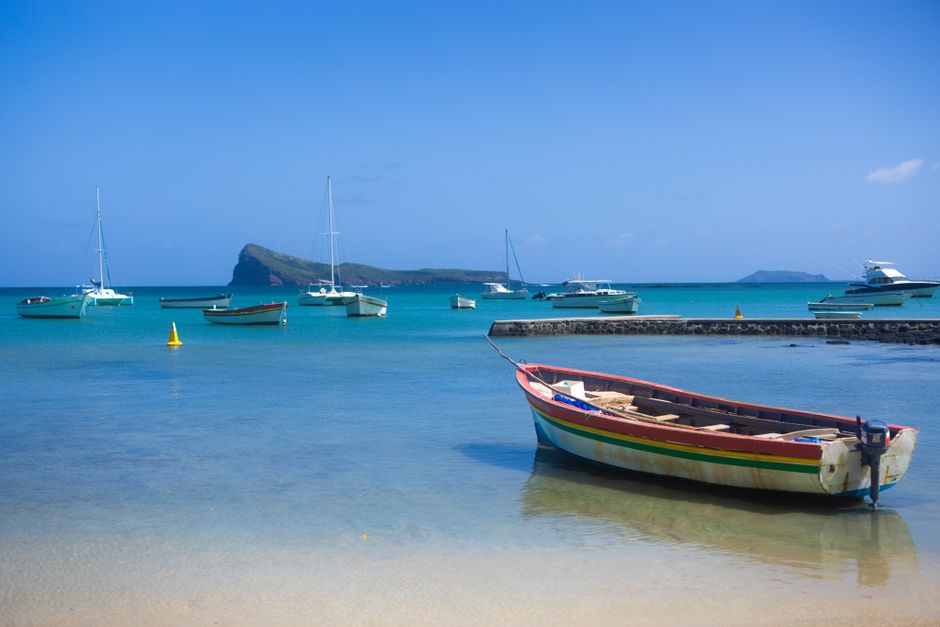
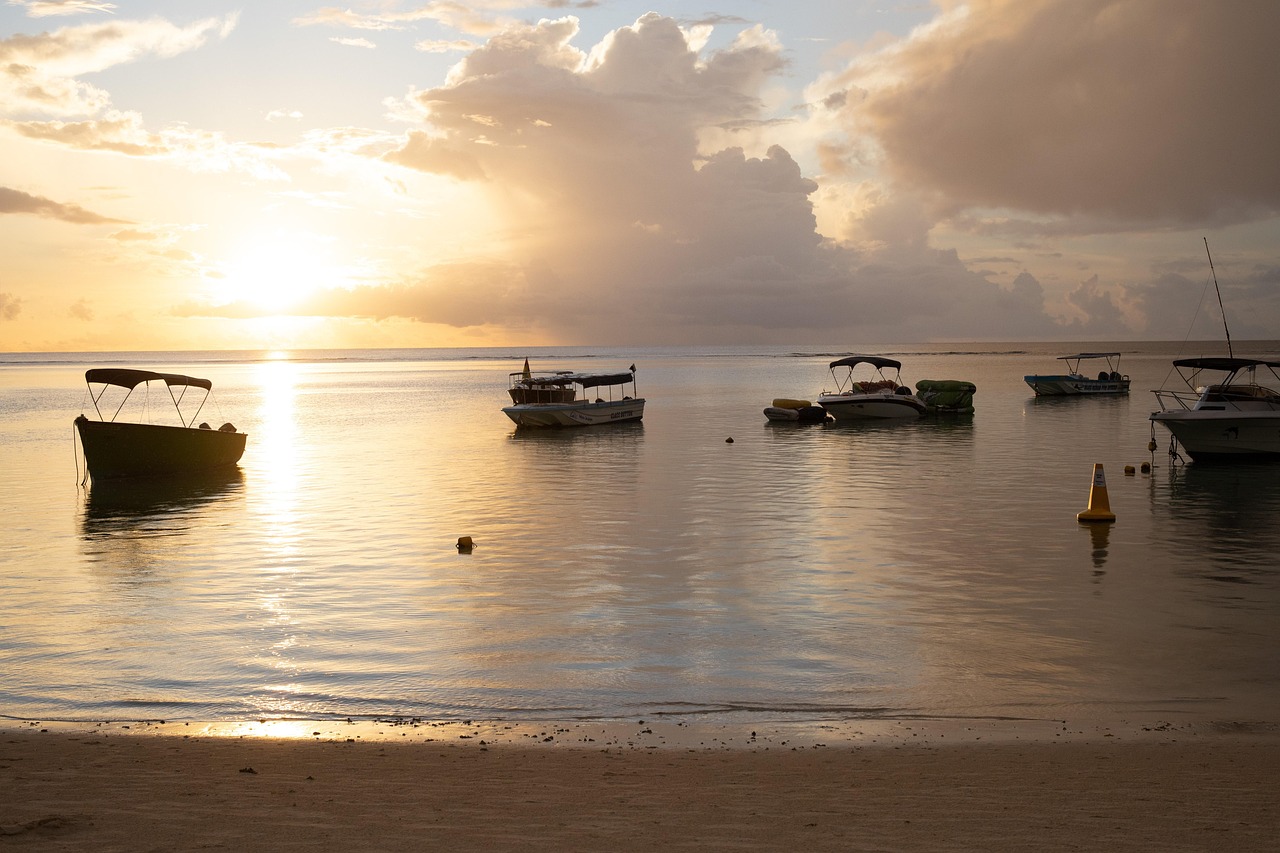
Grand Baie is the busiest and most sociable resort town in Mauritius, wrapped around a wide, sheltered bay on the island’s north coast. Once a quiet fishing village, it has grown into the north’s hub for shopping, restaurants, nightlife and boat trips, while keeping a relaxed seaside feel: fishing boats and catamarans swing at anchor in a turquoise lagoon, and the sunset turns the bay gold most evenings. Within a few minutes’ drive are some of the island’s prettiest public beaches, at Pereybère, Mont Choisy and Trou aux Biches, and the red-roofed church at Cap Malheureux, which looks out to the wedge-shaped island of Coin de Mire. From the jetty, catamarans head out daily to the northern islets for snorkeling and barbecue lunches, and dive boats visit reefs and wrecks offshore. Grand Baie has hotels and apartments for every budget, which makes it a good base for first-time visitors, families and anyone who wants to walk to dinner rather than eat every meal in a resort. The north is sheltered from the trade winds, so it is warm, sunny and fairly dry for much of the year; May to December is the most comfortable time to visit.
Right now in Grand Baie
- Wed 20–28°C 68–82°F 2 mm Light showers
- Thu 21–27°C 69–81°F 3 mm Showers
- Fri 21–27°C 70–80°F Mostly clear
Weather: MET Norway (CC BY 4.0) · Sea temperature: NOAA CoastWatch
Top tours in Grand Baie
See all tours for Grand Baie →
From local operators, with prices and reviews; you check availability and book on Viator, our partner. We may earn a commission at no extra cost to you. How we earn money
Grand Baie at a glance
- Best months: May to December for sunny, drier weather; October and November are especially good. January to April is hotter, more humid and the cyclone season.
- Getting there: about 1 hour 15 minutes by car or taxi from the international airport in the southeast, mostly on the motorway past Port Louis; Port Louis itself is about 30 minutes away.
- Where to stay: apartments and guesthouses in Grand Baie and Pereybère; mid-range and upscale beach hotels at Trou aux Biches, Mont Choisy, Pointe aux Canonniers and Cap Malheureux.
- Time needed: three to five nights, or a week as a base for touring the island.
- Costs (as of October 2026): a catamaran day trip costs about Rs 2,400–4,300 (US$50–90); a studio or guesthouse double from about Rs 2,400 (US$50) a night, plus the €3 tourist fee per person per night.
- Before you go: entry rules, the All-in-One Travel Digital Form and the tourist fee are covered in our Mauritius travel guide.
Grand Baie’s areas and who each one suits
Grand Baie town and the bay
The town center runs along the coast road around the bay, with the Sunset Boulevard shopping area, the main public beach (La Plage Publique), supermarkets, banks, dive centers, restaurants and the island’s best-known bars and clubs. It is convenient and lively, though the bay itself is busy with boats, so most people swim at the beaches nearby. Stay here if you want to walk everywhere.
Pereybère
A small, cheerful suburb about 2 km (1.2 miles) north, with a compact public beach, clear water good for snorkeling, food trucks and casual restaurants. Apartments and guesthouses make it popular with independent travelers and families on a budget, and it has a more local, less commercial feel than Grand Baie.
Pointe aux Canonniers, Mont Choisy and Trou aux Biches
West of the bay, the coast curves past Pointe aux Canonniers to the long casuarina-shaded beach of Mont Choisy and the calm lagoon of Trou aux Biches, often listed among the island’s best beaches. This stretch has some of the north’s best hotels and is quieter in the evening; you will need a short taxi or bus ride into Grand Baie.
Cap Malheureux and the far north
At the island’s northern tip, Cap Malheureux is a quiet fishing village with the much-photographed Notre-Dame Auxiliatrice church and views of Coin de Mire. Further east, Grand Gaube and Calodyne have secluded resorts and fewer visitors.
Top things to see around Grand Baie
Pereybère beach
A small crescent of white sand with shallow, sheltered water and coral heads close to shore, Pereybère is one of the best places in the north for families and for snorkeling straight off the beach. It fills up on Sundays, when Mauritian families come for picnics. A lifeguard post covers the main swimming area.
Trou aux Biches and Mont Choisy
These neighboring beaches form one of the longest stretches of soft sand in the north. Mont Choisy is wide and shaded by casuarina trees, popular for picnics and kitesurfing on breezy days; Trou aux Biches has a calm, clear lagoon with good snorkeling at its southern end, and dive centers that visit the outer reef.
Cap Malheureux and the red-roofed church
The little church of Notre-Dame Auxiliatrice, with its red roof facing the sea, is a classic photo stop, especially at sunset. The name “Cape of Misfortune” may recall shipwrecks on the reef; according to tradition, it is also where British troops landed in 1810 to take the island from the French.
The northern islets: Coin de Mire, Île Plate and Île Gabriel
The islands off the north coast are the goal of most boat trips from Grand Baie. Coin de Mire (Gunner’s Quoin) is a steep, uninhabited island and nature reserve that rises sharply from the sea; boats snorkel in its lee. Île Plate and Île Gabriel share a lagoon of white sand and clear shallow water, with a lighthouse on Île Plate. Most trips include snorkeling, swimming and a barbecue lunch on board or on Île Gabriel. On windy winter days the crossing can be rough.
The SSR Botanical Garden at Pamplemousses
About 20 minutes south by car, the Sir Seewoosagur Ramgoolam Botanical Garden is one of the oldest botanical gardens in the Southern Hemisphere, laid out from the 18th century. Its pond of giant Amazon water lilies, avenues of palms, spice trees, giant tortoises and deer park are worth half a day; licensed guides at the entrance explain the plants. The nearby L’Aventure du Sucre museum, in a former sugar factory, tells the story of sugar and slavery in Mauritius.
Underwater walks, submarines and glass-bottom boats
Grand Baie is the place for non-divers to see the reef: helmet-diving “undersea walks,” semi-submersibles and a tourist submarine operate from the bay, as do glass-bottom boats. Check that operators are licensed and that safety briefings are thorough.
Other things to do in Grand Baie
- Diving: dive centers in Grand Baie and Trou aux Biches visit reefs, drop-offs and wrecks such as the Stella Maru, sunk off Trou aux Biches as an artificial reef, and sites around Coin de Mire for experienced divers.
- Snorkeling: from the beach at Pereybère and Trou aux Biches, or on catamaran trips to the islets.
- Kitesurfing and water sports: windsurfing, paddleboarding, water-skiing and parasailing in the bay; kitesurfing on breezy days at Mont Choisy and Anse La Raie.
- Big-game fishing: charters go out for marlin, tuna and wahoo, best from October to April.
- Shopping: the Grand Baie Bazaar for crafts, pareos and spices; Sunset Boulevard and the La Croisette mall for brands and cafés.
- Hindu temples: the colorful Surya Oudaya Sangam temple on the coast road is open to respectful visitors.
- Nightlife: Grand Baie has the island’s liveliest bars and clubs, busiest on Friday and Saturday nights.
- Sunsets: the bay, Pointe aux Canonniers and Mont Choisy face west, with sunsets over the water.
Food and drink
Grand Baie has the widest choice of restaurants in the north, from beach shacks and food trucks to fine dining. Look for dholl puri and roti from street vendors, Creole seafood such as octopus curry and fish vindaye, Indian and Chinese restaurants, pizzerias and French bistros. Pereybère’s food trucks serve cheap fried noodles, briyani and grilled fish by the beach. Supermarkets in Grand Baie stock everything for self-catering, including Mauritian rum and Phoenix beer. Many restaurants close one day a week, and it is wise to book for Friday and Saturday dinners in high season.
Day trips from Grand Baie
Port Louis
The capital is about 30 minutes away by car or by direct bus. Spend a morning at the Central Market, the Aapravasi Ghat World Heritage Site and Le Caudan Waterfront, then climb to the Citadel for views. See our Mauritius travel guide for details.
Pamplemousses and the north’s sugar country
Combine the botanical garden with L’Aventure du Sucre and a drive through cane fields to Château de Labourdonnais, a restored 19th-century colonial house with orchards and a rum distillery.
The southwest: Chamarel, the national park and Le Morne
A long but rewarding day by car or with a driver: the Black River Gorges viewpoints, Grand Bassin’s sacred lake, the Seven Coloured Earths and waterfall at Chamarel, and the lagoon views of Le Morne Brabant. Allow 1.5 to 2 hours each way.
The east coast and Île aux Cerfs
Drive about an hour to Trou d’Eau Douce for a boat trip to Île aux Cerfs, with its sandbanks and lagoon, often combined with the Grande Rivière Sud-Est waterfall.
Nearby destinations
- Flic-en-Flac37 km
- Le Morne Brabant57 km
- Saint-Gilles-les-Bains267 km
Getting there and getting around
By air and road
International flights land at Sir Seewoosagur Ramgoolam International Airport (MRU) in the southeast of the island. From there, Grand Baie is about 1 hour 15 minutes by road, mostly on the motorway, depending on traffic around Port Louis. Hotels arrange transfers, and taxis wait at the airport; agree on the fare first. Rental cars are available at the airport and in Grand Baie.
Getting around
- On foot: the town center, Pereybère and the bay are walkable, although sidewalks are narrow or missing on parts of the coast road.
- By bus: frequent buses run along the coast road between Grand Baie, Pereybère and Cap Malheureux, and express buses go to Port Louis; most stop by early evening.
- By taxi: plentiful, without meters, so agree on the price first; drivers also offer day tours.
- By car: a car is the best way to explore the island. Drive on the left, watch for buses, motorbikes and pedestrians, and be patient in Grand Baie’s traffic at peak times.
- By scooter or bicycle: rentals are available in town, but traffic is heavy; scooter riders must wear helmets.
When to go and how long to stay
The north coast is one of the warmer and drier parts of Mauritius, sheltered from the southeast trade winds. Summer, from November to April, is hot and humid, with most of the year’s rain, sometimes in heavy showers, and the risk of tropical cyclones, most often from January to March. Winter, from June to September, is sunny and pleasant, with warm days and cooler nights; May and October are transition months, and October is often the driest month of the year.
The table shows long-term averages from Mauritius Meteorological Services (MMS) for Pamplemousses, its reference station for the north, about 12 km (7.5 miles) south of Grand Baie, for 1971–2000.
| Month | Average high | Average low | Rain | Rain days (over 1 mm) | Sunshine (hours a day) |
|---|---|---|---|---|---|
| Jan | 31 °C (88 °F) | 22 °C (72 °F) | 206 mm (8.1 in) | 16 | 8.1 |
| Feb | 31 °C (87 °F) | 22 °C (72 °F) | 240 mm (9.4 in) | 16 | 7.7 |
| Mar | 31 °C (87 °F) | 22 °C (71 °F) | 159 mm (6.3 in) | 15 | 7.6 |
| Apr | 30 °C (86 °F) | 21 °C (69 °F) | 158 mm (6.2 in) | 15 | 7.4 |
| May | 28 °C (83 °F) | 19 °C (65 °F) | 99 mm (3.9 in) | 12 | 7.6 |
| Jun | 26 °C (80 °F) | 17 °C (62 °F) | 68 mm (2.7 in) | 12 | 7.4 |
| Jul | 26 °C (78 °F) | 16 °C (61 °F) | 73 mm (2.9 in) | 14 | 7.6 |
| Aug | 26 °C (79 °F) | 16 °C (61 °F) | 75 mm (3.0 in) | 13 | 7.7 |
| Sep | 27 °C (81 °F) | 17 °C (62 °F) | 46 mm (1.8 in) | 9 | 7.5 |
| Oct | 28 °C (83 °F) | 18 °C (64 °F) | 48 mm (1.9 in) | 8 | 8.2 |
| Nov | 30 °C (86 °F) | 19 °C (66 °F) | 50 mm (1.9 in) | 8 | 8.7 |
| Dec | 31 °C (87 °F) | 21 °C (70 °F) | 128 mm (5.0 in) | 10 | 8.0 |
| Year | 29 °C (84 °F) | 19 °C (66 °F) | 1,349 mm (53.1 in) | 148 | 7.8 |
Figures are MMS long-term means; sunshine is the average number of hours of bright sunshine per day. The coast at Grand Baie is usually a little warmer and drier than Pamplemousses. The sea is about 23 °C (73 °F) in August and 28 °C (82 °F) in February.
Events worth planning around
- Chinese Spring Festival (January or February): celebrations in Port Louis’s Chinatown.
- Maha Shivaratri (February or March): pilgrims carry decorated kanwars along the roads to Grand Bassin; expect traffic.
- Independence Day (March 12): national holiday.
- Divali (October or November): homes and temples are lit with oil lamps.
- Christmas and New Year: the busiest weeks of the year in Grand Baie, with fireworks over the bay on New Year’s Eve; book well ahead.
How long to stay: 3, 5 and 7 nights
- Three nights: a catamaran trip to the islets, beach time at Pereybère and Trou aux Biches, and sunset at Cap Malheureux.
- Five nights: add a dive or undersea walk, the Pamplemousses botanical garden and a half day in Port Louis.
- Seven nights: use Grand Baie as a base for day trips to the southwest and the east coast, or split your week with Flic-en-Flac or Le Morne.
Where to stay in Grand Baie
- Apartments and studios: in Grand Baie and Pereybère, often with kitchens and pools, good value for families and longer stays.
- Guesthouses: small, family-run places with breakfast and table d’hôte dinners.
- Mid-range hotels: along the coast at Grand Baie, Pointe aux Canonniers and Trou aux Biches, many on the beach.
- Upscale resorts: at Trou aux Biches, Pointe aux Piments, Cap Malheureux and Grand Gaube, with spas and all-inclusive options.
- Villas: private villas with pools for groups, many in gated residences near the coast.
Book early for Christmas, New Year, Easter and European school holidays. All tourist accommodation adds the €3 per person per night tourist fee for guests aged 12 and over.
Typical costs in Grand Baie
| Item (as of October 2026) | Mauritian rupees | About US dollars |
|---|---|---|
| Catamaran trip to the northern islets with lunch | Rs 2,400–4,300 | US$50–90 |
| Two-tank dive | Rs 4,300–6,700 | US$90–140 |
| Undersea walk | Rs 2,400–3,300 | US$50–70 |
| Bus to Port Louis | Rs 40–70 | about US$1–1.50 |
| Taxi from the airport | Rs 2,400–3,300 | US$50–70 |
| Dholl puri from a street stall | Rs 20–40 | under US$1 |
| Meal in a beach restaurant | Rs 500–1,000 | US$11–21 |
| Studio or guesthouse double, per night | Rs 2,400–4,800 | US$50–100 |
| Beach hotel double, half board | Rs 9,500–19,000 | US$200–400 |
Prices are typical ranges, not official figures. Conversions use about Rs 47.5 per US dollar, from the Bank of Mauritius’ indicative rates of 5 October 2026.
Safety in Grand Baie
- Cyclone season (November to April): follow Mauritius Meteorological Services warnings and your hotel’s instructions; during the highest warning classes, everyone must stay indoors and boat trips stop.
- The sea: swim inside the reef and in front of lifeguard posts; currents are strong in the passes through the reef. Wear reef shoes against sea urchins and stonefish.
- Boats: in the busy bay, swim only in marked zones away from boat channels, and use licensed operators with life jackets for every passenger.
- Roads: the coast road is busy; walk facing traffic, use a light at night and take care crossing. Drive defensively.
- Theft: do not leave bags on the beach or valuables in cars; use your room safe.
- Nightlife: keep an eye on your drinks and use registered taxis late at night.
- Health: use mosquito repellent against dengue; there are private clinics and pharmacies in Grand Baie.
- Emergencies: call 999 or 112 for police, 114 for an ambulance and 115 for fire.
Practical tips for Grand Baie
- Cash and cards: ATMs are plentiful in town; carry small notes for street food, buses and the bazaar.
- Beaches on Sundays: public beaches are packed with local families on Sundays and public holidays; come early or go on a weekday.
- Boat trips: book catamaran trips a day or two ahead; check what is included (lunch, drinks, snorkel gear) and the cancellation policy for bad weather.
- Bargaining: expected at the bazaar and with taxi drivers, but not in shops with fixed prices.
- Self-catering: supermarkets are open daily, with shorter hours on Sundays.
- Sun: the tropical sun is strong all year; use reef-safe sunscreen and a hat.
What to pack for Grand Baie
Light summer clothes, swimwear, a rash vest, reef shoes, a mask and snorkel, reef-safe sunscreen, a hat and sunglasses, insect repellent, a light rain jacket in summer, a sweater for winter evenings, a smart-casual outfit for restaurants and a UK-style (type G) plug adapter.
Grand Baie travel FAQ
How far is Grand Baie from the airport?
About 1 hour 15 minutes by road from Sir Seewoosagur Ramgoolam International Airport in the southeast, depending on traffic around Port Louis.
Is Grand Baie a good base in Mauritius?
Yes, especially for first-time visitors. It has the north’s best choice of restaurants, shops, bars and boat trips, beaches nearby and good roads to Port Louis and the rest of the island.
What is the best beach near Grand Baie?
Pereybère for snorkeling and families, Trou aux Biches for its calm lagoon and Mont Choisy for a long, shaded stretch of sand.
Can you swim in Grand Baie bay?
There is a public beach, but the bay is busy with boats. Most visitors swim at Pereybère, Mont Choisy or Trou aux Biches, inside the reef and near lifeguard posts.
What is the best time to visit Grand Baie?
May to December, when it is sunny and drier; October and November are especially good. January to April is hot and humid, with a cyclone risk.
How do I get to Coin de Mire and Île Plate?
On a catamaran or speedboat trip from Grand Baie or Trou aux Biches, usually a full day with snorkeling and lunch.
Do I need a car in Grand Baie?
Not to enjoy the town and nearby beaches, which have frequent buses and taxis. A car or driver is useful for day trips around the island.
Is Grand Baie expensive?
It has options for every budget, from food trucks and studios in Pereybère to upscale beach hotels at Trou aux Biches.
Is there nightlife in Grand Baie?
Yes. Grand Baie has the liveliest bars and clubs in Mauritius, busiest on Friday and Saturday nights.
What is there to do in Grand Baie when it rains?
Visit the Pamplemousses botanical garden and L’Aventure du Sucre, shop in the malls and bazaar, or spend the day in Port Louis’s markets and museums.
Sources and last review
Researched and last reviewed on 5 October 2026. Climate: Mauritius Meteorological Services long-term means (1971–2000) for Pamplemousses, its reference station for the north; seasons and cyclone and torrential rain warnings: Mauritius Meteorological Services; the €3 tourist fee: the Mauritius Revenue Authority; rupee rates: the Bank of Mauritius; coordinates: Wikidata. Descriptions of beaches, the islets, dive sites, the botanical garden, events, travel times, emergency numbers and all prices are general references or estimates and should be checked locally. For entry rules, the All-in-One Travel Digital Form and money, see our Mauritius travel guide.
Plan your trip
Partner links: TravelerCenter may earn a commission if you book, at no extra cost to you.
🇫🇷 Useful French phrases for Grand Baie
All 38 French phrases: restaurant, hotel, emergencies, romance (printable) →