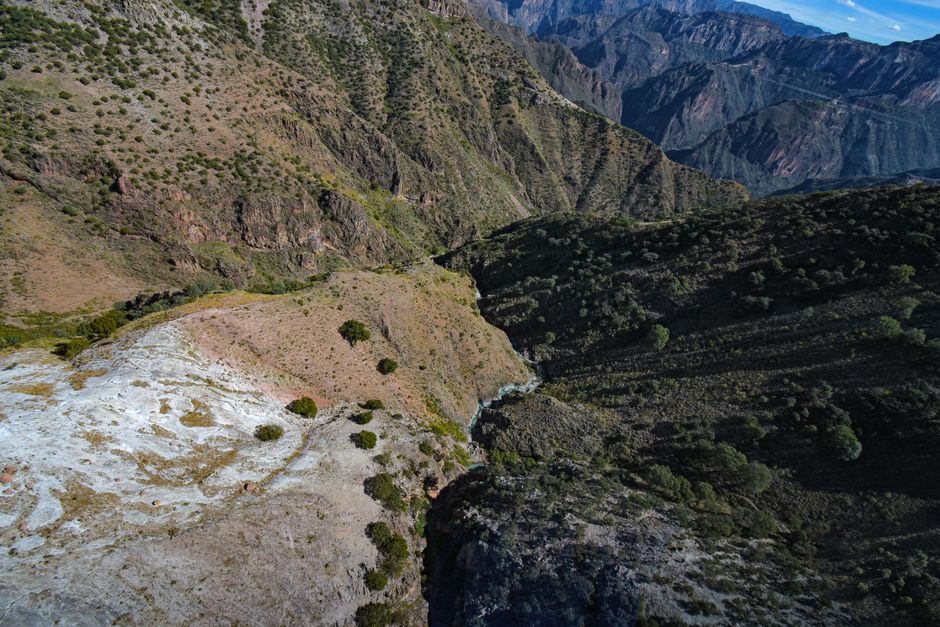
The Copper Canyon (Barrancas del Cobre) is a system of deep canyons cut by six rivers into the Sierra Tarahumara, part of the Sierra Madre Occidental in the state of Chihuahua. Taken together, the gorges are larger than the Grand Canyon, and several are deeper. Pine forests cover the rim at over 2,000 meters (6,600 feet), while the canyon floors are subtropical, with orange trees and mangoes. The region is home to the Rarámuri (Tarahumara) people, famous for their long-distance running. Most visitors travel on the Chepe, one of the world’s great train journeys, which climbs from the coast of Sinaloa through tunnels and over bridges to the canyon rim at Divisadero and the town of Creel. Spring and fall are the best seasons.
Right now in Copper Canyon (Creel)
- Tue 10–23°C 50–73°F 10 mm Heavy showers
- Wed 10–24°C 51–76°F 10 mm Heavy showers
- Thu 9–20°C 48–69°F Mostly clear
Weather: MET Norway (CC BY 4.0) · Rates: ECB
Top tours in Copper Canyon
See all tours for Copper Canyon →
From local operators, with prices and reviews; you check availability and book on Viator, our partner. We may earn a commission at no extra cost to you. How we earn money
Copper Canyon at a glance
- Best for: a scenic train journey, canyon viewpoints, hiking, zip lines and a cable car, waterfalls, mountain towns and Rarámuri culture.
- How long: 4–5 days for the train with stops at El Fuerte, Divisadero and Creel; a week or more to add Urique, Batopilas or Basaseachi Falls.
- Best time: March to May and October to November, with clear, mild days on the rim. Winter brings frost and sometimes snow on the rim; July and August are the rainy season, when the canyons are green but trails are muddy.
- Getting there: by the Chepe train from Los Mochis (Sinaloa) or Chihuahua city; by road from Chihuahua to Creel.
- Getting around: the train between stations; local vans, taxis and tours from Creel and Divisadero; a car for Basaseachi.
- Before you go: entry rules, money and general safety are in our Mexico travel guide.
The Copper Canyon’s areas: where things are
The main route follows the Chepe railroad from Los Mochis on the Sea of Cortez through El Fuerte, then up into the sierra to Bahuichivo, Divisadero and Creel, with the line continuing to Chihuahua city. The deepest canyons, Urique and Batopilas, lie south of the railroad, reached by long, steep roads.
El Fuerte
A colonial town in the lowlands of Sinaloa, the usual first or last night of a train trip, with a small fort-museum on the hill, colonial mansions turned into hotels and boat trips on the Fuerte river for birdwatching. The train station is a few minutes outside town.
Bahuichivo, Cerocahui and Urique
From Bahuichivo station, roads lead to Cerocahui, a village with a Jesuit mission church and lodges, and down to Urique, a village at the bottom of the Urique canyon, one of the deepest in the system and the home of a famous ultramarathon.
Divisadero
The train stops for about 15 minutes at Divisadero, on the rim, where three canyons meet: Urique, Copper and Tararecua. Viewpoints, hotels perched on the edge, food stalls and Rarámuri crafts are right by the station, and the Adventure Park is a short walk away.
Creel
A mountain town and Pueblo Mágico at about 2,340 meters (7,700 feet), the main base for the northern part of the sierra, with hotels, restaurants, tour operators, a Rarámuri crafts museum and access to lakes, rock formations and Rarámuri communities nearby.
Top things to see in the Copper Canyon
Prices, hours and timetables below were checked on the official sites in October 2026, unless we say otherwise; check again before you go.
The Chepe train
The Chihuahua al Pacífico railroad, completed in 1961, is an engineering feat, with dozens of tunnels and bridges. Today its operator runs two passenger services. The Chepe Express is the tourist train between Los Mochis and Creel, about 350 km (220 miles) in about nine hours, with first, executive and tourist classes, dining cars, a bar and an open-air terrace car. According to the official timetable, it leaves Los Mochis at 7:00 a.m. on Mondays, Thursdays and Saturdays, reaching El Fuerte at 9:20, Bahuichivo at 2:25 p.m., Divisadero at 4:15 and Creel at 5:40 p.m., and returns from Creel at 8:00 a.m. on Tuesdays, Fridays and Sundays, reaching Divisadero at 9:55, Bahuichivo at 11:25, El Fuerte at 2:35 p.m. and Los Mochis at 4:40 p.m. In May, June, August and September it runs only from Thursday to Sunday. Times are local: Sinaloa is one hour behind Chihuahua. The Chepe Regional, a cheaper, slower train with local stops, runs the whole line between Chihuahua city and Los Mochis, leaving Chihuahua on Tuesdays and Saturdays and Los Mochis on Wednesdays and Sundays. Book on the official site (chepe.mx); fares depend on class and season. After damage from Hurricane Polo in late September 2026, the operator announced that both trains would resume their regular timetables on October 3, 2026; check the status page before you travel.
Barrancas del Cobre Adventure Park
Next to Divisadero, the Parque de Aventura Barrancas del Cobre has some of the most spectacular rides in Mexico. According to its official site, it opens every day of the year from 9 a.m. to 5 p.m., and as of October 2026 its prices are: the cable car (teleférico), MXN 350 (about US$19), a 3-km (2-mile) gondola ride of about 45 minutes over the canyon; the ZipRider, one of the longest zip lines of its kind in the world, MXN 1,250 (about US$69); a circuit of seven zip lines with suspension bridges, MXN 1,250; the Bosque Aéreo, 12 suspension bridges and a mini zip line, MXN 380; and a via ferrata with rappelling and climbing, MXN 750. Rides have their own last departure times and age limits.
Basaseachi Falls National Park
North-west of Creel, the Basaseachi waterfall plunges 246 meters (807 feet) into the Candameña canyon; according to the National Commission of Natural Protected Areas (CONANP), it is the highest permanent waterfall in Mexico. The nearby Piedra Volada falls are even higher, 453 meters (1,486 feet), but flow only in the rainy season. CONANP lists the park as open daily from 8 a.m. to 5 p.m. (to 7 p.m. in summer), with a fee of MXN 125 (about US$7) per person per day. Trails lead to viewpoints at the top and down to the foot of the falls; it is about three hours from Creel by road.
Around Creel
Short trips from Creel visit Lake Arareco, ringed by pines and rock formations; the Valley of the Mushrooms and the Valley of the Frogs, with oddly shaped rocks; the San Ignacio Arareco mission church; and the Cusárare waterfall, a 30-meter (100-foot) fall reached by a walk through the forest.
More to see
- Urique canyon: a winding road descends from Bahuichivo or the rim to the village of Urique, with dramatic views and hot weather at the bottom.
- Batopilas: a former silver-mining town at the bottom of the Batopilas canyon, reached by a long, steep road from Creel.
- Rarámuri crafts: baskets, carved wooden figures, violins and textiles, sold at Divisadero, Creel and the Casa de las Artesanías in Creel.
- Basaseachi Falls
- Lake Arareco
Activities and best months
- HikingCONANP's Cascada de Basaseachi National Park has Basaseachi falls (246 m), open daily 8:00-17:00 (to 19:00 in summer), MXN 125; Piedra Volada (453 m) flows only in the rainy season. · source
- LandParque de Aventura Barrancas del Cobre at Divisadero is open every day 9:00-17:00, with a 3 km cable car (MXN 350), the ZipRider and a seven-zipline circuit (MXN 1,250 each) and a 12-bridge aerial walk. · source
Other things to do in the Copper Canyon
Hiking
Trails range from easy rim walks at Divisadero to multi-day treks down into the canyons, such as the classic route from the rim to Urique or between Batopilas and Urique. For anything beyond short walks, hire a local guide: the descents are steep, water is scarce, temperatures change dramatically from rim to floor, and signage is limited. See our hiking guide.
Rarámuri culture
The Rarámuri, whose name means “those who run”, live scattered across the sierra and are known for their endurance running and their colorful dress. Buy crafts directly from the makers, ask before you take photographs of people, and visit communities only with a local guide or by invitation. Easter Week (Semana Santa) brings important ceremonies in villages such as Norogachi.
Local food
Try machaca (dried beef), Chihuahua’s mild cheeses (queso menonita, made by the Mennonite communities of the state), beans, gorditas, apple products from the highlands and, at the bottom of the canyons, tropical fruit.
Day trips and side trips
- From Creel: Lake Arareco, the Valley of the Mushrooms, the San Ignacio mission and the Cusárare waterfall on a half-day tour.
- From Divisadero: the Adventure Park, rim hikes and viewpoints such as Piedra Volada and the hanging bridges.
- From Bahuichivo: Cerocahui’s mission and lodges, and the road down to Urique.
- Batopilas: a two-day trip from Creel, with a night in the canyon.
- Basaseachi Falls: a long day trip by car or tour from Creel.
Getting there and getting around
By air
The nearest airports are Chihuahua (CUU), with flights from Mexico City, Monterrey and several US cities, and Los Mochis (LMM) in Sinaloa, with domestic flights; check current routes. Many visitors fly into one and out of the other, riding the Chepe in between. Creel is about four to five hours from Chihuahua city by road.
By train
Plan around the Chepe timetable above. A classic route is to start in Los Mochis or El Fuerte, take the Chepe Express up to Bahuichivo or Divisadero, stay a night or two, continue to Creel, and leave by road or the Chepe Regional to Chihuahua. Stations open one hour before departure; book seats in advance in high season, and remember the one-hour time difference between Sinaloa and Chihuahua.
Getting around the canyon
Away from the railroad, distances are long and roads are winding, steep and sometimes unpaved. Hotels in Divisadero, Cerocahui and Creel arrange transfers and tours; local vans run between Creel and some villages. If you rent a car, drive only by day, carry fuel and water, and avoid unpaved roads after heavy rain.
When to go and how long to stay
The climate depends on altitude: the rim is cool and can freeze in winter, while the canyon floors are hot most of the year. SMN-Conagua’s normals for the Creel station, at 2,348 meters (7,703 feet), date from 1961–1990 (newer normals are not published for the sierra stations); the table shows average daily highs and lows, and days with rain, on the rim.
| Season | Average high / low (rim, Creel) | Rainy days per month | What it’s like | Good for |
|---|---|---|---|---|
| Winter (Dec–Feb) | 13–14 °C (55–58 °F) / −5 °C (23–24 °F) | 4–5 | Sunny days, freezing nights, occasional snow on the rim | Clear views, canyon-bottom hikes |
| Spring (Mar–May) | 17–24 °C (62–74 °F) / −4 to 2 °C (26–36 °F) | 2 | Dry, sunny and warming; canyon floors get hot by May | Hiking, the train, Easter ceremonies |
| Summer (Jun–Aug) | 24–26 °C (74–79 °F) / 7–10 °C (45–50 °F) | 9 in June, 18–21 in July and August | The rainy season: afternoon storms, green canyons and waterfalls | Waterfalls, Piedra Volada flowing |
| Fall (Sep–Nov) | 23 °C falling to 18 °C (73 to 64 °F) / 8 °C falling to −3 °C (46 to 27 °F) | 13 in September, 4 in November | Rain eases; clear, crisp days | Hiking, the train, fall colors |
The Creel station recorded about 750 mm (30 in) of rain a year, mostly in July and August; July is the wettest month, with about 178 mm (7 in).
Storms: Pacific hurricanes rarely reach the sierra at full strength, but their rain can cause landslides and wash out roads and railroad track, as Hurricane Polo did in September 2026, when the Chepe suspended service for repairs. According to NOAA’s National Hurricane Center, the eastern Pacific hurricane season runs from May 15 to November 30. Follow Chihuahua’s civil protection authorities and the Chepe’s status page in bad weather.
4 to 5 days in the Copper Canyon
Day one, El Fuerte, with a river boat trip. Day two, the Chepe Express to Divisadero; watch the sunset over the canyon. Day three, the Adventure Park’s cable car and zip lines, and a rim hike. Day four, the train or a transfer to Creel, then Lake Arareco and the Valley of the Mushrooms. Day five, Cusárare and onward to Chihuahua.
7 to 8 days in the Copper Canyon
Add two nights in Cerocahui or Urique to explore the bottom of the canyon, a trip to Batopilas, and a day at Basaseachi Falls on the way to or from Chihuahua.
Where to stay in the Copper Canyon and the hotel taxes
- Divisadero: hotels on the canyon rim with spectacular views; book early, as there are few.
- Creel: the widest choice, from hostels to mountain lodges, with restaurants and tour operators.
- Cerocahui and Urique: lodges near the mission and in the canyon, good for hikers.
- El Fuerte: colonial-style hotels in old mansions, convenient for the Los Mochis end of the line.
Room rates are often quoted before tax. Chihuahua’s state lodging tax is reported at 4% (the state’s official tax page did not load, so we flag the rate for checking), and Sinaloa’s lodging tax, which applies in El Fuerte and Los Mochis, is 3% under its state finance law; federal VAT (IVA) of 16% is added on top. Many canyon lodges sell packages that include meals and tours.
Practical tips for the Copper Canyon
- Time zone: Chihuahua uses Central time (UTC−6), while Sinaloa (Los Mochis, El Fuerte) is one hour behind; the Chepe’s timetable uses local time at each station.
- Cash: ATMs are in Creel, El Fuerte and Los Mochis but scarce elsewhere; bring pesos for crafts, guides and small lodges.
- Altitude and temperature: the rim is above 2,000 meters (6,600 feet); bring layers for cold mornings and heat at the canyon floor.
- Tipping: 10–15% in restaurants; tip guides and drivers.
- Safety: the train route, Divisadero and Creel are well visited. Parts of the Sierra Tarahumara have a presence of organized crime and drug cultivation, mostly in remote areas off the tourist routes. Stay on the main routes, travel by day, hire local guides for treks and remote villages, and don’t wander into fields or private land.
- Emergencies: call 911; mobile coverage is patchy in the canyons.
What to pack for the Copper Canyon
Pack layers: a warm jacket, hat and gloves for rim nights from November to March, and light clothes for the hot canyon floors. Bring sturdy hiking boots, a daypack, a refillable water bottle and purification tablets for treks, sunscreen and sunglasses for the strong mountain sun, a rain jacket in July and August, a headlamp, and snacks for the train. Plugs are the US type.
What to pack
- Day packs and anti-theft bagsA 20–30 litre pack carries layers, water, a head torch and snacks on full-day levada walks.
- Fleeces and warm layersSummits like Pico do Areeiro averaged about 11 °C over 2024, so a fleece is needed even in summer.
- HeadlampsLevada routes such as PR1 and PR9 pass through long, dark, wet tunnels.
- Hiking shoes and bootsMadeira's levadas and the Azores' crater rims are wet, rocky and slippery, so grippy shoes matter more than anywhere else in Portugal.
- Rain jacketsMountain and island weather changes fast; a real shell beats an umbrella in the wind.
- Trekking polesLong stone staircases and steep descents on Madeira's peaks and the Azores' crater rims are easier on the knees with poles.
- Water bottles and hydration packsAlgarve and Alentejo trails are hot and exposed with few refill points.
Copper Canyon travel FAQ
What days does the Chepe Express run?
From Los Mochis to Creel on Mondays, Thursdays and Saturdays, and from Creel to Los Mochis on Tuesdays, Fridays and Sundays, according to the official timetable. In May, June, August and September it runs Thursday to Sunday only.
How long is the Chepe train journey?
The Chepe Express covers about 350 km (220 miles) between Los Mochis and Creel in about nine hours, stopping at El Fuerte, Bahuichivo and Divisadero.
Is the Chepe running after Hurricane Polo?
The operator announced that both the Chepe Express and the Chepe Regional would resume regular service on October 3, 2026, after repairs. Check the official status page before you travel.
How much is the Copper Canyon cable car?
MXN 350 (about US$19) as of October 2026, according to the Adventure Park, for a 45-minute, 3-km ride over the canyon. The park opens daily from 9 a.m. to 5 p.m.
Is the Copper Canyon bigger than the Grand Canyon?
Taken together, the Copper Canyon’s gorges cover a larger area than the Grand Canyon, and several of them are deeper.
What is the best time to visit the Copper Canyon?
March to May and October to November, with clear, mild days on the rim. Winter nights freeze, and July and August are rainy.
Where should I stay in the Copper Canyon?
Divisadero for rim views, Creel for the most services and tours, Cerocahui or Urique for hiking, and El Fuerte at the start or end of the train trip.
How high is Basaseachi waterfall?
246 meters (807 feet), the highest permanent waterfall in Mexico, according to CONANP. The park fee is MXN 125 per person.
What taxes are added to hotel bills in the Copper Canyon?
16% IVA plus the state lodging tax: reported at 4% in Chihuahua, and 3% in Sinaloa for El Fuerte and Los Mochis.
What time zone is the Copper Canyon in?
Chihuahua uses Central time (UTC−6), the same as Mexico City; Los Mochis and El Fuerte in Sinaloa are one hour behind.
Sources and last review
Researched and last reviewed on 4 October 2026. Chepe timetables, routes and the service notice after Hurricane Polo: the operator’s official site (chepe.mx); the Adventure Park’s rides, prices and hours: the park’s official site; Basaseachi Falls: the National Commission of Natural Protected Areas (CONANP); Sinaloa’s lodging tax: the state finance law; hurricane season: NOAA’s National Hurricane Center; climate: SMN-Conagua 1961–1990 normals for the Creel station. Train fares, Chihuahua’s lodging tax rate, canyon sizes and depths, travel times, airports, local sights and the general safety summary come from secondary sources or general knowledge and are flagged for checking. Prices and timetables change, so check the official sites before you go. For entry rules, money and general safety, see our Mexico travel guide.
Plan your trip
Partner links: TravelerCenter may earn a commission if you book, at no extra cost to you.
🇪🇸 Useful Spanish phrases for Copper Canyon
All 38 Spanish phrases: restaurant, hotel, emergencies, romance (printable) →