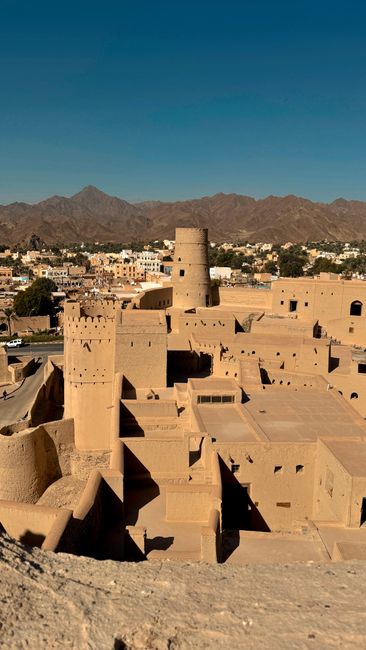
Nizwa, in the interior of northern Oman, is a historic oasis town at the foot of the Hajar Mountains and one of the country’s great centers of learning, religion and trade. For centuries it was the capital of the imams who ruled the interior, and its landmark is Nizwa Fort, built in the mid-17th century, whose massive round tower, 34 m (112 feet) high and 45 m (148 feet) across, rises above a sea of date palms. Beside the fort, the restored Nizwa Souq sells silver, pottery, halwa, dates and frankincense, and every Friday morning farmers and herders gather for a lively livestock auction. Nizwa is also the best base in Oman for exploring the interior: the UNESCO-listed Bahla Fort and the elegant castle of Jabreen are a short drive west, the “Green Mountain,” Jebel Akhdar, rises to the north, and Jebel Shams, Oman’s highest mountain, overlooks the canyon of Wadi Ghul. About 84,000 people live in Nizwa, about 160 km (100 miles) from Muscat. Nizwa has a hot, dry climate: winters from November to March are sunny and pleasant, with cool nights, while summer days are extremely hot, with recorded highs of about 48–50 °C (118–122 °F).
Right now in Nizwa
- Wed 26–40°C 80–104°F Mostly clear
- Thu 26–39°C 78–102°F Mostly clear
- Fri 25–37°C 78–99°F Clear
Weather: MET Norway (CC BY 4.0)
Top tours in Nizwa
See all tours for Nizwa →
From local operators, with prices and reviews; you check availability and book on Viator, our partner. We may earn a commission at no extra cost to you. How we earn money
Nizwa at a glance
- Best months: October to April, with warm, sunny days and cool nights. Summer is extremely hot in the town, though the mountains are cooler.
- Time needed: one day for the fort, souq and Friday market; two or three days with Bahla, Jabreen and Jebel Akhdar or Jebel Shams.
- Getting there: about two hours by road from Muscat; Mwasalat runs intercity buses.
- Costs (as of October 2026): fort tickets are sold at the entrance; the Oman Across Ages Museum in nearby Manah costs OMR 5 (about US$13) for visitors from outside the GCC.
- Before you go: visas, alcohol, dress and medicine rules are covered in our Oman travel guide.
Nizwa areas and who each one suits
The old town, fort and souq
The heart of Nizwa, with the fort, the souq, the Sultan Qaboos Mosque with its blue dome, and lanes of old mud-brick houses and palm gardens. Restored heritage guesthouses make it the most atmospheric place to stay.
The outskirts and the main road
Hotels along the main road toward Muscat and Bahla suit travelers with a car heading to the mountains.
Birkat Al Mouz
About 20 km (12 miles) toward Muscat, at the foot of Jebel Akhdar, this village has abandoned and restored mud-brick quarters, a falaj running through the palm groves and Bayt Al Ridaydah.
Jebel Akhdar
The mountain plateau at about 2,000 m (6,600 feet) has resorts and guesthouses among terraced villages, a cool alternative base, reached only by four-wheel drive.
Top things to see in Nizwa
Nizwa Fort
Built during the reign of Imam Sultan bin Saif bin Malik Al-Ya’rubi (1649–1679), Nizwa Fort is one of the finest works of Omani defensive architecture. Its great round tower, made of stone and sarooj (traditional Omani mortar), is filled with rubble to a height of about 15 m (49 feet) for stability, and its cannon openings gave 360-degree cover. Visitors climb a narrow staircase through seven fortified doors with defensive openings to the top, where the views take in the palm groves, the souq and the mountains. The fort also served as the seat of local government and the residence of the imam, with prisons, a date store, a weapons storeroom and silver and copper craft workshops. It opens Saturday to Thursday from 8 a.m. to 8 p.m., and on Friday from 8 to 11:30 a.m. and from 1:30 to 8 p.m.; buy tickets at the reception desk, and ask about guided tours.
Nizwa Souq
Next to the fort, the souq is divided into sections for fish, meat, vegetables, dates, handicrafts and antiques, in restored buildings around courtyards. Look for silver khanjar daggers and jewelry, Bahla pottery, frankincense, rosewater from Jebel Akhdar and Omani halwa, which you can taste before you buy.
The Friday livestock market
Every Friday from early morning, farmers and herders from the surrounding villages, and even from Jebel Shams and Ibri, bring goats, sheep and sometimes cattle to a small circular pavilion beside the souq. The auction, known locally as al-munadah, starts by about 7 a.m., with animals paraded around the ring while buyers bid; it’s usually over by about 9 or 9:30 a.m. Arrive by 7 a.m., stand at the rail and keep out of the way of the animals, and ask before photographing people.
Bahla Fort
About 40 km (25 miles) west, Bahla Fort was the first site in Oman inscribed on the UNESCO World Heritage List, in 1987. Its oldest parts date from before Islam, and it was expanded by the Nabhani dynasty, who made Bahla their capital. The irregular fort covers about 9,822 m² (2.4 acres) on a hill above a palm oasis, which is enclosed by mud-brick walls more than 12 km (7.5 miles) long with mosques, Quran schools, a market and potters’ workshops. It opens daily from 8 a.m. to 7 p.m., with tickets at the reception desk.
Jabreen Castle
About 20 km (12 miles) from Nizwa and 8 km (5 miles) from Bahla, Jabreen was built in 1675 under Imam Bil’arab bin Sultan Al-Ya’rubi as both a fort and a palace of learning. Its rooms have painted wooden ceilings, carved doors and floral decoration, with meeting halls, a courtroom, date and gunpowder stores, and the Sun and Moon Room used for important consultations. It opens daily from 7:30 a.m. to 9 p.m., with an automated guide and a cafe; buffet meals can be booked in advance.
Bayt Al Ridaydah
At the entrance to Wadi Al-Muaydin, west of Birkat Al Mouz, this 17th-century fortified house has painted ceilings, gypsum carvings, an internal well and the famous Falaj Al-Khatmain flowing through its courtyard. It opens daily from 8:30 a.m. to 10 p.m.
Oman Across Ages Museum
In the wilayat of Manah, about 25 km (16 miles) southeast of Nizwa, this large modern museum presents Oman’s natural heritage, history and culture from prehistory to today with interactive displays. The exhibition halls open Saturday to Thursday from 9 a.m. to 5 p.m. and on Friday from 1:30 to 7 p.m.; tickets cost OMR 1 for GCC citizens, OMR 2 for residents and OMR 5 for other visitors.
Other things to do in Nizwa
- Old town walk: explore the lanes of old Nizwa and the falaj channels among the palms in the early morning.
- Pottery in Bahla: visit workshops where potters still make traditional water jars.
- Al Hamra and Misfat Al Abriyeen: mountain villages of stone and mud-brick houses with terraced gardens and falaj, on the road toward Jebel Shams.
- Tanuf: the ruins of an old village below the mountains, near the source of a popular bottled water.
- Caves and wadis: guided visits to show caves and wadi walks in the foothills.
Food and drink
Try Omani dishes such as shuwa, harees and maqbous at local restaurants, and taste the fresh halwa made in Nizwa’s workshops with sugar, ghee, saffron and rosewater, served with kahwa and dates. Coffee shops around the fort and souq are good for a break, and Jebel Akhdar’s farms sell pomegranates, walnuts and rosewater. Alcohol is only served in some licensed hotels.
Day trips from Nizwa
Jebel Akhdar
The “Green Mountain” plateau, at about 2,000 m (6,600 feet), has terraced villages, fruit orchards and rose gardens; the roses are picked and distilled from March to May. A police checkpoint at the foot of the road allows only four-wheel-drive vehicles to continue. The mountains are up to 15 °C cooler than the lowlands, so bring a warm layer.
Jebel Shams
Oman’s highest mountain rises above the deep canyon of Wadi Ghul, and the balcony walk along the canyon’s rim leads to an abandoned village. The road to the top is partly unpaved near the summit; a 4×4 is recommended. Start early and carry plenty of water.
Bahla and Jabreen
The two great forts make an easy half-day loop west of Nizwa.
Muscat
About two hours by road for the Grand Mosque and Muttrah. See our Muscat guide.
Getting there and getting around
By road
Nizwa is about 160 km (100 miles) from Muscat on a good highway, about two hours by car. Mwasalat intercity buses link Muscat with Nizwa and other towns in the interior; check timetables on the Mwasalat app or website. Muscat International Airport is the nearest international airport. Since early 2026, regional tensions have led to periodic airspace closures across the Gulf, so flights to Muscat can be delayed, rerouted or canceled at short notice; check your flight with the airline before you travel.
Getting around
A rental car is the easiest way to see the forts, villages and mountains around Nizwa; taxis can be hired for the day, and tour operators run trips from Muscat and Nizwa. Roads are good, but watch for camels and goats, especially at night. Mountain roads to Jebel Akhdar need a four-wheel drive, and off-road tracks need a well-equipped 4×4, water and a phone.
When to go and how long to stay
October to April is the best time, with sunny days and cool nights; in midwinter, temperatures in Nizwa have fallen to about 5 °C (41 °F), and the mountains are colder still. May to September is extremely hot, with recorded highs of about 48–50 °C (118–122 °F) in the town, so plan sightseeing for early morning and spend the hottest hours indoors, or head up to Jebel Akhdar, which is up to 15 °C cooler. Rain is rare in the town but falls in sudden storms, mostly between October and March, and in summer thunderstorms over the mountains, which can flood wadis quickly.
| Month | Lowest recorded | Highest recorded |
|---|---|---|
| Jan | 5 °C (41 °F) | 34 °C (93 °F) |
| Feb | 5 °C (40 °F) | 37 °C (98 °F) |
| Mar | 6 °C (42 °F) | 43 °C (110 °F) |
| Apr | 14 °C (56 °F) | 46 °C (114 °F) |
| May | 18 °C (65 °F) | 48 °C (119 °F) |
| Jun | 21 °C (70 °F) | 49 °C (120 °F) |
| Jul | 21 °C (70 °F) | 50 °C (122 °F) |
| Aug | 21 °C (70 °F) | 48 °C (119 °F) |
| Sep | 19 °C (67 °F) | — |
| Oct | 13 °C (56 °F) | 43 °C (110 °F) |
| Nov | 10 °C (51 °F) | 37 °C (99 °F) |
| Dec | 6 °C (43 °F) | 38 °C (100 °F) |
Temperatures are the lowest and highest readings that Oman’s Directorate General of Meteorology reports for each month at its Nizwa station over 2013–2024; September’s maximum is left out as an apparent data error. Oman’s published normals don’t include reliable average highs and lows or rainfall for Nizwa; on Jebel Akhdar, the Saiq station’s 1991–2020 normals submitted to the World Meteorological Organization show about 286 mm (11.3 inches) of rain a year, with peaks in July and August and from March to May.
Events worth planning around
- Friday livestock market (every Friday morning): the busiest day in the souq.
- Rose season on Jebel Akhdar (March to May): rose picking and distilling in the mountain villages.
- Eid markets: the days before Eid al-Adha bring the biggest livestock auctions of the year, with Eid expected about 16 May 2027.
- Ramadan: in 2027 expected from about 8 February to 9 March; fort and souq hours change.
Dates change each year; check locally.
How long to stay: 1, 2 and 3 days
- One day: the Friday market at dawn, the souq, Nizwa Fort, and Bahla and Jabreen in the afternoon.
- Two days: add Jebel Akhdar’s villages and rose gardens, or Birkat Al Mouz and Bayt Al Ridaydah.
- Three days: add Jebel Shams, the balcony walk and Al Hamra.
Where to stay in Nizwa
- Old town heritage guesthouses: restored mud-brick houses close to the fort and souq.
- Hotels on the outskirts: modern hotels with parking, convenient for day trips.
- Jebel Akhdar resorts: cool mountain hotels and guesthouses with canyon views.
- Jebel Shams camps and lodges: simple stays near the canyon rim.
Book ahead for winter weekends and Eid holidays, and compare total prices with taxes.
Typical costs in Nizwa
| Item (as of October 2026) | Omani rials | About US dollars |
|---|---|---|
| Oman Across Ages Museum, non-GCC visitors | OMR 5 | $13 |
| Omani halwa, 500 g | about OMR 2–5 | about $5–13 |
| 4×4 rental, per day | about OMR 25–45 | about $65–117 |
| Casual restaurant meal | about OMR 2–5 | about $5–13 |
| Heritage guesthouse or mid-range hotel, per night | about OMR 30–60 | about $78–156 |
The museum fee is the Ministry of Heritage and Tourism’s published price; the other items are typical ranges. Fort tickets are sold at the entrance. The rial is worth about US$2.60.
Safety in Nizwa
Nizwa is calm and safe, with low crime. The main risks come from heat, wadis and mountain roads.
- Heat: in summer, recorded highs reach about 50 °C (122 °F); heat has caused deaths among hikers in Oman. Start walks at dawn, carry plenty of water and rest in the shade.
- Wadis and flash floods: never enter a wadi when rain is forecast, or for at least a day afterward; never cross flowing water, and if caught, climb to high ground. Follow the Royal Oman Police and the Civil Defence and Ambulance Authority.
- Mountain roads: use a 4×4 where required, low gears on descents, and avoid driving after dark.
- Hiking: follow marked trails, especially near the cliff edges of Jebel Shams.
- Dress codes: cover shoulders and knees in the town, the souq and villages; the interior is conservative.
- Alcohol, drugs, vapes and medicines: drinking in public and drink-driving are illegal, drug penalties are severe, e-cigarettes are banned, and some medicines are illegal; carry prescriptions.
- Photography: ask before photographing people, especially at the livestock market, and avoid military sites.
- Flight disruptions: since early 2026, regional tensions have led to periodic airspace closures across the Gulf, and flights can be delayed, rerouted or canceled at short notice. Check your flight with the airline before you travel.
- Emergencies: call 9999 for police, ambulance and fire.
Practical tips for Nizwa
- Time zone: Gulf Standard Time (UTC+4) all year.
- Weekend: Friday and Saturday; the fort closes between Friday prayers.
- Money: carry cash for the souq and village stalls; cards work in hotels and larger shops.
What to pack for Nizwa
Pack loose clothes that cover shoulders and knees, sturdy shoes for the fort’s steep stairs and mountain trails, a hat, sunglasses and sunscreen, and a warm jacket for winter nights and the mountains. Carry a refillable water bottle, and medicines with your prescription.
Nizwa travel FAQ
What are Nizwa Fort’s opening hours?
Saturday to Thursday, 8 a.m. to 8 p.m.; Friday, 8 to 11:30 a.m. and 1:30 to 8 p.m.
When is the Nizwa goat market?
Every Friday morning; the auction starts by about 7 a.m. and is usually finished by 9 or 9:30 a.m.
Is Bahla Fort a UNESCO site?
Yes. It was the first site in Oman inscribed on the World Heritage List, in 1987.
How far is Nizwa from Muscat?
About 160 km (100 miles), roughly two hours by road.
Do I need a 4×4 for Jebel Akhdar?
Yes. A police checkpoint at the foot of the mountain road lets only four-wheel-drive vehicles continue.
When is the rose season on Jebel Akhdar?
From March to May, when the roses bloom and are distilled into rosewater.
Can I swim in the wadis near Nizwa?
In dry weather, at some pools, with care and modest swimwear. Never enter a wadi when rain is forecast.
What is the best time to visit Nizwa?
October to April, when days are warm and nights are cool.
What should I buy in Nizwa Souq?
Omani halwa, dates, silver, khanjar daggers, frankincense, rosewater and Bahla pottery.
How long should I stay in Nizwa?
One day for the fort, souq and market; two or three days to add Bahla, Jabreen and the mountains.
Sources and last review
Researched and last reviewed on 5 October 2026. Nizwa Fort’s history, dimensions, design, facilities and opening hours, Bahla Fort’s history, size, oasis walls and hours, Jabreen Castle, Bayt Al Ridaydah, the Oman Across Ages Museum’s hours and fees, the rose season and Jebel Akhdar’s temperatures come from the Ministry of Heritage and Tourism’s Experience Oman website; Bahla’s World Heritage listing from UNESCO; the Friday livestock market’s timing and auction from the Oman Observer (state-owned newspaper; secondary); wadi floods, heat, driving and emergency numbers from GOV.UK’s Oman travel information (updated 22 July 2026); airspace disruption from the European Union Aviation Safety Agency; temperature extremes from Oman’s Directorate General of Meteorology and Jebel Akhdar rainfall from the 1991–2020 normals Oman submitted to the World Meteorological Organization; population from Wikidata. The fort ticket price, the Jebel Akhdar checkpoint, Jebel Shams details, Al Hamra, Misfat Al Abriyeen, Tanuf, distances, bus services, Eid and Ramadan 2027 dates and typical prices are general references and flagged for checking. For entry rules and money, see our Oman travel guide.
Plan your trip
Partner links: TravelerCenter may earn a commission if you book, at no extra cost to you.
🇪🇬 Useful Arabic phrases for Nizwa
All 38 Arabic phrases: restaurant, hotel, emergencies, romance (printable) →