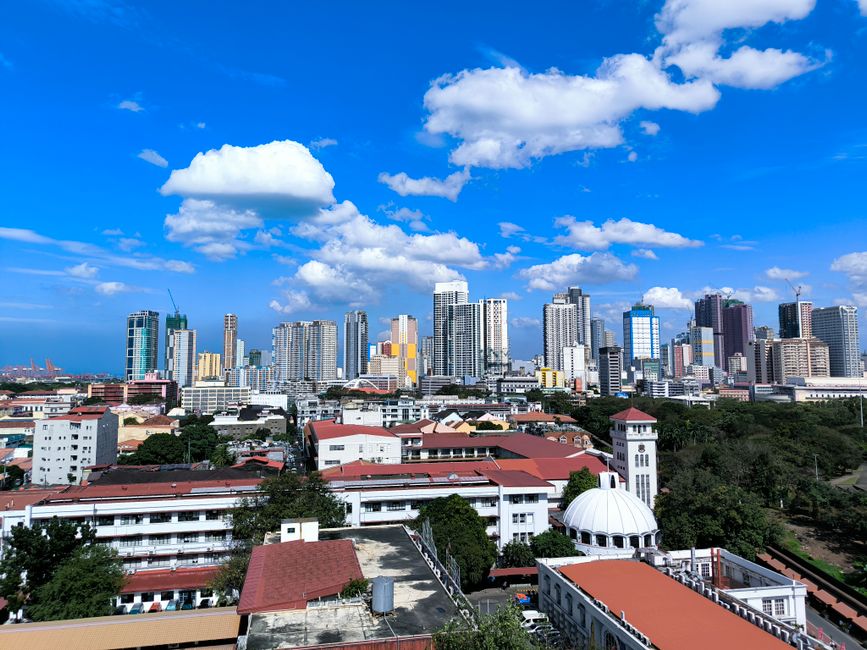
Manila, the capital of the Philippines, is a big, loud, warm-hearted city on the eastern shore of Manila Bay, and the point where most journeys to the islands begin. The City of Manila itself is the historic core of Metro Manila, a sprawling region of 16 cities and one municipality with more than 13 million people, and it holds the country’s deepest layers of history: the walled Spanish city of Intramuros, founded in 1571, with its stone churches and ramparts; Binondo, often called the world’s oldest Chinatown; the grand neoclassical buildings of the National Museum around Rizal Park; and a waterfront famous for its sunsets. Beyond the old city, the business districts of Makati and Bonifacio Global City (BGC) offer rooftop bars, malls and international restaurants, and the bayfront of Pasay has the vast Mall of Asia and casino resorts. Manila rewards a couple of days of exploring before you fly on, especially if you come for its food, its museums and its people. The driest months are January to April; from June to October the southwest monsoon and typhoons bring heavy rain and floods.
Right now in Manila
- Wed 25–31°C 77–89°F 7 mm Heavy showers
- Thu 25–31°C 77–87°F 17 mm Heavy showers
- Fri 24–29°C 76–84°F 3 mm Light rain
Weather: MET Norway (CC BY 4.0) · Sea temperature: NOAA CoastWatch
Top tours in Manila
See all tours for Manila →
From local operators, with prices and reviews; you check availability and book on Viator, our partner. We may earn a commission at no extra cost to you. How we earn money
Manila at a glance
- Best for: Spanish colonial history, museums, street food in Binondo, malls and nightlife, and a stopover between flights.
- How long: 2 to 3 days for Intramuros, the museums, Binondo and Makati or BGC; 4 or more with day trips to Tagaytay, Corregidor or Pampanga.
- Best time: December to April, when it is dry; highs reach about 34 °C (93 °F) in April and May, and July to September are the wettest months.
- Getting there: Ninoy Aquino International Airport (NAIA) is in Pasay and Parañaque, roughly 30 to 90 minutes from the main districts depending on traffic.
- Getting around: Grab cars, taxis, the LRT and MRT rail lines, jeepneys and, in the old city, on foot or by pedicab and e-trike.
- Good to know: check your NAIA terminal before you travel; Philippine Airlines, Cebu Pacific and foreign airlines use different terminals that are not connected airside.
- Before you go: eTravel registration, visa-free stays, money and general safety are in our Philippines travel guide.
Manila’s areas and where to stay
Metro Manila is a collection of cities rather than one center, and traffic between them can be slow, so choose a base near what you want to do.
Intramuros and Ermita
Intramuros, the old walled city on the south bank of the Pasig River, is Manila’s historic heart, with its churches, museums, cobbled streets and walls. A few heritage hotels and guesthouses stand inside the walls. Just south, Ermita and Rizal Park hold the National Museum complex and the bayfront.
Malate and the Manila Bay waterfront
Malate is a bohemian old district of restaurants, bars and mid-range hotels along Roxas Boulevard, the bayfront avenue. It is the best-placed area for sunsets, Intramuros and the museums, though it is grittier than the business districts.
Binondo and Quiapo
Across the river, Binondo’s Chinatown and the market district of Quiapo are busy, crowded and full of food; few travelers stay here, but they make a great half day.
Makati
Makati is Manila’s financial district, with the Ayala Center malls, Greenbelt’s gardens and restaurants, international hotels, Salcedo and Legazpi weekend markets, and the nightlife of Poblacion. It is the most practical base for first-time visitors, about 30 to 60 minutes from the airport.
Bonifacio Global City (BGC)
BGC, in Taguig, is a newer, walkable district of wide sidewalks, high-rises, malls, parks and restaurants. It feels the most orderly part of Manila, though it is farther from the old city.
Pasay and the Bay Area
Near the airport, the reclaimed Bay Area has the SM Mall of Asia, the casino resorts of Entertainment City and many hotels, convenient for short stopovers and early flights.
Top things to see in Manila
Intramuros
Built by the Spanish from 1571 as the seat of their colonial government, Intramuros was a city of churches, convents and mansions inside 4.5 km (2.8 miles) of stone walls. Much of it was destroyed in the Battle of Manila in 1945, but the walls, gates and many buildings have been restored by the Intramuros Administration. Walk or rent a bamboo bicycle along General Luna Street and the ramparts, or take a pedicab or e-trike tour; the free visitor desk at the Centro de Turismo Intramuros opens daily from 9 a.m. to 6 p.m.
Fort Santiago
At the northern tip of Intramuros, at the mouth of the Pasig River, Fort Santiago was the Spanish citadel and later a prison, where the national hero José Rizal spent his last night before his execution in 1896; a shrine and museum tell his story. According to the Intramuros Administration, the fort opens from 8 a.m. to 10 p.m. on weekdays (last entry 8 p.m.) and from 6 a.m. to 10 p.m. on weekends (last entry 8:30 p.m.), and entry costs ₱75 (₱50 for students, seniors and persons with disabilities).
San Agustin Church and the Manila Cathedral
San Agustin Church, completed in the early 17th century, is the oldest stone church in the country and one of the four churches inscribed by UNESCO as the Baroque Churches of the Philippines; its trompe-l’oeil ceiling and adjoining museum are highlights. A few blocks away, the Manila Cathedral faces Plaza de Roma. Dress modestly and avoid visiting during masses.
Casa Manila and the Intramuros museums
Casa Manila recreates a 19th-century mansion of a wealthy family, with period furniture around a courtyard. According to the Intramuros Administration, it opens Tuesday to Sunday from 9 a.m. to 6 p.m. and is closed on Mondays, as is the Museo de Intramuros, a museum of religious art; a combined ticket for the Museo de Intramuros and the Centro de Turismo museum costs ₱150 (₱120 concession). The Baluarte de San Diego, a restored bastion with gardens, opens daily from 8 a.m. to 5 p.m.
The National Museum and Rizal Park
Three grand buildings on the edge of Rizal Park make up the National Museum of the Philippines in Manila: the National Museum of Fine Arts, with Juan Luna’s huge painting Spoliarium; the National Museum of Anthropology, with archaeological treasures such as the Manunggul burial jar; and the National Museum of Natural History, with its “Tree of Life” atrium. Entry has traditionally been free, but check opening days and booking on the museum’s website. Rizal Park (Luneta), next door, has the Rizal Monument and gardens.
Binondo, Chinatown
Founded in 1594 for Chinese merchants, Binondo is a dense district of bakeries, dumpling houses, tea shops, gold stores and temples around the Binondo Church. Join a food walk or wander Ongpin Street and Escolta, where art deco buildings now house creative spaces.
Quiapo Church and the markets
Quiapo Church holds the Black Nazarene, a dark wooden statue of Christ carried through the streets by huge crowds every January 9. Around it, Quiapo’s markets sell everything from herbs and amulets to handicrafts under Quezon Bridge. Watch your belongings in the crowds.
More classic sights
- Manila Bay sunset: watch from the Manila Baywalk along Roxas Boulevard, from the Mall of Asia seaside or from a rooftop bar.
- Ayala Museum: in Makati, with dioramas of Philippine history and a gold collection of pre-colonial artifacts.
- Metropolitan Theater and the Manila Post Office: art deco and neoclassical landmarks by the Pasig River.
- American Cemetery and Memorial: in Taguig, the largest American military cemetery of World War II outside the United States.
- Bonifacio High Street and the Mind Museum area: BGC’s open-air promenade of shops and cafés.
Other things to do in Manila
Food and drink
Manila is the best place to sample Filipino food from every region. Try sisig, sizzling chopped pork; adobo and sinigang; kare-kare; lechon; pancit noodles; and halo-halo for dessert. In Binondo, look for siopao buns, fried dumplings and hopia pastries; in Makati and BGC, modern Filipino restaurants reinvent classics. Weekend markets such as the Salcedo Saturday Market and Legazpi Sunday Market in Makati sell regional food, and food halls in the malls are cheap and air-conditioned. Poblacion in Makati and BGC have the liveliest bars; try local craft beer, calamansi cocktails or Filipino rum.
Shopping and malls
Malls are Manila’s public squares, packed on weekends and especially before Christmas. The SM Mall of Asia by the bay, Greenbelt and Glorietta in Makati, and SM Megamall and Greenhills in the east are the giants; Greenhills and Divisoria are known for bargains, and Quiapo for handicrafts.
Festivals
The Feast of the Black Nazarene on January 9 draws millions to Quiapo. Chinese New Year brings dragon dances to Binondo, Holy Week fills the churches, and Christmas lights and lanterns decorate the city from September. June 24 is Manila Day, marking the city’s founding.
Tours and experiences
Walking and food tours of Intramuros and Binondo, cooking classes, river cruises on the Pasig and sunset cruises on Manila Bay are popular. See our city sightseeing guide.
Day trips from Manila
- Tagaytay and Taal: a ridge town 60 km (37 miles) south, about 2 hours by road, with cool air, bulalo soup and views over Taal Lake and Taal Volcano. In early October 2026, PHIVOLCS kept Taal at Alert Level 1, and entry to Taal Volcano Island and boating on the lake were not allowed.
- Corregidor: the fortified island at the mouth of Manila Bay, scene of World War II battles, reached on organized day trips by boat.
- Pampanga: the culinary capital of the country, about 2 hours north, for sisig, Kapampangan cooking and, in some villages, Holy Week rituals.
- Pagsanjan Falls: a boat ride up a gorge to a waterfall in Laguna, about 3 hours away.
- Las Casas Filipinas de Acuzar: a heritage resort in Bataan of reassembled Spanish-era houses, about 3 to 4 hours away.
Getting there and getting around
By air
Ninoy Aquino International Airport (NAIA, MNL) has three terminals, run by the New NAIA Infra Corp. In October 2026, according to the operator’s airline list, Philippine Airlines uses Terminal 1 for international flights and Terminal 2 for domestic flights, Cebu Pacific uses Terminal 3 for everything, AirAsia Philippines is listed at Terminals 1 and 2, and foreign airlines use Terminal 1 or 3. A free shuttle links the terminals hourly, around the clock, for connecting passengers. Clark International Airport, about 2 hours north, is an alternative for some low-cost flights; Genesis buses link NAIA Terminal 3 and Clark.
From the airport
The airport lists several options at each terminal: coupon taxis with fixed fares by destination; yellow metered airport taxis, from ₱75 for the first 500 m plus ₱4 for every 300 m; regular metered taxis, from ₱45; Grab cars and Grab’s fixed-fare “Airport to Anywhere” service; point-to-point buses such as UBE Express from Terminal 3 to Makati, Manila and PITX; and the ₱40 Airport Loop bus to the MRT-3 station in Pasay. Keep the dispatch slip that taxi staff give you. Allow at least an hour to Makati or Manila at busy times.
Rail, jeepneys and the river ferry
Three elevated lines help beat the traffic: LRT-1 runs north–south along Taft Avenue through Ermita (for Intramuros and the museums) and Pasay, MRT-3 runs along EDSA through Makati and Ortigas, and LRT-2 runs east from Recto. Fares are cheap, but trains are crushingly full at rush hour. Jeepneys, the colorful shared minibuses, cover fixed routes for a few pesos, and the Pasig River Ferry links Intramuros with points upriver.
Grab and taxis
Grab covers all of Metro Manila and is the most convenient way to get around, with fares shown upfront; its Move It motorcycle taxis are quicker in traffic. Metered taxis are plentiful; insist on the meter. Traffic is heaviest from about 7 to 10 a.m. and 5 to 9 p.m., and on Friday evenings and before holidays.
When to go and how long to stay
Manila has a sharp dry season and wet season. According to PAGASA, the national weather agency, the rainy season runs from June to November and the dry season from December to May; in 2026 PAGASA declared the start of the rainy season on June 4. The table uses PAGASA’s 1991–2020 normals for its Port Area station on Manila Bay, as submitted to the World Meteorological Organization (WMO).
| Month | Average high / low | Rain (days with 1 mm or more) | What to expect |
|---|---|---|---|
| January | 30 °C (86 °F) / 24 °C (75 °F) | 19 mm (0.8 in), 3 days | Dry and comfortable; Feast of the Black Nazarene |
| February | 31 °C (87 °F) / 24 °C (76 °F) | 22 mm (0.9 in), 2 days | The driest, most pleasant month |
| March | 32 °C (90 °F) / 25 °C (78 °F) | 22 mm (0.9 in), 3 days | Hot and dry; Holy Week in some years |
| April | 34 °C (93 °F) / 27 °C (80 °F) | 23 mm (0.9 in), 3 days | Very hot; the city empties over Holy Week |
| May | 34 °C (92 °F) / 27 °C (81 °F) | 159 mm (6.3 in), 9 days | Hottest stretch; first storms |
| June | 33 °C (91 °F) / 27 °C (80 °F) | 253 mm (10.0 in), 14 days | Rainy season begins |
| July | 32 °C (89 °F) / 26 °C (79 °F) | 432 mm (17.0 in), 19 days | Monsoon rain; typhoons possible |
| August | 31 °C (88 °F) / 26 °C (78 °F) | 492 mm (19.4 in), 19 days | The wettest month; floods likely |
| September | 31 °C (88 °F) / 26 °C (78 °F) | 396 mm (15.6 in), 18 days | Wet; typhoon peak |
| October | 31 °C (89 °F) / 26 °C (78 °F) | 221 mm (8.7 in), 14 days | Rain easing; typhoons still possible |
| November | 31 °C (88 °F) / 25 °C (78 °F) | 120 mm (4.7 in), 10 days | Drying out; Christmas decorations everywhere |
| December | 30 °C (87 °F) / 25 °C (76 °F) | 98 mm (3.9 in), 8 days | Pleasant; very busy before Christmas |
Port Area gets about 2,260 mm (89 in) of rain a year, almost all of it from May to November. Downpours flood low-lying streets quickly, snarling traffic for hours. PAGASA said in September 2026 that a strong El Niño was expected to bring below-normal rainfall to most of the country into early 2027, though the monsoon and storms can still soak the west.
2 days in Manila
Day one, Intramuros in the morning, with Fort Santiago, San Agustin Church and Casa Manila, then the National Museum of Fine Arts and Anthropology after lunch, and sunset on Manila Bay with dinner in Malate. Day two, a food walk through Binondo and Quiapo, then Makati’s Ayala Museum and Greenbelt, and drinks in Poblacion or BGC.
4 days with day trips
Add a day in Tagaytay for the Taal views and a day on Corregidor or in Pampanga for its food.
Where to stay in Manila
- Makati: the widest choice of international and mid-range hotels, restaurants and nightlife; the easiest first base.
- BGC: modern hotels and serviced apartments in a walkable district.
- Malate and Ermita: mid-range and budget hotels close to Intramuros, the museums and the bay.
- Intramuros: a few heritage hotels inside the walls for history lovers.
- Pasay and the Bay Area: big resorts, casinos and airport hotels for short stays.
Rooms are cheapest in the rainy season and most expensive around Christmas and major events.
What a trip to Manila costs
Prices are approximate, for October 2026, converted at about ₱62.6 to the US dollar.
| Item | Typical cost |
|---|---|
| LRT or MRT ride | ₱15–35 (about US$0.25–0.55) |
| Jeepney ride | from about ₱13 (about US$0.20) |
| Airport Loop bus to Pasay MRT | ₱40 (about US$0.65) |
| Grab from NAIA to Makati | ₱350–700 (about US$5.60–11) |
| Fort Santiago entry | ₱75 (about US$1.20) |
| Museo de Intramuros and Centro de Turismo ticket | ₱150 (about US$2.40) |
| Meal at a food court or carinderia | ₱150–300 (about US$2.40–4.80) |
| Dinner in a mid-range restaurant | ₱700–1,500 (about US$11–24) per person |
| Mid-range hotel in Makati, per night | ₱3,500–7,000 (about US$56–112) |
Practical tips for Manila
- Plan around traffic: group sights by area, travel outside rush hours and use the rail lines where you can.
- Check your terminal: NAIA’s terminals are far apart by road; confirm yours on your booking before heading to the airport.
- Keep small bills: jeepneys, pedicabs and small eateries want cash, and drivers often lack change for ₱1,000 notes.
- Dress for churches: cover shoulders and knees in San Agustin, the cathedral and Quiapo.
- Book museums early: the National Museum can limit visitor numbers on weekends; reserve online if possible.
Safety
Manila is generally safe for visitors who take city precautions. Pickpocketing and bag snatching happen in crowds, on jeepneys and trains, and around Quiapo, Divisoria and Baclaran; keep phones out of sight near the road. Use Grab, airport taxis or hotel cars rather than unmarked vehicles, and be wary of strangers who offer drinks, invitations or “friendly” card games, which are sometimes used to drug and rob visitors. During the rainy season, floods can rise quickly in low-lying streets; avoid wading through floodwater, which carries leptospirosis. Follow PAGASA’s tropical cyclone wind signals and local announcements when a typhoon approaches, as flights, ferries and schools may be suspended. The heat from March to May is intense, so drink plenty of water. Dengue occurs in the city, so use repellent. In an emergency, call 911.
What to pack for Manila
Light, breathable clothes, a compact umbrella or rain jacket for the wet season, comfortable shoes for Intramuros’s cobbles, a hat and sunscreen, and a light layer for the air-conditioned malls and buses. Cover shoulders and knees for churches. The Philippines uses 220 V and mostly flat two-pin US-style plugs (types A and B). See our rain jackets and travel adapters guides.
Manila travel FAQ
How many days do I need in Manila?
Two days cover Intramuros, the National Museum, Binondo and Makati; add one or two more for day trips to Tagaytay, Corregidor or Pampanga.
How much is Fort Santiago?
₱75 for adults and ₱50 for students, seniors and persons with disabilities, according to the Intramuros Administration. It opens from 8 a.m. on weekdays and 6 a.m. on weekends until 10 p.m.
Which NAIA terminal do I need?
In October 2026, Philippine Airlines uses Terminal 1 for international and Terminal 2 for domestic flights, Cebu Pacific uses Terminal 3, and foreign airlines use Terminal 1 or 3. Check your booking, as assignments change.
How do I get from NAIA to Makati?
By Grab or taxi in about 30 to 60 minutes, by UBE Express bus from Terminal 3, or by the ₱40 Airport Loop bus to the Pasay MRT station and then MRT-3 north to Makati.
Is there Grab in Manila?
Yes. Grab cars and Move It motorcycle taxis operate across Metro Manila, and Grab runs a fixed-fare “Airport to Anywhere” service at NAIA.
Where is the best place to stay in Manila?
Makati or BGC for comfort, restaurants and nightlife; Malate or Intramuros to be near the historic sights and the bay; the Bay Area for short stopovers near the airport.
What is the best time to visit Manila?
December to April, during the dry season; February is usually the most pleasant month. August is the wettest, and July to October is the typhoon peak.
Is Manila safe for tourists?
Yes, with normal city precautions: watch for pickpockets in crowds, use Grab or official taxis, be careful with offers of drinks from strangers, and avoid floodwater in the rainy season.
Can I visit Taal Volcano from Manila?
You can see it from Tagaytay, about 2 hours south. In early October 2026, PHIVOLCS kept Taal at Alert Level 1, and entering Taal Volcano Island and boating on Taal Lake were not allowed.
What food should I try in Manila?
Sisig, adobo, sinigang, kare-kare, lechon and halo-halo, plus dumplings and hopia in Binondo and modern Filipino cooking in Makati and BGC.
Sources and last review
Researched and last reviewed on 4 October 2026. Fort Santiago, Casa Manila, Baluarte de San Diego and Intramuros museum hours and fees: the Intramuros Administration; NAIA terminal assignments, the inter-terminal shuttle, taxi rates and airport buses: the New NAIA Infra Corp; Grab coverage: Grab Philippines; seasons, the 2026 rainy-season onset and the El Niño outlook: PAGASA, with climate normals via the World Meteorological Organization; Taal alert level and restrictions: PHIVOLCS; San Agustin’s World Heritage listing: UNESCO; exchange rate: the European Central Bank. National Museum admission, rail fares, history, festival details, day-trip times and typical prices are general references or estimates, flagged for checking. Prices and hours change, so check the official sites before you go. For entry rules, money and general safety, see our Philippines travel guide.
Plan your trip
Partner links: TravelerCenter may earn a commission if you book, at no extra cost to you.
🇵🇭 Useful Filipino phrases for Manila
All 38 Filipino phrases: restaurant, hotel, emergencies, romance (printable) →