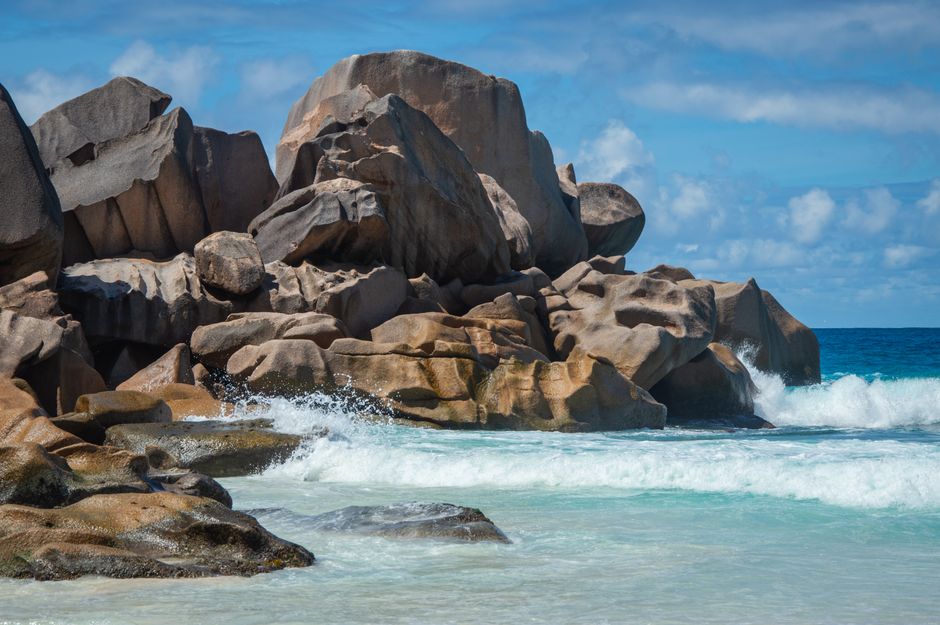
La Digue is the island that many people picture when they think of Seychelles: giant, sculpted granite boulders glowing pink and gray in the late afternoon light, framing beaches of soft white sand and shallow, glassy water. The most famous of them, Anse Source d’Argent, is one of the most photographed beaches in the world. The fourth-largest inhabited island of the archipelago, just 7 km (4 miles) from Praslin and a 15-minute ferry ride away, La Digue is small, about 5 km (3 miles) long and 3 km (2 miles) wide, with roughly 2,000 inhabitants and a pace of life that feels decades behind the rest of the world. There are very few cars; people get around by bicycle, on foot or in small electric buggy taxis, and cycling between beaches along quiet coastal lanes is the essence of a stay here. Beyond Anse Source d’Argent, the island has the old plantation of L’Union Estate, the wild, wave-pounded beaches of the east coast, forest walks to its highest point, Nid d’Aigle, and a reserve for the rare paradise flycatcher. Offshore, the islands of Félicité, Coco and the Sisters offer some of the best snorkeling in Seychelles. Stay at least two nights to enjoy the island after the day-trippers leave. April, May, October and November are usually the calmest months.
Right now in La Digue
- Wed 26–28°C 78–82°F 13 mm Heavy rain
- Thu 25–28°C 78–82°F 10 mm Partly cloudy
- Fri 27–29°C 80–83°F 14 mm Partly cloudy
Weather: MET Norway (CC BY 4.0) · Sea temperature: NOAA CoastWatch
Top tours in La Digue
See all tours for La Digue →
From local operators, with prices and reviews; you check availability and book on Viator, our partner. We may earn a commission at no extra cost to you. How we earn money
La Digue at a glance
- Best months: April to May and October to November for calm seas and clear water; May to September is drier but windier; December to March is wetter.
- Getting there: about 15 minutes by ferry from Praslin, and about 1 hour 10 minutes to 1 hour 45 minutes from Mahé by Cat Cocos, according to the operator; helicopters also fly from Mahé.
- Getting around: by bicycle, on foot or by electric buggy taxi; there are very few cars.
- Where to stay: guesthouses and small hotels around La Passe and La Réunion; a few upscale resorts.
- Time needed: two to three nights, or a day trip from Praslin.
- Costs (as of October 2026): bicycle rental costs about SCR 150–200 (US$10–14) a day; guesthouse doubles from about SCR 1,500 (US$100) a night.
- Before you go: the Travel Authorization, the visitor’s permit, money and ferries are covered in our Seychelles travel guide.
La Digue’s areas and who each one suits
La Passe
The village around the jetty is La Digue’s little hub, with bicycle rental stands, guesthouses, small shops, takeaways, a bank, cafés and the police station. Everything is within a short walk or ride, and boats leave from here for the islands. It is the most convenient base.
La Réunion and the west coast
South of La Passe, along the flat coastal road to L’Union Estate, guesthouses and small hotels sit among gardens and palm trees, close to the Veuve Nature Reserve and a few minutes’ ride from Anse Source d’Argent. It is quieter than La Passe but still central.
The east coast: Grand Anse, Petite Anse and Anse Cocos
The southeast coast faces the open ocean, with wide beaches, big surf and few buildings. There is little accommodation here, but it is a highlight of any visit, reached by bicycle and on foot.
The north: Anse Severe and Anse Patates
A coastal road loops around the north of the island past calm, sheltered coves good for snorkeling, with a few hotels and guesthouses.
Top things to see on La Digue
Anse Source d’Argent
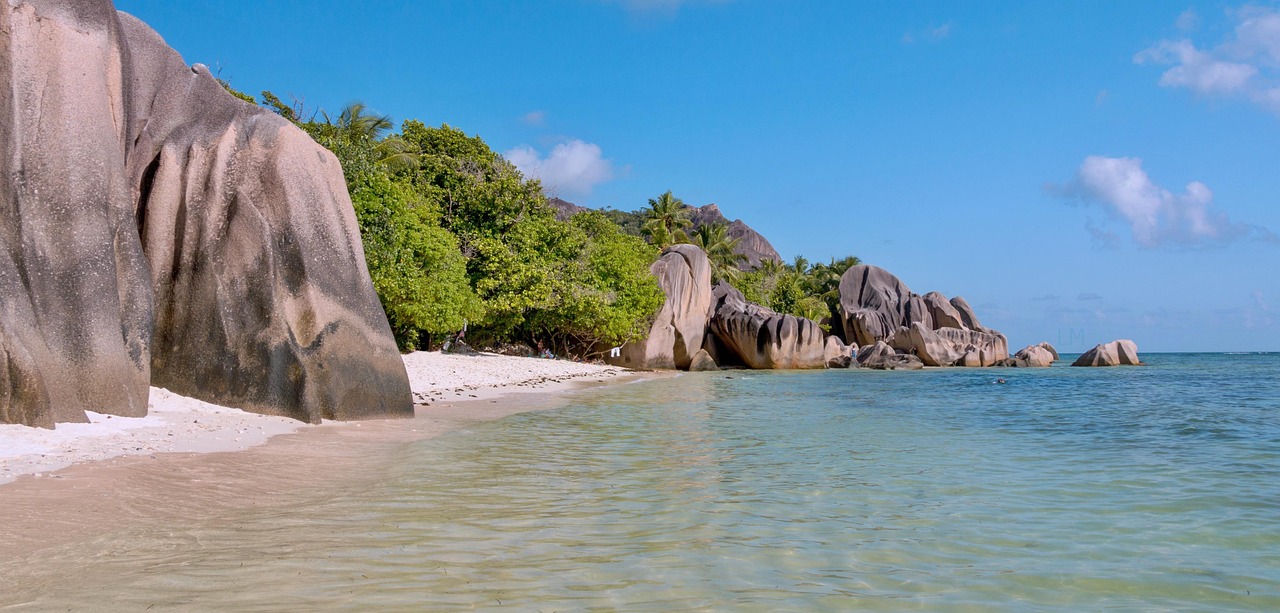
On the southwest coast, Anse Source d’Argent is a series of small coves of white sand set among huge granite boulders, with shallow, crystal-clear water protected by a reef. It is perfect for wading and photography, but the water is very shallow, especially at low tide, so it is better for paddling than swimming laps; check the tide times and come at high tide for swimming. Late afternoon brings the warmest light, and early morning the fewest people. The only access by land is through L’Union Estate, which charges an entrance fee.
L’Union Estate
The old coconut plantation that once powered La Digue’s economy is now a heritage park on the way to Anse Source d’Argent. You can see the traditional copra mill, where coconut flesh was dried and pressed for oil, a vanilla plantation, the colonial plantation house, an old cemetery, giant tortoises in a pen and a huge granite boulder that often appears in photos. The entrance fee covers the estate and the beaches beyond it.
Grand Anse, Petite Anse and Anse Cocos
The southeast coast has three spectacular, undeveloped beaches. Grand Anse is a long sweep of sand with powerful waves and a beach café, reached by bicycle along a hilly road. From there, a short trail over the rocks leads to Petite Anse, and another 20–30 minutes on to Anse Cocos, with a natural pool among the rocks at one end. These beaches are beautiful but exposed to the ocean swell, especially in the southeast trade-wind season, with dangerous currents; swim only when the sea is calm, and only in sheltered spots.
Nid d’Aigle and Belle Vue
The road and trail climb steeply from La Passe through forest to Belle Vue, a viewpoint over Praslin and the islands, and on to Nid d’Aigle (Eagle’s Nest), La Digue’s highest point at 333 m (1,093 ft). The climb is hot and steep; start early and carry water.
Veuve Nature Reserve
This small reserve near La Réunion protects the forest habitat of the Seychelles paradise flycatcher, known locally as the “veuve” (widow) for the male’s long black tail feathers. La Digue is its main stronghold. A short trail and an information center make it easy to visit; the birds are most active in the morning.
Anse Severe and Anse Patates
In the north of the island, these smaller beaches are good for swimming and snorkeling in calm weather, with turtles and reef fish around the rocks; Anse Patates is also a favorite sunset spot.
Other things to do on La Digue
- Cycling: the island’s main activity; ride the flat west coast road to L’Union Estate, loop around the north coast, or tackle the hilly road to Grand Anse.
- Snorkeling trips: boats from La Passe visit Coco Island, Félicité, Marianne and the Sisters, some of the best snorkeling in the Inner Islands, often with a barbecue lunch.
- Diving: a small dive center runs trips to granite reefs and islets around La Digue.
- Hiking: the trail from Grand Anse to Anse Cocos and the climb to Nid d’Aigle.
- Church of Our Lady of the Assumption: La Digue’s Catholic church in La Passe is the center of the island’s August 15 festival.
- Sunset watching: at Anse Severe, Anse Patates or the jetty.
Food and drink
La Digue’s food is simple and good. Takeaways in La Passe and along the main roads sell inexpensive Creole lunch boxes of fish curry, grilled fish, octopus, lentils and rice; beach cafés at Grand Anse and Anse Source d’Argent serve fresh juices, grilled fish and salads. Several small restaurants and guesthouses offer Creole dinners and grilled seafood, and a few hotels have more upscale dining. Fresh fruit and coconuts are sold from roadside stalls. Small supermarkets in La Passe stock basics, but choice is limited and prices are high; most guesthouses offer breakfast or half board.
Day trips from La Digue
Praslin
Just 15 minutes by ferry, Praslin has the Vallée de Mai World Heritage Site and Anse Lazio; take a taxi or bus between them.
Félicité, Coco and the Sisters
Full-day boat trips from La Passe to the islands northeast of La Digue, with snorkeling among granite boulders and reef fish, and lunch on the beach. Coco Island is a protected marine area.
Curieuse and Cousin
Boat trips from La Digue and Praslin visit the tortoises and mangroves of Curieuse and the seabird reserve of Cousin; check days and times locally.
Mahé
Direct ferries make a return trip to Mahé possible, but it is a long day; most travelers visit Mahé at the start or end of their trip.
Getting there and getting around
By sea and air
Cat Cocos runs ferries from Victoria on Mahé to La Digue, either direct (about 1 hour 10 minutes) or via Praslin (about 1 hour 45 minutes), and between Praslin and La Digue (about 15 minutes), according to the operator; smaller inter-island boats also run frequently between Praslin and La Digue. Book ahead, be at the jetty 30 minutes before departure and carry your passport. Helicopters fly from Mahé to a helipad on La Digue. There is no airport.
Getting around: bicycles, buggies and walking
La Digue has very few cars, mostly service vehicles, and visitors cannot rent cars. Instead, the island is famous for its bicycle culture: rental stands at the jetty and guesthouses rent bikes by the day, with baskets and locks, and most visitors cycle everywhere. The west coast and north loop are flat and easy; the road to Grand Anse crosses hills. Small electric buggies work as taxis for luggage and longer rides, and many guesthouses meet guests at the jetty. Walking is pleasant for short distances. The ox carts that once carried visitors are now rare.
Cycling tips
- Check your bike: test the brakes, tires and lock before you ride off, and ask for a bike with gears if you plan to ride to Grand Anse.
- Keep left: traffic drives on the left; ride single file and watch for buggies and other cyclists.
- Lock your bike: at beaches and the jetty, even though theft is rare.
- Ride before dark: roads are unlit in places; bring a light if you ride at night.
When to go and how long to stay
La Digue is hot and humid all year, with highs of about 29–32 °C (84–89 °F) and warm nights. The northwest monsoon (about December to March) brings heavier rain and humidity, with calmer seas on the east coast; the southeast trade winds (about May to September) bring drier, breezier weather, big waves on the east coast beaches and choppier ferry crossings. April and October to November usually bring light winds, calm seas and clear water.
The Seychelles Meteorological Authority has no published climate normals for La Digue; the table shows its 1991–2020 normals for Seychelles International Airport on Mahé, about 50 km (31 miles) away, via the World Meteorological Organization. La Digue’s weather is similar.
| Month | Average high | Average low | Rain | Sunshine (hours a month) |
|---|---|---|---|---|
| Jan | 30 °C (86 °F) | 25 °C (76 °F) | 427 mm (16.8 in) | 155 |
| Feb | 31 °C (87 °F) | 25 °C (78 °F) | 251 mm (9.9 in) | 178 |
| Mar | 31 °C (88 °F) | 25 °C (78 °F) | 204 mm (8.1 in) | 217 |
| Apr | 32 °C (89 °F) | 26 °C (78 °F) | 196 mm (7.7 in) | 239 |
| May | 31 °C (88 °F) | 26 °C (79 °F) | 171 mm (6.7 in) | 250 |
| Jun | 30 °C (85 °F) | 25 °C (77 °F) | 122 mm (4.8 in) | 216 |
| Jul | 29 °C (84 °F) | 24 °C (76 °F) | 80 mm (3.1 in) | 234 |
| Aug | 29 °C (84 °F) | 24 °C (76 °F) | 115 mm (4.5 in) | 235 |
| Sep | 29 °C (85 °F) | 25 °C (76 °F) | 184 mm (7.2 in) | 210 |
| Oct | 30 °C (86 °F) | 25 °C (77 °F) | 191 mm (7.5 in) | 224 |
| Nov | 30 °C (87 °F) | 25 °C (76 °F) | 215 mm (8.5 in) | 203 |
| Dec | 30 °C (87 °F) | 25 °C (76 °F) | 298 mm (11.7 in) | 176 |
| Year | 30 °C (86 °F) | 25 °C (77 °F) | 2,454 mm (96.6 in) | 2,538 |
Events worth planning around
- Feast of the Assumption (August 15): La Digue’s biggest festival, with a procession, Mass, music and celebrations that draw visitors from all over Seychelles; book ahead.
- Festival Kreol (late October): Creole music, food and dance.
- Christmas and New Year: the busiest weeks; ferries and guesthouses fill up.
How long to stay: day trip, 2 and 3 nights
- Day trip from Praslin: cycle to L’Union Estate and Anse Source d’Argent, then lunch and a swim at Grand Anse.
- Two nights: add the walk to Petite Anse and Anse Cocos, the Veuve reserve and sunset at Anse Severe.
- Three nights: add a full-day snorkeling trip to Coco, Félicité and the Sisters, and the climb to Nid d’Aigle.
Where to stay on La Digue
- Guesthouses: the island’s mainstay, family-run with breakfast and often Creole dinners, mostly around La Passe and La Réunion.
- Self-catering chalets: small bungalows in gardens, good for longer stays.
- Small hotels: on the west and north coasts, some on the beach.
- Upscale resorts: a handful of more luxurious options near the jetty and on the north coast.
All accommodation must be certified by the Department of Tourism, and you need your booking to apply for the Travel Authorization. Book well ahead for August 15, Christmas and New Year.
Typical costs on La Digue
| Item (as of October 2026) | Seychelles rupees | About US dollars |
|---|---|---|
| Bicycle rental, per day | SCR 150–200 | US$10–14 |
| L’Union Estate entrance (for Anse Source d’Argent) | about SCR 150–200 | about US$10–14 |
| Ferry, Praslin–La Digue, one way | about SCR 250–400 | about US$17–27 |
| Electric buggy taxi, short ride | SCR 100–250 | US$7–17 |
| Snorkeling boat trip with lunch | SCR 1,300–2,200 | US$90–150 |
| Takeaway Creole lunch | SCR 75–120 | US$5–8 |
| Fresh juice at a beach café | SCR 60–100 | US$4–7 |
| Guesthouse double with breakfast | SCR 1,500–3,000 | US$100–200 |
| Upscale hotel double | SCR 4,400–8,800 | US$300–600 |
Prices are typical ranges, not official figures. Conversions use about SCR 14.7 per US dollar, from the Central Bank of Seychelles’ rates of 5 October 2026.
Safety on La Digue
- East coast beaches: Grand Anse, Petite Anse and Anse Cocos have strong waves and dangerous currents, especially from about May to September; swim only in calm conditions and never alone. There are no lifeguards on most beaches.
- Anse Source d’Argent: shallow water and coral; wear reef shoes and watch for stonefish and sea urchins.
- Cycling: ride carefully on hills and sandy stretches, and wear a helmet if one is available; falls are the most common injury.
- Hiking: the trail to Anse Cocos crosses rocks; wear proper shoes and carry water.
- Heat: cycling in the midday sun is tiring; drink plenty of water.
- Health: La Digue has a small hospital in La Passe; serious cases are transferred to Mahé. Use repellent against dengue.
- Emergencies: call 999 for police, ambulance and fire.
Practical tips for La Digue
- Tides: check the tide times before visiting Anse Source d’Argent; high tide is best for swimming.
- Cash: there are few ATMs, so bring enough rupees or euros for bikes, takeaways and guesthouses.
- Luggage: travel light; many guesthouses arrange buggy transfers from the jetty.
- Early starts: reach Anse Source d’Argent before the day-trippers arrive around mid-morning.
- Evenings: La Digue is quiet at night; plan dinner at your guesthouse or a nearby restaurant.
What to pack for La Digue
Swimwear, a rash vest, water shoes, a mask and snorkel, reef-safe sunscreen, a hat and sunglasses, insect repellent, a small daypack for cycling, a bike light, a reusable water bottle, a light rain jacket and a type G plug adapter.
La Digue travel FAQ
How do I get to La Digue?
By ferry: about 15 minutes from Praslin, or about 1 hour 10 minutes to 1 hour 45 minutes from Mahé with Cat Cocos. There is no airport, but helicopters fly from Mahé.
Are there cars on La Digue?
Very few. Visitors cannot rent cars; the island is explored by bicycle, on foot or by electric buggy taxi.
How do I get to Anse Source d’Argent?
By bicycle or on foot from La Passe, through L’Union Estate, which charges an entrance fee.
Is Anse Source d’Argent good for swimming?
It is better for wading and photos; the water is very shallow, especially at low tide. Go at high tide for a proper swim.
Can you visit La Digue as a day trip?
Yes, easily from Praslin, and possible from Mahé. But staying overnight lets you enjoy the beaches early and late, when they are quiet.
Is it safe to swim at Grand Anse on La Digue?
Only in calm conditions. Grand Anse and nearby Anse Cocos face the open ocean, with big waves and strong currents, especially from May to September.
How much does it cost to rent a bike on La Digue?
About SCR 150–200 (US$10–14) a day from stands at the jetty and guesthouses.
Where can I see the paradise flycatcher?
In the Veuve Nature Reserve near La Réunion, in the mornings; La Digue is the bird’s main stronghold.
How many days do you need on La Digue?
Two to three nights is ideal for the beaches, a snorkeling trip and a hike.
What is the best time to visit La Digue?
April to May and October to November, when the sea is usually calm and clear.
Sources and last review
Researched and last reviewed on 5 October 2026. Area, population, height of Nid d’Aigle and coordinates: Wikidata; ferry times and boarding rules: Cat Cocos; climate: the Seychelles Meteorological Authority’s 1991–2020 normals for Seychelles International Airport on Mahé, via the World Meteorological Organization (no published normals for La Digue); certified accommodation: the Seychelles Electronic Border System; rupee rates: the Central Bank of Seychelles. Descriptions of beaches, L’Union Estate and its fee, vehicle and cycling rules, the Veuve reserve, snorkeling sites, events, emergency numbers and all prices are general references or estimates and should be checked locally. For the Travel Authorization, the visitor’s permit and money, see our Seychelles travel guide.
Plan your trip
Partner links: TravelerCenter may earn a commission if you book, at no extra cost to you.