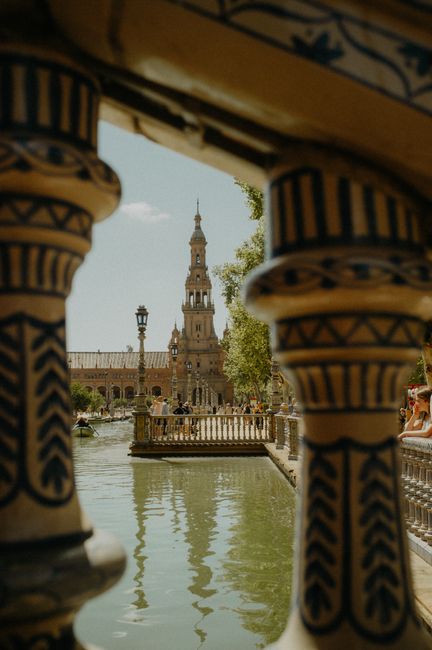
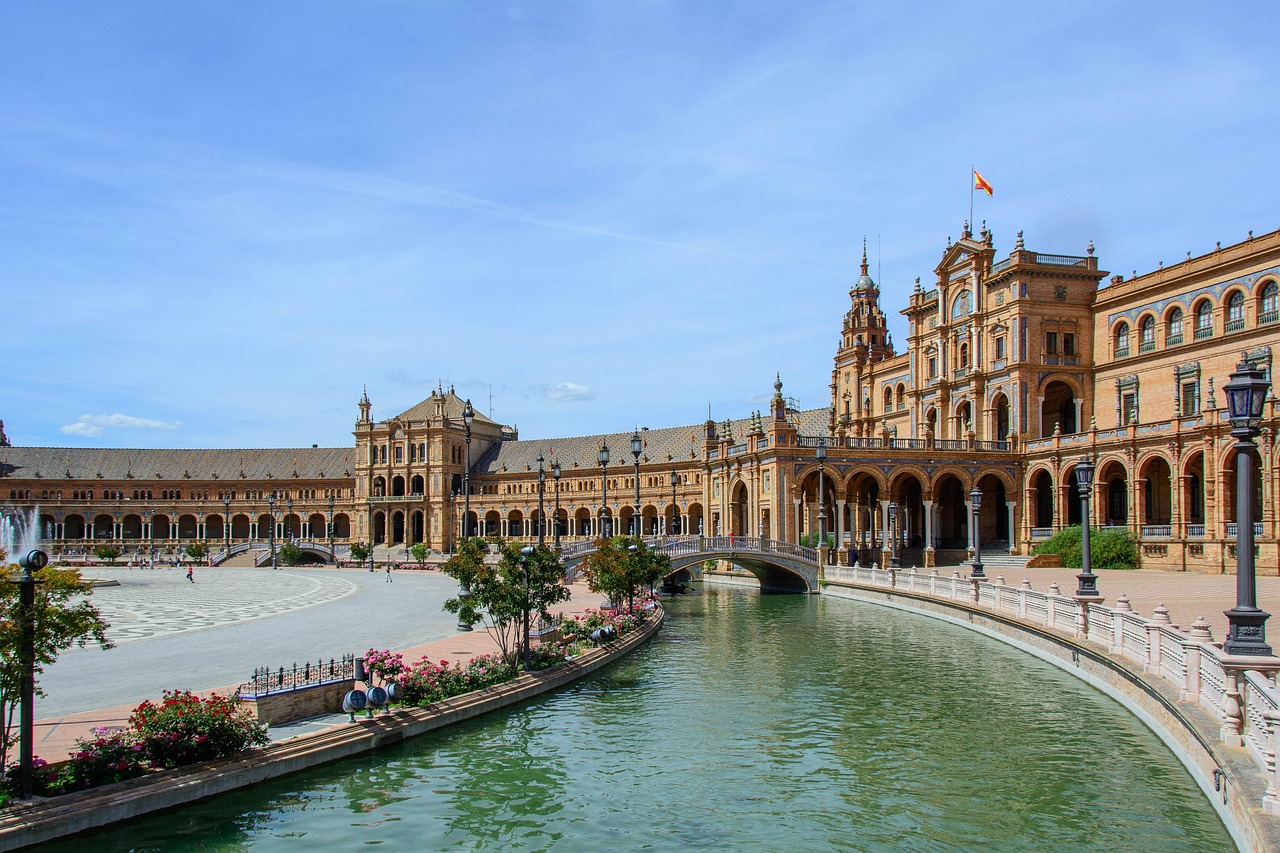
The Plaza de España is Seville’s grandest square: a vast half-circle of brick, marble and painted tiles around a canal, built by the architect Aníbal González for the 1929 Ibero-American Exposition. It is free and open to the public, with no ticket and no entry fee (as of October 2026). Go early in the morning or near sunset, give it about an hour, and combine it with the shady María Luisa Park next door.
Right now in Plaza de España
- Wed17–28°C63–82°FPartly cloudy
- Thu17–29°C62–85°FClear
- Fri18–27°C64–80°FClear
- Mon 12 Oct National Day of Spain (Fiesta Nacional de España)
Tickets and tours for Plaza de España
See all tours for Plaza de España →
From local operators, with prices and reviews; you check availability and book on Viator, our partner. We may earn a commission at no extra cost to you. How we earn money
Why the Plaza de España matters
In the 1910s Seville began preparing an international exposition to show off Spain’s ties with Latin America and Portugal. The city turned the old gardens of the San Telmo Palace into the María Luisa Park and placed the two showpieces of the fair beside it: the Plaza de América and, the largest building of the event, the Plaza de España. Aníbal González, Seville’s leading architect of the time, designed it in the Regionalist style, mixing Renaissance, Baroque and Neo-Mudéjar ideas with the brick and glazed ceramics of Triana’s workshops. It was completed in 1928, and the exposition opened in 1929.
The half-circle opens towards the park, a gesture often read as Spain embracing its former American territories. After the fair, the buildings became government and military offices, which they still are. Between 2007 and 2010 the city spent about €9 million restoring the square, its tiles and its canal. It is protected as a Bien de Interés Cultural, Spain’s highest heritage listing.
What you’ll see
- The province alcoves: along the base of the building, a tiled bench for each Spanish province, with a map and a scene from its history painted on the tiles, and tiled bookshelves at the sides. Finding your own province, or the one you are travelling to, is a favourite game for Spanish visitors.
- The canal and bridges: a moat-like canal follows the curve of the building, crossed by four bridges that stand for the old kingdoms of Spain, with ceramic balustrades in blue and yellow.
- The towers and galleries: two tall towers mark the ends of the half-circle. Climb the stairs to the upper arcades for the best photos of the whole curve.
- The fountain: the central fountain by Vicente Traver, often surrounded by street performers and flamenco dancers.
The square has played other places in films, including Naboo in Star Wars: Episode II – Attack of the Clones (2002) and scenes in Lawrence of Arabia (1962).
Practical information
As of October 2026:
- Opening and price: it is a public square, free and open at all times. In 2024 the mayor suggested charging non-residents to enter, but this has not gone ahead. A new municipal ordinance going through the city council in October 2026 regulates events in the square and does not set any entry fee.
- Events: the square is sometimes partly closed for large concerts, above all the summer Icónica festival. The new ordinance limits big events to 45 days a year per promoter from 2027.
- Rowing boats: small boats can usually be hired on the canal from a kiosk by the square. Local listings for 2026 give about €6 for 35 minutes (plus a €4 deposit) for up to four people, roughly 10:00 to 22:00, with the service suspended while the summer festival is on. Check the kiosk for current prices.
- María Luisa Park: free, open roughly 8:00–22:00, later in summer. It has shaded paths, ponds, tiled benches and fountains.
- Horse carriages: they wait at the square and near the cathedral. Agree the route and the price before you set off.
When to go
Early morning is the calmest and coolest time, with soft light on the tiles. Late afternoon and sunset are livelier, with musicians and families, and the brick glows orange. Avoid midday from June to September, when the open square has almost no shade and temperatures pass 35 °C. Allow an hour for the square, more if you take a boat or walk the park.
Accessibility
The main level of the square is flat and paved, with plenty of space for wheelchairs and pushchairs. The arched bridges and the stairs to the upper galleries are harder, and some paths in María Luisa Park are gravel.
Getting there
The square is on the eastern edge of María Luisa Park, about 1 km south of the cathedral. Walk down the Avenida de la Constitución and through the San Fernando gardens in about 15 minutes. Metro line 1 and the Metrocentro tram both stop at Prado de San Sebastián, a few minutes’ walk away.
Combine it with
From the Real Alcázar it’s about a 15-minute walk south, so the two pair naturally: the palace in the morning, the park for a picnic in the shade, and the square in the late afternoon light. Continue to the river and the Torre del Oro, or back to Seville Cathedral and the Giralda. Seville is one of Spain’s flattest cities for cycling, and the park is a good place to start; see our cycling guide and our Seville travel guide.
Plaza de España FAQ
Do you have to pay to visit the Plaza de España in Seville?
No. As of October 2026 the square is free and open to everyone. Plans to charge visitors were discussed in 2024 but not adopted, and the city’s new ordinance on the square sets no entry fee.
Can you rent a boat at the Plaza de España?
Usually, yes. Rowing boats are hired from a kiosk by the square, for about €6 for 35 minutes in 2026 local listings, though the service stops during the summer festival.
What are the tiled alcoves for?
Each one represents a Spanish province, with its coat of arms, a map and a tiled scene from its history, plus a bench to sit on.
When is the best time to visit the Plaza de España?
Early morning for calm and cool, or the hour before sunset for warm light and street musicians. Avoid midday in summer.
Was Star Wars filmed at the Plaza de España?
Yes. It appears as part of the planet Naboo in Star Wars: Episode II – Attack of the Clones (2002).
How far is the Plaza de España from the cathedral?
About 1 km, a flat 15-minute walk, or a few minutes on the Metrocentro tram to Prado de San Sebastián.