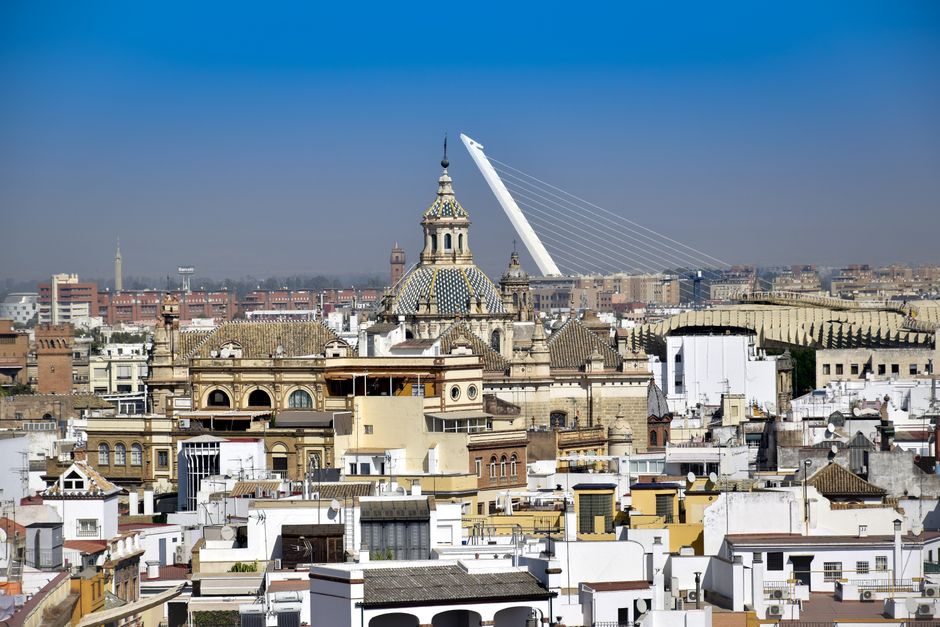
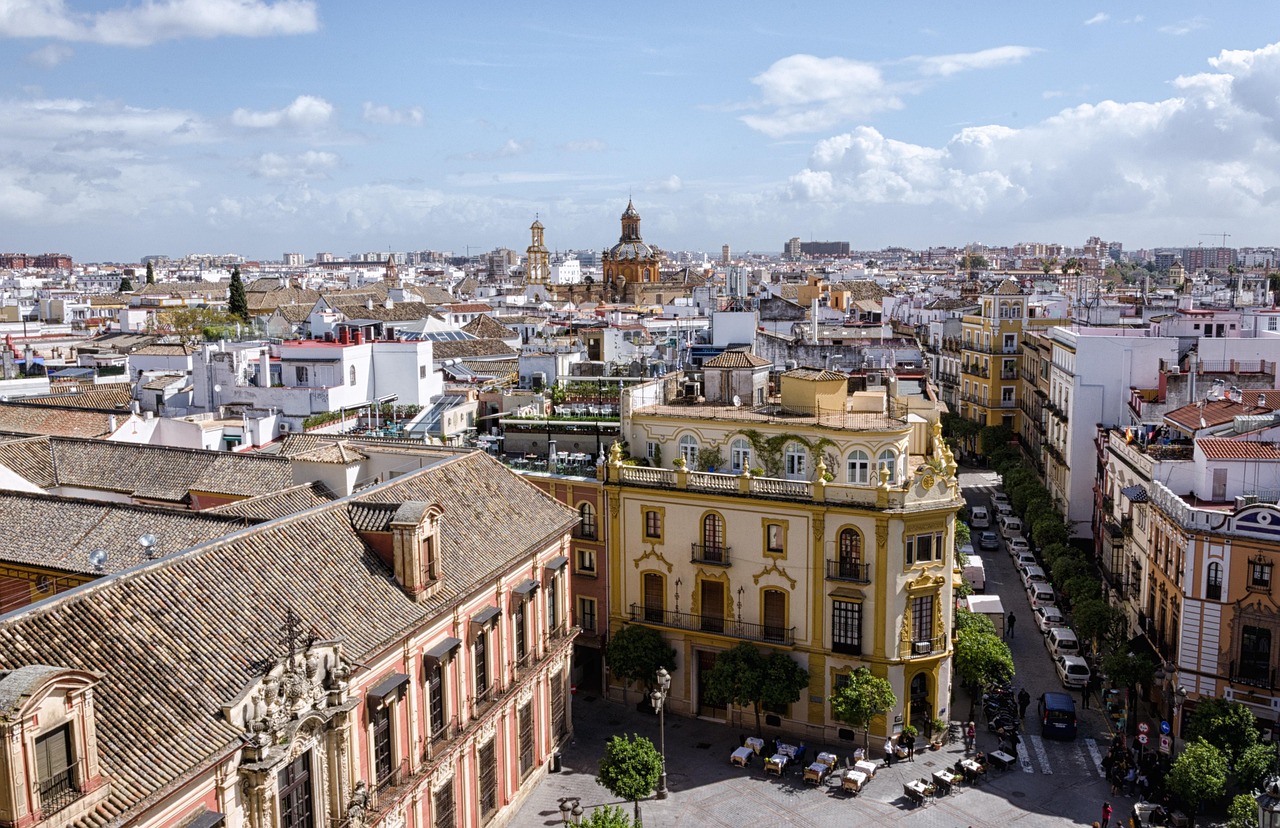
Seville is Andalusia’s capital and its most romantic city: orange trees in every square, a royal palace of tiled courtyards and fountains, the world’s largest Gothic cathedral, and flamenco and tapas late into warm nights. The best months are March to May and late September to November. Summer is very hot: July and August average about 36 °C. Three days covers the city well; add one or two for Córdoba, Cádiz or the white villages.
Right now in Seville
- Wed 17–27°C 63–80°F Mostly clear
- Thu 16–29°C 61–84°F Clear
- Fri 18–27°C 65–81°F Partly cloudy
- Mon 12 Oct National Day of Spain (Fiesta Nacional de España)
Weather: MET Norway (CC BY 4.0) · Air quality: OpenAQ · Rates: ECB · Holidays: Nager.Date
Top tours in Seville
See all tours for Seville →
From local operators, with prices and reviews; you check availability and book on Viator, our partner. We may earn a commission at no extra cost to you. How we earn money
Seville at a glance
- Best months: March–May and late September–November. Average highs are about 22–27 °C in spring and 26 °C in October, with 4–6 rainy days a month (AEMET normals, Seville airport). July and August average 35–36 °C, and much of the city slows down in the afternoon.
- Days needed: 2–3 for the city, 4–5 with day trips to Córdoba, Cádiz or Ronda.
- Airport: Seville San Pablo (SVQ), about 10 km northeast of the centre. The EA airport bus costs €6 and a taxi has a fixed fare of €26 on weekdays (as of October 2026).
- Getting around: the old centre is flat and best on foot or by bike; buses, a tram and one metro line cover the rest.
- Budget level: mid-range for Spain. Rooms are cheap in July and August and very expensive in Easter week and during the April Fair. There is no tourist tax in Andalusia as of October 2026. See our Spain guide for money, entry rules and daily costs.
Seville’s neighbourhoods
Seville’s sights are packed into a flat old town on the east bank of the Guadalquivir, with Triana across the river.
- Santa Cruz: the old Jewish quarter beside the cathedral and the Alcázar, a tangle of narrow, whitewashed lanes, little squares with orange trees, and hidden patios. The most beautiful and the most touristy area. Best for a short first stay; book a quiet room off the main lanes.
- Arenal: between the cathedral and the river, home to the Maestranza bullring, the Torre del Oro and traditional tapas bars. Central and lively, a short walk from everything.
- Centro (around Plaza Nueva and Calle Sierpes): the shopping streets, the town hall and the Setas, with plenty of hotels. Flat, central and handy for buses and the tram.
- Alfalfa and San Bartolomé: small squares and some of the city’s best tapas bars, just east of the centre. Good for food lovers and nightlife; quieter streets in San Bartolomé.
- Triana: across the Isabel II bridge, the historic quarter of potters, sailors and flamenco singers, with tiled ceramic workshops, the Triana market and riverside terraces along Calle Betis. Local, with great views back to the old town at sunset.
- Macarena and Alameda de Hércules: to the north, the long Alameda square is the city’s alternative hub, with bars, terraces and late-night life, and the Macarena basilica and medieval walls beyond. Better value, younger crowd.
Top things to see in Seville
Prices and hours below come from the official websites, as of October 2026. Book the Alcázar and the cathedral online in spring and in the hottest months, when you want to go early.
Real Alcázar
Still a royal residence, the Alcázar is a palace complex built and rebuilt over a thousand years, with Mudéjar courtyards of carved plaster and tiles, the Palace of King Peter I, Gothic halls and huge gardens of fountains, pools and orange trees. With the cathedral and the Archivo de Indias, it has been a UNESCO World Heritage Site since 1987. How to visit: daily 9:30–19:00 from 1 April to 30 September and 9:30–17:00 from 1 October to 31 March. A general ticket is €15.50; reduced €8 for over-65s and students aged 14–30; children up to 13 with an adult go free. The Cuarto Real Alto, the royal apartments upstairs, costs €5.50 extra and is visited at set times. Closed 1 and 6 January, Good Friday and 25 December. Buy online on the official site (alcazarsevilla.org) or at the Patio de Banderas ticket office (cards only). A limited free visit runs on Monday evenings, booked online in advance. Allow at least 2–3 hours.
Cathedral and the Giralda
Built on the site of the great mosque, Seville Cathedral is the largest Gothic cathedral in the world. It holds a vast gilded altarpiece and the tomb of Christopher Columbus. Its bell tower, the Giralda, began as the mosque’s minaret. You climb it by 34 ramps, wide enough for a horse, and then 17 steps. How to visit: Monday to Saturday 10:45–19:00 and Sunday 14:30–19:00; the ticket office closes at 18:00. A general ticket is €13 online or €14 at the ticket office, reduced €7/€8, and under-13s with an adult go free. It includes the Giralda and the Iglesia del Salvador. A guided rooftop tour (€20 online, about 1.5 hours, from age 9) takes you over the vaults and is not suitable for anyone with vertigo. A limited free visit runs on Sundays (not holidays) from 16:30 to 18:00 and must be booked on the official site.
Plaza de España and María Luisa Park
Built for the 1929 Ibero-American Exposition, the Plaza de España is a huge half-circle of brick and tiled arcades around a canal crossed by little bridges, with a tiled alcove for every Spanish province. It’s free to visit. Plans to charge non-residents for entry were floated in 2024 but have not gone ahead; a new city ordinance going through council in October 2026 regulates events in the square and sets no entry fee. Next door, the María Luisa Park is the city’s big green escape, with shaded paths, ponds and tiled benches. Go early in the morning or at sunset; at midday in summer the plaza is an oven.
Setas de Sevilla (Metropol Parasol)
The giant wooden “mushrooms” over the Plaza de la Encarnación are one of the world’s largest timber structures. A walkway on top gives 360° views over the rooftops. How to visit: open daily 9:30–1:00 (last entry 0:15). The general ticket is €16 and includes the viewpoint, a short film and, in the evening from April to October, the “Aurora” light show. Roman remains are on show in the basement.
Casa de Pilatos
A 16th-century noble palace that mixes Mudéjar, Gothic and Renaissance styles, with some of Seville’s finest tiles, a garden and a collection of Roman sculpture. Calmer and cheaper than the Alcázar. How to visit: daily 9:00–18:00. The ground floor is €12, and the upper floor €6 extra; children under 11 go free.
Triana, the river and the Torre del Oro
Walk across the Isabel II bridge to Triana for its tile shops, the market built over the ruins of a medieval castle, and the river terraces of Calle Betis. On the way, the 13th-century Torre del Oro, a twelve-sided watchtower on the riverbank, houses a small naval museum. The riverside path between the Torre del Oro and the Triana bridge is the best place to watch the sun go down.
Monuments
Museums
- Casa de Pilatos
- General Archive of the Indies
- Torre del Oro
Palaces
- Palacio de San Telmo
Other sights
Things to do in Seville
Watch flamenco
Seville is one of the homes of flamenco. You can see it in small tablaos (show venues) in Santa Cruz and Triana, in the Museo del Baile Flamenco, or at casual peñas (local clubs) where locals sing for each other. Book shows in the evening; most last about an hour. The city’s big flamenco festival, the Bienal, is held every two years in September; the 2026 edition ran from 9 September to 3 October, and the next is in 2028.
Tapas crawl
Seville does tapas standing at the bar: espinacas con garbanzos (spinach with chickpeas), solomillo al whisky (pork in a garlic-whisky sauce), fried fish, salmorejo and fino sherry from nearby Jerez. The Alfalfa, the Arenal and Triana are the classic areas. Locals eat late: lunch from 14:00, dinner from 21:00.
Easter week and the April Fair
Semana Santa (Holy Week) is Seville’s great event: brotherhoods carry huge religious floats through the streets day and night, followed by silent penitents and brass bands. In 2027 it runs from Palm Sunday, 21 March, to Easter Sunday, 28 March. Two weeks later comes the Feria de Abril, a week of flamenco dresses, sevillanas dancing, horses and private casetas (marquees) on the fairground in Los Remedios; in 2027 it is expected to run from 12 to 18 April. Book rooms months ahead for both, and expect high prices.
Get on the river
Sightseeing boats leave from beside the Torre del Oro for one-hour cruises along the Guadalquivir, and you can rent kayaks and paddleboards for a gentler view of the bridges. In summer, go out in the evening when the heat eases. See our boat trips guide.
Day trips from Seville
- Córdoba: about 45 minutes by high-speed train, for the Mezquita-Catedral and the Judería. Read our Córdoba guide.
- Cádiz: one of Europe’s oldest cities, on a narrow peninsula surrounded by the Atlantic, with city beaches and fried-fish bars. Regional trains take about 1 h 40. See our beaches guide for the coast.
- Ronda and the white villages: Damas buses leave from the Plaza de Armas bus station several times a day (about 2 h 20–2 h 45). With a car, combine Ronda with white villages such as Arcos de la Frontera, Zahara de la Sierra and Grazalema in the Sierra de Grazalema natural park, with good walks. See our hiking guide.
- Jerez de la Frontera: sherry bodegas, tastings and Andalusian horses, on the train line to Cádiz. See our wine tasting guide.
- Itálica: the ruins of a Roman city with one of the largest amphitheatres of the Roman world, in Santiponce, just north of Seville by bus.
- Granada and Málaga: Granada is about 2 h 30 by train, so stay a night (read our Granada guide). Málaga is about 2 hours (read our Málaga guide).
- The Algarve: buses link Seville with Faro in about 2 h 40, so Portugal’s beaches are an easy next stop. Read our Algarve guide.
Nearby destinations
Getting there and getting around
From the airport to the city
- EA airport bus: Tussam’s airport line runs to the centre (Plaza de Armas) via Santa Justa train station and the Prado de San Sebastián, about every 15–20 minutes by day. A single is €6 and a return €8 (as of October 2026).
- Taxi: a fixed fare applies between the airport and the city centre: €26 on weekdays from 7:00 to 21:00, and €29 at night, at weekends, on holidays and during Easter week and the Fair (2026 tariff).
Trains from Madrid and Andalusia
High-speed trains run from Madrid Puerta de Atocha to Seville Santa Justa in about 2 h 30–2 h 45, with Renfe (AVE and AVLO) and Iryo, among others. The line was closed after the Adamuz rail crash on 18 January 2026 and reopened on 17 February 2026 with some speed restrictions, so check journey times when you book. From Santa Justa, trains reach Córdoba in about 45 minutes, Málaga in about 2 hours, Granada in about 2 h 30–3 h and Cádiz in about 1 h 40. Santa Justa is about 2 km from the cathedral; take the bus, a taxi or the EA airport bus, which stops there.
Getting around the city
The old town is flat, and most sights are within a 20-minute walk of the cathedral. Tussam buses and the short tram (Metrocentro) between the Plaza Nueva and San Bernardo cost €1.40 a ride (as of October 2026), and a rechargeable card brings that down. The single metro line is useful mainly for the suburbs. Seville is one of Spain’s best cycling cities, with long, flat bike lanes and the Sevici public bike scheme, though in summer it’s best to ride early or late. Horse-drawn carriages wait near the cathedral and the Plaza de España; agree the route and price before you set off. Don’t drive in the old town: streets are narrow, many are restricted, and parking is scarce.
When to go and how long to stay
Seville has one of the hottest summers in Europe. In AEMET’s normals for the airport, July averages 36 °C, and temperatures above 40 °C are common in heatwaves; the station record is 46.6 °C. Spring and autumn are glorious, and winter days are mild and sunny, with cool nights.
| Season | Average high / low | Rainy days a month | What it’s like |
|---|---|---|---|
| Spring (Mar–May) | 22–27 °C / 9–14 °C | 4–6 | The best season: orange blossom, Easter week and the April Fair. Highest prices. |
| Summer (Jun–Aug) | 32–36 °C / 18–20 °C | 0–1 | Very hot, dry afternoons; many locals leave in August. Cheapest rooms. Sightsee early and late. |
| Autumn (Sep–Nov) | 20–32 °C / 10–18 °C | 3–6 | September is still hot; October and November are warm, golden and less crowded. |
| Winter (Dec–Feb) | 16–18 °C / 6–7 °C | 5–7 | Mild, sunny days and cool nights. Christmas lights and the quietest sights. |
AEMET’s published normals for Seville airport cover 1981–2010; its 1991–2020 table for this station was not online when we checked.
2 days in Seville
Day 1: the Alcázar first thing, then Santa Cruz and the cathedral with the Giralda; tapas in the Arenal and sunset along the river by the Torre del Oro. Day 2: Plaza de España and María Luisa Park in the morning, Casa de Pilatos or the Setas in the afternoon, then Triana for dinner and a flamenco show.
3 days in Seville
Add a slower day: the Macarena and the Alameda de Hércules, the Triana market and a ceramics workshop, the cathedral rooftop tour, and a sunset boat trip or the Setas at night.
4–5 days
Add a day trip to Córdoba by train, or Cádiz and Jerez, or rent a car for Ronda and the white villages. Seville also makes a good start for a loop into the Algarve.
Where to stay in Seville
- First visit: Santa Cruz, the Arenal or the Centro, all within walking distance of the main sights. Santa Cruz is the most atmospheric; the Centro has more choice.
- Food and nightlife: the Alfalfa or the Alameda de Hércules, with bars and terraces on the doorstep. Expect street noise at weekends.
- Local feel: Triana, across the river, with good-value rooms and the best sunset views of the old town.
- Arriving by train or on a budget: around Santa Justa station or the Macarena, with larger, cheaper hotels and a short bus ride in.
- In summer: a room with strong air conditioning and, if possible, a rooftop pool.
Practical tips for Seville
- Plan around the heat: from June to September, sightsee from opening until about 13:00, rest through the afternoon, and go out again after 20:00 like the locals.
- Book the big two: the Alcázar and the cathedral both sell timed tickets online, and the free slots (Alcázar on Monday evenings, cathedral on Sunday afternoons) must be booked in advance.
- Closures: the Alcázar closes on 1 and 6 January, Good Friday and 25 December. Easter week changes opening hours across the city.
- Rosemary and carnations: near the cathedral, women sometimes press a sprig of rosemary on tourists and then ask for money for a “fortune”. A firm “no, gracias” and walking on is enough.
- Pickpockets: watch your bag in the crowds around the cathedral, in Santa Cruz and during Easter week processions. The emergency number is 112.
- No tourist tax: Andalusia does not charge one as of October 2026, although Seville’s mayor has asked the regional government for one.
Weather month by month
Averages from AEMET normals 1991–2020, Sevilla Aeropuerto (San Pablo) · Last reviewed 4 Oct 2026
What to pack for Seville
Pack for strong sun most of the year. From May to October, bring a wide-brimmed hat, sunglasses, high-factor sunscreen, a refillable water bottle and light, loose clothes; afternoons regularly pass 35 °C in summer. Add a light scarf or shirt to cover shoulders in the cathedral and churches. Comfortable walking shoes matter: you’ll walk a lot on paving stones and cobbles. From November to March, pack a light jacket and layers for nights around 6–7 °C, and a small umbrella. For Easter week or the Fair, bring something smart; locals dress up.
Seville travel FAQ
How many days do you need in Seville?
Three days covers the Alcázar, the cathedral, Plaza de España, Triana and a flamenco show at a relaxed pace. Add a day or two for Córdoba, Cádiz or Ronda.
What is the best time to visit Seville?
March to May and late September to November. July and August average 35–36 °C, which makes afternoon sightseeing hard.
How much does the Real Alcázar cost?
A general ticket is €15.50, and the upstairs royal apartments (Cuarto Real Alto) are €5.50 extra (as of October 2026). Children up to 13 with an adult go free, and a limited free visit runs on Monday evenings, booked online.
How much does Seville Cathedral cost, and is the Giralda included?
€13 online or €14 at the door (as of October 2026), including the Giralda and the Iglesia del Salvador. A free visit runs on Sunday afternoons from 16:30, with limited places booked online.
Do you have to pay to visit Plaza de España?
No. It’s free and open to everyone. Plans to charge visitors were floated in 2024 but were not adopted, and as of October 2026 there is no entry fee.
Does Seville have a tourist tax?
No. As of October 2026, there is no tourist tax anywhere in Andalusia, although Seville’s city council has asked for one.
How do I get from Seville airport to the city centre?
Take the EA airport bus (€6, as of October 2026) or a taxi, which has a fixed fare of €26 on weekdays from 7:00 to 21:00 and €29 at other times.
How long is the train from Madrid to Seville?
About 2 h 30–2 h 45 on high-speed trains. After the January 2026 Adamuz crash, some speed restrictions remain, so check journey times when you book.
Is Seville too hot in summer?
It’s very hot: average highs are around 36 °C in July and August, and heatwaves pass 40 °C. If you go, sightsee in the morning and evening and choose a hotel with air conditioning and a pool.
When are Easter week and the April Fair in 2027?
Holy Week runs from 21 to 28 March 2027. The April Fair is expected from 12 to 18 April 2027; check the city’s official programme when it is published.
Can you go from Seville to the Algarve?
Yes. Buses run from Seville to Faro in about 2 h 40, and the drive is similar, so you can combine southern Spain and Portugal in one trip.
Which is better, Seville or Granada?
Do both if you can. Seville is bigger and livelier, with the Alcázar, the cathedral and flamenco; Granada is smaller and hillier, with the Alhambra and free tapas. They are about 2 h 30 apart by train.
Sources
- © OpenStreetMap contributors · ODbL · fetched 3 Oct 2026
- Wikidata · CC0 · fetched 3 Oct 2026
Sources and last review
Researched and last reviewed on 3 October 2026. Hours, prices and free-visit rules come from the official websites of the Real Alcázar, Seville Cathedral, the Setas de Sevilla and the Fundación Medinaceli (Casa de Pilatos). The Bienal de Flamenco dates come from the Junta de Andalucía’s cultural agenda, and the climate figures from AEMET’s normals for Seville airport. Airport bus fares, taxi tariffs, train times, Fair dates and the Plaza de España ordinance and tourist-tax news were checked in Spanish press and transport references where the official sites could not be read. Prices, timetables and opening hours change, so check the official sites before you travel.
Plan your trip
Partner links: TravelerCenter may earn a commission if you book, at no extra cost to you.
🇪🇸 Useful Spanish phrases for Seville
All 38 Spanish phrases: restaurant, hotel, emergencies, romance (printable) →