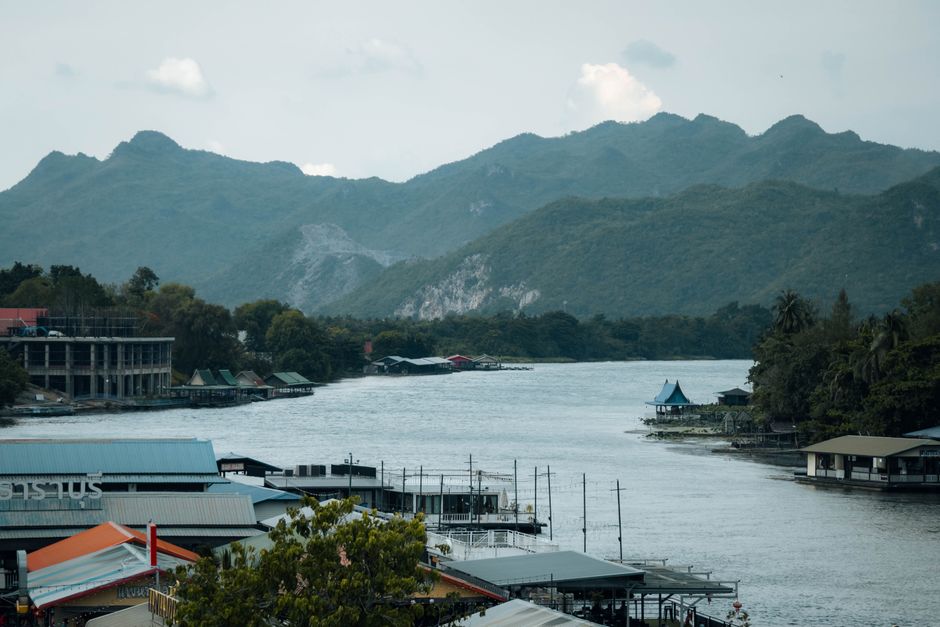
Kanchanaburi is a relaxed provincial town about 130 km (80 miles) west of Bangkok, where the Khwae Noi and Khwae Yai rivers meet among limestone hills. It is known around the world for the Bridge over the River Kwai and the Thailand–Burma “Death Railway,” built in 1942–43 by Allied prisoners of war and Asian laborers forced to work by the Japanese army, at a terrible cost in lives. The town’s war cemeteries, museums and the railway itself, which still runs through gorges and along the river, make it one of Thailand’s most moving historical destinations. Beyond the history, Kanchanaburi province is a green, mountainous region of waterfalls, caves, national parks and floating raft houses, a popular escape for Bangkok residents at weekends. Come for the bridge and the railway journey, the Hellfire Pass memorial, the seven-tiered Erawan Falls, river life and a slower pace. Kanchanaburi is driest and most pleasant from November to February; it gets very hot in March and April, and most rain falls from May to October.
Right now in Kanchanaburi
- Wed23–30°C74–85°F5 mm rain
- Thu24–31°C75–88°F1 mm rain
- Fri24–30°C75–87°F1 mm rain
Top tours in Kanchanaburi
See all tours for Kanchanaburi →
From local operators, with prices and reviews; you check availability and book on Viator, our partner. We may earn a commission at no extra cost to you. How we earn money
Kanchanaburi at a glance
- Best for: World War II history, scenic train journeys, waterfalls and national parks, river raft houses, and a quiet break from Bangkok.
- How long: 2 days for the town, the bridge and the railway; 3–4 days to add Erawan, Hellfire Pass and Sai Yok.
- Best time: November to February, with highs of about 32–33 °C (89–91 °F) and almost no rain; March and April are very hot, up to about 38 °C (100 °F).
- Getting there: about 2–3 hours by bus or minivan from Bangkok, or a slow but scenic train from Bangkok’s Thonburi station.
- Getting around: bicycles and scooters in town, songthaews and buses to the outlying sights, and the train to Nam Tok.
- Fees to know: national parks such as Erawan and Sai Yok charge an entry fee; according to the national parks department, both were temporarily closed after heavy rain in late September 2026, so check that they have reopened.
- Before you go: entry rules, the Thailand Digital Arrival Card, money and general safety are in our Thailand travel guide.
Kanchanaburi’s areas and where to stay
The town stretches for several kilometers along the east bank of the Khwae Mae Klong river, with the bridge at its northern end.
The town center and Saeng Chuto Road
The main road, Saeng Chuto, runs through the commercial center with the bus station, the railway station, the main war cemetery and the Thailand–Burma Railway Centre close together. The old town, with wooden shophouses and the city gate, is near the river at the southern end.
Mae Nam Khwae Road (the riverside strip)
The road parallel to the river, a short ride north of the center, is the traveler hub: guesthouses, floating raft-house rooms, bars, restaurants and tour agents. It is the most convenient area to stay without a car.
The bridge area
Around the bridge at the northern end of town there are riverside restaurants, a small market, the station for the bridge, the World War II Museum and larger hotels. It is busy by day with tour groups and peaceful in the evening.
Outside town
Along the Khwae Noi and Khwae Yai rivers, upstream towards Sai Yok and Erawan, are resorts and raft houses set among jungle and hills, best with your own transport or as a destination in themselves.
Top things to see in Kanchanaburi
The Bridge over the River Kwai
The steel bridge across the Khwae Yai was built by prisoners of war in 1943 as part of the Death Railway, with spans brought from Java; it was bombed by the Allies in 1945, and the curved original spans you see today were repaired after the war, while the straight central sections are replacements. You can walk across it on the narrow walkway beside the tracks, and the train still crosses a few times a day. A small steam locomotive and other old engines stand by the station. Come early in the morning or at sunset to avoid the crowds.
Kanchanaburi War Cemetery
In the town center, this immaculately kept cemetery, cared for by the Commonwealth War Graves Commission, holds the graves of nearly 7,000 Allied prisoners of war, mostly British, Australian and Dutch, who died building the railway. It is quiet and deeply moving; dress respectfully.
Thailand–Burma Railway Centre
Next to the cemetery, this museum explains the building of the railway in clear, well-researched detail, with maps, photographs, artifacts and personal stories of prisoners and laborers. Allow 1–2 hours, and visit before the cemetery for context.
Chungkai War Cemetery
A smaller, peaceful cemetery on the bank of the Khwae Noi, about 2 km (1.2 miles) south of town, on the site of a former prisoner-of-war camp and hospital. It is a pleasant bicycle or boat ride from the center.
JEATH War Museum
At Wat Chaichumphon by the river in the south of town, a simple museum in a reconstructed bamboo hut, where the name stands for the nations involved: Japan, England, Australia/America, Thailand and Holland. Its displays are older and less polished, but the setting tells its own story.
More classic sights
- Wat Tham Suea and Wat Tham Khao Noi: two hilltop temples south of town, side by side, with a huge seated golden Buddha and a pagoda in Chinese style, and wide views over the rice fields.
- Wat Ban Tham: a cave temple reached through the mouth of a dragon sculpture, with stairs climbing into the hillside.
- The old city gate and Pak Phraek Road: a quiet street of old wooden shophouses, with a weekend walking street in some seasons.
- Prasat Mueang Singh Historical Park: the ruins of a 13th-century Khmer temple of laterite on the Khwae Noi, about 45 km (28 miles) west of town.
Museums
- JEATH War Museum
- Thailand-Burma Railway Centre
Monuments
- Chungkai War Cemetery
- Kanchanaburi War Cemetery
The Death Railway and the train to Nam Tok
The Thailand–Burma Railway ran for about 415 km (258 miles) from Nong Pladuk in Thailand to Thanbyuzayat in Myanmar, built in little more than a year through jungle and mountains. Tens of thousands of Asian laborers and over 12,000 Allied prisoners of war died from overwork, disease and malnutrition. Today only the Thai section from Bangkok to Nam Tok, about 50 km (31 miles) beyond Kanchanaburi, is in use.
Riding the train
The State Railway of Thailand runs ordinary trains from Bangkok’s Thonburi station through Kanchanaburi and over the River Kwai bridge to Nam Tok, usually twice a day; the journey from Kanchanaburi to Nam Tok takes about 2–2.5 hours. The highlight is the Wang Pho viaduct near Tham Krasae station, where the train creeps along a wooden trestle built against a cliff above the Khwae Noi. Sit on the left side heading north for the best views. Trains are often late, the carriages are third class with fans, and in high season seats fill quickly at Kanchanaburi; foreigners pay a flat fare for the line. At weekends and on some holidays the railway also runs special excursion trains from Bangkok.
The Royal Blossom
The State Railway’s new luxury sightseeing train, the Royal Blossom, made from former Japanese carriages, runs from Bangkok’s historic Hua Lamphong station to Kanchanaburi on selected dates, with stops at Nakhon Pathom for its giant golden chedi and at the River Kwai bridge, according to the Tourism Authority of Thailand. Check the State Railway’s website for dates and fares.
Hellfire Pass
The most notorious section of the railway, Konyu Cutting, was hacked through solid rock by prisoners working day and night by the light of torches, which gave it its name. The Hellfire Pass Memorial Museum, about 80 km (50 miles) northwest of town on Highway 323, has an excellent museum and a walking trail along the old railway bed through the cutting and beyond. Allow half a day including travel.
Waterfalls, caves and national parks
Erawan National Park
Erawan Falls, about 65 km (40 miles) northwest of town, is one of Thailand’s most beautiful waterfalls: seven tiers of turquoise pools in the forest, linked by a trail of about 2 km (1.2 miles) that becomes steep and rough towards the top. Swimming is allowed in several pools, where small fish nibble your feet. According to the national parks department, the whole park was temporarily closed from September 30, 2026 because of heavy rain, until conditions return to normal; check that it has reopened before you go.
Sai Yok National Park
Along the Khwae Noi farther northwest, Sai Yok has the Sai Yok Yai waterfall tumbling into the river, caves, bat colonies and raft-house stays. According to the national parks department, the park was temporarily closed from September 27, 2026 after heavy rain. Sai Yok Noi waterfall, near Nam Tok station, is a small, easy stop that flows mainly in the rainy season.
Tham Krasae
A cave shrine with a Buddha image beside the Wang Pho viaduct, reached by a short walk along the tracks from Tham Krasae station; many visitors combine it with the train ride.
Other things to do in Kanchanaburi
Food and drink
Try pla kang and other river fish, steamed or fried, at the restaurants by the bridge and on floating platforms; central Thai curries; khao kha moo (stewed pork leg on rice); and the bamboo-tube sticky rice (khao lam) sold along the roads. The night market near the bus station and the evening stalls on Saeng Chuto Road are the cheapest places to eat, and Mae Nam Khwae Road has international cafés and bars.
River life and raft houses
Staying on a floating raft house is a Kanchanaburi tradition: a simple room or a resort on pontoons on the river, with kayaking, swimming and long-tail boat trips. Long-tail boats from the bridge also visit Chungkai and the JEATH museum.
Festivals
River Kwai Bridge Week, usually from late November into early December, features a sound-and-light show at the bridge re-creating the wartime bombing, with a fair and markets. On ANZAC Day (April 25) dawn services are held at Hellfire Pass and the war cemetery, and on Loy Krathong (November 24 in 2026) people float krathongs on the river.
Day trips from Kanchanaburi
- Erawan Falls: about 1.5 hours by bus or car, once the park reopens.
- The railway to Nam Tok: with Tham Krasae and Sai Yok Noi, by train and bus.
- Hellfire Pass and Sai Yok: about 1.5 hours by road; best combined in a tour or with a car.
- Sangkhla Buri: a lakeside town near the Myanmar border, with a Mon community and a long wooden bridge, about 3–4 hours away; best with an overnight stay.
- Bangkok: the capital’s temples and markets are 2–3 hours away; see our Bangkok guide.
Nearby destinations
Getting there and getting around
By road, rail and air
Buses and minivans leave frequently from Bangkok’s Southern Bus Terminal (Sai Tai Mai) and Mo Chit for Kanchanaburi bus station, taking about 2–3 hours. Ordinary trains from Thonburi station take about 3 hours to Kanchanaburi and continue to the River Kwai Bridge and Nam Tok stations. There is no airport; Bangkok’s Suvarnabhumi and Don Mueang airports are about 2.5–3 hours away by car or taxi.
Around Kanchanaburi
The town is flat and easy to explore by bicycle or scooter; songthaews run along the main road to the bridge, and tuk-tuks wait at the bus and train stations. Local buses run from the bus station to Erawan and to Nam Tok, Sai Yok and Hellfire Pass, but services are infrequent, and many visitors hire a car with driver or join a tour. Ride-hailing apps have limited coverage outside town.
When to go and how long to stay
Kanchanaburi has a tropical climate with three seasons: cool and dry from November to February, hot from March to May, and rainy from May to October, with the heaviest rain in September and October, when rivers rise and waterfalls are at their fullest. The table uses the 1991–2020 normals of the Thai Meteorological Department (TMD) for its Kanchanaburi station, as submitted to the World Meteorological Organization (WMO): average daily highs and lows, total rain, and days with at least 1 mm of rain.
| Month | Average high / low | Rain (days with 1 mm or more) | What to expect |
|---|---|---|---|
| January | 33 °C (91 °F) / 20 °C (69 °F) | 8 mm (0.3 in), 1 day | Dry and sunny, with cool mornings; peak season |
| February | 35 °C (96 °F) / 22 °C (72 °F) | 18 mm (0.7 in), 1 day | Dry and warming up |
| March | 37 °C (99 °F) / 24 °C (76 °F) | 39 mm (1.6 in), 3 days | Hot; waterfalls running low |
| April | 38 °C (100 °F) / 26 °C (78 °F) | 66 mm (2.6 in), 4 days | The hottest month; ANZAC Day and Songkran |
| May | 36 °C (97 °F) / 26 °C (78 °F) | 139 mm (5.5 in), 10 days | First heavy storms |
| June | 35 °C (95 °F) / 25 °C (78 °F) | 99 mm (3.9 in), 10 days | Showers; the countryside turns green |
| July | 34 °C (93 °F) / 25 °C (77 °F) | 106 mm (4.2 in), 11 days | Rain and sun mixed |
| August | 34 °C (93 °F) / 25 °C (77 °F) | 101 mm (4.0 in), 11 days | Rain and sun mixed; waterfalls filling |
| September | 34 °C (93 °F) / 24 °C (76 °F) | 219 mm (8.6 in), 14 days | The wettest month; rivers high, parks may close |
| October | 32 °C (90 °F) / 24 °C (75 °F) | 206 mm (8.1 in), 12 days | Wet early, drying later; waterfalls at their best |
| November | 32 °C (90 °F) / 22 °C (72 °F) | 45 mm (1.8 in), 4 days | Dry season begins; River Kwai Bridge Week |
| December | 32 °C (89 °F) / 20 °C (69 °F) | 7 mm (0.3 in), 1 day | Dry and pleasant; busy at New Year |
Kanchanaburi gets about 1,050 mm (41 in) of rain a year, most of it from May to October. Heavy rain in late September and October can flood riverside areas and close national parks for days at a time.
Weather month by month
2 days in Kanchanaburi
Day one, the Thailand–Burma Railway Centre and the war cemetery, then the bridge at sunset and dinner by the river. Day two, the morning train from Kanchanaburi over the Wang Pho viaduct to Nam Tok, with Sai Yok Noi waterfall, and back by bus or train.
3–4 days
Add a day at Erawan Falls and a day for Hellfire Pass and Sai Yok, or a night on a raft house upriver.
Where to stay in Kanchanaburi
- Mae Nam Khwae Road: guesthouses, raft rooms, restaurants and tour agents; the most convenient base.
- The bridge area: riverside hotels close to the main sight, quieter at night.
- The town center: practical hotels near the bus and train stations.
- Upriver raft houses and resorts: nature, river views and peace near Sai Yok or Erawan, best with transport.
Prices rise at weekends and on Thai holidays, when Bangkok residents arrive.
What a trip to Kanchanaburi costs
Prices are approximate, for October 2026, converted at about 33 baht to the US dollar.
| Item | Typical cost |
|---|---|
| Street food or market dish | 40–100 baht (about US$1.20–3) |
| Riverside dinner for two | 500–1,200 baht (about US$15–36) |
| Bus or minivan from Bangkok | 100–200 baht (about US$3–6) |
| Train from Kanchanaburi to Nam Tok, foreign visitors | about 100 baht (about US$3) |
| Thailand–Burma Railway Centre entry | 150–200 baht (about US$4.50–6) |
| National park entry (Erawan, Sai Yok), foreign adult | 200–300 baht (about US$6–9) |
| Full-day tour with Erawan and the railway | 1,200–2,000 baht (about US$36–60) |
| Mid-range hotel or raft-house double | 1,000–3,000 baht (about US$30–90) |
Practical tips for Kanchanaburi
- Check park status: after heavy rain, Erawan, Sai Yok and other parks can close at short notice; ask your hotel or check the national parks’ announcements.
- Trains: get to the station early, as trains to Nam Tok fill up; they often run late, so don’t plan tight connections.
- Respect the memorials: dress modestly at the cemeteries and temples and be quiet; the cemeteries are places of mourning, not photo backdrops.
- Heat: start early and rest at midday, especially from March to May.
- Cannabis and vaping: cannabis flower needs a Thai prescription, and e-cigarettes are illegal in Thailand.
- Help: the Tourist Police (1155) speak English, and the TAT Contact Center (1672) answers tourist questions.
Safety
Kanchanaburi is a quiet, friendly town with little crime affecting visitors.
- The bridge and the railway: trains still cross the River Kwai bridge and the Wang Pho viaduct, slowly but with little room to spare. When you hear a horn, step into one of the side platforms on the bridge, keep children close, and don’t walk the viaduct while a train is due. The walkways have gaps and low railings; wear proper shoes and watch your footing.
- Rivers: currents are strong, especially in the rainy season; swim only where locals do, wear a life jacket when kayaking, and don’t jump from raft houses after drinking.
- Waterfalls: rocks at Erawan and Sai Yok are slippery; keep to the marked swimming areas and leave when rangers close the upper tiers.
- Floods: heavy rain in September and October can flood riverside roads and close parks; follow local instructions.
- Road safety: Highway 323 is fast, with trucks; wear a helmet on a scooter and avoid riding at night.
- Heat: drink plenty of water and use sunscreen, especially on the open bridge and at Hellfire Pass.
- Emergencies: call 1155 for the Tourist Police (English spoken), 191 for the police and 1669 for an ambulance.
What to pack for Kanchanaburi
Light, breathable clothes and something to cover shoulders and knees for temples and cemeteries, a hat and sunscreen, sandals that can get wet for waterfalls, comfortable walking shoes for Hellfire Pass, insect repellent, a light rain jacket from May to October, and a warm layer for cool December mornings. Thailand uses 220 V; sockets take both flat two-pin and round two-pin plugs.
Kanchanaburi travel FAQ
Can I walk across the Bridge over the River Kwai?
Yes. There is a walkway beside the tracks; step into the side platforms when a train approaches.
How do I take the Death Railway train?
Ordinary trains run from Bangkok’s Thonburi station through Kanchanaburi and over the bridge to Nam Tok, usually twice a day. You can board at Kanchanaburi or the River Kwai Bridge station.
Is Erawan National Park open?
According to the national parks department, Erawan was temporarily closed from September 30, 2026 after heavy rain. Check that it has reopened before you travel.
How far is Kanchanaburi from Bangkok?
About 130 km (80 miles), 2–3 hours by bus, minivan or car, or about 3 hours by train.
How many days do I need in Kanchanaburi?
Two days for the town, the bridge and the train; three or four days to add Erawan, Hellfire Pass and Sai Yok.
Can I visit Kanchanaburi as a day trip from Bangkok?
Yes, on a long tour that combines the bridge, the cemetery and a short train ride, but you will see much more with a night or two.
What is Hellfire Pass?
A rock cutting on the Death Railway, dug by prisoners of war in 1943, now a memorial with a museum and walking trail about 80 km (50 miles) northwest of town.
When is the best time to visit Kanchanaburi?
November to February, when it is dry and comfortable. March and April are very hot, and September and October are the wettest months.
What is River Kwai Bridge Week?
An annual festival, usually from late November into early December, with a sound-and-light show at the bridge, a fair and markets.
Is it worth staying on a raft house?
Yes, for a night or two: floating rooms on the river are a classic Kanchanaburi experience, from simple to resort style.
Plan your trip
Partner links: TravelerCenter may earn a commission if you book, at no extra cost to you.
🇹🇭 Useful Thai phrases for Kanchanaburi
All 38 Thai phrases: restaurant, hotel, emergencies, romance (printable) →
Sources · last reviewed 4 October 2026
Researched and last reviewed on 4 October 2026. National park closures: the Department of National Parks, Wildlife and Plant Conservation; the Royal Blossom train, cannabis and e-cigarette rules and the Tourist Police: the Tourism Authority of Thailand (TAT); climate normals: the Thai Meteorological Department via the World Meteorological Organization’s 1991–2020 normals; Loy Krathong date: the 12th-month full moon from the US Naval Observatory; exchange rate: the US Federal Reserve. Train times and fares, museum fees, wartime figures, festival dates, journey times and typical prices are general references or estimates, flagged for checking; the State Railway of Thailand’s website could not be read when this guide was reviewed. Prices and schedules change, so check the official sites before you go. For entry rules, money and general safety, see our Thailand travel guide.
Also: TMD normals 1991–2020, Kanchanaburi (climate)
Data: Weather: MET Norway (CC BY 4.0) · Rates: ECB · Costs: World Bank ICP and price levels · Wikidata (CC0)