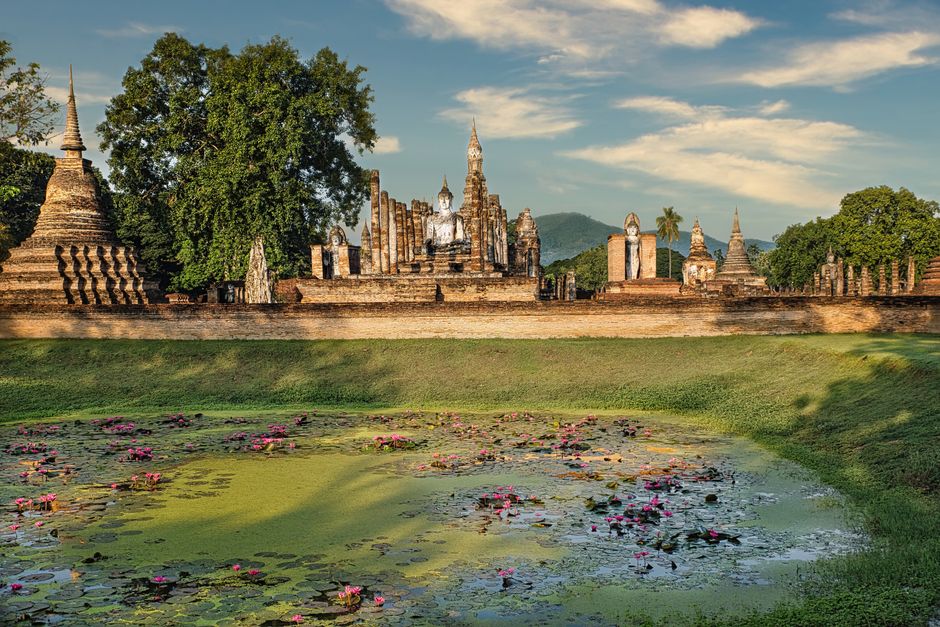
Sukhothai, in the lower north of Thailand about 430 km (270 miles) from Bangkok, was the capital of the first great Thai kingdom in the 13th and 14th centuries, and its ruins are among the most beautiful in Southeast Asia. Today there are two Sukhothais: the modern provincial town of Sukhothai Thani (New Sukhothai), on the Yom River, where most travelers sleep and eat, and the old city 12 km (7 miles) to the west, preserved as Sukhothai Historical Park. Its lotus-bud chedis, serene seated and walking Buddhas, moats and lotus ponds are part of the UNESCO World Heritage site of the Historic Town of Sukhothai and Associated Historic Towns, together with Si Satchanalai and Kamphaeng Phet. Come to cycle among the temples at sunrise, see the giant Buddha of Wat Si Chum, try Sukhothai noodles, and, in November, watch the candlelit Loy Krathong festival, which many Thais believe began here. The cool, dry months from November to February are the most comfortable; March to May are very hot, and most rain falls from May to October.
Right now in Sukhothai
- Wed 23–31°C 73–87°F 9 mm Light showers
- Thu 24–32°C 76–89°F 1 mm Mostly clear
- Fri 25–32°C 78–89°F Mostly clear
Weather: MET Norway (CC BY 4.0) · Rates: ECB
Top tours in Sukhothai
See all tours for Sukhothai →
From local operators, with prices and reviews; you check availability and book on Viator, our partner. We may earn a commission at no extra cost to you. How we earn money
Sukhothai at a glance
- Best for: history and temple ruins, cycling, photography, Buddhist art, and the Loy Krathong festival.
- How long: 2 days for the historical park; 3 days to add Si Satchanalai or Kamphaeng Phet.
- Best time: November to February, with highs of about 31–34 °C (88–92 °F) and little rain; early mornings are cool and clear.
- Getting there: about 1 hour 15 minutes by air from Bangkok to Sukhothai Airport, 6–7 hours by bus, or by train to Phitsanulok and a 1-hour bus.
- Getting around: songthaews and buses between the new town and the historical park, and bicycles, electric carts or tram tours inside the park.
- Fees to know: the historical park charges foreign visitors a separate entry fee for each zone, plus a small fee for bicycles or vehicles.
- Before you go: entry rules, the Thailand Digital Arrival Card, money and general safety are in our Thailand travel guide.
Sukhothai’s areas and where to stay
New Sukhothai (Sukhothai Thani)
The modern town on the Yom River is a practical, friendly place with guesthouses, hotels, a night market and the bus station a little out of the center. It has little to see itself but is a comfortable base, with frequent songthaews to the old city.
Old Sukhothai and the historical park
Around the park’s main gate on Highway 12, the small village of Mueang Kao has guesthouses, boutique resorts, bicycle rentals and restaurants. Staying here lets you be among the ruins at sunrise and sunset, before and after the day visitors.
The countryside
Resorts set among rice fields between the two towns offer pools and quiet, best with your own transport or bicycles.
Where to stay in Sukhothai
- Old Sukhothai: walk or cycle to the ruins at first light; quieter in the evening.
- New Sukhothai: more choice, restaurants and the night market; 30 minutes from the park.
- Countryside resorts: pools and peace, a short drive from the park.
Prices rise during the Loy Krathong festival, when hotels fill weeks in advance.
Top things to see in Sukhothai
Wat Mahathat
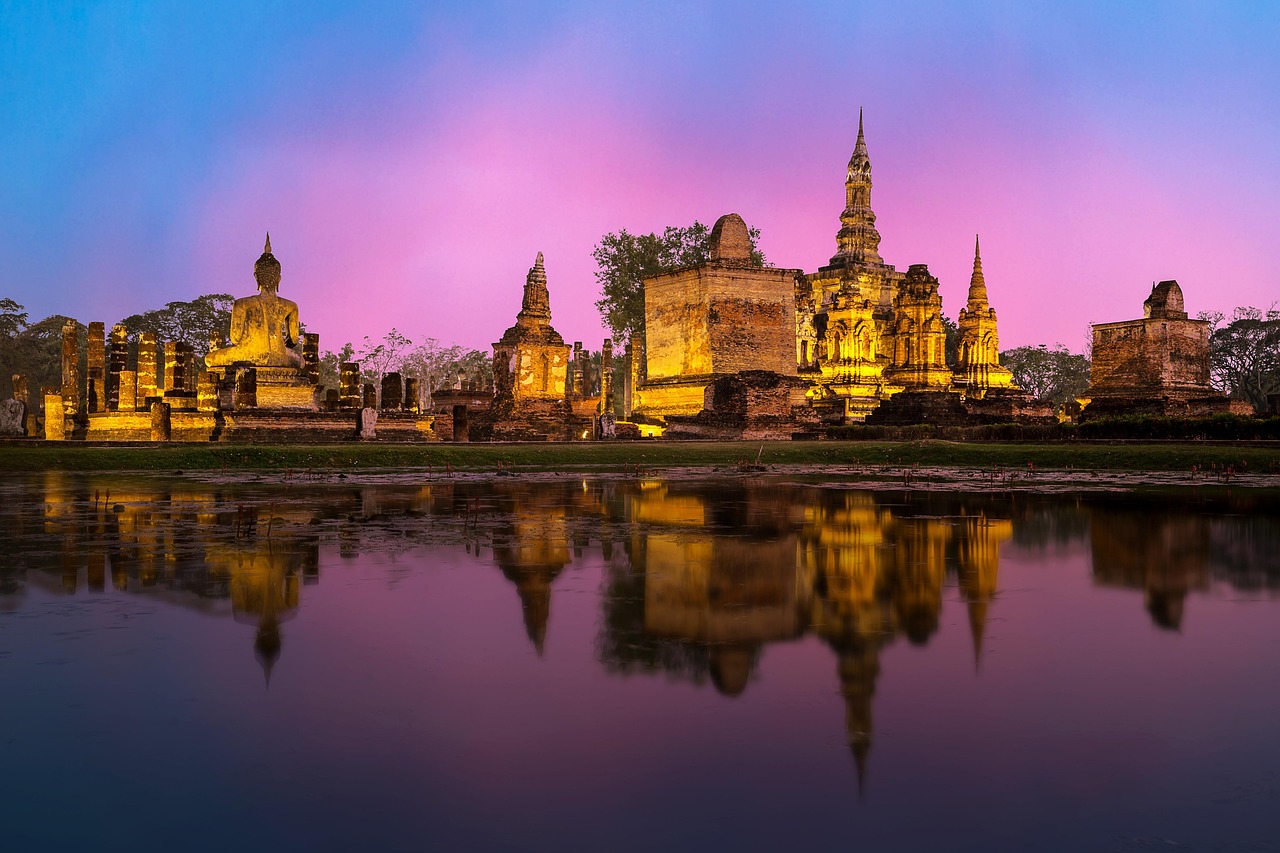
The spiritual heart of the old city and its largest temple, in the center of the walled area: a main chedi with the characteristic lotus-bud top, rows of columns of the former assembly halls, standing Buddhas in brick niches and a large seated Buddha, all reflected in the surrounding ponds. Go at sunrise or late afternoon for the best light.
Wat Si Chum
North of the walls, a square mondop with tall walls encloses Phra Achana, a seated Buddha about 15 m (49 ft) high whose long, elegant fingers you can see through a narrow opening. It is one of Thailand’s most memorable images. The Fine Arts Department, which manages the park, carried out conservation work at Wat Si Chum in 2026, so parts of the site may be under scaffolding.
Wat Si Sawai and Wat Sa Si
Wat Si Sawai, just south of Wat Mahathat, has three corn-cob-shaped towers in the Khmer style, a reminder that the site was a Khmer outpost before the Thai kingdom. Wat Sa Si stands on an island in a lake, with a bell-shaped chedi and a seated Buddha reached by a footbridge.
Wat Saphan Hin
West of the walls, a path of slate slabs climbs a hill to a standing Buddha about 12 m (40 ft) tall, raising one hand in blessing over the city. The walk takes about 15 minutes and gives the best view of the park.
Ramkhamhaeng National Museum
Near the central zone’s entrance, this museum displays sculptures, ceramics and other finds from Sukhothai and the area, with a copy of the famous Ramkhamhaeng inscription, traditionally regarded as the earliest example of Thai script. The monument to King Ramkhamhaeng stands nearby.
More classic sights
- Wat Trapang Ngoen: a lotus-bud chedi on an island in a pond, with a fine walking Buddha.
- Wat Chang Lom: in the eastern zone, a bell-shaped chedi ringed by elephant sculptures.
- Wat Phra Phai Luang: a large northern temple with a Khmer-style tower and Buddha images in stucco.
- Wat Traphang Thong Lang: in the east, known for its stucco reliefs of the Buddha.
- The moats and walls: three rings of earthen walls and moats that once enclosed the city, best seen by bicycle.
Archaeological sites
- Wat Chang Lom
- Wat Mahathat
- Wat Phra Phai Luang
- Wat Sa Si
- Wat Saphan Hin
- Wat Si Chum
Museums
- Ramkhamhaeng National Museum
Parks and gardens
- Sukhothai Historical Park
Visiting the historical park
Zones, fees and hours
Sukhothai Historical Park is divided into zones: the central zone within the old walls, with most of the major temples, and the north, west, south and east zones outside them. Foreign visitors pay a separate fee for each of the central, north and west zones, about 100 baht (about US$3) each, plus a small charge for bicycles or cars; the gates generally open from early morning to early evening, and the central zone is lit up on some evenings. Keep your tickets, as they are checked at each zone. Fees and hours can change, so check at the gate.
Getting around the park
The best way to see the park is by bicycle: the ruins are spread over several square kilometers, and the paths are flat and shaded. Bicycles are rented at the main gate for a small daily fee. Electric carts and an open-air tram tour are alternatives in the heat.
Candlelit nights at the ruins
On major Buddhist holy days, such as Visakha Bucha and Asalha Bucha, the Fine Arts Department invites the public to candlelit processions with oil lamps around the temples of the old city. It also runs a passport scheme in which visitors collect stamps at the historic sites.
Activities and best months
- CultureThe Fine Arts Department holds candlelit 'Wian Tian' processions at the Sukhothai Historical Park on Buddhist holy days (Visakha Bucha, Asalha Bucha), part of the Historic Town of Sukhothai World Heritage site. · source
Other things to do in Sukhothai
Food and drink
Sukhothai’s signature dish is kuay tiew Sukhothai, rice noodles with pork, ground peanuts, green beans, pickled radish and a sweet-sour, chili-spiked broth or served dry. Try it at noodle shops in both towns, along with khao poep (crepe-wrapped noodles) and northern curries. The night market in New Sukhothai is the best place for street food.
Crafts
Sukhothai is known for its celadon-style Sangkhalok ceramics and for gold and silver jewelry made in the traditional style in Si Satchanalai; workshops and shops show the techniques.
The Loy Krathong and Candle Festival
Sukhothai is the most famous place in Thailand to celebrate Loy Krathong, the festival of lights on the full moon of the twelfth lunar month (November 24 in 2026). The Sukhothai Loy Krathong and Candle Festival turns the historical park into a stage for light-and-sound shows, processions, traditional fireworks and thousands of candles and floating krathongs; in 2025 it ran for ten days, from October 27 to November 5, according to the Tourism Authority of Thailand. Check the 2026 dates when they are announced, and book a hotel early.
Day trips from Sukhothai
- Si Satchanalai Historical Park: a quieter, partly forested site about 1 hour north, with Wat Chang Lom’s elephant-ringed chedi and the old Sangkhalok kilns; the community of Tha Chai in Si Satchanalai was named among the 2025 Green Destinations Top 100 Stories.
- Kamphaeng Phet Historical Park: laterite temples and giant Buddhas in a forest, about 1.5 hours southwest; the third part of the World Heritage site.
- Phitsanulok: Wat Phra Si Rattana Mahathat and its revered Phra Phuttha Chinnarat Buddha, about 1 hour east.
- Ramkhamhaeng National Park: the forested mountain of Khao Luang, southwest of the old city; according to the national parks department, it closes every year from March 1 to May 31.
- Ayutthaya: the later capital, on the way back to Bangkok; see our Ayutthaya guide.
Nearby destinations
- Chiang Mai216 km
- Pai299 km
Getting there and getting around
By air, road and rail
Sukhothai Airport (THS), about 30 km (19 miles) north of New Sukhothai, is a small private airport owned by Bangkok Airways, with flights from Bangkok’s Suvarnabhumi Airport in about 1 hour 15 minutes; shuttles connect with the town and historical park. Buses from Bangkok’s Mo Chit terminal take about 6–7 hours, and buses also run from Chiang Mai (about 5 hours) and Phitsanulok (about 1 hour). The nearest railway station is Phitsanulok, on the State Railway of Thailand’s northern line, about 5–7 hours from Bangkok, with buses or minivans on to Sukhothai. Phitsanulok also has an airport with more flights.
Around Sukhothai
Blue songthaews run between New Sukhothai and the historical park every 20–30 minutes in the daytime, taking about 30 minutes. In the new town, tuk-tuks and motorcycle taxis are cheap; scooters and cars can be rented, and some guesthouses arrange transfers. Inside the park, rent a bicycle.
When to go and how long to stay
Sukhothai lies on the plains of the lower north, with three seasons: cool and dry from November to February, very hot from March to May, and rainy from May to October. There is no long-term weather station in Sukhothai, so the table uses the 1991–2020 normals of the Thai Meteorological Department (TMD) for its Phitsanulok station, about 55 km (34 miles) to the east, as submitted to the World Meteorological Organization (WMO): average daily highs and lows, total rain, and days with at least 1 mm of rain.
| Month | Average high / low | Rain (days with 1 mm or more) | What to expect |
|---|---|---|---|
| January | 32 °C (89 °F) / 19 °C (67 °F) | 7 mm (0.3 in), 1 day | Cool, dry mornings; peak season |
| February | 34 °C (92 °F) / 21 °C (69 °F) | 17 mm (0.7 in), 1 day | Dry and sunny; warming up |
| March | 36 °C (96 °F) / 24 °C (75 °F) | 29 mm (1.1 in), 2 days | Hot; visit the ruins early |
| April | 37 °C (99 °F) / 25 °C (78 °F) | 59 mm (2.3 in), 4 days | The hottest month; Songkran |
| May | 36 °C (96 °F) / 25 °C (78 °F) | 166 mm (6.5 in), 10 days | First heavy storms; very hot and humid |
| June | 34 °C (94 °F) / 25 °C (77 °F) | 161 mm (6.3 in), 12 days | Showers; ponds and moats fill |
| July | 33 °C (92 °F) / 25 °C (77 °F) | 188 mm (7.4 in), 14 days | Rainy, green and quiet |
| August | 33 °C (91 °F) / 25 °C (76 °F) | 241 mm (9.5 in), 16 days | Wet; lotus in bloom |
| September | 33 °C (91 °F) / 25 °C (76 °F) | 268 mm (10.6 in), 15 days | The wettest month; possible flooding on the Yom River |
| October | 33 °C (91 °F) / 24 °C (75 °F) | 139 mm (5.5 in), 9 days | Rains easing; festival preparations |
| November | 32 °C (90 °F) / 22 °C (72 °F) | 32 mm (1.2 in), 2 days | Dry and pleasant; Loy Krathong festival |
| December | 31 °C (88 °F) / 19 °C (67 °F) | 13 mm (0.5 in), 1 day | Cool and clear; ideal for cycling |
The Phitsanulok station records about 1,320 mm (52 in) of rain a year, most of it from May to October. The Yom River sometimes floods low-lying parts of New Sukhothai in September and October.
Weather month by month
Averages from TMD normals 1991–2020, Phitsanulok · Last reviewed 5 Oct 2026
2 days in Sukhothai
Day one, rent a bicycle at sunrise and explore the central zone, Wat Mahathat, Wat Si Sawai and Wat Sa Si, then the museum in the midday heat, and the north zone with Wat Si Chum in the late afternoon. Day two, climb to Wat Saphan Hin in the west zone in the early morning, cycle around the east zone, and eat Sukhothai noodles for lunch.
3 days or more
Add a day trip to Si Satchanalai or Kamphaeng Phet, or a visit to Phitsanulok on the way north or south.
What a trip to Sukhothai costs
Prices are approximate, for October 2026, converted at about 33 baht to the US dollar.
| Item | Typical cost |
|---|---|
| Bowl of Sukhothai noodles | 40–70 baht (about US$1.20–2) |
| Dinner for two at a restaurant | 400–1,000 baht (about US$12–30) |
| Historical park entry, per zone, foreign visitors | about 100 baht (about US$3) |
| Bicycle rental, per day | 30–50 baht (about US$1–1.50) |
| Songthaew between the new town and the park | 30–50 baht (about US$1–1.50) |
| Bus from Bangkok | 300–500 baht (about US$9–15) |
| Guesthouse double | 500–1,200 baht (about US$15–36) |
| Boutique resort double near the park | 1,500–4,000 baht (about US$45–120) |
Practical tips for Sukhothai
- Start early: be at the park gate at opening time for cool air, soft light and empty ruins; rest at midday.
- Dress respectfully: the ruins are still sacred; cover shoulders and knees, don’t climb on monuments or Buddha images, and don’t pose disrespectfully with them.
- Keep your tickets: they are checked at each zone.
- Book Loy Krathong early: hotels fill up weeks ahead of the festival.
- Cannabis and vaping: cannabis flower needs a Thai prescription, and e-cigarettes are illegal in Thailand.
- Help: the Tourist Police (1155) speak English, and the TAT Contact Center (1672) answers tourist questions.
Safety
Sukhothai is a quiet, safe town; the main risks are heat and traffic.
- Heat: from March to May, temperatures reach the high 30s °C (around 100 °F); cycle in the early morning and late afternoon, drink plenty of water and wear a hat.
- Cycling and roads: inside the park the lanes are quiet, but Highway 12 between the zones and the towns has fast traffic; use the side paths and lights at dusk.
- Ruins: steps and brickwork are uneven and steep; take care at Wat Saphan Hin and don’t climb the monuments.
- Floods: heavy rain in September and October can flood parts of New Sukhothai; check local conditions.
- Festival crowds: at Loy Krathong, keep an eye on your belongings and children, and be careful around fireworks and candles.
- Dogs: stray dogs sometimes chase bicycles on quiet lanes; slow down and keep going calmly.
- Emergencies: call 1155 for the Tourist Police (English spoken), 191 for the police and 1669 for an ambulance.
What to pack for Sukhothai
A wide-brimmed hat, sunglasses and strong sunscreen, light clothes that cover shoulders and knees, comfortable shoes for cycling and walking on uneven ground, a refillable water bottle, insect repellent for dusk, a light rain jacket from May to October, and a warm layer for cool December mornings. Thailand uses 220 V; sockets take both flat two-pin and round two-pin plugs.
Sukhothai travel FAQ
How much does Sukhothai Historical Park cost?
Foreign visitors pay a separate fee for each zone, about 100 baht for each of the central, north and west zones, plus a small charge for bicycles or cars. Check current prices at the gate.
How far is the historical park from New Sukhothai?
About 12 km (7 miles), roughly 30 minutes by songthaew.
What is the best way to see Sukhothai Historical Park?
By bicycle, starting at sunrise; electric carts and a tram tour are alternatives.
When is the Sukhothai Loy Krathong festival?
Around the full moon of the twelfth lunar month, which falls on November 24 in 2026; the festival in the historical park usually lasts about a week or more. Check the 2026 dates when they are announced.
How many days do I need in Sukhothai?
Two days for the historical park; three to add Si Satchanalai or Kamphaeng Phet.
Is Sukhothai worth visiting?
Yes. It is one of the most beautiful and peaceful historic sites in Thailand, and much less crowded than Ayutthaya.
How do I get to Sukhothai from Bangkok?
Fly to Sukhothai Airport in about 1 hour 15 minutes, take a bus (6–7 hours), or take the train to Phitsanulok and a bus from there.
Can I visit Sukhothai from Chiang Mai?
Yes, by bus in about 5 hours; it fits well on a route between Bangkok and Chiang Mai.
What is Sukhothai famous for?
As the capital of the first Thai kingdom, for its ruined temples and graceful Buddha images, the walking Buddha style, the origins of Thai script and its Loy Krathong festival.
Is Sukhothai a UNESCO World Heritage site?
Yes, as part of the Historic Town of Sukhothai and Associated Historic Towns, together with Si Satchanalai and Kamphaeng Phet.
Sources and last review
Researched and last reviewed on 4 October 2026. Candlelit processions, the stamp passport and conservation at Wat Si Chum: the Fine Arts Department’s Sukhothai Historical Park office; national park closures: the Department of National Parks, Wildlife and Plant Conservation; the Loy Krathong and Candle Festival, the Green Destinations listing, Sukhothai’s status after the late-September 2026 rain, cannabis and e-cigarette rules and the Tourist Police: the Tourism Authority of Thailand (TAT); climate normals: the Thai Meteorological Department via the World Meteorological Organization’s 1991–2020 normals; World Heritage listing: UNESCO via Wikidata; Loy Krathong date: the 12th-month full moon from the US Naval Observatory; exchange rate: the US Federal Reserve. Park fees and hours, journey times, monument sizes and typical prices are general references or estimates, flagged for checking. Prices and schedules change, so check the official sites before you go. For entry rules, money and general safety, see our Thailand travel guide.
Plan your trip
Partner links: TravelerCenter may earn a commission if you book, at no extra cost to you.
🇹🇭 Useful Thai phrases for Sukhothai
All 38 Thai phrases: restaurant, hotel, emergencies, romance (printable) →