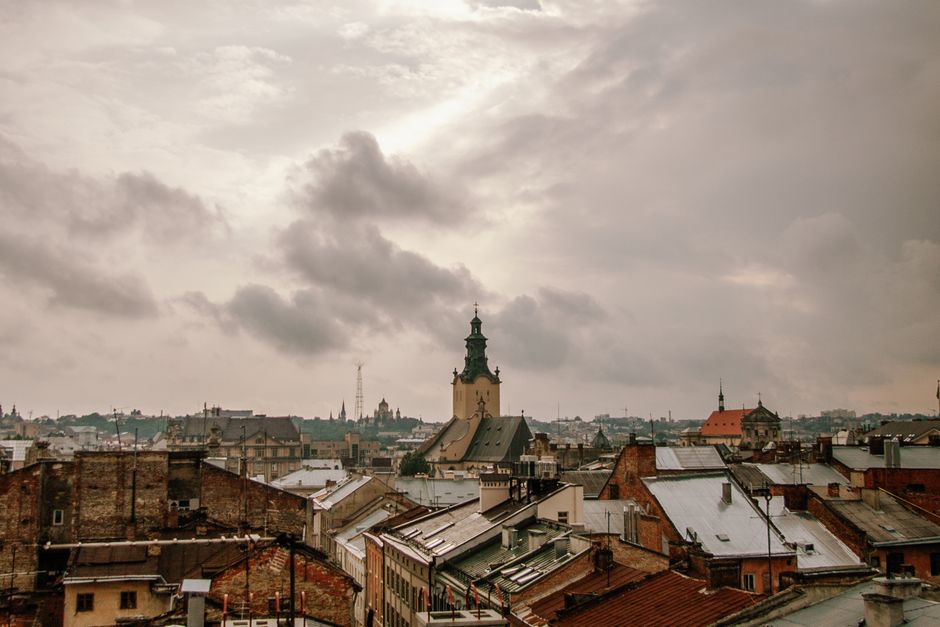
Lviv is the main city of western Ukraine and one of the most beautiful in Central and Eastern Europe: a compact old town of cobbled streets, Renaissance merchants’ houses, Baroque churches of several faiths and grand Habsburg-era buildings, gathered around the Market Square and its town hall. For centuries it was a meeting point of Ukrainian, Polish, Jewish, Armenian and Austrian cultures, and it is known for its cafés, its coffee and chocolate, and its music. Since 2022, Lviv has been a refuge for people displaced from other parts of Ukraine and a gateway for aid. Its historic centre is a UNESCO World Heritage Site. This guide explains what Lviv is known for and how it came to be, with notes on current conditions.
Right now in Lviv
- Wed 9–20°C 48–69°F Partly cloudy
- Thu 11–22°C 51–72°F Mostly clear
- Fri 10–16°C 50–61°F 2 mm Light rain
Weather: MET Norway (CC BY 4.0)
Lviv at a glance
- Status: administrative centre of the Lviv region (ISO 3166-2 code UA-46), about 70 km from the Polish border.
- Population: about 720,000 before 2022, according to Ukraine’s statistics service; it has risen and fallen since with the movement of displaced people.
- Names: Lviv in Ukrainian, Lwów in Polish, Lemberg in German and Yiddish, Lvov in Russian.
- Language: Ukrainian, which is spoken more widely here than in most of the country.
- Time zone: Eastern European Time, UTC+2 (UTC+3 in summer).
- World Heritage: L’viv – the Ensemble of the Historic Centre, inscribed by UNESCO in 1998 and placed on the List of World Heritage in Danger in September 2023.
A short history of Lviv
Lviv was founded in the mid-13th century by King Danylo of Galicia-Volhynia, who named it after his son Lev; the first written mention dates from 1256. In 1349 the Polish king Casimir III took the city, and in 1356 it received Magdeburg rights of self-government. For more than four centuries Lviv was one of the leading cities of the Kingdom of Poland, a trading hub on the routes between the Baltic, the Black Sea and the East, with Catholic, Orthodox, Armenian and Jewish communities, each with its own churches, synagogues and quarters. Its Renaissance houses on the Market Square and the Dormition Church with its Korniakt tower date from this golden age.
In 1772, with the first partition of Poland, Lviv became Lemberg, capital of the Habsburg province of Galicia. Under Austrian rule it gained its opera house, university buildings, parks, coffee houses and railway station, and became a centre of both the Polish and the Ukrainian national movements. After the First World War, Polish and Ukrainian forces fought for the city; it became part of Poland between the wars. In 1939 it was occupied by the Soviet Union, and from 1941 to 1944 by Germany. During the Holocaust, nearly all of Lviv’s Jewish community, which numbered more than 100,000 people, was murdered, many in the Janowska camp on the city’s edge. After 1944 Lviv became part of Soviet Ukraine, and its Polish population was moved west.
From the late 1980s Lviv was a centre of the Ukrainian independence movement, and since 1991 it has been one of Ukraine’s main cultural cities, with restored churches and a busy café and festival scene. Since the full-scale invasion of 2022 it has received hundreds of thousands of displaced people and has itself been hit by missile and drone strikes.
What Lviv is known for
The Market Square and the old town
The Market Square (Ploshcha Rynok) is surrounded by more than 40 houses, many with Renaissance or Baroque façades, such as the Black House and the Kornyakt House, and has a fountain at each corner. In the centre stands the 19th-century town hall, whose tower offers views over the rooftops. The surrounding streets are a dense network of lanes, courtyards and passages that UNESCO describes as a rare example of a medieval urban structure preserved with its later Renaissance, Baroque and Habsburg layers.
Churches of many faiths
Lviv’s skyline reflects its many communities: the Latin Cathedral, Gothic in origin; the Armenian Cathedral, founded in the 14th century, with its painted interior; the Dormition Church and its tall Korniakt bell tower, the centre of the Orthodox community; the Jesuit Church of Saints Peter and Paul; the Dominican Church with its green dome; and, on a hill outside the old town, the Baroque St George’s Cathedral, the historic seat of the Ukrainian Greek Catholic Church. The small Boim Chapel, covered in carved stone, is one of the most striking Renaissance monuments in the city.
The Opera House and Freedom Avenue
The Lviv Opera House, opened in 1900, closes the long boulevard of Freedom Avenue (Prospekt Svobody), the city’s main promenade. Its richly decorated interior and hall of mirrors are among the finest of the Habsburg era.
Coffee, chocolate and beer
Lviv likes to call itself Ukraine’s coffee capital, a tradition traced to the Habsburg coffee houses and to local legends about a Viennese café owner from Lviv. The city is also known for handmade chocolate, and its brewery, founded in 1715, is one of the oldest in Ukraine. The Pharmacy Museum, in a pharmacy that has operated since 1735, is one of the oldest in Europe.
Lychakiv Cemetery and the High Castle
Lychakiv Cemetery, opened in 1786, is a romantic park of tombs and sculptures where poets, scholars and soldiers of several nations are buried. The High Castle hill, the site of the city’s first fortress, is now a park with a viewing mound over the old town.
Climate
Lviv has a moderate continental climate, cooler and wetter than Kyiv because of its higher altitude and the nearby Carpathians: cold, often grey winters averaging a little below freezing, and mild summers, with July averaging about 19 °C and frequent showers. Winter temperatures in Ukraine can fall below −20 °C, which matters during power cuts.
| Season | Average temperature (day and night) | Rain or snow per month |
|---|---|---|
| Winter (Dec–Feb) | −2.7 to −1.3 °C | 45–50 mm |
| Spring (Mar–May) | 2.5 °C rising to 13.9 °C | 48–93 mm |
| Summer (Jun–Aug) | 17.3–19.0 °C | 72–96 mm |
| Autumn (Sep–Nov) | 13.5 °C falling to 3.3 °C | 49–70 mm |
Lviv gets about 764 mm of rain and snow a year, most of it in late spring and summer. The figures are the official 1991–2020 averages for the Lviv station that Ukraine submitted to the World Meteorological Organization; that submission gives average (mean) temperatures rather than daytime highs and night-time lows.
Safety and current conditions
An armed conflict is ongoing in Ukraine. Lviv is further from the front line than Kyiv or the east, but Russian missile and drone attacks do happen in the western regions. Martial law is in force, attacks on the power grid cause blackouts, and Ukraine’s airspace is closed.
Entry
Ukraine allows British citizens visa-free visits of up to 90 days in any 180-day period, confirmed until 30 January 2027; Ukraine’s Ministry of Foreign Affairs lists the same visa-free rule for citizens of the EU, the US, Canada, Australia, New Zealand and Japan. At the border you fill in an immigration card, may be asked for fingerprints, and should be ready to show evidence of funds such as cash, bank statements, bookings or a return ticket. Your passport must be valid for the length of your stay. Carry it at all times in Ukraine.
Getting there
Ukraine’s airspace is closed, so the only ways in are overland. Lviv is about 70 km from the Polish border, and since 2022 trains from Przemyśl in Poland have been the main rail link into the city; check current timetables with Ukrzaliznytsia and Polish operators before you go. The main road crossings with Poland near Lviv are Krakovets–Korczowa and Shehyni–Medyka, where queues can be long. Bring food, water and warm clothing for border waits. The nearest airports are in Poland, at Rzeszów and Kraków; see our Kraków guide.
Safety on the ground
- Air alerts: install an air-alert app, know where your nearest shelter is, and take shelter immediately when the siren sounds; follow instructions on trains, which can stop during alerts.
- Curfew and martial law: a nationwide curfew applies; check local hours, carry your passport at all times and follow instructions from officials.
- Power cuts: keep water, food, a charged power bank, warm clothing and some cash in hryvnias, as card terminals and cash machines may not work during blackouts.
- Photography: do not photograph military sites, checkpoints, infrastructure or the results of attacks.
- Further north and east: areas within 50 km of the Belarusian border in the neighbouring Volyn and Rivne regions are restricted, and attacks are more frequent in Kyiv and central, eastern and southern Ukraine.
- Insurance: standard travel insurance policies almost always exclude war zones, so check the wording of your policy.
- Consular help: in-person consular help in Ukraine is very limited, and some countries offer full consular services only in neighbouring countries.
- Emergencies: 101 fire and rescue, 102 police, 103 ambulance. British nationals can call the British Embassy in Kyiv on +380 44 490 3660.
Lviv FAQ
Is it safe to travel to Lviv now?
An armed conflict is ongoing in Ukraine. Missile and drone attacks happen less often in the west than in the east, but they do happen in Lviv, air-raid alerts are frequent and martial law applies. See the safety section above for the details.
How do people get to Lviv without flights?
Ukraine’s airspace is closed, so people travel overland, most often by train or bus from Poland. Lviv’s railway station has international connections, and the main road crossings are at Krakovets–Korczowa and Shehyni–Medyka. Expect long border queues.
Do I need a visa for Ukraine?
Citizens of the EU, the UK, the US, Canada, Australia, New Zealand and Japan can visit Ukraine without a visa for up to 90 days in any 180-day period. You complete an immigration card at the border and may be asked to show funds.
What is Lviv known for?
Its UNESCO-listed old town and Market Square, churches of many faiths including the Armenian Cathedral and St George’s Cathedral, the Opera House, Lychakiv Cemetery, and its coffee, chocolate and café culture.
What was Lviv called in the past?
Lwów under Polish rule, Lemberg under the Habsburgs (and in German and Yiddish), and Lvov in Russian and in the Soviet period. Lviv is the Ukrainian name and the official one today.
Sources and last review
Researched and last reviewed on 4 October 2026. Safety and practical information from GOV.UK foreign travel information (updated 2 October 2026) and the US State Department’s country information (27 August 2026); World Heritage listing and danger status (September 2023) from UNESCO; entry rules from GOV.UK and Ukraine’s Ministry of Foreign Affairs (archived copy); climate from the official 1991–2020 normals Ukraine submitted to the World Meteorological Organization. The pre-war population, train routes from Poland, road crossing names and some historical details come from secondary sources or general knowledge and are flagged for checking. History is summarised from standard reference works. Conditions can change at short notice, so check the latest official information.
Plan your trip
Partner links: TravelerCenter may earn a commission if you book, at no extra cost to you.
🇺🇦 Useful Ukrainian phrases for Lviv
All 38 Ukrainian phrases: restaurant, hotel, emergencies, romance (printable) →