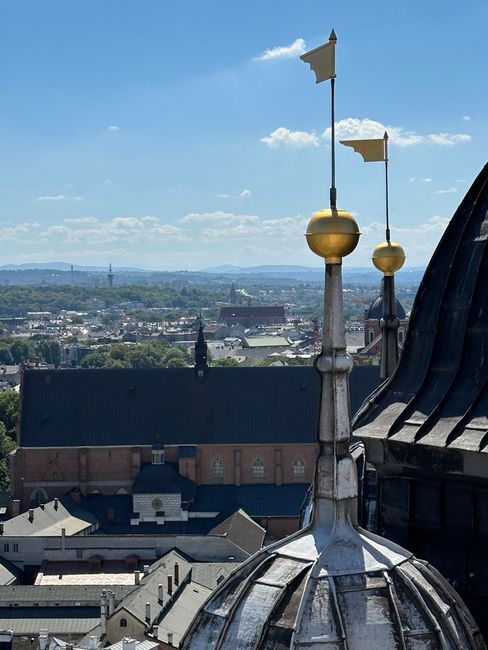
Kraków was Poland’s royal capital for more than 500 years, and unlike Warsaw it came through the Second World War almost untouched. Its medieval Main Square is one of the largest in Europe, ringed by palaces and cafés around the Renaissance Cloth Hall, and a trumpeter still plays from the tower of St Mary’s Basilica every hour. Above the Vistula, Wawel Castle and Cathedral hold the tombs of Polish kings; to the south, Kazimierz, the former Jewish town, is now the city’s liveliest quarter. Kraków is also the base for two of the country’s most visited sites: the Wieliczka salt mine, with chapels carved from salt, and the Auschwitz-Birkenau Memorial, which every visitor should approach with time, preparation and respect. Give it three days for the city, five to add both day trips without rushing.
Right now in Kraków
- Wed 9–21°C 47–70°F Partly cloudy
- Thu 10–23°C 50–74°F 7 mm Partly cloudy
- Fri 8–14°C 47–58°F 1 mm Partly cloudy
Weather: MET Norway (CC BY 4.0) · Rates: ECB
Top tours in Kraków
See all tours for Kraków →
From local operators, with prices and reviews; you check availability and book on Viator, our partner. We may earn a commission at no extra cost to you. How we earn money
Kraków at a glance
- Best for: medieval and Renaissance architecture, royal history, Jewish heritage, Second World War history, cafés, bars and food.
- How long: 3 days for the Old Town, Wawel and Kazimierz; 5 days to add the Auschwitz-Birkenau Memorial and the Wieliczka salt mine.
- Best time: May, June and September; December for the Christmas market. July and August are busy and can be hot.
- Getting in: Kraków Airport (Balice) is linked to the main station by a train taking about 20 minutes. Trains from Warsaw take about 2 hours 15 minutes.
- Book ahead: Wawel Castle’s timed tickets, the Wieliczka salt mine and especially the Auschwitz-Birkenau Memorial, where an entry pass is compulsory. As of October 2026, a guided visit to Auschwitz in English cost 150 zł.
- Before you go: entry rules, money and trains are in our Poland travel guide.
Kraków, area by area
The Old Town (Stare Miasto)
The medieval city, a UNESCO World Heritage Site since 1978, fits inside the Planty, a ring of parkland laid out where the walls once stood. At its centre is the Main Square (Rynek Główny), with the Cloth Hall, St Mary’s Basilica and the Town Hall Tower; streets such as Floriańska, part of the old Royal Route from St Florian’s Gate and the Barbican, lead to it. Best for: first visits, sightseeing and atmosphere.
Wawel Hill
At the southern tip of the Old Town, the limestone hill above the Vistula holds the royal castle and the cathedral, the symbolic heart of the Polish nation. Best for: history and views of the river.
Kazimierz
Founded as a separate town in the 14th century, Kazimierz was for centuries the centre of Jewish life in Kraków, until the Nazis expelled its inhabitants in 1941 and murdered most of them. Its synagogues, cemeteries and squares survived, and since the 1990s it has become the city’s most creative quarter, with bars, galleries and restaurants around Plac Nowy and Szeroka Street. Best for: Jewish heritage, food and nightlife.
Podgórze
Across the river from Kazimierz, Podgórze was where the Nazis created the Kraków ghetto in 1941. It is home to Oskar Schindler’s former factory, now a museum, the Ghetto Heroes Square with its memorial of empty chairs, and the Eagle Pharmacy. Best for: wartime history and a quieter base.
Nowa Huta
East of the centre, Nowa Huta is a planned socialist-realist town built in the 1950s around a giant steelworks, with wide avenues and grand housing blocks. Best for: communist-era history and architecture.
Top things to see in Kraków
Prices and hours below were checked on official sites in October 2026. They change, so check before you go.
The Main Square and the Cloth Hall
The Rynek Główny, laid out in 1257, is about 200 m on each side and is the city’s living room, full of flower stalls, horse-drawn carriages, street performers and café terraces. In the middle stands the Cloth Hall (Sukiennice), a Renaissance trading hall with a market of amber, wooden toys and souvenirs on the ground floor and a gallery of 19th-century Polish painting upstairs. Nearby, the Town Hall Tower is all that remains of the old town hall.
The Rynek Underground. Beneath the square, an excavation of the medieval marketplace has become a high-tech museum of the city’s early history. As of October 2026, entry costs 45 zł (35 zł reduced), and it is free on Tuesdays, when it opens 10:00–15:00 and tickets are given out at the desk on the day only. It opens until 19:00 or 20:00 on other days and closes on the second Monday of each month.
St Mary’s Basilica
The brick Gothic basilica on the corner of the square has two unequal towers. From the taller one, every hour, a trumpeter plays the hejnał, a short tune that breaks off mid-note, in memory, legend says, of a watchman shot by a Tatar arrow while sounding the alarm. Inside, the star-studded blue vault and the huge carved wooden altarpiece by Veit Stoss (Wit Stwosz), completed in 1489, are breathtaking.
As of October 2026, tourists enter by the south door; the church is open to visitors Monday to Saturday 11:30–18:00 and on Sundays and holidays 14:00–18:00, and the ticket costs 20 zł (10 zł reduced). The altarpiece is opened at 11:50 (on Sundays at 14:10). From May to October you can climb the bugle tower in small groups (20 zł); it is closed from November to April.
Wawel Castle
The royal castle on Wawel Hill was the residence of Polish kings until 1596, rebuilt in Renaissance style around an arcaded courtyard. It is now a museum with several separate exhibitions, each with its own ticket, and entry is by timed ticket with daily limits, so book online (up to one month ahead at the castle’s official ticket shop) or arrive early.
| Exhibition | Price (normal / reduced), as of October 2026 | What you see |
|---|---|---|
| The castle (first and second floors) | 95 / 71 zł, audio guide included | The State Rooms, including the Senators’ Hall and its Flemish tapestries, the royal apartments, the Ottoman tents and more |
| First floor or second floor only | 57 / 43 zł each | Half of the above |
| Crown Treasury | 47 / 35 zł | Royal regalia, including the coronation sword Szczerbiec |
| Armoury | 47 / 35 zł | Weapons and armour |
| Castle Underground (incl. Lost Wawel) | 47 / 35 zł, audio guide included | Remains of the earliest buildings on the hill |
| Dragon’s Den | 15 / 10 zł | A cave under the hill, open seasonally until 31 October |
The main exhibitions open Tuesday to Sunday 9:00–17:00. On Mondays, a limited number of free tickets for selected exhibitions are given out at the ticket windows only, 10:00–16:00. The castle courtyards and the hill are free to walk around, and selected exhibitions are free in November 2026. A pass for all exhibitions costs 199 zł.
The Dragon’s Den. Kraków’s legendary dragon lived in a cave under Wawel Hill until a clever cobbler tricked it into eating a sheep stuffed with sulphur. You can walk down through the cave (seasonally) and come out by the river beside a fire-breathing bronze dragon.
Wawel Cathedral
The coronation and burial church of Polish kings is run by the cathedral parish, separately from the castle. Inside are the tombs of most Polish monarchs, national heroes and poets, the gilded Sigismund Chapel, one of the finest Renaissance buildings north of the Alps, and, up a steep wooden stair, the great Sigismund Bell of 1520, rung only on major national and religious occasions. As of October 2026, the cathedral ticket costs 26 zł (18 zł reduced), or 41 zł with an audio guide, sold at the ticket office and on the parish’s official site; the cathedral opens to visitors Monday to Saturday 9:00–16:30 and Sunday 12:30–16:30.
Kazimierz and Jewish Kraków
Walk along Szeroka Street, the broad square at the heart of the old Jewish town. The Old Synagogue, the oldest surviving synagogue building in Poland, is a branch of the Museum of Kraków on Jewish history and culture (22 zł as of October 2026; it closes on some holidays). The small Remuh Synagogue, still in use, stands beside a Renaissance cemetery. The Galicia Jewish Museum, open daily 10:00–18:00, uses photography to tell the story of Jewish life in the region. Every summer, the Jewish Culture Festival fills Kazimierz with music. In the evening, Plac Nowy’s round market hall sells zapiekanki, long open baguettes with toppings, the city’s favourite late-night snack.
Schindler’s Factory
In Podgórze, the enamel factory where Oskar Schindler saved more than a thousand Jewish workers now holds the Museum of Kraków’s exhibition “Kraków under Nazi Occupation 1939–1945”, one of the best history museums in the country. As of October 2026, tickets cost 60 zł (reduced 40–45 zł) and are timed and named: buy online up to 90 days ahead and bring ID. The museum opens Tuesday to Sunday 9:00–20:00 and Monday 10:00–15:00, when limited free tickets are available on site, and closes on the first Tuesday of each month. It is very popular: book a few days ahead.
Historic centres
- Main Market Square (Rynek Główny)
Monuments
- St. Mary's Basilica in Kraków
- Wawel Castle
- Wawel Cathedral
Museums
- Auschwitz-Birkenau Memorial and Museum
- Oskar Schindler's Enamel Factory
Other sights
- Wieliczka Salt Mine
The Auschwitz-Birkenau Memorial
About 65 km west of Kraków, in the town of Oświęcim, the Auschwitz-Birkenau State Museum preserves the largest of the Nazi German concentration and extermination camps, where at least 1.1 million people were murdered, about a million of them Jews, as well as Poles, Roma, Soviet prisoners of war and others. It is a cemetery and a place of remembrance, not a tourist attraction, and a visit is deeply moving. The memorial has two parts: Auschwitz I, the original camp, with exhibitions in the brick blocks, and Auschwitz II-Birkenau, the vast extermination camp 3.5 km away, with its railway ramp and the ruins of the gas chambers. A free museum bus links the two.
Booking is compulsory. Entry to the grounds is free, but every visitor needs a named entry pass, booked in advance on the memorial’s official website, visit.auschwitz.org; buy only there or from licensed tour operators. Passes cannot be changed after booking, and you must show ID at the entrance. As of October 2026, there are two ways to visit:
- With a museum educator: the general guided tour takes about 3.5 hours, with headphones. An individual pass costs 150 zł in a foreign language (140 zł reduced) and 140 zł in Polish (price list valid from 2 January 2026). During the main part of the day, entry to Auschwitz I is only possible with an educator.
- Free entry passes: free, but available online only (up to six per person per day) and valid only for early or late entry times outside the educator-only hours, which run, for example, from 7:30 to 16:00 in October and to 14:00 in November.
A limited number of same-day guided passes are sold at the Visitor Service Centre, subject to availability, but in busy months they run out; don’t count on them.
Opening hours. The memorial opens at 7:30 all year, and visitors may stay until 15:30 in December, 16:30 in January and November, 17:30 in February, 18:30 in March and October, 19:30 in April, May and September, and 20:30 in June to August; last entry is 90 minutes before closing. It is closed on 1 January, 25 December and Easter Sunday.
Rules. Bags may be no larger than 35 × 25 × 15 cm; larger bags must be left in the left-luggage office, and everyone passes an X-ray check, so arrive 30 minutes before your entry time. The memorial recommends visits for people aged 14 and over. Photography is allowed for private use, but without flash or tripods inside buildings, and it is strictly forbidden in the room displaying victims’ hair and in the basement of Block 11. Don’t eat, drink alcohol or smoke on the grounds, keep your voice down, don’t make phone calls inside the buildings, dress respectfully, and never pose for selfies on the railway tracks or by the fences. Candles may be placed at the Death Wall and the Birkenau monument.
Getting there. Lajkonik buses from Kraków’s bus station go straight to the museum car park in about 1 hour 30 minutes; trains reach Oświęcim station, 1.5 km from the museum. Many tour companies sell transport plus a museum-guided tour. Allow at least a full day, including the journey, and leave time afterwards to reflect.
The Wieliczka Salt Mine
Just south-east of the city, Wieliczka is one of the oldest salt mines in the world, worked from the 13th century until 1996, and a UNESCO World Heritage Site. The classic Tourist Route leads 3.5 km through tunnels, chambers and underground lakes, down to 135 m below the surface, past statues carved from salt by miners and the astonishing Chapel of St Kinga, an underground church with chandeliers, floor tiles and reliefs all made of salt. Tours take two to three hours, including the museum of the Kraków Saltworks, and involve more than 800 steps, mostly down; a lift brings you back up. The temperature is 17–18 °C all year, so bring a light layer.
As of October 2026, the Tourist Route opens daily from 8:00 to 18:00, with frequent tours in English. Prices on the official website start from about 121 zł per person and vary with the date, language and ticket type, so check and book online at the mine’s official ticket shop, which also sells the hands-on Miners’ Route, where visitors work as apprentice miners. For tours in languages other than English or Polish, tickets must be bought online in advance. Children under 4 go free.
Getting there. The SKA1 suburban train runs from Kraków Główny to Wieliczka Rynek-Kopalnia, near the mine entrance, in about 20–25 minutes. Kraków’s older salt mine at Bochnia, also UNESCO-listed, is less crowded and has an underground slide and boat ride.
Things to do in Kraków
Eat and drink like a local
Try pierogi in a milk bar, obwarzanek (Kraków’s ring-shaped bread, sold from blue street carts), zapiekanka in Kazimierz and oscypek smoked cheese from the mountains, grilled at the Christmas market. Kraków’s cellar bars, under the Old Town’s houses, are a nightlife institution. See our city sightseeing guide.
Walk the Vistula boulevards
Paths and cycle lanes follow the river below Wawel, with boat trips, floating bars and the Father Bernatek footbridge to Podgórze. See our boat trips guide.
Christmas in Kraków
The Christmas market fills the Main Square from late November until after Christmas, with wooden stalls, grilled sausages and mulled wine. In early December, Kraków holds its famous competition of szopki, the city’s glittering nativity cribs modelled on its own churches: on the first Thursday of December, the makers bring them to the Mickiewicz monument on the Main Square, and the best are then displayed at the Museum of Kraków. The tradition is on UNESCO’s list of intangible cultural heritage.
Activities and best months
- City sightseeingThe Polish Tourism Organisation calls the UNESCO-listed Old Town, whose medieval street plan is unchanged, a must: the Main Market Square (Europe's largest medieval square) with the Cloth Hall and St Mary's Church and its Veit Stoss altarpiece, Wawel Hill with the royal castle and cathedral, Collegium Maius, the Barbican and St Florian's Gate, and the former Jewish town of Kazimierz. The Planty park rings the Old Town where the walls once stood. · source
Night-time alcohol rules in Kraków
Kraków has tightened its rules on alcohol to calm the Old Town’s nightlife. Since 1 September 2026, shops across the whole city may not sell alcohol between 22:00 and 6:00; bars, pubs and restaurants can still serve drinks on their premises. Drinking alcohol in public places, including the Main Square, the Planty and the river banks, is illegal everywhere in Poland, and police do issue fines. Stag and hen groups are a frequent target of complaints: keep the noise down at night in residential streets.
Day trips from Kraków
- The Auschwitz-Birkenau Memorial: about 1 hour 30 minutes by bus; a full day. See above.
- The Wieliczka Salt Mine: about 20–25 minutes by train; half a day.
- Zakopane and the Tatras: about 2 hours by train or bus; better with a night or two.
- The Dunajec gorge: wooden raft trips through the Pieniny mountains, about 2 hours away, from April to October.
- Ojców National Park: limestone valleys, caves and Pieskowa Skała castle, 30 km north.
- Wadowice: the hometown of Pope John Paul II.
Nearby destinations
- Zakopane85 km
- High Tatras100 km
- Banská Štiavnica194 km
- Wrocław236 km
- Eger243 km
- Warsaw253 km
- Brno258 km
- Budapest292 km
Getting to Kraków
By air. Kraków John Paul II International Airport (KRK), at Balice, 11 km west of the centre, has flights from across Europe. The Koleje Małopolskie train runs from the airport to Kraków Główny in about 20 minutes, every 30 minutes or so by day; taxis and app cars take 20–40 minutes depending on traffic. Katowice Airport, about an hour away, has more low-cost flights.
By train. Kraków Główny, next to the Old Town and the Galeria Krakowska mall, is served by PKP Intercity trains from Warsaw (about 2 hours 15 minutes since the 2026 timetable change), Gdańsk, Wrocław and Zakopane, and by international trains from Prague, Vienna and Budapest. Book on intercity.pl.
By car. The A4 motorway from Katowice is a paid private section for cars (36 zł end to end as of October 2026). Parking in the centre is limited; use park-and-ride car parks.
Getting around Kraków
The Old Town and Kazimierz are walkable, and much of the Old Town is closed to traffic. Trams and buses (MPK Kraków) cover the rest of the city; buy tickets at machines or on board by card, or in an app, and validate paper tickets on boarding. Taxis and Bolt or Uber cars are inexpensive. Electric golf carts offering tours in the Old Town are expensive for what they are; walking is better.
When to go and how long to stay
Kraków has warm summers and cold winters, often with smog on still winter days. The table uses the IMGW 1991–2020 averages for Kraków-Balice, near the airport.
| Season | Average high | Average low | Rain per month | What it’s like |
|---|---|---|---|---|
| Winter (Dec–Feb) | 2–4 °C | −5 to −3 °C | 32–38 mm | Cold, grey, sometimes snowy; the Christmas market and cosy cellar bars |
| Spring (Mar–May) | 8 °C rising to 20 °C | −1 °C rising to 9 °C | 38–79 mm | Blossom in the Planty, Easter markets, pleasant sightseeing |
| Summer (Jun–Aug) | 23–25 °C | 12–14 °C | 73–98 mm | Warm with thunderstorms; café terraces, the Jewish Culture Festival and busy streets |
| Autumn (Sep–Nov) | 20 °C falling to 8 °C | 9 °C falling to 1 °C | 41–66 mm | Golden September and October, damp November; All Saints’ candles on 1 November |
Kraków gets about 670 mm of rain a year, most of it in summer. In winter, air pollution from heating can be high on calm days; Kraków has banned coal and wood burning in the city, but smog from surrounding areas still drifts in.
Kraków in 3 days
Day 1: the Main Square, St Mary’s Basilica at 11:50 for the altarpiece, the Rynek Underground and the Cloth Hall, then Wawel Castle and Cathedral in the afternoon. Day 2: Kazimierz and its synagogues in the morning, Schindler’s Factory and Podgórze in the afternoon, dinner around Plac Nowy. Day 3: the Wieliczka salt mine in the morning, and a walk along the Vistula or around the Planty.
Kraków in 5 days
Add a full day for the Auschwitz-Birkenau Memorial, and a day in Nowa Huta, Ojców or the Dunajec gorge, or a night in Zakopane.
Weather month by month
Averages from IMGW-PIB normals 1991–2020, Kraków-Balice (airport) · Last reviewed 4 Oct 2026
Where to stay in Kraków
- The Old Town: the most central and atmospheric base, but noisy at night around the Main Square; ask for a quiet room.
- Kazimierz: boutique hotels and apartments in the city’s liveliest quarter, a 15-minute walk from the square.
- Podgórze: quieter, good value and close to Kazimierz across the footbridge.
- Near Kraków Główny: convenient for trains, airport links and day trips.
As of October 2026, Kraków charges no tourist tax, though the city is discussing one. Book early for summer weekends, the Christmas market season and New Year.
Practical tips for Kraków
- Book the big three: the Auschwitz-Birkenau Memorial, the Wieliczka salt mine and Wawel all have timed tickets that sell out in summer.
- Bring ID: Auschwitz passes and Schindler’s Factory online tickets are named.
- Mind the bag size: 35 × 25 × 15 cm at Auschwitz-Birkenau.
- Know the closing days: Wawel’s main exhibitions close on Mondays (with limited free tickets), Schindler’s Factory on the first Tuesday of the month.
- Free days: the Rynek Underground is free on Tuesdays.
- Buy alcohol before 22:00: shops can’t sell it after that.
What to pack for Kraków
Comfortable shoes for cobbles, Wawel’s hill and the salt mine’s 800 steps, a light layer for the mine’s 17 °C, and a small bag that fits Auschwitz’s size limit. Pack modest clothes for churches and the memorial, layers and a rain jacket from spring to autumn, and a warm coat, hat and gloves for winter, when temperatures often stay below freezing.
What to pack
- City walking shoesLisbon and Porto are steep, with polished limestone cobbles that get slippery, so grippy soles matter.
- Day packs and anti-theft bagsA small zipped or anti-theft bag makes crowded trams and viewpoints less stressful.
- Rain jacketsFrom October to April Porto and Lisbon see rain on roughly a third of days.
- Travel adapters and convertersPortugal uses Type C and F sockets at 230 V, so most visitors from outside Europe need an adapter.
Kraków travel FAQ
Do I need to book the Auschwitz-Birkenau Memorial in advance?
Yes. Every visitor needs a named entry pass, booked on the memorial’s official site, visit.auschwitz.org. As of October 2026, a guided visit with an educator in English costs 150 zł; free passes are available online only, for early and late entry times.
How long does it take to visit Auschwitz from Kraków?
Allow a full day: about 1 hour 30 minutes each way by bus to Oświęcim, and about 3.5 hours for the general guided tour of Auschwitz I and Birkenau.
What is the bag size limit at Auschwitz?
35 × 25 × 15 cm. Larger bags must go in the left-luggage office, and all visitors pass a security check, so arrive 30 minutes early.
How much are Wawel Castle tickets?
As of October 2026, the main castle exhibition (State Rooms and royal apartments) costs 95 zł (71 zł reduced), and the Crown Treasury, the Armoury and the Castle Underground 47 zł each. The cathedral has a separate ticket (26 zł).
Is Wawel Castle free on Mondays?
Partly. On Mondays, a limited number of free tickets for selected exhibitions are given out at the ticket windows between 10:00 and 16:00; the main exhibitions otherwise open Tuesday to Sunday.
How much does the Wieliczka Salt Mine cost?
Prices on the official site start from about 121 zł per person and vary by date, language and ticket type. Book online for an English-language tour.
How do I get from Kraków to Wieliczka?
Take the SKA1 train from Kraków Główny to Wieliczka Rynek-Kopalnia, about 20–25 minutes.
Can you buy alcohol at night in Kraków?
Not in shops: since 1 September 2026, take-away alcohol sales are banned across the city from 22:00 to 6:00. Bars and restaurants can still serve. Drinking in public is illegal everywhere in Poland.
When does the St Mary’s trumpeter play?
Every hour, day and night, from the taller tower of St Mary’s Basilica. The tune breaks off mid-note in memory of a medieval watchman.
Does Kraków have a tourist tax?
Not as of October 2026. A new law allows cities to charge up to 5 zł per night, and Kraków is discussing it.
How many days do you need in Kraków?
Three days for the city; five to include Auschwitz-Birkenau and Wieliczka without rushing.
When is the Kraków Christmas market?
It runs on the Main Square from late November until after Christmas. The nativity crib competition is held on the first Thursday of December.
Sources
- © OpenStreetMap contributors · ODbL · fetched 4 Oct 2026
- Wikidata · CC0 · fetched 4 Oct 2026
Sources and last review
Researched and last reviewed on 4 October 2026. Wawel exhibitions, prices, hours and the free Monday: Wawel Royal Castle (wawel.krakow.pl); Wawel Cathedral: the cathedral parish (katedra-wawelska.pl and its ticket shop); the Wieliczka salt mine: wieliczka-saltmine.com; the Auschwitz-Birkenau Memorial: auschwitz.org and its 2026 price list, visitor rules and booking terms; St Mary’s Basilica: mariacki.com; the Rynek Underground, Schindler’s Factory and the Old Synagogue: the Museum of Kraków; the Galicia Jewish Museum: its website; climate: IMGW 1991–2020 averages for Kraków-Balice via secondary sources. The alcohol sales ban, the tourist-tax discussion, airport and Wieliczka train times, the Christmas market dates and the szopki date come partly from press reports and secondary sources and are flagged for checking. Prices and rules change, so check the official links before you go. For entry rules and money, see our Poland travel guide; for the capital, our Warsaw guide; for the next country, our Prague guide.
Plan your trip
Partner links: TravelerCenter may earn a commission if you book, at no extra cost to you.
🇵🇱 Useful Polish phrases for Kraków
All 38 Polish phrases: restaurant, hotel, emergencies, romance (printable) →