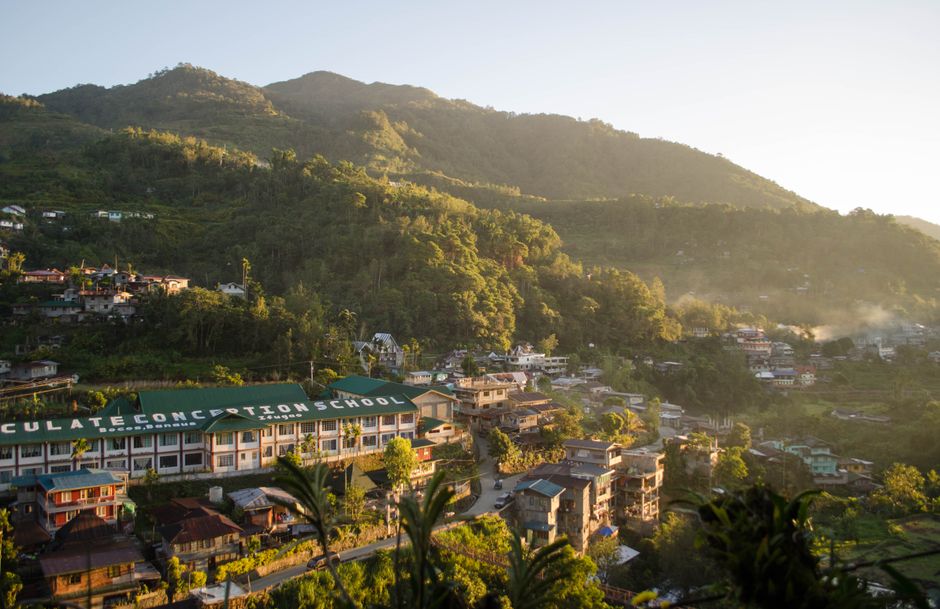
Banaue is a mountain town in the province of Ifugao, high in the Cordillera of northern Luzon, and the gateway to the rice terraces that the Ifugao people have carved into the mountainsides over many centuries. According to the Department of Tourism, the terraces around Banaue, a National Cultural Treasure, date back as far as 2,000 years and rise to about 1,500 m (4,900 ft), a testament to Ifugao engineering and sustainable farming. Two of the five clusters of terraces inscribed by UNESCO in 1995 as the Rice Terraces of the Philippine Cordilleras lie within Banaue: the stone-walled amphitheater of Batad and the terraces of Bangaan. The town itself, a compact strip of guesthouses, shops and the market along the road above the river, is a base for viewpoints, hikes along the terrace walls, village visits, waterfalls and Ifugao culture, including woodcarving and weaving. Banaue is about 340 km (210 miles) north of Manila, an overnight bus ride away. The terraces change with the farming year: flooded and mirror-like around January and February, green from about April to August, and golden at harvest.
Right now in Banaue
- Wed 16–23°C 61–74°F 5 mm Showers
- Thu 18–22°C 65–71°F 10 mm Heavy rain
- Fri 18–23°C 65–73°F 6 mm Rain
Weather: MET Norway (CC BY 4.0)
Top tours in Banaue
See all tours for Banaue →
From local operators, with prices and reviews; you check availability and book on Viator, our partner. We may earn a commission at no extra cost to you. How we earn money
Banaue at a glance
- Best for: rice terrace scenery, hiking between villages, Ifugao culture and crafts, waterfalls and cool mountain air.
- How long: 2 to 3 days for Banaue’s viewpoints and Batad; 4 to 5 with Hapao and Hungduan, Kiangan or Sagada.
- Best time: the dry season from about November to April for clear trails; the terraces look different in each phase of the rice cycle, and the DOT suggests August to November for Batad’s greenest terraces.
- Getting there: overnight buses from Manila take about 9 to 10 hours; vans run from Bontoc, for Sagada, and buses from Baguio.
- Getting around: tricycles and jeepneys between town and the viewpoints and trailheads, then on foot.
- Fees to know: an environmental fee for visitors in Banaue and a separate fee in Batad, plus guide fees for hikes.
- Before you go: eTravel registration, visa-free stays, money and general safety are in our Philippines travel guide.
Banaue’s areas and where to stay
According to the Provincial Government of Ifugao, Banaue is a municipality of 18 barangays with about 20,650 people (2020 census), 24 km (15 miles) from the provincial capital, Lagawe.
Banaue town (Poblacion)
The town center, set along a steep road above the river, has the market, the tourist information center, the bus stops, guesthouses and simple restaurants with terrace views from their balconies. It is the most practical base, with transport to all the sights.
The viewpoint area
North of town along the road to Bontoc, a series of viewpoints overlook the terraces of the Banaue valley, the classic postcard view. A few inns stand near them.
Batad
The village of Batad, below a mountain saddle about 16 km (10 miles) from town, is reached only on foot from the road’s end, a walk of about 15 to 40 minutes depending on where vehicles stop. Simple family-run inns overlook the amphitheater of terraces, and staying overnight lets you see it at dawn and dusk without day-trippers.
Bangaan and the other villages
Bangaan, a small traditional village below the road to Batad, and other hamlets offer homestays for travelers who want to experience village life.
Top things to see in Banaue
The Banaue viewpoints
The main viewpoints, a short tricycle ride north of town, look across the terraces of the Banaue valley climbing the mountainside. Local elders in traditional dress sometimes pose for photos for a small tip. Morning light is best, before clouds build.
Batad Rice Terraces
According to the DOT, the terraces of Batad, sculpted into the mountains in the shape of an amphitheater, are among only five rice terrace clusters in the Cordilleras on the UNESCO World Heritage list. The trek from the saddle drops into the village, and from there, paths run along the narrow stone walls of the terraces. Walking among them is the highlight of any visit; go with a local guide, as the paths are steep and narrow, and respect the farmers’ fields.
Tappiya Falls
From Batad village, a steep trail of about an hour each way crosses the terraces and descends to Tappiya Falls, a tall waterfall with a cold plunge pool for swimming. The climb back up is tough; take water.
Bangaan Rice Terraces
The terraces of Bangaan surround a small village of traditional thatched Ifugao houses, the other UNESCO-listed cluster in Banaue, seen from a viewpoint on the road to Batad or on a walk down to the village.
Hapao and the Hungduan terraces
According to the DOT, the 2,000-year-old Hungduan Rice Terraces, in the neighboring municipality, span three villages amid rivers and resemble a spider’s web, with Hapao known for its valley of extensive rice fields; there are also hot springs and waterfalls. Hungduan is another of the UNESCO-listed clusters, about an hour by road from Banaue.
More classic sights
- Banaue Museum: a small museum of Ifugao artifacts and photographs near the town center.
- The woodcarvers of Banaue: workshops making bul-ul (rice god) figures and household items, some open to visitors.
- Ifugao houses: traditional pyramid-roofed houses on stilts, with rat guards, still standing in Bangaan, Batad and other villages.
- The market: the morning market in town, with mountain vegetables, heirloom rice and crafts.
Other things to do in Banaue
Hiking between villages
Banaue is best experienced on foot. Popular routes include the trek from the Batad saddle to Batad village and Tappiya Falls, the walk from Batad over the ridge to Cambulo and on to Pula and the road, a full day, and shorter walks from town through the terraces to villages such as Poitan and Tam-an. Hire a guide accredited by the municipal tourism office; the trails are slippery after rain, and some cross private terraces. See our hiking guide.
Ifugao culture
The Ifugao have farmed these terraces for generations, guided by rituals tied to the rice cycle, and the Hudhud chants of the Ifugao are recognized by UNESCO as intangible heritage. Visit with respect: ask before photographing people, don’t enter houses uninvited, and buy crafts directly from makers. According to the DOT, the Imbayah Festival, one of Banaue’s most important cultural events, is a four-day celebration with a parade of cultural traditions, arts and ethnic games; in nearby Hungduan, the Punnuk Festival on the Hapao River marks the end of the harvest with a tug-of-war in the river.
Shopping and crafts
Banaue’s shops sell Ifugao woodcarvings, from bul-ul figures to bowls and spoons, woven textiles and baskets, and heirloom rice grown on the terraces, sold in small bags. Buying heirloom rice and crafts directly from local cooperatives helps keep the terraces farmed, as many young Ifugao have left for jobs in the cities.
Food and drink
Meals in Banaue are simple and hearty: rice from the terraces, vegetables, pork and chicken dishes such as pinikpikan, a Cordillera chicken soup, plus local coffee and rice wine (bayah or tapuy). Most guesthouses serve meals with terrace views, and a few cafés in town cater to travelers.
Day trips from Banaue
- Batad and Tappiya Falls: a full day, or better, an overnight stay in Batad.
- Hapao and Hungduan: terraces, hot springs and waterfalls, about an hour away.
- Kiangan: the oldest town in Ifugao, with the Nagacadan terraces (another UNESCO cluster) and a World War II memorial to the surrender of the Japanese commander in 1945, about an hour away.
- Sagada: about 3 to 4 hours away via Bontoc, with hanging coffins, caves and pine forests; better for several days.
- Baguio: the mountain city, about 6 to 8 hours by road. See our Baguio guide.
Getting there and getting around
By bus from Manila
According to the DOT, Banaue is about 348 km (216 miles) from Manila, eight to ten hours by private vehicle, and there are daily public buses on the Manila–Banaue route; overnight services take about 9 to 10 hours and arrive early in the morning. Book a seat in advance on weekends and holidays. The road climbs through Nueva Vizcaya and the Cordillera on winding mountain roads.
From Sagada, Bontoc and Baguio
According to the DOT, travelers coming from Sagada take a jeepney to Bontoc and then a van to Banaue, leaving from the tourism office in Bontoc at set times in the morning and early afternoon. Buses link Baguio and Banaue in about 6 to 8 hours, and many travelers do a loop of Manila, Baguio, Sagada and Banaue.
Around Banaue
Tricycles wait in town for trips to the viewpoints and other short hops, and jeepneys and hired tricycles or vans go to the Batad saddle; agree on the fare and the waiting time first. From the saddle, everything is on foot. There is no Grab in Banaue.
When to go and how long to stay
Banaue’s climate is cool and wet, with a drier season from about November to April and heavy rain from May to October, when typhoons crossing northern Luzon can bring landslides. The terraces also follow the farming year: in the DOT’s words, January to February gives a clean, mirror-like panorama of flooded terraces, April to May a green carpet view and July to August a golden view at harvest. Banaue has no PAGASA climate station, so the table uses PAGASA’s 1991–2020 normals for its Baguio City station, about 75 km (47 miles) to the southwest in the same mountain range, as submitted to the World Meteorological Organization (WMO). Banaue lies about 300 m lower than Baguio, so expect temperatures a little warmer and rain generally less extreme than these figures.
| Month | Average high / low | Rain (days with 1 mm or more) | What to expect |
|---|---|---|---|
| January | 23 °C (74 °F) / 13 °C (55 °F) | 16 mm (0.6 in), 2 days | Cool and dry; flooded, mirror-like terraces |
| February | 24 °C (75 °F) / 13 °C (56 °F) | 24 mm (0.9 in), 2 days | Dry; planting season |
| March | 25 °C (77 °F) / 14 °C (58 °F) | 50 mm (2.0 in), 4 days | Dry; young rice |
| April | 26 °C (78 °F) / 16 °C (61 °F) | 100 mm (3.9 in), 8 days | Warmest month; terraces turning green |
| May | 25 °C (76 °F) / 16 °C (62 °F) | 340 mm (13.4 in), 18 days | Green terraces; rainy season begins |
| June | 24 °C (76 °F) / 16 °C (62 °F) | 406 mm (16.0 in), 20 days | Wet and misty; lush green |
| July | 23 °C (74 °F) / 16 °C (61 °F) | 773 mm (30.4 in), 24 days | Golden rice and harvest; very wet |
| August | 22 °C (72 °F) / 16 °C (61 °F) | 963 mm (37.9 in), 25 days | Wettest month at Baguio; landslides possible |
| September | 23 °C (73 °F) / 16 °C (61 °F) | 537 mm (21.2 in), 22 days | Wet; typhoon peak |
| October | 24 °C (74 °F) / 16 °C (60 °F) | 490 mm (19.3 in), 13 days | Rain easing; second crop greening |
| November | 24 °C (75 °F) / 15 °C (59 °F) | 96 mm (3.8 in), 7 days | Dry season begins; clear trails |
| December | 24 °C (74 °F) / 14 °C (57 °F) | 42 mm (1.6 in), 4 days | Cool, dry and crisp |
Baguio gets about 3,840 mm (151 in) of rain a year. PAGASA said in September 2026 that a strong El Niño was expected to bring below-normal rainfall to most of the country into early 2027, which can also affect the water that feeds the terraces.
2 days in Banaue
Arrive on the overnight bus, visit the viewpoints and the town in the morning, then head to the Batad saddle and walk down to stay overnight in Batad. On day two, hike to Tappiya Falls, walk the terraces and return to Banaue for the night bus.
4 days
Add a day trip to Hapao and Hungduan, a day in Kiangan for the Nagacadan terraces, or continue to Sagada.
Where to stay in Banaue
- Banaue town: guesthouses and simple hotels with terrace views, close to transport.
- Near the viewpoints: a few inns with dramatic views.
- Batad: family-run inns and homestays overlooking the amphitheater; basic but unforgettable.
- Bangaan and other villages: homestays for a closer look at village life.
Accommodation is mostly simple, with shared bathrooms in cheaper places and limited hot water; bring warm clothes for the nights.
What a trip to Banaue costs
Prices are approximate, for October 2026, converted at about ₱62.6 to the US dollar.
| Item | Typical cost |
|---|---|
| Overnight bus from Manila, one way | ₱700–1,000 (about US$11–16) |
| Banaue environmental fee | about ₱50 (about US$0.80) |
| Batad environmental fee | about ₱50 (about US$0.80) |
| Tricycle or jeepney to the Batad saddle and back, hired | ₱1,000–1,800 (about US$16–29) |
| Local guide in Batad, per group for the falls trek | ₱800–1,200 (about US$13–19) |
| Tricycle tour of the viewpoints | ₱300–500 (about US$4.80–8) |
| Meal at a guesthouse | ₱200–400 (about US$3.20–6.40) |
| Guesthouse double in Banaue or Batad, per night | ₱1,000–2,500 (about US$16–40) |
Practical tips for Banaue
- Bring cash: ATMs in Banaue are few and unreliable, and Batad has none.
- Pay the environmental fees: keep your receipts; they fund the maintenance of the terraces and trails.
- Hire a local guide: guides know safe routes along the terrace walls and help the community earn from tourism.
- Walk carefully on the terraces: stay on the walls and paths, and never damage the irrigation channels.
- Start early: clouds often cover the terraces by midday, and the afternoon brings rain in the wet season.
Safety
Banaue is peaceful and welcoming. The main hazards are natural: the terrace walls are narrow and can be slippery, and trails to Batad and Tappiya Falls are steep, so wear good shoes and walk with a guide. In the rainy season, from about May to October, heavy rain and typhoons can cause landslides that block mountain roads, sometimes for days; follow PAGASA’s Tropical Cyclone Wind Signals and local road information, and allow spare time. Mountain roads are winding and foggy at night. Medical facilities are basic, with the nearest hospitals in Lagawe and beyond. Nights are cold from December to February. In an emergency, call 911.
What to pack for Banaue
Sturdy hiking shoes or sandals with good grip, a rain jacket, a warm layer for cool nights, a headlamp, a small daypack with water, and cash. The Philippines uses 220 V and mostly flat two-pin US-style plugs. See our hiking shoes, rain jackets and travel adapters guides.
Banaue travel FAQ
Are the Banaue Rice Terraces a UNESCO World Heritage Site?
The Rice Terraces of the Philippine Cordilleras were inscribed in 1995 as five clusters, including Batad and Bangaan in Banaue; the terraces seen from the main Banaue viewpoints are a National Cultural Treasure but are not themselves among the inscribed clusters.
How old are the Banaue Rice Terraces?
According to the Department of Tourism, the terraces date back as far as 2,000 years.
How do I get to Banaue from Manila?
By overnight bus in about 9 to 10 hours; Banaue is about 348 km (216 miles) from Manila, according to the DOT.
Is there an environmental fee in Banaue?
Yes. Visitors pay a small environmental fee in Banaue, collected by the local government, and a separate fee in Batad; keep the receipts.
How do I get to Batad?
By tricycle, jeepney or hired van from Banaue to the Batad saddle or road’s end, about 16 km (10 miles) away, then on foot to the village in about 15 to 40 minutes.
What is the best time to see the rice terraces?
January and February for flooded, mirror-like terraces, April to May for green terraces and July to August for golden rice, according to the DOT; the dry season from November to April is best for hiking.
How many days do I need in Banaue?
Two days for the viewpoints and an overnight in Batad; three or four to add Hapao, Hungduan or Kiangan.
Can I go from Banaue to Sagada?
Yes, via Bontoc, in about 3 to 4 hours by van and jeepney.
Is there Grab in Banaue?
No. Use tricycles, jeepneys and hired vans.
Is Banaue cold?
It is cool rather than cold: days are mild, but nights from December to February can drop to around 10–13 °C (50–55 °F). Bring a warm layer.
Sources and last review
Researched and last reviewed on 4 October 2026. The terraces’ age, elevation, National Cultural Treasure status, seasonal views, distance and buses from Manila, Batad’s UNESCO status and access, the Hungduan terraces, the Imbayah and Punnuk festivals and the Bontoc vans: the Department of Tourism; Banaue’s population, barangays and distances: the Provincial Government of Ifugao; the inscription of the Rice Terraces of the Philippine Cordilleras: UNESCO; climate normals for Baguio and the El Niño outlook: PAGASA, via the World Meteorological Organization; Grab coverage: Grab Philippines; exchange rate: the European Central Bank. Environmental fee amounts, guide and transport fees, trails, the Hudhud’s intangible heritage listing, Kiangan’s history, travel times from Baguio and typical prices are general references or estimates, flagged for checking, because the Municipality of Banaue’s website could not be read. Fees change, so check with the Banaue tourism office before you go. For entry rules, money and general safety, see our Philippines travel guide.
Plan your trip
Partner links: TravelerCenter may earn a commission if you book, at no extra cost to you.
🇵🇭 Useful Filipino phrases for Banaue
All 38 Filipino phrases: restaurant, hotel, emergencies, romance (printable) →