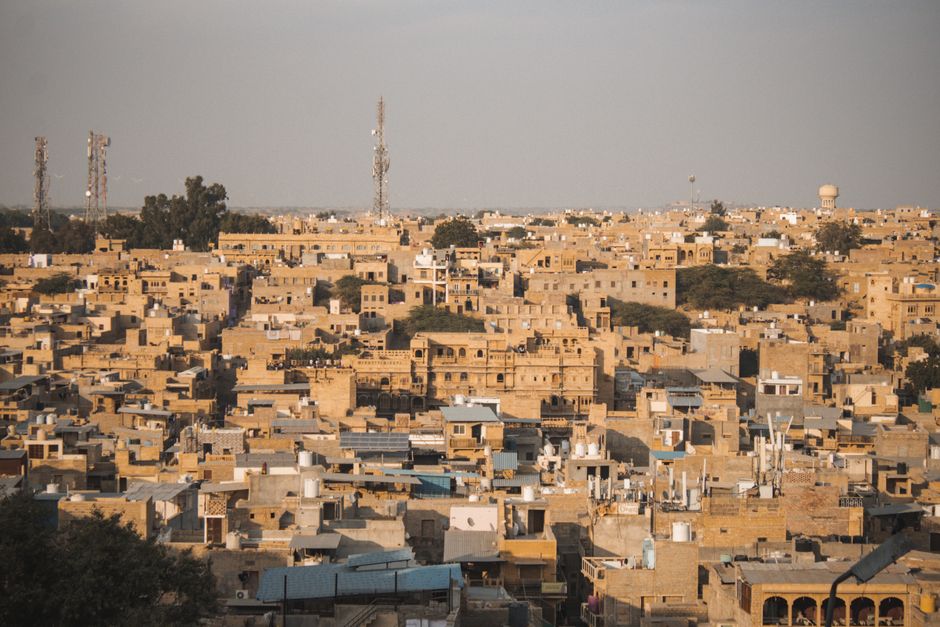
Jaisalmer, the “Golden City,” rises from the Thar Desert in the far west of Rajasthan like a mirage of yellow sandstone. Its centerpiece is Jaisalmer Fort, built on Trikuta Hill after Rawal Jaisal founded the city in the 12th century and today part of the Hill Forts of Rajasthan UNESCO World Heritage Site. It is one of the very few “living forts” left in India: according to Incredible India, nearly 3,000 people still live inside its walls, among Jain temples, shops, guesthouses and restaurants. Below the ramparts, the old city is filled with the carved stone mansions, or havelis, of the merchants who grew rich on the caravan trade between India and Central Asia. Beyond the town, the desert begins: sand dunes at Sam and Khuri, desert camps with folk music under the stars, camel and jeep safaris, ruined villages and fossil forests. Jaisalmer is a small city of about 65,000 people and feels remote, closer to Pakistan than to Jodhpur. The best time to visit is from November to March; summer heat is extreme, with average highs above 40 °C (104 °F) from May to June.
Right now in Jaisalmer
- Wed24–35°C76–95°FClear
- Thu24–35°C75–95°FClear
- Fri24–33°C75–91°FClear
Top tours in Jaisalmer
See all tours for Jaisalmer →
From local operators, with prices and reviews; you check availability and book on Viator, our partner. We may earn a commission at no extra cost to you. How we earn money
Jaisalmer at a glance
- Best for: a living sandstone fort, carved havelis, Jain temples, sand dunes, desert camps, camel safaris and starry skies.
- How long: 2 days for the fort, havelis and one night in the dunes; 3 days with Kuldhara, Bada Bagh and the Desert National Park.
- Best time: November to March; the Desert Festival is usually in late January or February.
- Getting there: about 5 hours by train or road from Jodhpur; overnight trains from Delhi and Jaipur; a small airport with seasonal domestic flights.
- Getting around: on foot in the fort and old town; by jeep or car to the dunes, Kuldhara and other outlying sights.
- Good to know: the fort is a residential neighborhood, not a museum; walk respectfully and support businesses that look after it.
- Before you go: the e-Visa, the online e-Arrival card, money, trains and general safety are in our India travel guide.
Jaisalmer’s areas and where to stay
The city is compact: the fort sits on its hill in the middle, the old town wraps around its base, and newer hotels line the roads leading out toward the dunes.
Inside the fort
Staying inside Jaisalmer Fort is a unique experience: small guesthouses and heritage hotels occupy old houses within the walls, often with rooftop views over the desert. However, the fort’s walls and drains are fragile, and heavy water use from hotels has been linked to damage to its foundations. If you stay inside, choose a small place, use water sparingly, and expect steep, car-free lanes.
The old town below the fort
The lanes around Gadisar Gate, the havelis and the main market, at the foot of the fort, have many guesthouses, haveli hotels and rooftop restaurants with fort views. This is the most practical base, within walking distance of everything and with less impact on the fort itself.
Sam Road and the outskirts
Larger hotels and resorts built in golden sandstone line the roads leading west and south of town, with pools and gardens. They are comfortable, but you will need transport to the center.
Desert camps at Sam and Khuri
Many visitors spend one night in a desert camp near the dunes at Sam, about 40 km (25 miles) west, or the quieter Khuri, about 45 km (28 miles) southwest. Camps range from simple tents with shared bathrooms to luxury tented resorts with private bathrooms. Most packages include a jeep or camel ride to the dunes at sunset, a folk music and dance show, dinner and breakfast.
Top things to see in Jaisalmer
Jaisalmer Fort (Sonar Qila)
Built of yellow sandstone that glows gold at sunset, Jaisalmer Fort crowns Trikuta Hill with a double ring of walls and 99 bastions. Legend says Rawal Jaisal chose the site after a sage told him of a prophecy by Lord Krishna that a descendant of his Yaduvanshi clan would found a kingdom here. Enter through a series of massive gates to the main square, Dussehra Chowk, where the Raj Mahal (Royal Palace) stands, now a museum with royal rooms, rooftop views and carved balconies. Entry to the fort itself is free; the palace museum charges a separate ticket. Spend time simply wandering the lanes, where houses carved with stone screens alternate with shops, temples and homes.
The Jain temples
Inside the fort, a group of seven interconnected Jain temples, built from the 12th to the 16th centuries, are carved in astonishing detail with dancers, animals, deities and geometric patterns. They are active places of worship and open to visitors for limited hours, usually in the morning; remove shoes and leather items, dress modestly, and expect a small fee for cameras.
Patwon ki Haveli
Jaisalmer’s second most visited attraction is not a single mansion but a cluster of five, begun in 1805 by Guman Chand Patwa, a wealthy merchant in gold, silver and brocade, and completed over about 50 years. Their facades are covered with carved balconies and lattice windows, and one of the mansions is open as a museum showing how a merchant family lived.
Nathmal ki Haveli and Salim Singh ki Haveli
Nathmal ki Haveli, built for a prime minister of Jaisalmer in the 19th century, was carved by two brothers, each working on one half, so the two sides do not quite match. Salim Singh ki Haveli, with its distinctive peacock-shaped brackets and an upper story that flares outward, belonged to another powerful minister.
Gadisar Lake
This 14th-century reservoir on the southeastern edge of the city, once the main water supply, is lined with small temples, shrines and ghats, and entered through the carved Tilon ki Pol gateway. Rowboats and pedal boats can be rented, and it is especially beautiful at sunrise.
Sam Sand Dunes
About 40 km (25 miles) west of the city, the Sam dunes stretch for about 2 km (1.2 miles) and are the most famous in the Thar. Camel rides and jeep safaris run at sunrise and sunset, and the area is lined with camps. It can be busy and commercial in the high season; Khuri, farther south, is quieter.
More classic sights
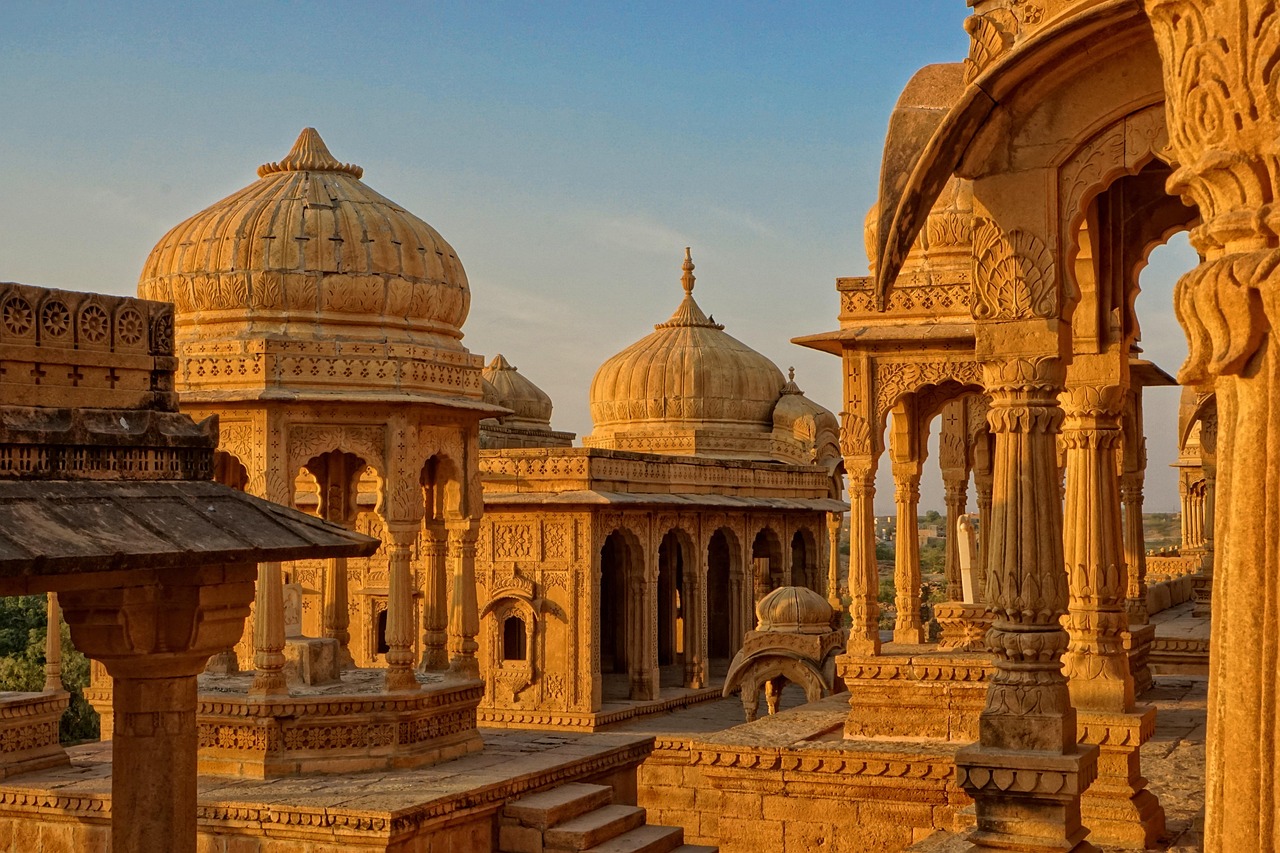
- Bada Bagh: a garden of royal cenotaphs (chhatris) on a ridge north of the city, most photogenic at sunset.
- Kuldhara: an abandoned village of stone houses, about 18 km (11 miles) west, the subject of local legends about its residents leaving overnight.
- Vyas Chhatri: a sunset point with sandstone cenotaphs just outside the old town.
- Lodhruva: the former capital, with an ornate Jain temple, about 16 km (10 miles) northwest.
- Akal Wood Fossil Park: fossilized tree trunks around 180 million years old, in a 21-hectare (52-acre) park about 17 km (11 miles) south.
Other things to do in Jaisalmer
Desert camps and safaris
A night in the desert is the highlight for most visitors. Camel safaris range from a short sunset ride on the dunes to multi-day treks with nights under the stars, away from the main camps. Jeep safaris and “dune bashing” in 4x4s are also popular, as are quad bikes and parasailing at Sam. To make it a good experience, choose camps registered with the state tourism department and recommended by recent travelers, ask what is included before you pay, check the condition of the camels and their saddles, and avoid operators who overload jeeps or race on the dunes. At night, the desert sky away from the lights is spectacular.
Food and drink
Jaisalmer’s food is classic desert cooking: dal baati churma, ker sangri, gatte ki sabzi, kadhi and, for meat eaters, laal maas. Street snacks include mirchi bhajiya and pyaaz kachori, washed down with makhaniya lassi or saffron kesariya thandai. Rooftop restaurants with fort views are a highlight of the evening; many also serve Western and Italian dishes. Note that bhang lassi, sold openly in some shops, contains cannabis and can be very strong.
Shopping and crafts
The bazaars below the fort, Sadar Bazaar, Bhatia Bazaar and Sonaron ka Bas, sell mirror-work and appliqué textiles, block prints, embroidered juttis (leather slippers), silver jewelry, camel-leather goods and carved stone. Barmer, south of Jaisalmer, is a center of hand-block printing and embroidery.
Folk music and festivals
Jaisalmer is home to Manganiyar and Langa musicians, whose hereditary folk music is performed in camps, hotels and the city’s cultural spaces almost every evening. The three-day Desert Festival, usually in late January or February around the full moon, brings camel races, puppet shows, turban-tying contests and folk dances to the city and the Sam dunes. Gangaur, in spring, is celebrated by women for 18 days. See our city sightseeing guide for more ideas.
Day trips from Jaisalmer
- Desert National Park: a large protected area of dunes and grassland southwest of the city, one of the last refuges of the critically endangered great Indian bustard, with chinkara gazelles and desert birds; visits are arranged at the park office.
- Khuri: quieter dunes and a traditional village of mud houses, about 45 km (28 miles) southwest.
- Tanot and Longewala: the Tanot Mata temple and the Longewala War Memorial, about 120 km (75 miles) and 110 km (68 miles) northwest, on roads close to the international border. Some areas near the border are restricted, and foreign visitors may need a permit from the district administration for parts of the route, so arrange the trip through your hotel and carry your passport.
- Pokhran and Ramdevra: a fort town and a major pilgrimage temple of the folk saint Baba Ramdev, about 110 to 120 km (70 to 75 miles) east, on the road to Jodhpur.
- Jodhpur: about 5 hours away. See our Jodhpur travel guide.
Nearby destinations
- Jodhpur221 km
Getting there and getting around
By train
Jaisalmer station, about 2 km (1 mile) east of the fort, is at the end of the line, with trains from Jodhpur (about 5 to 6 hours) and overnight trains from Delhi and Jaipur. Book well ahead in the high season.
By air
Jaisalmer’s small civil airport, about 15 km (9 miles) south, has seasonal domestic flights, mainly in the winter months. Schedules change from year to year, so many travelers fly to Jodhpur instead. Neither airport is a designated e-Visa entry airport.
By road
The drive from Jodhpur takes about 5 hours across the desert, and many travelers continue to Jaisalmer on a hired-car circuit of Rajasthan. Overnight sleeper buses run from Jodhpur, Jaipur, Udaipur and Ahmedabad.
Around the city
The fort and old town are best explored on foot; the lanes are narrow and steep. Auto-rickshaws cover short trips, and cars or jeeps with drivers are the way to reach Sam, Khuri, Kuldhara and the other outlying sights. Camps usually include transfers from town.
When to go and how long to stay
Jaisalmer has a hot desert climate with very little rain. November to March is the best time, with sunny days of 23 to 33 °C (74 to 92 °F) and cold nights, around 9 °C (49 °F) in January, and colder still out in the dunes. April to September is extremely hot: average highs reach 42 °C (108 °F) in May, and sandstorms are possible. The little rain that falls comes in July and August. The table shows 1991–2020 normals for the Jaisalmer station from the India Meteorological Department (IMD), as published by the World Meteorological Organization (WMO); rainy days are days with at least 2.5 mm of rain.
| Month | Average high / low | Rain (rainy days) | What to expect |
|---|---|---|---|
| January | 23 °C (74 °F) / 9 °C (49 °F) | 2 mm (0.1 in), under 1 day | Sunny days, cold desert nights |
| February | 27 °C (81 °F) / 12 °C (54 °F) | 4 mm (0.2 in), under 1 day | Pleasant; Desert Festival in many years |
| March | 33 °C (92 °F) / 18 °C (65 °F) | 5 mm (0.2 in), under 1 day | Warming up; Holi |
| April | 39 °C (102 °F) / 24 °C (74 °F) | 7 mm (0.3 in), under 1 day | Hot and dry |
| May | 42 °C (108 °F) / 26 °C (80 °F) | 12 mm (0.5 in), under 1 day | Hottest month; sandstorms possible |
| June | 41 °C (106 °F) / 28 °C (82 °F) | 30 mm (1.2 in), 1 day | Extreme heat |
| July | 38 °C (101 °F) / 27 °C (81 °F) | 64 mm (2.5 in), 4 days | Occasional monsoon showers |
| August | 37 °C (98 °F) / 26 °C (79 °F) | 73 mm (2.9 in), 3 days | Humid heat, a few storms |
| September | 37 °C (98 °F) / 25 °C (77 °F) | 32 mm (1.3 in), 2 days | Hot, rains ending |
| October | 36 °C (98 °F) / 22 °C (72 °F) | 5 mm (0.2 in), under 1 day | Warm days; season begins |
| November | 31 °C (88 °F) / 16 °C (61 °F) | 1 mm, under 1 day | Ideal; Diwali in some years |
| December | 26 °C (78 °F) / 11 °C (52 °F) | 2 mm (0.1 in), under 1 day | Cool nights; peak season |
The station gets only about 240 mm (9 in) of rain a year, most of it in July and August.
Two days in Jaisalmer
Day one: Jaisalmer Fort, the palace museum and the Jain temples in the morning, the havelis and bazaars in the afternoon, and sunset at Vyas Chhatri or Bada Bagh. Day two: sunrise at Gadisar Lake, Kuldhara, then on to the dunes at Sam or Khuri for a camel ride at sunset and a night in a desert camp.
Three days with the desert
Add a morning at the Desert National Park or Akal Wood Fossil Park, or a longer camel trek with a night in the open dunes, away from the main camps.
Where to stay in Jaisalmer
- Inside the fort: atmospheric small guesthouses; use water sparingly to protect the fort.
- Old town and Gadisar area: haveli hotels and guesthouses with fort views, the most convenient base.
- Sam Road resorts: sandstone hotels with pools on the edge of town.
- Sam dunes camps: the busiest camps, with music and dance shows.
- Khuri camps: quieter, more rural camps and village homestays.
In the high season, from November to February, book camps and heritage hotels early, especially around Christmas, New Year and the Desert Festival.
What a trip to Jaisalmer costs
Prices are approximate, for October 2026, converted at about 96 rupees (₹) to the US dollar. They are estimates, as no official price lists for camps and safaris could be checked.
| Item | Typical cost |
|---|---|
| Fort palace museum ticket with audio guide | ₹500–1,000 (about US$5–10.40) |
| Patwon ki Haveli museum | ₹100–300 (about US$1–3) |
| Sunset camel ride at the dunes | ₹500–1,500 (about US$5–16) |
| Jeep safari at Sam | ₹1,500–3,500 per jeep (about US$16–36) |
| Desert camp, per person per night with dinner and breakfast | ₹2,500–10,000 (about US$26–104) |
| Rajasthani thali on a rooftop | ₹350–900 (about US$3.60–9.40) |
| Car and driver for a day to Kuldhara and Sam | ₹2,500–4,000 (about US$26–42) |
| Mid-range haveli hotel double, per night | ₹3,000–8,000 (about US$31–83) |
Practical tips for Jaisalmer
- Visit the Jain temples in the morning: they are usually open to visitors only for a few hours.
- Check what your camp includes: transfers, camel rides, dinner and the show are sometimes extra.
- Bring cash: ATMs exist in town but not in the dunes; cards and UPI work in most hotels.
- Respect the fort: do not litter, and conserve water if you stay inside.
- Plan the border area: trips toward Tanot and Longewala need early starts, a driver who knows the rules, and your passport.
Safety
Jaisalmer is a safe, easygoing town for visitors. Heat and sun are the main risks: from April to September, temperatures regularly pass 40 °C (104 °F), so start early, rest in the afternoon, and drink plenty of water; even in winter, the desert sun is strong. Desert nights in December and January can drop close to freezing, so bring warm clothes for camps. Camel and jeep rides: hold on firmly when a camel stands up or kneels, and avoid operators who race jeeps over the dunes. Sandstorms can blow up in late spring and early summer. Touts meet trains and buses offering cheap rooms and safaris on commission; book ahead or go directly to your guesthouse. Border areas: parts of the district near the international border are restricted, so follow your driver’s guidance and carry your passport. Food and water: eat at busy places and drink bottled or filtered water. Women travelers generally find Jaisalmer relaxed; dress modestly and choose well-reviewed camps. In an emergency, call 112.
What to pack for Jaisalmer
Light, loose clothes that cover shoulders and knees, a wide-brimmed hat or scarf against sun and sand, sunglasses, high-factor sunscreen, lip balm, comfortable shoes for the fort’s stone lanes, and a warm fleece or jacket for desert nights from November to February. A headlamp is useful in camps. India uses 230 V, with round-pin plugs of types C, D and M. See our travel adapters guide.
Jaisalmer travel FAQ
How many days do I need in Jaisalmer?
Two days covers the fort, the havelis and one night in a desert camp. Three days lets you add Kuldhara, Bada Bagh and the Desert National Park.
Is it free to enter Jaisalmer Fort?
Yes, the fort is a living neighborhood and free to enter. The palace museum and the Jain temples charge separate tickets or camera fees.
Can I stay inside Jaisalmer Fort?
Yes, small guesthouses operate inside. Because water and drainage problems threaten the fort’s foundations, many travelers prefer to stay just outside the walls.
Which is better, Sam or Khuri?
Sam has the biggest dunes and the most camps, but it is busy. Khuri is smaller and quieter, with a more rural feel.
What is the best time to visit Jaisalmer?
November to March, when days are warm and nights cool. Summer heat is extreme.
When is the Jaisalmer Desert Festival?
It is a three-day festival usually held in late January or February, around the full moon. Check the dates for the year before you plan.
How do I get to Jaisalmer?
By train or road from Jodhpur in about 5 hours, by overnight train from Delhi or Jaipur, or by seasonal flights to Jaisalmer’s small airport.
Is a desert camp worth it?
For most visitors, yes. A night in the dunes with folk music, a camel ride at sunset and a starry sky is a highlight of Rajasthan. Choose a reputable camp.
Can foreigners visit Tanot and Longewala?
Many do, on day trips by car, but some areas near the border are restricted. Go with a local driver who knows the current rules, and carry your passport.
Is Jaisalmer safe for tourists?
Yes. Take care in the heat, choose reputable camps and safari operators, and ignore touts at the station.
Plan your trip
Partner links: TravelerCenter may earn a commission if you book, at no extra cost to you.
🇮🇳 Useful Hindi phrases for Jaisalmer
All 38 Hindi phrases: restaurant, hotel, emergencies, romance (printable) →
Sources · last reviewed 4 October 2026
Researched and last reviewed on 4 October 2026. Jaisalmer’s founding legend, the living fort and its residents, the UNESCO listing, the havelis, Patwon ki Haveli’s history, the Jain temples, Gadisar Lake, Kuldhara, Akal Wood Fossil Park, the Sam dunes and their distance, the Desert National Park, the Desert Festival, Gangaur, food, shopping, desert activities and the best season: Incredible India (Ministry of Tourism); restricted border areas for foreigners: the Bureau of Immigration; the list of designated e-Visa airports (which does not include Jaisalmer or Jodhpur): the Bureau of Immigration; climate normals for the Jaisalmer station: the India Meteorological Department, via the World Meteorological Organization (1991–2020 normals archived by NOAA’s National Centers for Environmental Information); population: Wikidata; the exchange rate: the Reserve Bank of India (FBIL reference rate). Rajasthan’s tourism website could not be reached, so the fort museum and temple fees, desert camp rules, festival dates, distances, train times and typical prices are general references or estimates, flagged for checking. Prices and hours change, so check locally before you go. For the e-Visa, money and trains, see our India travel guide.
Data: Weather: MET Norway (CC BY 4.0) · Rates: ECB · Costs: World Bank ICP and price levels · Wikidata (CC0)