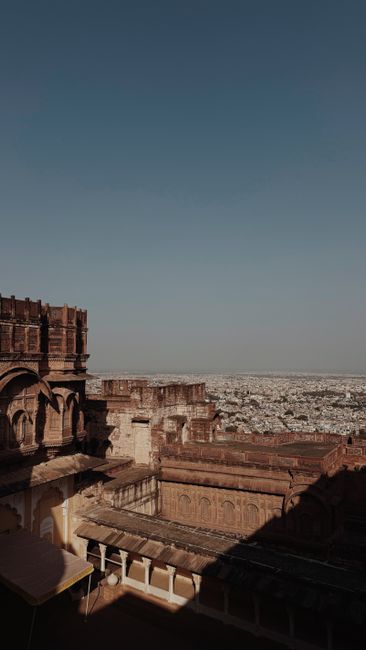
Jodhpur, the “Blue City,” spreads out beneath one of the most dramatic forts in India: Mehrangarh, a sandstone citadel that seems to grow straight out of a rocky ridge on the eastern edge of the Thar Desert. Founded in 1459 by Rao Jodha, chief of the Rathore clan, Jodhpur was the capital of the Marwar kingdom, and its old city is a maze of indigo-washed houses, stepwells, temples and bazaars clustered around a clock tower. With about a million people, it is the second-largest city in Rajasthan, yet it feels more relaxed than Jaipur. Most visitors come for two or three days: a morning inside Mehrangarh’s museum, an afternoon at the marble cenotaph of Jaswant Thada, a walk through the blue lanes of Brahmpuri and Navchokiya, sunset from a rooftop, and a trip out to the gardens of Mandore or the Bishnoi villages in the desert. Jodhpur is also called the “Sun City” because the sun shines almost every day of the year, and the heat is fierce from April to June, so the best months to visit are October to March.
Right now in Jodhpur
- Wed 25–35°C 76–96°F Clear
- Thu 26–36°C 78–97°F Clear
- Fri 26–34°C 78–93°F Clear
Weather: MET Norway (CC BY 4.0)
Top tours in Jodhpur
See all tours for Jodhpur →
From local operators, with prices and reviews; you check availability and book on Viator, our partner. We may earn a commission at no extra cost to you. How we earn money
Jodhpur at a glance
- Best for: one of India’s great forts, a blue-painted old city, Rajput palaces and museums, desert landscapes, crafts and Marwari food.
- How long: 2 days for the city; 3 or 4 with Mandore, the Bishnoi villages, Osian or Nagaur.
- Best time: October to March, when days are warm and nights cool; April to June is very hot.
- Getting there: Jodhpur Airport (JDR), about 5 km (3 miles) south of the center, with domestic flights; trains from Delhi, Jaipur, Jaisalmer, Udaipur and Mumbai.
- Getting around: on foot in the old city, by auto-rickshaw or app cab elsewhere; the climb to the fort is steep.
- Good to know: Jodhpur’s airport is not an e-Visa entry airport, so international visitors arrive in India through Delhi, Jaipur, Ahmedabad or another designated airport first.
- Before you go: the e-Visa, the online e-Arrival card, money, trains and general safety are in our India travel guide.
Jodhpur’s areas and where to stay
The old city lies in a bowl below the fort ridge, enclosed by remains of a 16th-century wall, while the newer city spreads south and east toward the railway, the airport and the Umaid Bhawan Palace on its own hill.
The old city and the Clock Tower
The lanes around the Ghanta Ghar (Clock Tower) and Sardar Market are the commercial heart of old Jodhpur, full of spice shops, textile stalls and street-food sellers. Many guesthouses and small heritage hotels are tucked into the streets between the clock tower and the fort, often with rooftop terraces facing Mehrangarh. It is noisy and lively by day, but you can walk to most sights.
Navchokiya and Brahmpuri: the blue city
Directly below the fort walls, the neighborhoods of Navchokiya and Brahmpuri are where the blue houses are most concentrated. Traditionally, the city’s Brahmins painted their houses blue, both to show their caste and to keep them cool, and the color has since spread across the old city. Small family-run guesthouses here offer the best views up to Mehrangarh, but the lanes are steep, narrow and difficult for cars.
Ratanada, Sardarpura and the new city
South of the old city, Ratanada and Sardarpura have mid-range and business hotels, restaurants and shopping streets, with easy access to the airport and the railway station. It is quieter and more spacious than the old city, though you will need an auto-rickshaw to reach the fort.
Palace hotels on the outskirts
Jodhpur has some of India’s grandest heritage stays, including part of the Umaid Bhawan Palace, which is still the residence of the former royal family, and a handful of restored forts and hunting lodges in the countryside, often combined with village and desert excursions.
Top things to see in Jodhpur
Mehrangarh Fort
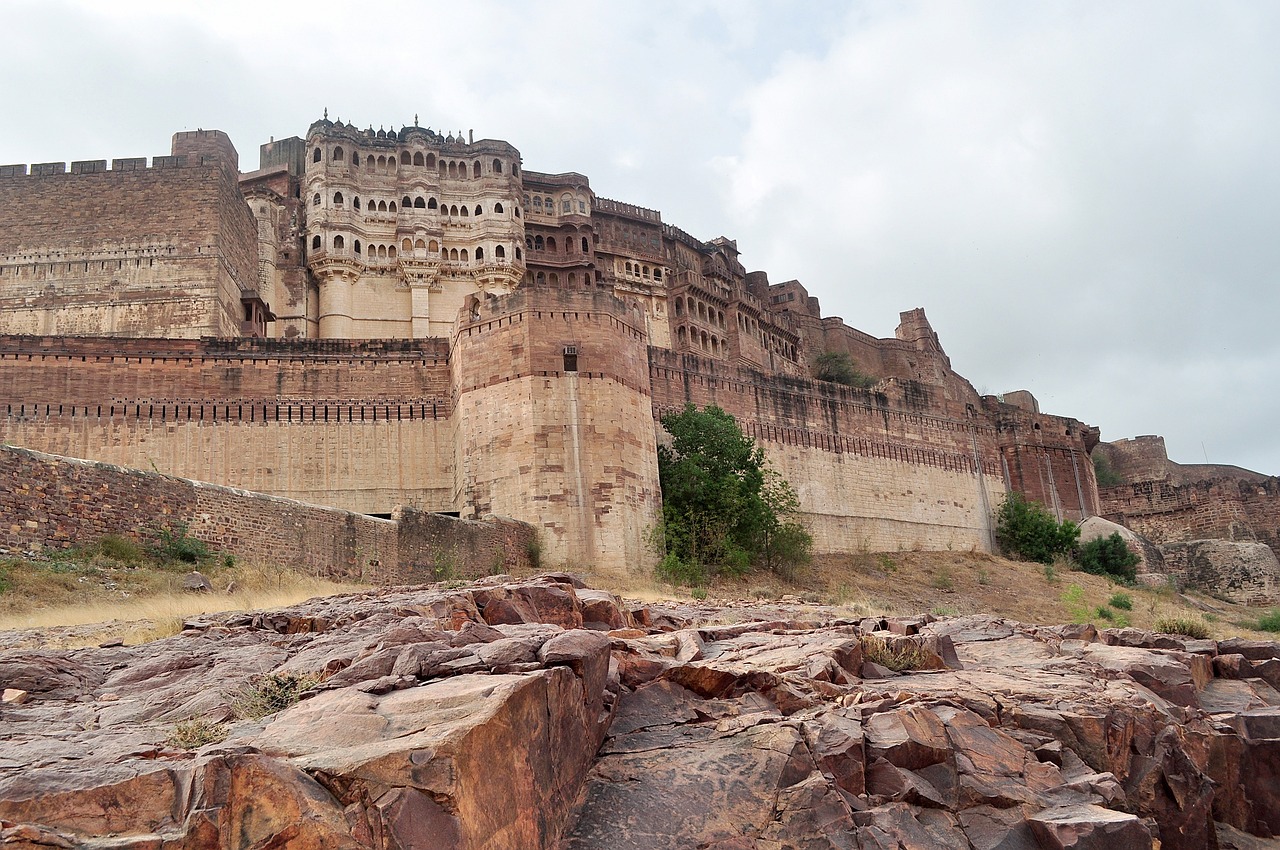
Mehrangarh rises about 125 m (410 ft) above the city on a sheer-sided rock, its walls reached through a series of seven great gates, some still marked by cannonball hits and the handprints of royal widows. Rao Jodha laid its foundations in 1459, and successive rulers added palaces with carved sandstone screens and balconies. Inside, the Mehrangarh Museum, run by the Mehrangarh Museum Trust, leads through courtyards and palaces such as the Moti Mahal (Pearl Palace), the Phool Mahal (Flower Palace) and the Sheesh Mahal (Hall of Mirrors), with collections of royal palanquins, howdahs, arms, textiles, miniature paintings and the cradles of infant princes. From the ramparts, lined with old cannons, the whole blue city lies below you. According to the trust, the museum is open every day from 9 a.m. to 5 p.m., ticket sales close at 5 p.m., and international visitors pay ₹800 (₹500 for students), including an audio guide; domestic visitors pay ₹200. An elevator from near the lower gates costs ₹50 one way and saves the steep climb. The Chamunda Mata temple, at the southern end of the fort, is an active shrine.
Jaswant Thada
A short walk or drive below the fort, Jaswant Thada is a white marble memorial built by Maharaja Sardar Singh in memory of his father, Maharaja Jaswant Singh II, who ruled from 1873 to 1895, and completed in 1906. Thin marble panels glow in the sun, and the terraces and small lake around it offer some of the best views of Mehrangarh. The trust lists entry at ₹100 for international and ₹50 for domestic visitors, with the same 9 a.m. to 5 p.m. hours.
Rao Jodha Desert Rock Park
Created in 2006 on rocky wasteland next to the fort, this park restores the native plants of the Thar Desert across about 72 hectares (180 acres) of volcanic rock and sandstone. Walking trails lead along canyons and up to viewpoints below the fort walls. Entry is ₹100, and a naturalist guide costs ₹200; hours are 7 a.m. to 6:30 p.m. from April to September, and 8 a.m. to 5:30 p.m. from October to March. Early morning is best for birds and to avoid the heat.
The blue city on foot
The best way to experience Jodhpur is to wander. Start at the Clock Tower, walk through Sardar Market, then climb into Navchokiya and Brahmpuri, where blue houses, small temples, doorways decorated for weddings and neighborhood wells line the lanes. Ask before photographing people and their homes. The restored Toorji ka Jhalra, an 18th-century stepwell near the clock tower, is a striking geometric space surrounded by cafés and shops.
Umaid Bhawan Palace
Built in the 20th century for Maharaja Umaid Singh, the Umaid Bhawan is one of the world’s largest private residences, a domed building in a blend of Art Deco and Indo-Saracenic styles. It is divided into three parts: the royal family’s residence, a luxury hotel, and a museum open to the public with displays of royal clocks, photographs and vintage cars.
Mandore Gardens
About 9 km (6 miles) north of the city, Mandore was the capital of Marwar before Jodhpur was founded. Its gardens hold the red sandstone cenotaphs (devals) of former rulers, built like temples, as well as the Hall of Heroes with brightly painted figures of folk heroes and deities. Monkeys and langurs are common.
More classic sights
- Chokhelao Bagh: an 18th-century garden at the foot of the fort, restored by the Mehrangarh Museum Trust as a living botanical museum.
- Mahamandir Temple: a large 19th-century temple with 84 carved pillars, east of the old city.
- Kaylana Lake: an artificial lake west of town, popular at sunset.
- Machiya Safari Park: a small biological park on the road to Kaylana.
- Sardar Government Museum: a small museum in the Umaid Gardens with sculpture and local history.
Other things to do in Jodhpur
Food and drink
Marwari cooking is hearty and vegetarian-heavy, built for the desert. Try mirchi bada (large green chilies stuffed with spiced potato, battered and fried), pyaaz kachori (onion-filled pastry), mawa kachori (a sweet pastry filled with milk solids and soaked in syrup), and thick makhaniya lassi flavored with saffron. Main dishes include dal baati churma, gatte ki sabzi (gram-flour dumplings in yogurt curry), ker sangri (desert beans and berries) and, for meat eaters, fiery laal maas. The stalls around the Clock Tower are famous for kachoris and lassis; choose busy ones where food is freshly fried. Rooftop restaurants in the old city serve thalis with fort views. Drink bottled or filtered water.
Shopping and crafts
Jodhpur is known for its bandhani (tie-dye) textiles, leather mojari shoes, silver jewelry, lacquer bangles and spices, as well as antique and reproduction furniture from the warehouses on the edge of town. Sardar Market and the lanes off the Clock Tower are the places to browse; bargain politely, and be wary of anyone who offers to take you to a “cooperative” or “factory outlet.”
Festivals
The Marwar Festival, held in autumn around the full moon, celebrates the region’s music and folk heroes, and the Rajasthan International Folk Festival, staged at Mehrangarh in October, brings together musicians from across the state and beyond. Holi and Diwali are celebrated with enthusiasm, and Mehrangarh is free for all visitors on 12 May, Jodhpur’s foundation day, when only the elevator is charged.
Village and desert trips
Half-day jeep trips visit the villages of the Bishnoi community southwest of Jodhpur, known for their centuries-old commitment to protecting trees and wildlife, where blackbuck and chinkara gazelles are often seen. Tours usually stop at potters’, weavers’ and rug makers’ workshops. Choose operators who pay families fairly and ask before photographing. See our city sightseeing and hiking guides for more ideas.
Day trips from Jodhpur
- Osian: a desert town with a cluster of 8th- to 12th-century Hindu and Jain temples and nearby sand dunes, about 65 km (40 miles) north.
- Nagaur: the Ahhichatragarh Fort, the “fort of the hooded cobra,” spread over 36 acres and in the care of the Mehrangarh Museum Trust since 1985, with restored palaces and murals; about 135 km (84 miles) northeast. The town hosts a large cattle and camel fair in winter.
- Khichan: a village where thousands of demoiselle cranes are fed each morning from about September to March, about 140 km (87 miles) northwest, on the way to Jaisalmer.
- Ranakpur and Kumbhalgarh: the marble Jain temple of Ranakpur and the walls of Kumbhalgarh Fort, a UNESCO site, on the road to Udaipur (about 170 km, 105 miles). On the Archaeological Survey of India’s (ASI) booking site, foreigners pay ₹550 online for Kumbhalgarh. See our Udaipur travel guide.
- Jaisalmer: the Golden City, about 5 hours by road or train to the west. See our Jaisalmer travel guide.
Getting there and getting around
By air
Jodhpur Airport (JDR), about 5 km (3 miles) south of the center and shared with the Indian Air Force, has domestic flights to Delhi, Mumbai, Bengaluru and a few other cities. It is not a designated e-Visa entry airport, so international visitors land elsewhere first, typically in Delhi, Jaipur, Ahmedabad or Mumbai.
By train
Jodhpur Junction is well connected, with direct trains to Delhi (overnight), Jaipur (about 5 to 6 hours), Jaisalmer, Ahmedabad and Mumbai. According to Indian Railways, Jodhpur is one of the stations with an International Tourist Bureau, where foreign visitors can get help booking tickets.
By road
Jodhpur sits at the center of the classic Rajasthan circuit: about 5 to 6 hours by road from Jaipur, 5 hours from Udaipur via Ranakpur, and 5 hours from Jaisalmer. Many travelers hire a car and driver for the whole circuit, which is also the easiest way to reach Osian, Nagaur and the Bishnoi villages.
Around the city
The old city is best explored on foot, though the lanes are narrow and busy with motorbikes. Auto-rickshaws and app cabs cover the rest; agree on auto fares before setting off. The walk up to Mehrangarh from the old city takes about 15 to 20 minutes on a stepped path, or a rickshaw can take you to the main gate by road.
When to go and how long to stay
Jodhpur has a hot, arid desert climate. October to March is the best time to visit, with sunny days of 25 to 36 °C (77 to 97 °F) and cool nights, around 10 °C (49 °F) in January. April to June is extremely hot, with average highs above 40 °C (104 °F) in May and June. The short monsoon, from July to September, brings occasional heavy showers and humid heat, but the rain is modest compared with the rest of India. The table shows 1991–2020 normals for the Jodhpur station from the India Meteorological Department (IMD), as published by the World Meteorological Organization (WMO); rainy days are days with at least 2.5 mm of rain.
| Month | Average high / low | Rain (rainy days) | What to expect |
|---|---|---|---|
| January | 25 °C (77 °F) / 10 °C (49 °F) | 4 mm (0.2 in), under 1 day | Sunny days, cold nights |
| February | 28 °C (83 °F) / 12 °C (54 °F) | 5 mm (0.2 in), under 1 day | Pleasant and dry |
| March | 34 °C (93 °F) / 18 °C (64 °F) | 4 mm (0.1 in), under 1 day | Warm; Holi in some years |
| April | 39 °C (102 °F) / 23 °C (74 °F) | 6 mm (0.2 in), under 1 day | Hot; sightseeing early and late |
| May | 41 °C (106 °F) / 28 °C (82 °F) | 13 mm (0.5 in), 1 day | Hottest month |
| June | 40 °C (104 °F) / 28 °C (83 °F) | 42 mm (1.7 in), 3 days | Very hot; dust storms possible |
| July | 36 °C (97 °F) / 27 °C (81 °F) | 120 mm (4.7 in), 6 days | Monsoon showers, humid |
| August | 34 °C (93 °F) / 26 °C (78 °F) | 114 mm (4.5 in), 6 days | Wettest spell; green scrub |
| September | 35 °C (95 °F) / 25 °C (76 °F) | 56 mm (2.2 in), 3 days | Rains ending |
| October | 36 °C (97 °F) / 20 °C (68 °F) | 6 mm (0.2 in), under 1 day | Warm and dry; season begins; folk festival |
| November | 32 °C (89 °F) / 15 °C (59 °F) | 0 mm, under 1 day | Ideal; Diwali in some years |
| December | 28 °C (82 °F) / 11 °C (52 °F) | 1 mm, under 1 day | Cool nights; peak season |
The city gets about 370 mm (15 in) of rain a year, almost all of it from June to September.
Two days in Jodhpur
Day one: Mehrangarh Fort and its museum in the morning, when it is coolest, then Jaswant Thada and a walk through the Rao Jodha Desert Rock Park; in the evening, stroll down through the blue lanes to the Clock Tower for kachoris and a lassi. Day two: Mandore Gardens, the Umaid Bhawan Palace museum, Toorji ka Jhalra, shopping in Sardar Market, and sunset from a rooftop facing the fort.
Four days with the desert
Add a morning jeep trip to the Bishnoi villages and a day to Osian or Nagaur, or continue west to Jaisalmer with a stop at Khichan to see the cranes.
Where to stay in Jodhpur
- Old city near the Clock Tower: guesthouses and small heritage hotels, close to markets and food stalls.
- Navchokiya and Brahmpuri: family-run guesthouses in blue houses right below the fort, with the best views.
- Ratanada and Sardarpura: modern mid-range and business hotels, quieter, with easy transport.
- Palace and fort hotels: luxury stays in Umaid Bhawan and other royal residences.
- Countryside lodges: heritage forts and homestays in the villages, good with a car.
Rooftop rooms in the old city can be very hot in May and June; check that air conditioning works, and that your guesthouse is reachable by car if you have heavy luggage.
What a trip to Jodhpur costs
Prices are approximate, for October 2026, converted at about 96 rupees (₹) to the US dollar. Mehrangarh, Jaswant Thada and Rock Park prices are those listed by the Mehrangarh Museum Trust; the Kumbhalgarh fee is the ASI’s online price for foreigners.
| Item | Typical cost |
|---|---|
| Mehrangarh Museum, international visitor (audio guide included) | ₹800 (about US$8.30) |
| Mehrangarh elevator, one way | ₹50 (about US$0.50) |
| Jaswant Thada, international visitor | ₹100 (about US$1) |
| Rao Jodha Desert Rock Park | ₹100 (about US$1) |
| Kumbhalgarh Fort, foreigners online | ₹550 (about US$5.70) |
| Mirchi bada and lassi at a street stall | ₹80–200 (about US$1–2) |
| Rajasthani thali on a rooftop | ₹400–900 (about US$4–9.40) |
| Half-day Bishnoi village jeep tour | ₹1,500–3,500 (about US$16–36) |
| Mid-range heritage hotel double, per night | ₹3,500–9,000 (about US$36–94) |
Practical tips for Jodhpur
- Go to the fort early: doors open at 9 a.m.; the courtyards are cooler and quieter before tour groups arrive.
- Take the audio guide: international tickets include it, and it brings the museum’s collections to life.
- Wear good shoes: the fort ramps and the old city lanes are steep and uneven, and can be slippery.
- Carry small notes: for stalls, rickshaws and temple donations; cards and UPI work in hotels and bigger shops.
- Photograph respectfully: the blue city is a living neighborhood, not a set; ask before taking pictures of people and homes.
Safety
Jodhpur is generally a safe and friendly city for visitors. Heat is the main risk: from April to June, temperatures pass 40 °C (104 °F), so sightsee early and late, wear a hat, and drink plenty of water. Traffic in the old city is chaotic, with motorbikes racing through lanes barely wider than a car; walk carefully and watch for cows and dogs. Touts and commission shopping are common around the Clock Tower and the fort; ignore offers of free guiding that end in a shop, and book jeep or village tours through your hotel or a known operator. Monkeys live around Mandore and some temples; keep food out of sight. Food and water: eat at busy stalls and restaurants and drink bottled or filtered water. Women travelers generally find Jodhpur comfortable; dress modestly and use app cabs at night. In an emergency, call 112.
What to pack for Jodhpur
Light, loose clothes that cover shoulders and knees, a wide-brimmed hat, sunglasses and high-factor sunscreen, sturdy walking shoes with good grip for the fort and old city, a scarf against dust, and a warm layer for winter nights, when temperatures drop to about 10 °C (49 °F). India uses 230 V, with round-pin plugs of types C, D and M. See our travel adapters and hiking shoes guides.
Jodhpur travel FAQ
How many days do I need in Jodhpur?
Two days covers Mehrangarh, Jaswant Thada, the blue city, Mandore and the markets. Allow three or four with the Bishnoi villages, Osian or Nagaur.
How much is the Mehrangarh Fort ticket?
According to the Mehrangarh Museum Trust, international visitors pay ₹800, including an audio guide (₹500 for students), and domestic visitors pay ₹200. The elevator is ₹50 one way.
What are Mehrangarh’s opening hours?
The museum is open every day from 9 a.m. to 5 p.m., and ticket sales close at 5 p.m. Arrive early to avoid crowds and heat.
Why is Jodhpur called the Blue City?
Many houses in the old city are painted blue. Tradition says the city’s Brahmins first painted their homes blue to show their caste and keep them cool, and neighbors followed.
What is the best time to visit Jodhpur?
October to March, when days are warm and nights cool. April to June is extremely hot.
Can I fly into Jodhpur on an e-Visa?
Not directly. Jodhpur’s airport is not a designated e-Visa entry point, so you must arrive in India at a designated airport, such as Delhi or Jaipur, and then connect.
How do I get from Jodhpur to Jaisalmer?
By train or road in about 5 hours across the desert. Many travelers hire a car and stop at Osian or Khichan on the way.
Where should I stay in Jodhpur?
In the old city near the Clock Tower or below the fort in Navchokiya for atmosphere and views; in Ratanada or Sardarpura for quieter, modern hotels.
Is Jodhpur worth visiting?
Yes. Mehrangarh is one of the finest forts in India, and the blue city, the food and the desert villages make Jodhpur a highlight of Rajasthan.
Is Jodhpur safe for tourists?
Yes, it is a relaxed city. Take care in the heat and traffic, and avoid touts who steer you to shops.
Sources and last review
Researched and last reviewed on 4 October 2026. Mehrangarh Museum, Jaswant Thada and Rao Jodha Desert Rock Park prices and hours, the 12 May free-entry day, and the history of Chokhelao Bagh and the Nagaur fort: the Mehrangarh Museum Trust; the city’s founding, the blue city, the Sun City, Umaid Bhawan, Mandore and the list of sights: Incredible India (Ministry of Tourism); the Kumbhalgarh fee: the Archaeological Survey of India’s e-ticket booking site; the International Tourist Bureau at Jodhpur station: Indian Railways; the list of designated e-Visa airports (which does not include Jodhpur): the Bureau of Immigration; climate normals for the Jodhpur station: the India Meteorological Department, via the World Meteorological Organization (1991–2020 normals archived by NOAA’s National Centers for Environmental Information); population: Wikidata; the exchange rate: the Reserve Bank of India (FBIL reference rate). Rajasthan’s tourism website could not be reached, so festival dates, distances, train times, village tours and typical prices are general references or estimates, flagged for checking. Prices and hours change, so check locally before you go. For the e-Visa, money and trains, see our India travel guide.
Plan your trip
Partner links: TravelerCenter may earn a commission if you book, at no extra cost to you.
🇮🇳 Useful Hindi phrases for Jodhpur
All 38 Hindi phrases: restaurant, hotel, emergencies, romance (printable) →